AI
Will AI replace your marketing agency? What AI now does, what you still pay a partner for, and what to ask before you renew
AI won't replace a good marketing agency, but it's shrinking the hours you pay for. What AI does now, how fees should change, and 5 questions before you renew.

· 10 min read
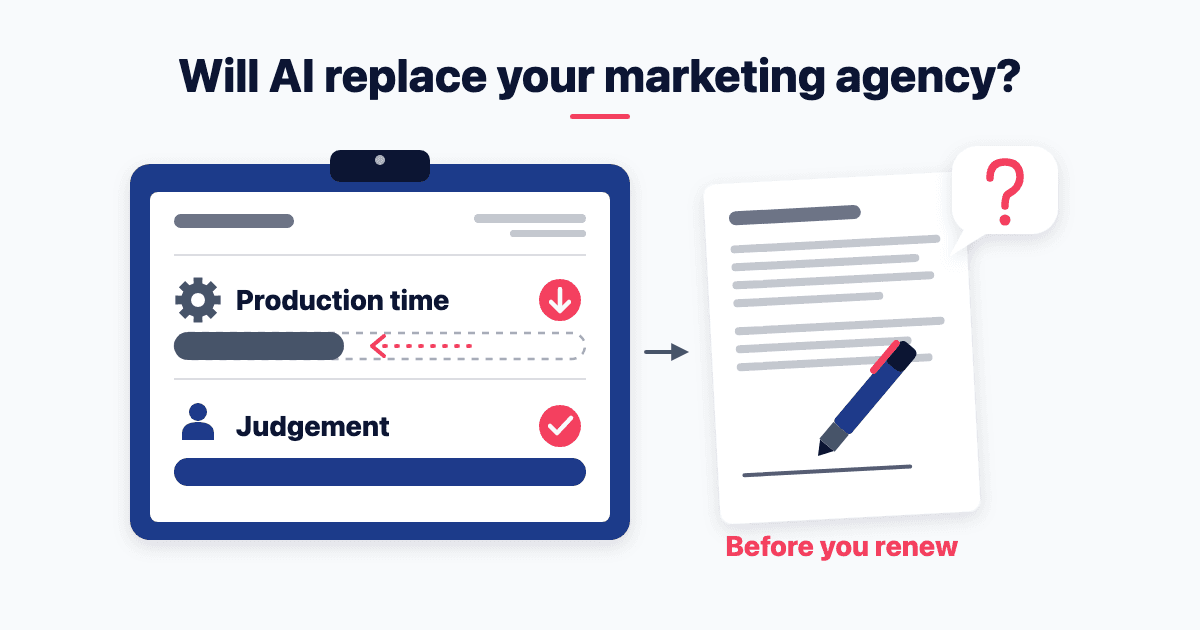
For over a century, agencies grew by adding people and billable hours, Forrester observes. AI is now shrinking the hours. Will AI replace marketing agencies next? Not the good ones. It will replace the part of your fee that pays for production time. Before you renew, find that part and price it per output.
This is for founders and marketing heads with an agency renewal coming up. I sell marketing services myself, as an independent consultant and fractional CMO, so I have a stake in this answer. That's why every figure and quote below links to its source. Weigh the advice in between with that in mind.
What did Forrester predict for marketing agencies in 2027?
In its 28 October 2026 predictions blog, Forrester's verdict fits in one line: "No, AI won't kill agencies, but it will divide them." It expects that "marketing agencies in 2027 will fall into two buckets: orchestrators and executors".
Orchestrators help marketing chiefs redesign how marketing runs and govern how AI is used. Executors bring specialist skills for the work AI can't do well. An agency that sells only production hours has to become one or the other.
The pitch will change too. Forrester predicts: "Three-fourths of agency RFPs will require AI transformation expertise." RFPs are requests for proposals, the documents brands send when they choose an agency.
For you, the buyer, the point is simple. If big brands will make agencies prove their AI method at the pitch, you can ask yours at the renewal. Keep in mind what this is, though: a forecast from an analyst firm that sells research and advice to marketers. It isn't a measurement.
Which agency work is AI already doing?
Three kinds of agency hours are going first: production, reporting and routine bid changes. The cuts land on hours inside the firms, not on the firms themselves. These three are where to look for savings on your own account.
Production. The clearest public numbers come from Klarna, the payments company. In May 2024, Klarna said it had "decreased its spending on external marketing suppliers by 25%". The cut covered translation, production, customer relationship management (CRM) and social agencies. It also cut its "image development cycle from 6 weeks to just 7 days", and it uses "AI for 80% of all copywriting".
Read those as Klarna's own figures, from 2024. Note, too, that it cut agency spend by a quarter, not to zero.
More brands plan to follow. Forrester reports that "67% of B2C marketing decision-makers" call insourcing more creative and production work "a high priority over the next 12 months". B2C means consumer-facing. It predicts enterprises will bring "up to 60% of templated content production" in-house.
Reporting. A routine weekly report is assembly work: pull the numbers, chart them, send the deck. That's a repeatable job you can hand to a tool, whether it uses AI or plain automation. So don't pay analyst hours for the assembly. Pay for someone to read the report and tell you what to change.
Routine optimisation. Google's own automation now makes many bid moves. Its Performance Max help page says: "Using Smart Bidding, real-time auctions bid based on your conversion probability." With text customisation on, "Google AI generates headlines and descriptions from your landing page content". So hours billed for manual bid changes are hours the platform now spends.
So the work stays, but fewer paid hours sit behind each output. Your fee should start to reflect that. Who handles the smaller job, your own team or an outside partner, is a separate decision. If you're weighing a partner abroad, here's what to hand an offshore partner, and what to keep.
What are you still paying a human partner for?
Stop asking whether AI will replace your agency. Ask which lines of the invoice still pay for hours AI no longer needs. The first question has no answer you can check. This one does, line by line.
AI takes a growing share of the production hours. It can't replace these four things, and they're what a senior partner earns:
Judgement. Which channel, which message, what to cut. At OurBus, the US intercity coach company I advise, the call that mattered was a human one. The case study records it: "Split the account into six channels and priced each one, so every channel's real contribution became visible."
Accountability. A named person who answers for a number and signs off every claim. I've set out who signs off when AI does the work.
Platform depth. Knowing where automation goes wrong. Google says your inputs, "like images, data feeds, and bidding goals", "are combined with the power of Google AI". Feed it a weak goal or a messy feed, and the mistake scales with the spend.
Creative that's actually different. Forrester sees agencies winning by "outflanking AI production slop with the highest-caliber creative ideation and execution". Cheap variants are now everywhere. A genuinely new idea isn't.
Some work stays with you, whoever you hire: brand approvals, customer conversations and final budget calls.
How should your agency fee change when AI does the hours?
Pay for outputs and senior judgement, not for time. Big advertisers are already moving. The World Federation of Advertisers (WFA) published a report on agency pay on 29 September 2026. It found labour-based pay "dropping from 54% in 2011 to 19% today". Over the same years, "fixed-fee/output models have risen from 20% to 33%".
WFA expects AI to speed this up, but most brands haven't moved yet. Only 20% are "already evolving their commercial models in response to AI, although 61% intend to". WFA's Laura Forcetti says AI is "making time an increasingly weak proxy for value".
These are big-company numbers. The sample was "69 different multinational companies", and "Most (71%) respondents were in a global marketing procurement role". Smaller buyers may differ. Regions differ too: "In the USA and Canada, labour/FTE remains the most common approach at 38%". FTE means full-time equivalent, a fee for a set number of people's time.
Other services are heading the same way. In a June 2026 post on AI agents, I wrote that work sold "as billable hours becomes a piece of software you buy by the resolved ticket".
A rule I wrote for pricing AI products works for agency fees too: "Floor + meter, don't go pure usage". Here it is as a three-line term sheet for your renewal:
Floor: a fixed monthly fee for the senior people named on your account and the decisions they own. It's "the trust anchor", and it keeps the fee predictable.
Meter: a price per output you already count, such as an asset, a landing page, a test or a report. That's the atomic outcome: "The smallest unit of value the buyer already counts."
Ceiling: price the meter against what the output would cost you to make in-house, because "the buyer's avoided cost sets the ceiling of what's payable."
Don't expect to move the whole fee onto results. Across most disciplines, WFA found "between 67% and 80% of respondents say performance-based remuneration accounts for less than 20% of total agency compensation". But fixed-fee or output pay already dominates creative ad-hoc work (58%) and production (61%). That's where the meter fits first.
What should you ask your agency before you renew?
Five questions, each with its reason and a good answer to listen for.
1. Where does AI sit in the work on our account, and who checks each step?
Ask for a step-by-step map of the work, with a named reviewer for each step. Speed without checks is just faster risk. Even Klarna's faster image cycle "includes checks for brand consistency, image quality, and legal compliance". A good answer names a person, not a tool, at every step.
2. What did AI save on our account last quarter, and where did those hours go?
Many brands can't see this. In WFA's study, 89% of brands believe they get value for money, "but only 48% feel they have sufficient transparency into agency costing and profitability". A good answer: the hours went into more tests, more senior time or a lower fee. If the agency can't say, assume it kept the saving.
3. Which AI tools touch our data, and on which terms?
The consumer and business plans of one tool can carry different terms. Take Anthropic's August 2025 update to its consumer terms: "We will train new models using data from Free, Pro, and Max accounts when this setting is on." The update does "not apply to services under our Commercial Terms". Other vendors' terms differ, so check each one.
A good answer: business or commercial plans, confirmed in writing. Then hold the agency to a red list. My guide to AI training for marketing teams quotes the one in my session sheet. It includes customer personal data and "media plans, research verbatims, agency commercials".
4. Who owns the prompts, workflows and files when we part, and what can be owned at all?
Start with what the law protects. In January 2025, the US Copyright Office concluded that "copyright does not extend to purely AI-generated material, or material where there is insufficient human control over the expressive elements". It added that, with today's tools, "prompts do not alone provide sufficient control" over the output.
So ask which deliverables had real human creative control. Then list prompts, workflows and source files in the contract's handover clause. This is US law, other countries differ, and it isn't legal advice.
5. Which decision did you make for us last quarter that AI couldn't have made?
This is the test behind Forrester's split. Even its execution-focused agencies earn their place by helping marketing chiefs "deliver what AI can't automate or authentically execute". A good answer is a named decision tied to a number. The OurBus channel split above is one: each channel got its own price, so its real contribution became visible. No answer means you're buying execution, so price it per output.
Send the questions in writing before the notice period starts. The answers become the new scope.
"AI makes our work better, not cheaper." Does that justify the same fee?
Only partly. In WFA's report, Laura Forcetti puts it well: "Clients ultimately care about the quality, impact and performance of the work – not how many people or hours were required to produce it." So pay for better work, priced as output.
But "better" has to show up in your numbers. In a 2023 MIT study, ChatGPT cut writing-task time by 40 percent and lifted quality by 18 percent. The 453 participants were college-educated marketers, grant writers, consultants and other professionals. Yet the tasks "didn't require precise factual accuracy or context about things like a company's goals or a customer's preferences".
Your account needs exactly that context. So ask for the before-and-after on your own account, not a demo.
Five steps before you sign the renewal
Pull the last three invoices and list every line.
Mark the lines AI now drafts or runs: production, reporting, routine bid changes.
Send the five questions in writing.
Propose a floor for named senior time and a meter per output.
Decide: keep, re-scope or switch. If you switch, see how to choose and test a new agency: run a paid test and exit in order.
If the answers come back thin, or you want someone senior to own the calls while AI does the hours, book a free call.
Frequently asked questions
Will AI replace creative and advertising agencies?
Not the strongest ones, on Forrester's reading. It expects the winners to be agencies "that retain top talent and deliver differentiated creative thinking" (Forrester's 2027 predictions). What changes first is how creative work is paid. Fixed-fee or output pay already dominates creative ad-hoc work (58%) and production (61%), WFA found. Expect a price per piece first.
Can a small business use AI tools instead of a marketing agency?
Often yes, for the production, on one channel with simple content. But someone still has to choose the channel, check every output and own the number. Even Klarna cut its agency spend by a quarter, not to zero (Klarna's May 2024 release). If nobody in-house can make those calls, that's a direction gap. Try the gap test first.
Will AI replace digital marketers?
In my view, it replaces tasks faster than roles. In the 2023 MIT study, workers exposed to ChatGPT were "twice as likely to report using it in their real job" two weeks later (MIT News). The marketers I'd keep are the ones who direct and check AI's work. See how AI changes a marketing team.
Are AI marketing agencies worth it?
Judge the method, not the label. Ask the five questions above, and pay per output with a named senior owner. If an "AI-native" agency quotes big savings, ask for the study behind the figure and who paid for it. Forrester's split between orchestrators and executors is a better test than the label (Forrester's agency predictions).
- Marketing agencies
- AI
- Vendor management
Written by Siddhesh Joglekar
Fractional CMO and AI marketing consultant Siddhesh Joglekar helps founders and growth-stage teams build marketing engines that compound.