Leadership
Fractional CMO vs agency vs full-time CMO: which should an Indian startup hire?
Fractional CMO, agency or full-time CMO? A decision guide for Indian founders: what each can't do, hybrid setups, and the questions to ask before you sign.

· 11 min read
Hire a fractional CMO when nobody in the company can yet say what marketing should do, for which customer, and why. Hire an agency when that answer exists and you need hands to execute it. Hire a full-time CMO when marketing has become a team to lead and a budget to defend every week, and needs a leader in the building every day.
Founders often frame this as fractional CMO vs agency, as if the two compete. They rarely do. A startup between product-market fit and a full marketing team usually needs both, and the expensive mistake is buying one to fix the other's problem: an agency to find your strategy, or a senior strategist to run your ads.
A disclosure: I sell one of these options. I work as a fractional CMO, after seven and a half years in-house as VP Marketing at BYJU'S. This guide names where a fractional CMO is the wrong answer.
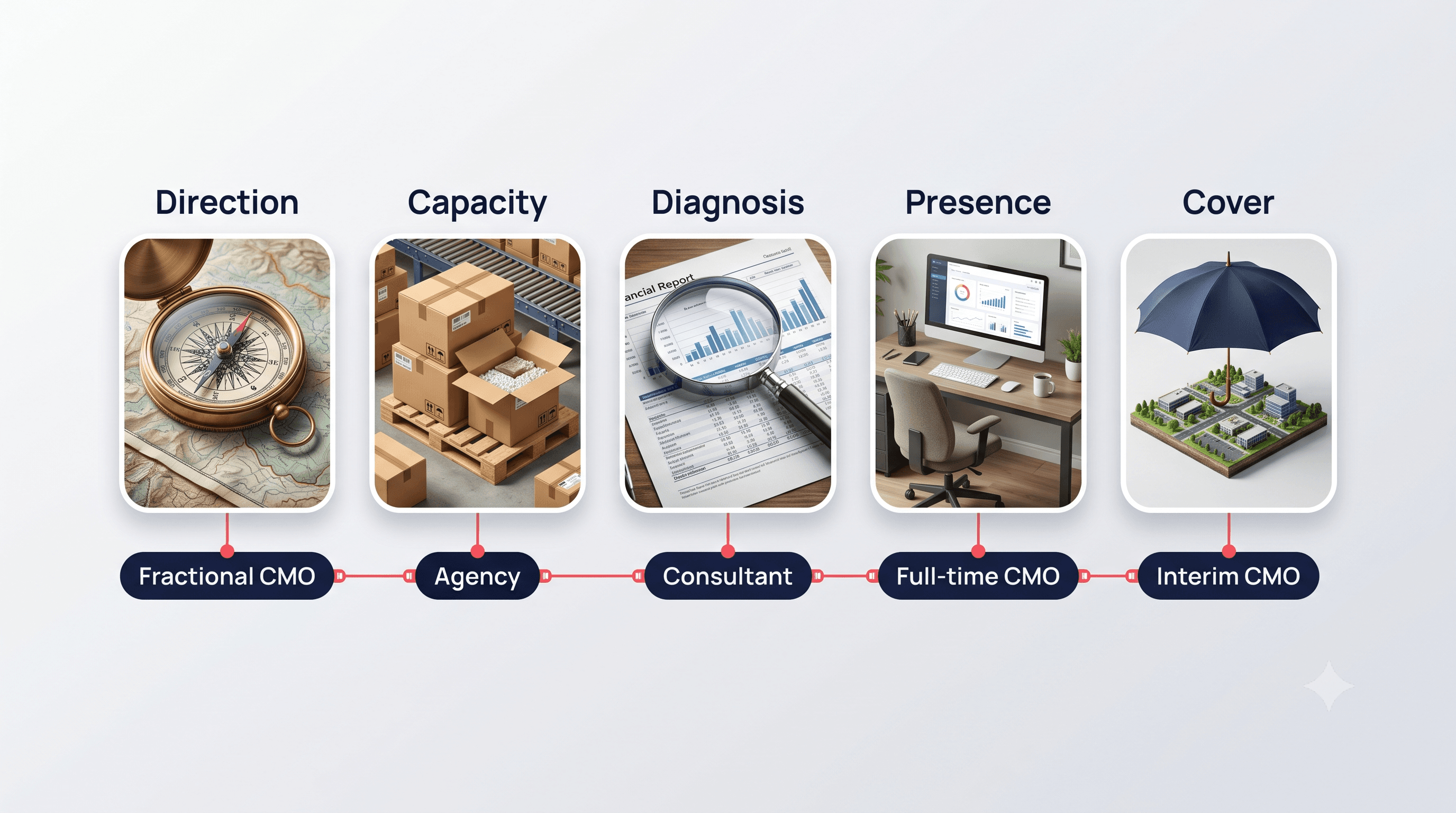
The short answer, by the gap you are filling:
Direction: nobody can say which customer, message and channel, and why — Buy first: Fractional CMO; Not: An agency
Capacity: the plan exists; nobody has the hours to run it — Buy first: Agency or mid-level marketing manager; Not: A CMO of any kind
Diagnosis: one thing is broken and you want an outside read — Buy first: Consultant or fixed-scope audit; Not: A retainer
Presence: a large team and budget that need daily leadership — Buy first: Full-time CMO; Not: A part-timer
Cover: your marketing head has left and you are hiring — Buy first: Interim CMO; Not: A rushed permanent hire
Fractional CMO vs agency vs full-time CMO: what's the difference?
Fractional CMO: a senior marketing leader who works part-time for a few companies. The mandate ranges from advising the founder to owning the marketing plan and its results.
Marketing agency: an outside team that executes a defined scope, such as media, creative or content.
Full-time CMO: a senior executive on your payroll, usually with equity, who leads marketing every day.
Marketing consultant: an expert who diagnoses a specific problem, recommends a fix and leaves. A fractional CMO stays and is accountable for what happens next.
Mid-level marketing manager: an in-house hire who runs channels and vendors against a plan someone more senior has set.
Interim CMO: a full-time, temporary leader who holds the seat until a permanent hire starts. A fractional CMO is part-time and ongoing.
For fractional fees, see what a fractional CMO costs in India.
Which gap are you trying to fill?
Start with the gap, not the job title. The table above is a decision lens, not a formal method.
Test direction first. Can you write a one-page plan naming the customer, the message, two channels and the number they should move? If not, you have a direction gap.
The costliest misreading is feeling a capacity gap when the real gap is direction. "We need more hands" is easier to say than "we don't know what to do", and an agency is easier to buy than a leader. One fractional CMO firm, writing for US private-equity portfolio companies, calls "buying capacity to solve a leadership problem" "the single most common and most expensive error in this decision" (its 2026 comparison guide).
Which option fits your stage?
Stage sets the default:
Before product-market fit: founder-led marketing, plus a consultant or narrow-brief agency for one channel test. Add a marketing manager once a channel works. Hire no CMO of any kind: marketing can't prove what the product hasn't.
After fit, scaling one or two channels: a fractional CMO plus an agency, or one or two in-house executors. Avoid a big agency retainer nobody inside can judge.
At scale: a full-time CMO, with specialist agencies.
Three situations override stage:
Before a fundraise: a go-to-market and measurement diagnosis, not a senior hire made to reassure investors.
An agency is underperforming: a diagnosis, or a fractional CMO to judge the work. Check the brief before you switch; a new agency on the same brief repeats the result.
Your marketing head has just left: an interim CMO, or a fractional one with enough days to hold the team. Then a full-time hire against a written brief.
Revenue bands are a rough starting point at best, because two companies at the same revenue can have opposite gaps.
What can't each option do?
An agency can't set your strategy, or fix what isn't a media problem
An agency is paid to deliver a scope. If the problem sits in the product, the checkout or the measurement, a good agency will deliver its scope well and the number still won't move.
At Rally, a US company that runs event and community group trips, the growth problem was two words on the payment screen: riders were told their trip was "not confirmed" at the moment of paying. The fix I worked on was in the product, not the media plan. The engagement shipped that fix and opened new demand channels. Its record month, June 2026, was 1.5–2× the previous best on gross booking value, with growth figures indexed and supplied by the client (Rally's payment screen).
The 1970 Shop, an Indian D2C snacks brand, shows the same pattern before any more went into ads. The rule was "Audit first. Spend later." The 1970 Shop audit found stock-outs, dead Amazon listings, reviews search engines couldn't read, and GA4 and Meta not connected to Shopify.
An agency briefed to scale ads would have spent into every one of those problems. That programme is still in progress, so there are no results to report.
A fractional CMO can't be your execution team, or be in the room every day
A fractional CMO sells judgement, not hours. If the plan is clear and the work isn't getting done, a fractional CMO will write a better plan that also doesn't get done. It is the wrong answer when:
The gap is capacity. You need hands: an agency for specialist work such as media or creative, or a manager for daily coordination.
Nobody will execute. Without an agency, a manager or real founder time behind the plan, the engagement produces documents.
You want marketing run, but won't hand over decision rights. A CMO hired to run marketing who can only recommend is an expensive consultant. If you want advice, buy the advisory model.
A full-time CMO can't be undone cheaply
The full-time CMO is the right answer at scale, and the costliest one to get wrong. A fractional CMO or an agency starts in weeks; a full-time CMO takes months. Count the search, the notice period and the ramp-up, the equity you grant, and the cost of a wrong hire: a lost quarter or two, and a team rebuilt around a plan that didn't fit.
A marketing consultant can't own the result after the deck
A consultant delivers a diagnosis and a recommendation: right when your team can act on it, wrong when nobody can and the report sits in a folder. Buy one when the question is narrow: why a channel stopped working, or whether your measurement can be trusted. A fixed-scope diagnosis is also a low-risk way to test an outside leader's judgement before you sign a retainer.
A mid-level marketing manager can't set a strategy they've never seen work
A founder's version of this choice: a fractional CMO or a mid-level marketing manager? Many good managers haven't yet chosen a strategy from a blank page, or judged whether an agency's work is good or merely busy.
Hired without direction, a manager guesses or waits for the founder. Hired under direction, often a fractional CMO's, the same person can be the best-value hire on this list.
What do hybrid setups look like?
Past product-market fit, the mix matters less than one rule: one named owner for the plan, and one owner for each agency relationship.
Fractional CMO plus a specialist agency: when one or two paid or content channels carry growth.
Fractional CMO plus one or two in-house executors: when you want the skills to stay in the company.
Fractional CMO as the bridge to a full-time hire: when you will need a full-time CMO but can't yet say what kind. The fractional CMO can write the brief for the permanent role and sit in the interviews.
Judge any outside leader by how the engagement ends. The Rally case study's handover line reads "Three demand surfaces now sit under a growth plan the team can run without me." If you want an outside leader to set the plan and direct your agency, that is the work I do as a fractional CMO.
"A part-time CMO can't really be committed to my company." Is that true?
The objection at full strength: a leader split across companies gives you their second-best hours, isn't there when something breaks, and can leave at short notice. One fractional CMO who writes about the Indian market traces it to a long-standing Indian preference for time in the seat over actual value (a practitioner's essay, 19 May 2026).
Part of the objection is right. If you need someone at every stand-up and in every crisis, that is a presence gap, and the honest answer is a full-time CMO.
The rest is structure, not seat time. Put five things in writing:
Days or hours a week, and how many other clients.
A weekly meeting with the founder and whoever executes.
Decision rights: what the fractional CMO approves alone.
One scorecard, reviewed weekly.
A named executor for every item on the plan.
A full-time hire without these drifts too. If someone pitching a fractional role won't put these in the contract, treat that as your answer.
What should you ask before you sign?
Ask an agency:
Whose name are the ad accounts, pixels and analytics properties in, on Google and on Meta? They should be your company's, with the agency given access. Google's third-party policy for agencies says "Google requires that you use a separate account for each end-advertiser that you manage". So your campaigns should never share an account with another client's.
Will you share our Google Ads customer ID, and show Google's charges separately from your fee? Google's transparency requirements for third-party partners require partners to share customer IDs "when requested". When they share cost data, they must report "the exact amount charged by Google, exclusive of any fees". They must also disclose any management fee in writing before the first purchase and on every invoice.
How is your fee calculated: flat retainer, project fee or share of ad spend? If it rises with our ad spend, how are you rewarded for telling us to spend less?
Who works on our account day to day, and how senior are they?
Ask a fractional CMO what will exist in 90 days, and how the engagement ends.
Ask a full-time CMO candidate:
Have you built marketing from where we are now, or only scaled a large budget?
What would you not spend on in your first quarter?
Data handling matters under Indian law too. Once section 8 of the Digital Personal Data Protection Act, 2023 (MeitY text) takes effect, your company, as the Data Fiduciary, will be responsible for processing done on its behalf by a Data Processor, such as an agency running your CRM or WhatsApp lists, "irrespective of any agreement to the contrary". Section 8(2) will let you engage a processor "only under a valid contract".
Section 8 comes into force in May 2027, eighteen months after the commencement notification G.S.R. 843(E) of 13 November 2025. An agency contract signed now may still be running then. This is general information, not legal advice. Before you sign, ask what consent records the agency keeps on your behalf: see the DPDP consent checklist for marketers.
What to do this week
Try to write the one-page plan. If you can't, you have a direction gap.
List who executes marketing today, by name and by hours a week.
Check that every ad account, pixel and analytics property is in your company's name, with admin access held inside the company.
Pick your first buy from the gap table at the top of this guide.
Not sure which gap you have? Book a call: tell me where you're stuck, and I'll help you work out which gap it is and whether I'm the right person to fill it.
Frequently asked questions
Is a fractional CMO more expensive than an agency?
Sometimes, but comparing the two fees misleads, because they buy different things. An agency's fee pays for execution: ads run, content made, campaigns shipped. A fractional CMO's fee pays for direction, and you still pay someone to act on it. So compare agency alone with agency plus a leader: would better direction save or earn more than the extra fee?
Should your fractional CMO and your agency come from the same firm?
Only if someone outside the firm judges the work. A firm supplying the plan and the team asks its leader to review its own people, so a weak result is easy to explain away. If you buy both, have the founder check results against the plan monthly, and keep the right to replace the team without losing the CMO.
Should a startup hire a marketing agency or in-house staff?
Usually both, split by the type of work. Keep in-house what you do every week and learn from, such as messaging and reporting; early on, that is often the founder. Use agencies for specialist or occasional work: video production, a new platform test, or a channel too small for a full-time hire.
Should I hire a head of marketing or a CMO?
Hire for the job, not the title. If the hire will run channels and vendors against a plan the founder sets, that is a marketing manager's job, whatever you call it. If they must set direction, you need CMO-level judgement: part-time if direction is the gap, full-time if a team and budget need a leader in the building every day.
- Hiring
- Agencies
- Fractional CMO
- Marketing
Written by Siddhesh Joglekar
Fractional CMO and AI marketing consultant Siddhesh Joglekar helps founders and growth-stage teams build marketing engines that compound.