Strategy
AI marketing strategy for Indian companies: where AI moves acquisition cost, cost per lead and output, and where it doesn't
An AI marketing strategy for Indian companies: choose uses by the cost line they move, run work as a control room, meter tokens, and prove it in 90 days.

· 15 min read
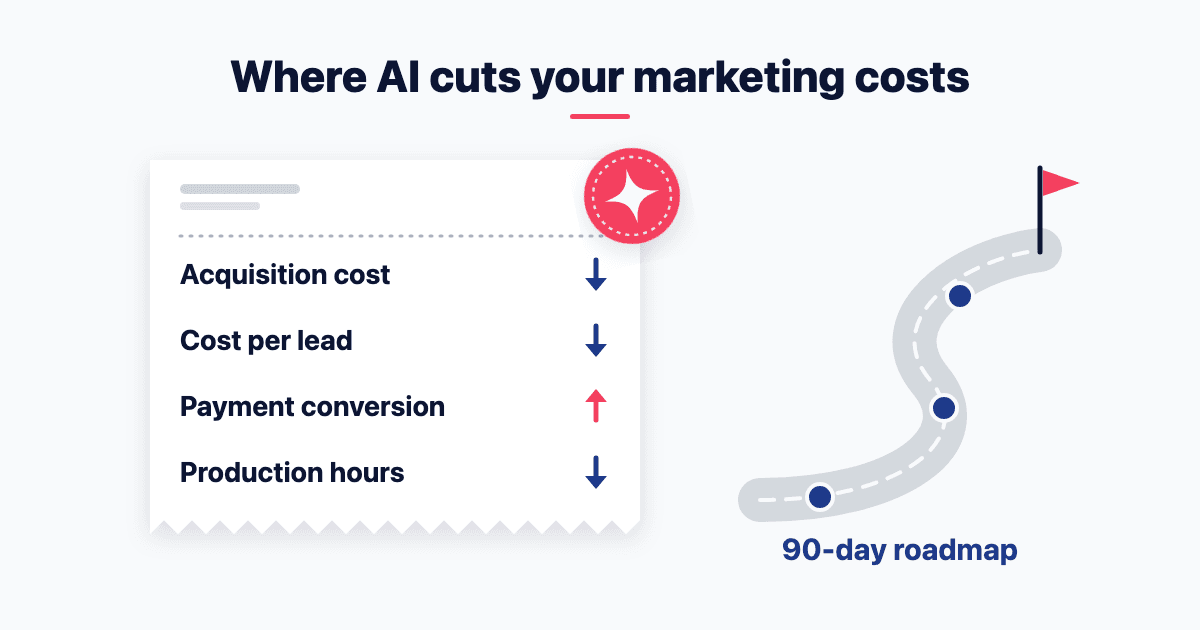
In Salesforce's 2026 India findings, 81% of marketers say they've adopted AI. Yet 47% haven't worked out how to adapt their strategy to it. An AI marketing strategy closes that gap. Put AI only where it moves a money line: customer acquisition cost (CAC), cost per lead, payment conversion or production hours. Prove each bet in 90 days.
This guide is for founders and marketing heads of growth-stage Indian companies whose board wants an AI strategy. It covers where AI goes first, how the work should run, what it costs in rupees, and the next 90 days.
What is an AI marketing strategy?
An AI marketing strategy is a plan for where AI changes the economics of your marketing. It names which cost AI lowers, which output it multiplies, who checks its work and what it may cost.
That's different from using AI tools. Most teams already use AI somewhere: an assistant for drafts, the ad platform's bidding, a few automations. Strategy is a different question. It's about choosing the few places where AI changes a number your board watches.
In India, access isn't the constraint. The same Salesforce report says "siloed systems and poor data quality remain the top barriers" to AI-driven personalisation. It surveyed marketing decision makers, 250 of them in India.
Adobe's India findings point the same way. Its India sample of 250 executives names the biggest barriers as "data integration and quality issues (69%), talent and skills gaps (65%), unclear ROI (62%)" (Adobe India, 2026 AI and Digital Trends). ROI here means return on investment.
Read both as signals, not census figures. Each comes from a company that sells marketing software. But the message is consistent: the hard parts are choosing the line, cleaning the data and proving the return. This guide takes them in that order.
Which money lines can AI move? The four-line test
Every AI use must name the line it moves and the number you'll watch. If it can't, defer it.
I applied this rule to a single budget in how a D2C brand should spend its first ₹10 lakh on AI. Here it runs across a whole marketing team, with four lines:
Acquisition cost: AI sets bids and assembles ads. First you need a clean conversion signal and a target for each business line. Watch cost per acquisition, line by line.
Cost per lead: AI speeds up the first reply, qualifies and routes. First you need one clean lead record in your customer relationship management (CRM) system, and a named owner. Watch cost per qualified lead.
Payment conversion: AI nudges, reminds and answers doubts. First you need to know where the payment moment leaks. Watch the share of sign-ups who pay.
Production hours: AI drafts content, variants and reports. First you need a person who still judges the output. Watch hours per approved asset.
Line 1: acquisition cost
AI is already bidding in your ad account. Google defines Smart Bidding as "bidding strategies that use Google AI to optimize for conversions or conversion value in every auction" (Google Ads Help: About Smart Bidding). In Performance Max, your assets and settings are "combined with the power of Google AI" (Google Ads Help: About Performance Max).
So the strategic lever isn't the AI. It's the target you give it and the signal it learns from, set for each business line.
OurBus Charters, a US coach-hire business, shows why. It shared an ad account with the Lines business, and both were managed "against one blended target". Once the two were split, Charters turned out to be buying conversions at 6.5× the cost of Lines. That ratio comes from the client's weekly Google Ads scorecard.
The blended target had hidden the gap. One target averages the costs of every line it covers, so the same can happen in an Indian account with several business lines. Part of the fix was separate campaigns, each with its own cost target. Not a smarter algorithm.
Line 2: cost per lead
On leads, AI acts in three places. It speeds up the first reply on WhatsApp and web forms. It qualifies before a salesperson calls. And it routes each lead to the right person. Each one cuts wasted sales time, which is where cost per lead hides.
At DocTutorials, a medical-exam prep company where I lead marketing as an adviser, operations run on "n8n workflows, CRM AI and LLM content pipelines". LLM means large language model. n8n is a workflow-automation tool. I won't put a number on AI's share there. The case study names the influencer engine as the biggest lever.
For the build, start with the first n8n workflows worth automating. A clean lead record and a fast first reply come before anything clever. Lead scoring is a deeper topic of its own. Don't start there.
Line 3: payment conversion
At the payment moment, AI can do three jobs. It can send onboarding nudges matched to what a user did. It can remind people when a trial ends or a payment fails. And it can answer pre-purchase doubts in the user's own language.
This line matters most for apps, edtech and subscriptions, where revenue rides on the free-to-paid step. I don't have a published client result that ties payment conversion to AI, so treat this section as guidance.
Fix the leak before you automate the nudge. My audit of where the payment moment leaks is the place to start. An AI reminder on a broken UPI flow only reminds people that the flow is broken.
Line 4: production hours
This is the line many teams start with, and the one I know best. At Programming Hub, where I was CEO, I owned "the shift to AI-built content and marketing systems".
The case study's headline is "+40% revenue in 18 months, profitable and bootstrapped, by moving content production to AI". The 18 months ran from May 2023 to November 2024. Those figures are from my tenure as CEO.
Here AI acts on content drafts, creative variants, weekly reports and research briefs. The catch: output only counts if a person still judges it. More drafts with no reviewer is more risk, not more output. The next sections cover who signs off and what review really costs.
Where doesn't AI move the money?
AI tends to underdeliver in four places. Check each one before you spend.
Outside the frontier. On a task "selected to be outside the frontier", consultants using AI were "19 percentage points less likely to produce correct solutions" than those without it. That's from a pre-registered experiment with 758 consultants (Dell'Acqua and co-authors, 2023). Positioning, pricing and which market to enter stay human calls.
On dirty data. AI scales whatever your CRM and tracking pixels say. Duplicate leads, broken events and a goal set on the wrong action get amplified, not fixed. Both surveys above rank this data barrier among the top.
At low volume. "Google recommends meeting certain conversion baselines" before you rely on Smart Bidding. To judge results, it suggests periods with "at least 30 conversions, such as a month or longer (50 conversions for Target ROAS)" (Google Ads Help). ROAS is return on ad spend. Below that, the system has less to calibrate on, and you can't judge the result fairly.
In conversations people expect to be human. In Adobe's India sample of 300 consumers, "61% would stop engaging if they discovered they were speaking to AI when they expected a human" (Adobe India). Let AI draft and route. Don't let it pose as a person.
Relay race or control room: how should AI work run?
In April 2026 I wrote on LinkedIn: "Your marketing isn't slow because of people. It's slow because of the relay race." "Most of us still run marketing like this," I added. Strategy hands off to content, content waits for design, design hands off to distribution. One bottleneck and the whole thing stalls.
A colleague had asked me that weekend whether we could run like a control room instead. In a control room, one person steers AI agents working in parallel: content, design, distribution and analytics. As I put it then: "I don't write the first draft. I don't resize the graphic. I review, refine, and steer."
I wrote that the result was "5x the output. Same headcount (me)." It's one person's content system, self-reported, which I was still building that week. It's an observation, not a benchmark.
Better evidence comes from a 2025 field experiment. In a pre-registered study with 776 professionals at Procter & Gamble, "individuals with AI matched the performance of teams without AI". AI also narrowed the gap between functions. Without AI, research and development staff leaned technical and commercial staff leaned commercial. With AI, both produced balanced solutions.
That's one company, on product-innovation tasks, and the paper discloses financial support from Procter & Gamble. Still, it points the same way as the control room.
A control room only works with rules on who signs off:
Nothing goes out without a named approver. Agents draft; a person publishes.
People own the numbers and the claims. An agent can pull a figure. A person checks it before it reaches a customer or a board.
No workflow skips a consent check or holds up an opt-out. Before any workflow messages a customer, run the consent checklist for India's Digital Personal Data Protection (DPDP) Act.
What will AI cost, and how do you keep the bill in check?
In July 2026 I wrote on LinkedIn that "a token represents a unit of media spend, priced per million, metered, and as manageable as a Google Ads budget". A token is the unit an AI model bills you in.
My rule of thumb from that post: give full power to the 20% of tasks that need it. Use cheaper, cached options for the 80% that don't. That split is a heuristic, not a measurement.
The price ladder. List prices per million input tokens through each provider's application programming interface (API), in US dollars, checked on 11 October 2026:
Anthropic: Claude Haiku 5.5 $0.10 (for prompts up to 100,000 tokens), Sonnet 5.5 $2, Opus 5.5 $4 and Fable 5.1 $10 (Claude API pricing).
OpenAI: gpt-6-luna $0.10 and gpt-6-astra $10 (OpenAI API pricing).
So Opus 5.5 input costs 40 times Haiku 5.5's, and gpt-6-astra costs 100 times gpt-6-luna. Output costs more again: $20 per million tokens on Opus 5.5, $0.50 on Haiku 5.5.
Two discounts matter. Anthropic's Batch API, for jobs that can wait, gives "a 50% discount on both input and output tokens". And on Anthropic's models, a cache hit costs a tenth of the normal input price or less. A cache hit means re-reading a stored part of the prompt, such as a fixed brief.
Worked example A: follow-up drafts. Say you write 2,000 personalised follow-up drafts a month. Each uses about 3,000 input tokens and 300 output tokens. The input is a 2,000-token fixed brief plus a 1,000-token customer record. That's 6 million input and 0.6 million output tokens a month.
On Opus 5.5: 6 × $4 + 0.6 × $20 = $36, about ₹3,478.
On Haiku 5.5: 6 × $0.10 + 0.6 × $0.50 = $0.90, about ₹87.
With batch: half of either, so $18 (about ₹1,739) or $0.45 (about ₹43).
Worked example B: an agent loop. This is where bills climb. Say an agent re-reads a 50,000-token context at each of 20 steps. That's 1 million input tokens per run, plus about 10,000 output tokens.
On Opus 5.5: $4 + 0.01 × $20 = $4.20 a run, about ₹406.
Run daily for 30 days: $126, about ₹12,173, for one workflow.
The same loop on Haiku 5.5: $3.15 a month, about ₹304.
Rupee figures use the Financial Benchmarks India (FBIL) reference rate shown on the RBI home page. It was ₹96.6149 per US dollar, as at 1 pm on 9 October 2026. These are list prices on 11 Oct 2026, before GST. It's illustrative arithmetic, not a quote. For how GST applies to a paid seat, see the GST line in my seat-plan post.
The real bill is bigger than tokens. My IIT Kanpur session sheet from 27 September 2026 sets out the full cost of a classroom ad exercise: "Cost line: subscriptions + tokens + making time + human review (~₹26,500 for 16 ads ≈ ₹1,650 each). AI wins on arguments per rupee, not on the bill."
That's a teaching example, not a client account. My view is that tokens are the easy line to cut. Making time and review are the lines to plan for.
Five levers to keep the bill in check:
Size the model to the task. Use the small model for sorting, tagging and first drafts, and the large one for judgement.
Batch anything that can wait a day. The Batch API halves the price.
Cache the fixed brief. A brand guide read 2,000 times shouldn't be billed at full price 2,000 times.
Cap agent steps. A loop with no ceiling is an open purchase order.
Give each use case its own budget line, reviewed like a media budget.
I've argued before that AI cost moves with usage, not with seats. These levers are how you manage the usage.
Build, buy or train: what comes first?
Configure what you already pay for, train before you build, and build only what repeats every week.
Configure or buy first. Your ad platforms already run AI, as the acquisition-cost line showed, and your CRM may have AI features you haven't switched on. Set them up with the right targets before you buy anything new. For the assistant your team writes with, see which assistant to standardise on.
Train next. Adobe's India executives put "talent and skills gaps (65%)" second among the barriers. I've trained 2,000+ senior professionals on applied AI since 2024, with a 9.8/10 rating (Applied AI for Executives). The count is cumulative across institutions and corporates. The rating comes from one cohort at IIM Calcutta in 2026.
What works is building, not slides: every session ends with one deliverable that participants build themselves. For curriculum and format, see how to train a marketing team on AI.
Build last, and only for repeat jobs. Build an n8n-style workflow or an agent only for a job that repeats weekly and has a named owner. For why agents change what you're buying, read why agents sell the work, not the seat.
Each of these three steps is part of my work on AI in marketing with growth-stage teams.
"Isn't AI just another tech fad?"
In a session with senior marketers in late 2025, someone asked me: "Is AI really that big a deal for marketing, or is it just another tech fad?" I shared the question on LinkedIn at the time. The evidence gives a split answer.
In the consultant experiment, the gains inside AI's frontier were real. Outside it, AI users were less likely to be right. Adoption is broad: 81% in Salesforce's India findings. Yet in Adobe's separate India survey, "unclear ROI (62%)" is one of the top barriers. Different surveys and different respondents, but the same tension.
The fad isn't AI. It's buying AI before you've chosen the number it should move.
A team that picks the line first can tell within a quarter whether AI earned its place. A team that buys first has nothing to judge it against.
Your 90-day AI marketing roadmap
Each step has a rule, then the reason. Run it for one money line at a time.
Days 1–30: choose and clean
Pick one money line and write down its baseline. Without a starting number, no result can be judged.
Check the data feeding it. Events, duplicate leads and consent: AI will scale whatever is there. Use the DPDP consent checklist for the consent part.
Write the full cost line for the use case. Subscriptions, tokens, making time and human review, before anyone builds.
Days 31–60: build one thing well
Build one workflow with a named approver. One live workflow beats five on a slide.
Size the model, then batch and cache. Start on the smallest model that passes your quality check.
Set a fair comparison. Use the prior period or a holdout. Judge over at least 30 conversions, the floor Google suggests for evaluating Smart Bidding.
Days 61–90: decide
Scale, fix or stop. If the line moved and the cost line holds, scale it. If not, fix one thing or stop.
Review the token line every fortnight, like media spend. At OurBus Charters, "cost per lead now tracked fortnightly" is part of the result. As the case study puts it, "Charter costs drift upward quietly; the only defence is measuring them on a schedule someone keeps".
Train the team on what you kept. Teach the workflow that survived, not every tool you tried (AI training for marketing teams).
Not sure which money line to start with? Book a free call and we'll choose it together.
Frequently asked questions
Can an AI marketing plan generator write your strategy?
It can draft one, but it can't choose for you. To create a marketing strategy using AI, let it list options and test your reasoning. It can't see your margins. You pick the money line. As my IIT Kanpur sheet on reading the money says: "Don't outsource your judgement to a prompt every time."
How do you use AI in marketing operations?
Start with jobs that repeat every week: reporting, lead routing, draft-then-approve content and creator shortlists. Automate one, give it a named approver, and measure the hours or leads it changes. At OurBus, a Monday scorecard and Friday deep dive run as standing automation. My n8n guide lists the first marketing workflows to build.
Will AI tools replace marketing agencies?
In my view, not wholesale, but what they bill for will shift. Production billed by the hour is the most exposed; judgement and accountability are the least. In one company's field experiment, individuals with AI matched teams without it. As I've argued, agents sell you the work, not software seats. I expect pricing to follow output.
How do you measure the ROI of AI in marketing?
Take the change in your chosen money line, multiply it by volume, then subtract the full cost line: subscriptions, tokens, making time and review. Judge it against a baseline or holdout. For ad results, Google suggests judging Smart Bidding over at least 30 conversions. Don't count hours saved unless they went to other work.
- Customer acquisition
- AI marketing
- Strategy
Written by Siddhesh Joglekar
Fractional CMO and AI marketing consultant Siddhesh Joglekar helps founders and growth-stage teams build marketing engines that compound.