Startups
How to build a marketing team in a startup: who to hire first, and how AI changes it
How to build a marketing team in an Indian startup: who to hire first, when to add specialists, how to test candidates and how AI changes each role.
· 10 min read
In a hiring process I wrote about in September 2025, the resumes for a marketing role looked great: SEO, Google Ads, analytics, all checked. What was missing: AI fluency. That gap changes how to build a marketing team in a startup. Hire in order: you first, one hands-on marketer once a channel works, then specialists for proven channels.
This guide is for Indian founders making their first one to five marketing hires. It covers when, whom, in what order, and how AI changes the count. And it shows how to test candidates beyond a good CV and a pleasant chat.
When should a startup make its first marketing hire?
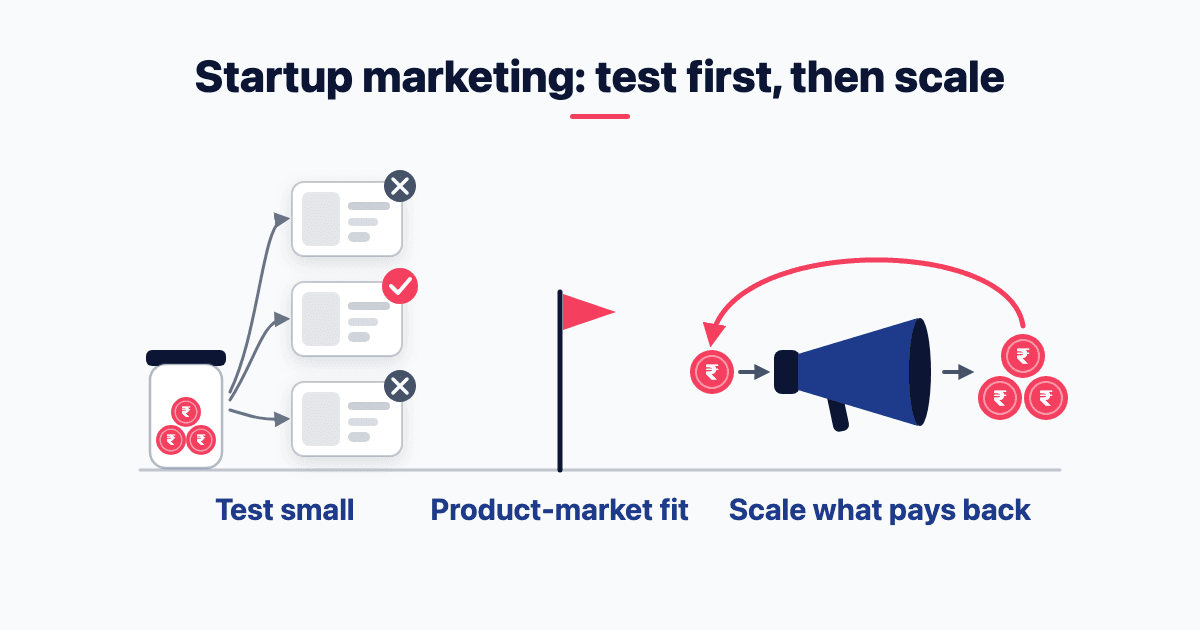
Make the hire when one channel shows it can pay back. Until then, you own marketing and buy hands by the task. A freelancer for a landing page, AI for first drafts, one small, tightly scoped channel test. A full-time marketer with no working channel spends months guessing on your payroll.
A startup's first marketing hire is the person who runs your one working channel and reports one number weekly. It is not the person who decides your strategy: they run the channel and its vendors against a plan you set.
Then check one thing: can anyone direct this person? If nobody can, the gap is direction, not hands. A fractional chief marketing officer (CMO) can set the plan while you hire the hands. My guide on who should lead marketing at each stage covers that choice.
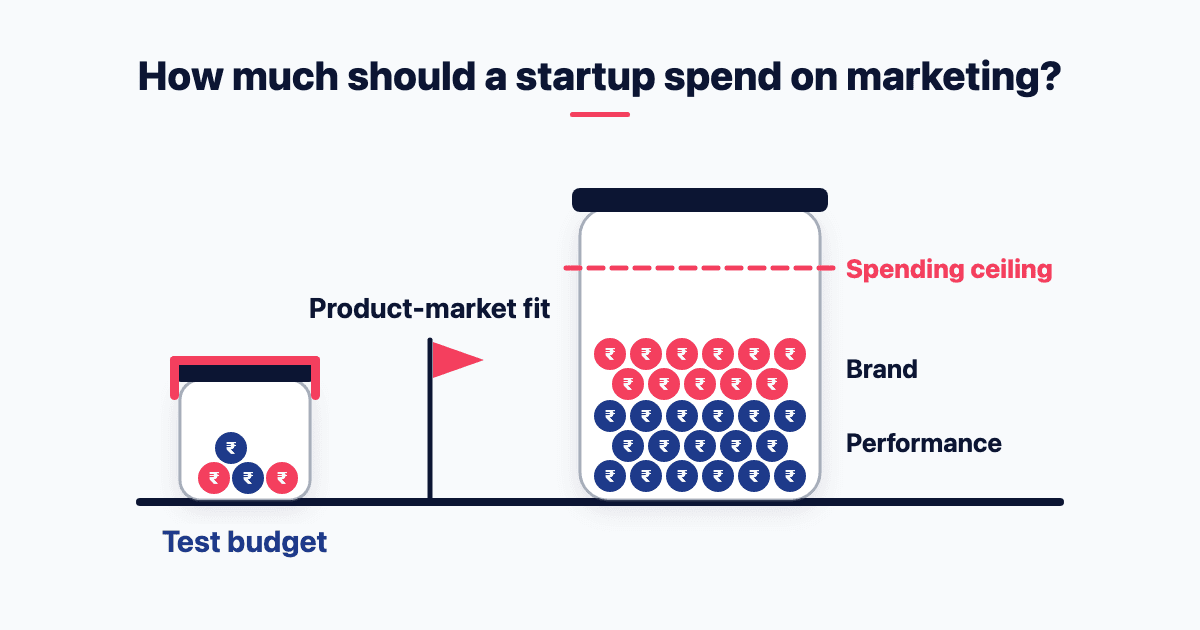
The hire is also a budget line. It has to fit inside how much a startup should spend on marketing, with money left for the channel itself.
Should your first marketing hire be a generalist or a specialist?
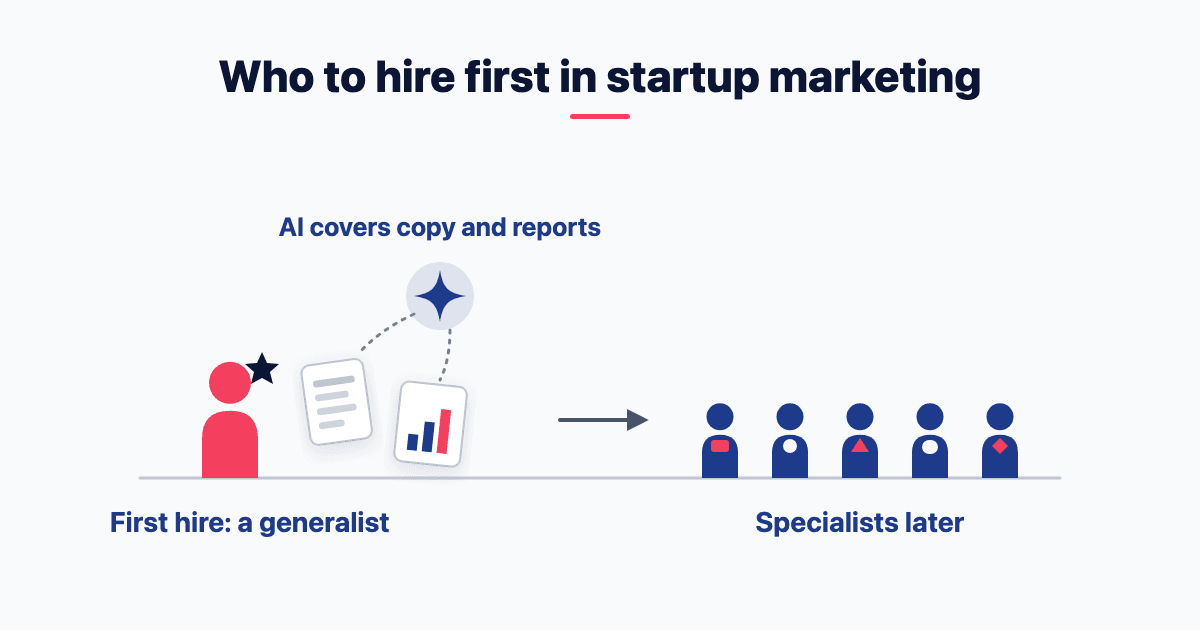
Hire a generalist with one deep skill, and make that skill the channel that's already working. With AI, a good generalist can cover the copy, landing pages and weekly reports that once needed a second person.
Hire your first specialist when any two of these show up:
One channel carries most of your new revenue and still has room to grow.
Your first marketer spends more than half the week on it.
Mistakes in it now cost real money every week.
Some guides set the trigger as a revenue figure. Revenue tells you what you can afford, not what you need. A company with one channel at full stretch needs a specialist sooner than a bigger one spread across five half-tested channels.
What should the marketing team structure look like at each stage?
What the team does comes from your marketing strategy before and after product-market fit. Here is the team to build around it: who's in-house, what you buy, and what stays with you.
Before product-market fit
In-house: nobody full-time in marketing.
Bought: freelancers by the task, one small, tightly scoped channel test, and AI for first drafts and research.
Yours: the message and the customer conversations. Nobody else learns what those calls teach you.
After fit: one or two channels working
In-house: the first marketer. Add a second hands-on executor only once the specialist signals above appear.
Bought: production such as design and video, plus a specialist agency or freelancer for one channel.
Yours, or an outside leader's: direction, through one of the hybrid setups with a part-time leader.
Your marketer directs AI for ad variants and reporting. So the second hire is the one you can delay.
At scale
In-house: a specialist per proven channel, a content or brand lead, and one marketing-operations owner who looks after the automations and agents.
Bought: specialist agencies and production.
Yours: less each quarter, as direction moves to a full-time marketing leader.
Two teams I've worked with show the shape. At Programming Hub, where I was CEO, content, product and marketing ran on AI-built content and marketing systems. At DocTutorials, where I lead marketing as an adviser, I set up weekly cost-per-acquisition reporting that the in-house marketing team can run without me.
Big-company scale looks nothing like this. The on-ground, below-the-line operation I ran at BYJU'S had 4,600 people across 170+ cities in a season at its peak. Those figures are from public record and my tenure. A startup needs the opposite instinct: add people only behind a channel that pays.
The order, in one line: you, the first marketer, a second executor or channel specialist, an operations owner, then a leader. Bought help fills each gap until a hire is justified.
How does AI change the shape of a marketing team?
AI can now take the first draft of most execution work. People own the brief, the check and the call.
Microsoft's 2026 Work Trend Index findings for India, published on 3 September 2026, point the same way. Indian respondents "ranked quality control of AI output highest of any market at 63%, against 50% globally". It is a survey of AI users in ten markets, run by a company that sells AI tools.
So hire people who can check AI output, and test for it. Then, before each new hire, write down what AI can't do in the role. Shopify's CEO, Tobi Lütke, made that a rule in a memo he posted on 7 April 2025. His words: "Before asking for more Headcount and resources, teams must demonstrate why they cannot get what they want done using AI."
Agents and people can share one team. The DocTutorials case study describes "An FMGE Instagram content engine with a faculty review board". FMGE is an exam for doctors who qualified abroad. Its AI agents act as planner, manager, designer and student reviewer. It runs alongside the in-house team above. AI changed what the team runs, not whether it exists.
What does AI fluency mean in a hire? Not coding. In an earlier post I called it "functional literacy": "enough to understand what you want, describe it clearly, and guide AI to build it." If you're growing an existing team, train the team you already have before adding to it. For the money side, see where AI moves cost and output.
"With AI, do I even need a marketing team?"
The objection is half right. AI does remove the second and third executor in the early stages, and that's real money saved.
It's wrong about the rest. Someone still has to choose the channel, own the number and check every output before a customer sees it. AI doesn't answer for a campaign that misfires.
So stop counting heads. Count the decisions that need an owner.
How do you test a marketer before you hire them?
Use real work, and ask everyone the same questions. A 2022 review in the Journal of Applied Psychology by Paul Sackett and colleagues re-estimated how well common hiring methods predict job performance. The numbers are correlations with later performance: 0 means no link, 1 a perfect one.
Structured interview: 0.42, the top predictor.
Work sample: 0.33.
Unstructured interview: 0.19.
Prior work experience at the point of hire: 0.07.
Read the bottom line twice. The experience on a CV barely predicts how someone will do the job. A free-flowing chat does only a little better. A work sample beats both, though nothing is a guarantee.
Set a paid work sample on your real material: last month's ad-account export, a live landing page or a real brief. Keep it to three or four hours, and pay for it.
Let candidates use AI, and ask them to show their work. What did they ask it, what did it get wrong, and what did they change? That's your AI-fluency check.
Write the scoring rubric before you see any answer.
Run a structured interview: the same questions, in the same order, scored. Ask "tell me about a time when…" questions. The authors' 2023 follow-up counts them, like work samples, as ways to sample real job behaviour.
Use both. Each method alone scored lower than once thought. Combining methods, the follow-up says, gives overall validity "quite similar to what prior work would indicate".
Freshers are the exception. The follow-up says some top methods are "not generally applicable for entry-level hiring" where skills are learned after hire. Its next line: "Work samples and job knowledge tests clearly fall into this category." So ask a fresher for a link to something they've made. My sheet for a session for B.Com and BBA students tells them: "Every week, make one small thing a stranger can open. AI drafts it; AI marks it."
One caution on the sample itself. Under India's Copyright Act, 1957, the author is the first owner of written work such as copy or a plan (section 17). A candidate isn't your employee yet, so the employer rule in section 17(c) doesn't apply. An assignment is valid only "in writing signed by the assignor" (section 19(1)). So don't use a candidate's sample in your marketing unless you've agreed that in writing.
Fixed-term or permanent: what do India's labour codes change for your first hires?
India's four labour codes were "made effective from 21st November 2025", says the labour ministry's press release. Three changes touch your first hires.
Appointment letters: the codes bring "mandatory appointment letters to all workers". Put the role, the number they own and the review date in it.
Gratuity for fixed-term staff: "Fixed-term employees will become eligible for gratuity after one year of continuous service". The government factsheet on the Code on Social Security cites section 53. The bar fell "from five years to one year", with gratuity paid "on proportionate basis". So a fixed-term contract still suits a hire you want to review at a year, but it no longer avoids gratuity.
Pay structure: "wages" includes basic pay, dearness allowance and retaining allowance. If other pay-outs "exceed 50% of the total remuneration", the excess is "added back to wages". That raises wage-linked benefits such as gratuity, so check how the offer is split.
None of this, or the copyright point above, is legal advice. Rules under the codes are framed "by the Central Government as well as by the State Governments" (Press Information Bureau). So check with your payroll or HR adviser.
What to do this month
Write down the one channel that's working. If you can't, don't hire yet: run a test with a freelancer.
Write the role as the number it owns, the channel, and what AI will do in it. That's your headcount test.
Decide fixed-term or permanent, and draft the appointment letter.
Build a paid three-to-four-hour work sample from your real data, with an AI part and the rubric written first.
Ask every candidate the same structured interview questions, and score the answers.
Plan the next hire only when two of the specialist signals appear.
Making your first marketing hire? I'm happy to look over the role, the work sample or the hiring order with you. Book a call.
Frequently asked questions
How big should a startup's marketing team be?
Size it by owners, not by a ratio. Plan one person per proven channel, production bought or done with AI, and one operations owner once automations and reporting need care. Check the count every quarter. If a channel stops paying back, rethink the role that runs it before you add anyone.
Should a startup's first marketer be junior or senior?
Usually mid-level: someone who has run a channel with their own hands and owned a number. A fresher needs daily direction you may not have time to give. A senior leader will want to build a team before the channel justifies one. If nobody in the company can direct the hire, solve that first with a part-time or full-time leader.
What should a startup marketing job description include?
Start with the number the person will own and the channel they'll run. Then say what they'll do by hand, what AI will do, and who they report to. Add the paid work sample and its fee, and whether the role is fixed-term or permanent. Those terms belong in the appointment letter too.
How do you onboard your first marketing hire?
On day one, give them access to every ad, analytics and customer-database account, all held in the company's name. In week one, agree the one number they own and a weekly review with you. By day 30, expect an audit and one fix. By day 60, a first test result. By day 90, they run the channel's weekly report.
- Hiring
- Founders
- Marketing team
Written by Siddhesh Joglekar
Fractional CMO and AI marketing consultant Siddhesh Joglekar helps founders and growth-stage teams build marketing engines that compound.