Leadership
How to choose a digital marketing agency in India: the brief, a paid test, the contract and the first 90 days
How to choose a digital marketing agency in India, for founders: a one-page brief, a paid test, contract clauses that keep your work, and 90 days.

· 11 min read
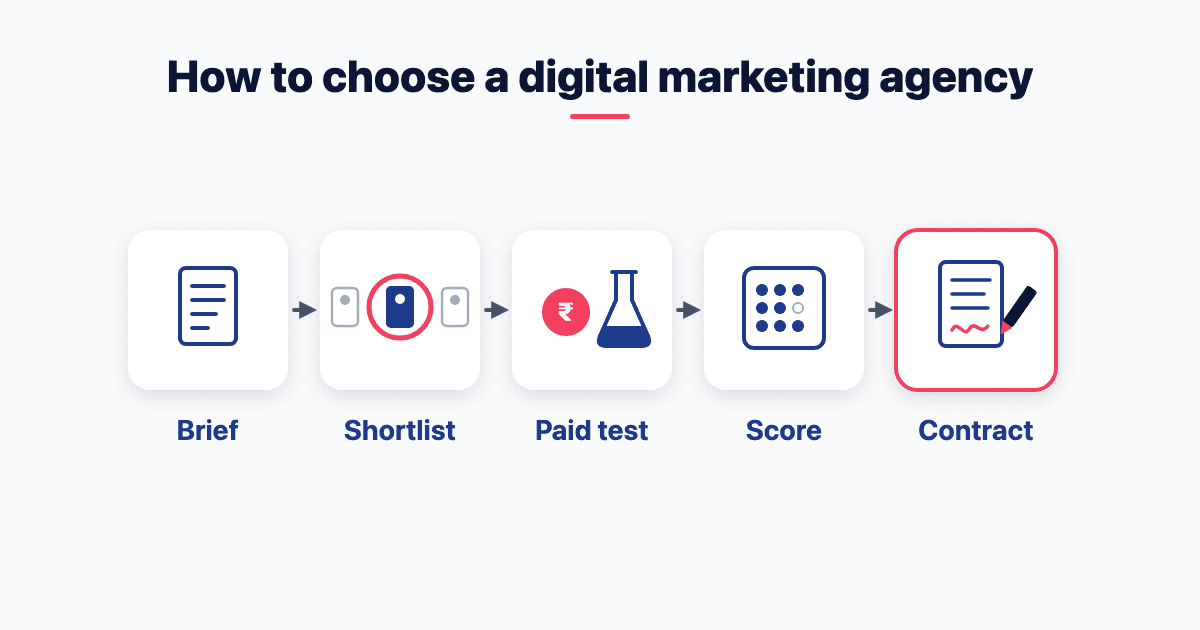
Eighty per cent of marketers think they write good briefs. Only 10% of creative agencies agree (Institute of Practitioners in Advertising, 2021). To choose a digital marketing agency in India, start with the brief, not the pitch. Pay two agencies for short audits. Pilot the better one for 30 days. Sign a contract that hands you the work.
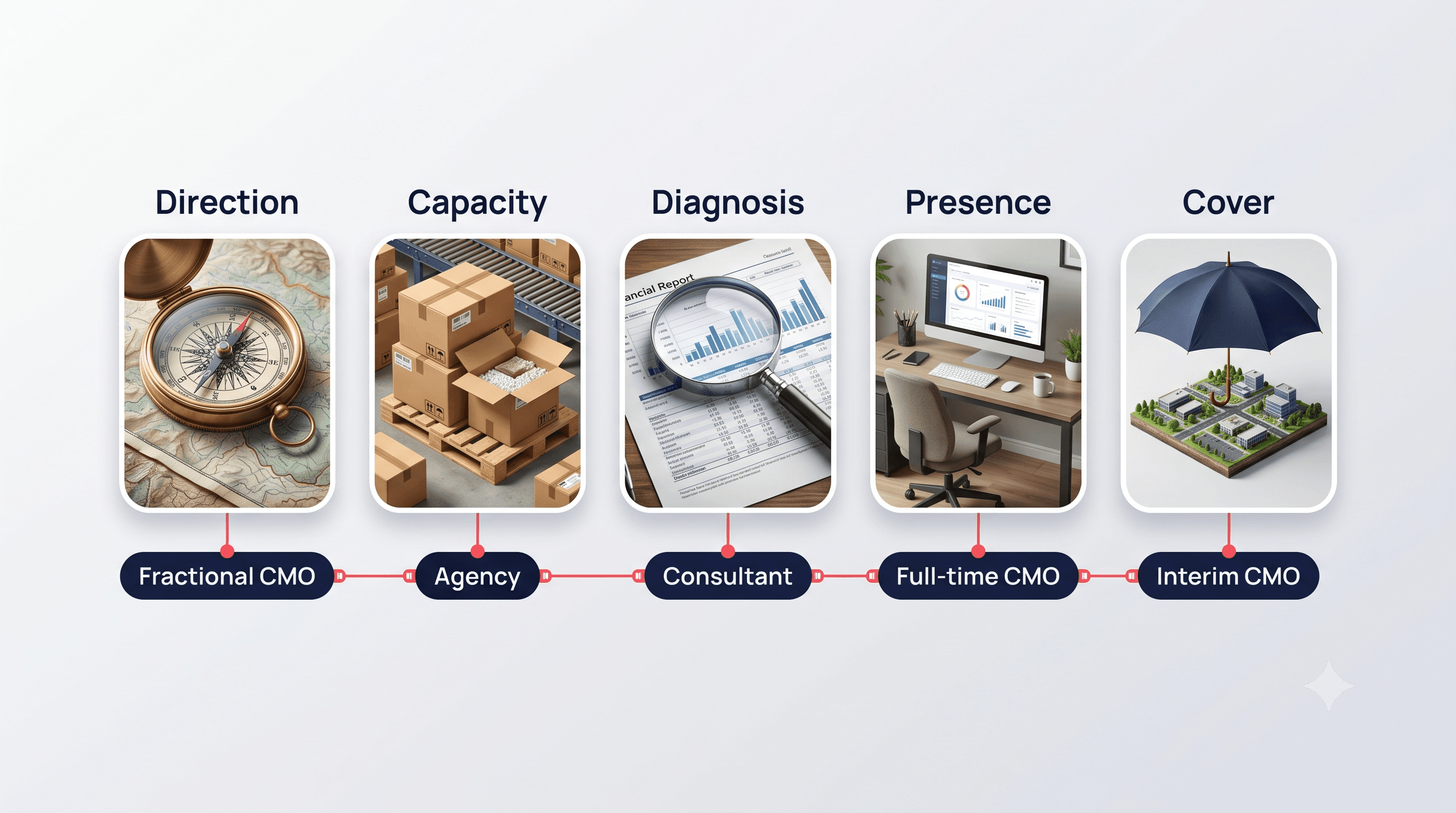
After signing, manage the first 90 days against a weekly scorecard, with a firing rule written in advance. This guide is for founders hiring a first agency or replacing one. Still choosing between an agency, a fractional leader and a hire? Compare the three options first.
Step 1: What should your brief to an agency say?
A brief is your strategy on one page. If you have no strategy yet, start with marketing strategy for startups in India.
The briefs survey quoted at the top is global, not Indian: over 1,700 marketers and agency staff in more than 70 countries. And the 10% is creative agencies only. But the fix costs one page, and seven lines are enough:
The goal, as a number. Orders, leads or revenue, by a date.
Your cost-per-acquisition ceiling. The most one new customer can cost and still pay back in the time you can fund. No number yet? Set your cost-per-acquisition ceiling first.
The customer and the offer. Who buys, what they pay, and why they pick you.
What you've tried, and what happened. Include the failures.
Channels in scope and out of scope.
What's measured and connected. Google Analytics 4 (GA4), your ad accounts, your store or sales records.
Two budgets, kept apart. Media spend, and the agency's fee.
Add who decides, and by when. That's the page.
Check line 6 first. I audited The 1970 Shop, an Indian snacks brand, in July 2026. "GA4 and Meta were not connected to Shopify, so no ad decision could be checked against revenue" (The 1970 Shop case study). No agency can be judged in that setup.
Step 2: How do you build a shortlist worth testing?
Three names is enough. Find them through founders at your stage, and through work you've admired in your category. Skip anyone who found you first. Google's advice on hiring a search agency: "Be wary of SEO firms and web consultants or agencies that email you out of the blue" (Google Search Central).
Call two current clients and one former one. Google again: "Check your SEO's business references." Ask the former client how the exit went.
Before anyone pitches, send each agency the four questions from the agency-versus-fractional comparison linked above. An agency that dodges them is out.
Don't shortlist on badges either. The FAQ below explains why.
Step 3: Why pay for a test instead of taking a free pitch?
A free pitch shows you the pitch team. A paid test shows you the team you'll actually get. Forrester, the analyst firm, made the point in May 2023: "Clients complain that the seasoned agency pitch team doesn't end up being their day-to-day account team." Its answer: "Reframe pitches into paid projects" (Forrester).
How to set up the audit and the pilot
Stage 1: a paid audit by two agencies, over one to two weeks.
Pay a fixed fee. Give read-only access: Read-only in Google Ads, and the GA4 Viewer role, which "Can see settings and data" (Google Analytics roles).
Google gives the same advice for search audits: "only grant read access to Search Console (at this stage, don't grant them write access)".
Ask each agency for a diagnosis, a 30-day plan and the pass line they'd sign up to.
Stage 2: a 30-day pilot for the better agency, on your own accounts.
Give Google Ads Standard access, which "can edit campaigns". Only Admin can give account access, change access levels or unlink manager accounts (Google Ads access levels).
Don't give the agency's manager account ownership. With it, Google says, that account's admins "can also edit user access, managers, and product links within your account".
In GA4, stay on Viewer unless the pilot needs new events. Marketer "Can create, edit, and delete audiences, events, and key events": the power to change what counts as a result. Administrator "can manage users", so it stays in-house.
Write the pass line before day 1. One number, non-brand, with a minimum volume.
Leave room for late conversions. Measure how long yours take to arrive, and read the pilot only after that lag.
The test fee. There's no independent Indian benchmark. Price it from the agency's own quoted retainer, pro rata, or as a fixed project fee. Never free, and media spend sits outside it.
This is the agency version of a work-sample test for a first hire.
The objection: "Good agencies won't do paid tests"
Sometimes that's right. A small account may not justify two audits, so audit with one and keep the pilot.
Mostly, it's backwards. In February 2025, the Advertising Agencies Association of India (AAAI) proposed a ₹5 lakh pitch fee (Manifest Media). It would apply "only when the client's pitch brief demands brand strategy and creative work". It's a proposal, not confirmed as adopted. But it shows which side agencies are on.
The same presentation said pitch ideas "shall remain the exclusive property of the creative agency". So put ownership of the test work in your letter.
Step 4: How do you score what the test showed?
Fix the weights before the test starts, so the best talker can't rewrite them. Treat these as a starting point, out of 100:
Result against the pass line, non-brand only (30 points).
Quality of diagnosis (20). What did they find that you didn't know?
Work shipped (20). Campaigns, pages and creative live in your accounts.
Reporting honesty (15). Do they show what failed? Does the change history match the report?
Same team (10). The people you met are the people who did the work.
Commercial fit (5). Fee basis, notice and how they handle scope.
Why non-brand only? Brand demand makes everyone look good. At OurBus, a US coach operator, there was at first "No separation between brand and generic demand, so brand traffic flattered everything else" (OurBus case study).
To judge a performance marketing agency, read the search terms report yourself: the searches that actually triggered your ads. Prompt 1 from my June 2026 session at IIT Kanpur hands that report to an AI. Its key line: "Flag high-spend / zero-conversion terms first" (Reading the Money session sheet). That's where waste shows.
Step 5: What should a digital marketing agency contract include in India?
This is general information, not legal advice. Have a lawyer check the assignment clause.
Under section 17 of the Copyright Act, 1957, "the author of a work shall be the first owner". For staff work, "the employer shall, in the absence of any agreement to the contrary, be the first owner" (s.17(c)). Agency staff are usually its employees. So by default, the agency owns the copy and designs you paid for.
Three wrinkles:
Photos and films. Under s.17(b), these go to whoever commissioned them "for valuable consideration", absent an agreement. If the agency booked the shoot, that's likely the agency.
Freelancers. A freelancer the agency hires is usually an author in their own right, so you need a written chain of assignment.
AI-made work. For computer-generated work, the author is "the person who causes the work to be created" (section 2(d)(vi)). How that applies to generative AI isn't settled, so name AI-made work in the assignment.
The fix is a written assignment. It isn't valid "unless it is in writing signed by the assignor" (s.19(1)). It must "identify such work, and shall specify the rights assigned and the duration and territorial extent". If it stays silent:
the term is "deemed to be five years from the date of assignment";
the territory is "presumed to extend within India";
rights unused for a year are "deemed to have lapsed" unless the assignment says otherwise.
It also won't cover a medium "which did not exist or was not in commercial use" at signing, unless it names it.
Four clauses to add:
Assignment of every deliverable, source files included. For the full term of copyright, worldwide, in every medium you need, each one named (s.18(1)), and not lapsing for non-use.
A register of third-party assets. Stock images, fonts, music and creator content: who holds each licence, and what you own versus rent.
Accounts and data. For account ownership and the data-processor clause, see the same comparison. For consent records and erasure, see the DPDP consent checklist for marketers.
Handover within a fixed number of days. Files, logins and documentation. Put the term and notice period in writing. For how GST and tax deducted at source apply to the fee, see the invoice section of the fractional CMO cost guide. Confirm the agency's case with your accountant.
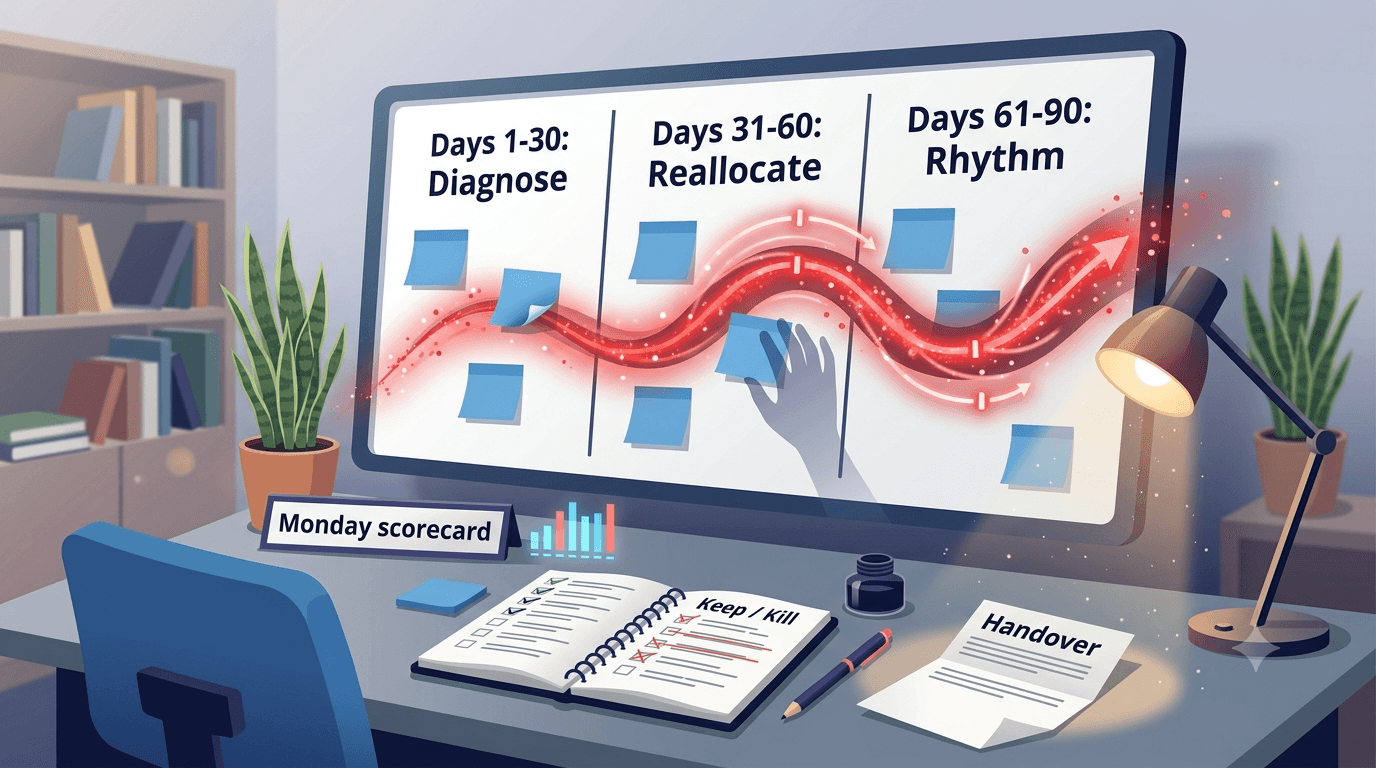
How do you manage a digital marketing agency in the first 90 days?
Days 1–30: set the baseline.
Audit who holds which access level, on every account.
Record the baseline your pass line is measured against.
Agree a weekly scorecard with a few flag signals, and a deeper look at anything flagged.
Your job: fast answers and sales data. An agency can't optimise to revenue it never sees.
Days 31–60: check the work, not the report.
Read Google Ads change history weekly. It "lists the changes made to your account, campaigns, and ad groups during the past 2 years" (Google's change history page).
Its "User" column "will show the email address of the person who made the change", for changes made in the Google Ads interface. So every agency person needs their own login.
Entries such as "Google Ads system" are automated. If that's all you see for weeks, ask who is working the account.
Where OurBus started, the reporting "described what happened, not what to do about it" (OurBus case study).
Review the search terms with Prompt 1.
Days 61–90: decide. Review against the pass line, non-brand only. Keep, re-scope or exit.
The scorecard is yours, not the agency's. If no one in-house can read it, that's a direction gap, and closing it is the job of a fractional CMO. The gap test in that comparison shows whether you need one.
When should you fire a digital marketing agency?
Write the triggers down on day 1:
two months below the pass line, with no diagnosis and no changed plan;
change history going quiet;
access or data withheld;
results reported only blended, or with brand included.
When one fires, exit in this order:
Collect the files and the signed assignment.
Confirm two administrators inside your company. Google warns: "If your account has only one administrator, you may lose access to your tags if that user becomes unavailable."
Remove agency users.
Unlink the manager account, an Admin-only action.
Downgrade or remove their GA4 roles.
Confirm data erasure: see the consent checklist above.
Public Indian data on why agency relationships end is thin. So treat these triggers as a starting rule you adjust, not a law.
What to do this week
Write the one-page brief, with your cost-per-acquisition ceiling on it.
Check what's connected: analytics, ad accounts, store or sales records.
Name three agencies, and call their references.
Send two of them the audit offer, with a fixed fee and read-only access.
Draft the assignment clause and send it to your lawyer.
Hiring or replacing an agency this quarter? Book a call and bring your one-page brief; we'll design the paid test together.
Frequently asked questions
How much does it cost to hire a digital marketing agency in India?
You pay a monthly fee plus ad spend, and no independent survey sets a fair fee. One agency's own guide says startup programmes "typically start from ₹30,000 to ₹50,000 per month", unsourced (an agency's 2026 fee guide). Buying from Google India, most advertisers pay 18% GST on ad spend (Google Ads tax page). Not tax advice.
What are the red flags when hiring a digital marketing agency?
Four, before you sign. Guaranteed rankings: Google says "No one can guarantee a #1 ranking on Google" (Google Search Central). Ad accounts in the agency's name, not yours. A flat refusal of any paid test. And a demand for Admin access before the pilot, when Standard access already "can edit campaigns" (Google Ads access levels).
Does a Google Partner badge mean an agency is good?
It means the agency meets Google's thresholds, not that it will grow your business. Partners need a "minimum optimization score of 70%", a "90-day ad spend of $10,000 USD" and 50% of account strategists certified. Premier Partners are the "top 3%" in a country, ranked on factors such as clients' ad spend growth and retention (Google's Partner requirements).
Should you hire one full-service agency or a specialist for each channel?
Either works if someone on your side owns one target across channels. Without that, each specialist can hit its own number while the business misses. Price every channel against the same cost target, and judge them together. If nobody in-house can own it, you have a direction gap.
- Hiring
- Agencies
- Contracts
Written by Siddhesh Joglekar
Fractional CMO and AI marketing consultant Siddhesh Joglekar helps founders and growth-stage teams build marketing engines that compound.