Strategy
Outsourcing marketing to India: how US companies work with an Indian partner, what to hand over and what to keep
Outsourcing marketing to India from the US? Hand over work you can check in your own accounts, keep the decisions you can't undo, and start with a paid pilot.

· 12 min read
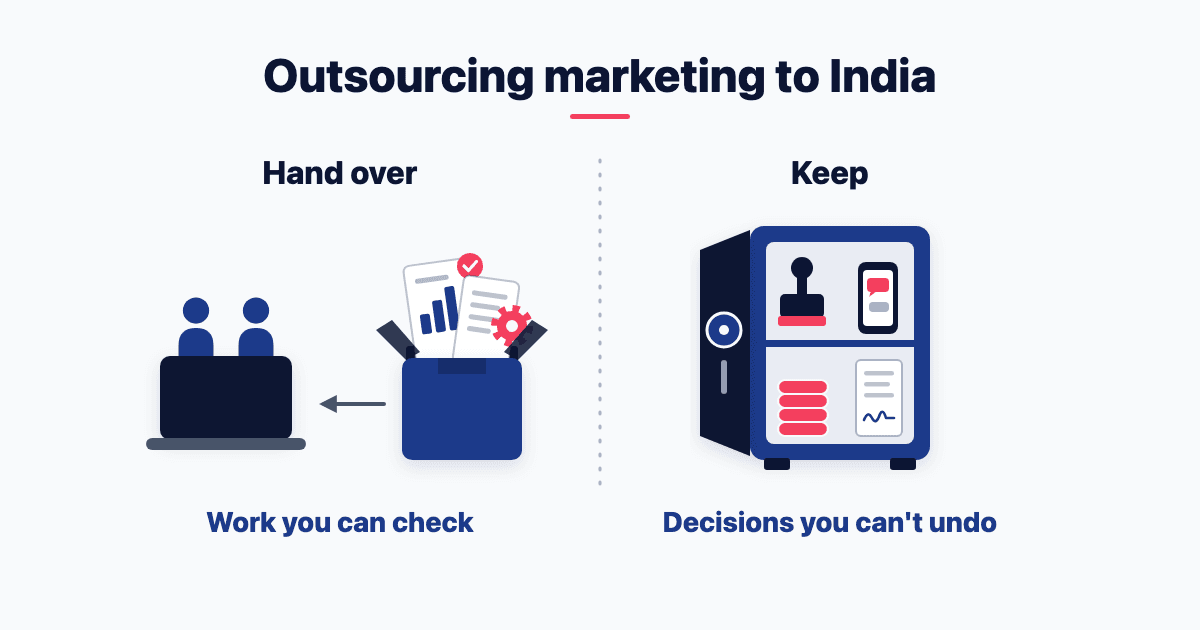
Cost is no longer the main reason companies outsource. In Deloitte's 2024 outsourcing survey, 34% of organisations named cost savings as their main reason, down from 70% in its 2020 survey. Take the hint when you outsource marketing to India: pay for a skill you're missing, not a lower rate. Hand over work you can check in your own accounts. Keep the decisions you can't undo.
This guide is for US founders and marketing heads weighing an Indian agency, startup or consultant. I'm not a neutral author here: marketing leadership is part of what I sell. OurBus and Rally, both US companies, are among my published case studies. Every statistic, rule and client result below links to its source, and the advice between them is my own.
Why do companies outsource marketing to India?
Outsourcing marketing to India means paying an Indian agency, team or consultant to run part of your marketing, usually in your accounts, under your brand. The usual sales pitch is cost. The buyers' own data points somewhere else.
Deloitte's survey puts it plainly: "Access to talent has emerged as the number-one driver influencing outsourcing decisions." Cost reduction, it adds, "is no longer the central focus". And marketing is well inside the scope: "Half of the survey respondents use outsourced services for sales, marketing, and R&D capabilities." R&D here means research and development.
Read those numbers with care. The survey covers every kind of outsourcing, worldwide, from "more than 500 global business and technology leaders". It isn't a study of India, or of marketing alone. Treat it as a signal about what buyers value now, not as proof about any one country.
So why outsource to India at all? Do it when a specific team there has a skill you're missing, and you can check its work. India is where the team sits. The skill is what you're buying. Judge the team in front of you, not the country on its address.
That last condition matters most. When the work happens in accounts you own, you can see it, check it and take it back. That's the basis of the test in the next section.
What should you hand over, and what should you keep?
Run every line of marketing work through two questions. I call it the check-and-undo test.
Can you check it in your own accounts within a week? A bid change shows up in your ad account's change history. A report matches your analytics, or it doesn't. A draft waits in your folder until someone approves it.
If it goes wrong, can you undo it within a week? A paused campaign restarts. A public brand claim, a promise to a customer or a spent budget doesn't come back.
Two yeses: hand it over. Any no: keep it, or keep the final say.
What passes, so you can hand it over
Five lines of work usually pass both questions.
Paid media management. A bid or budget change can be seen in your own account and reversed the same day. Set a limit on how much budget the partner may move alone.
Analytics and reporting. A report either reconciles to your own analytics or it doesn't. You'll know within the week, and a wrong report gets corrected in the next one.
Content production. Drafts, designs and edits wait for approval before anything goes live. Nothing public happens without your yes, so there's nothing to undo.
Automation. Email sequences, lead routing and reporting jobs run inside your own tools. You can read what they did and switch them off.
Research. Competitor scans, keyword lists and review analysis. You check research by reading it, and it changes nothing until you act on it.
What fails, so you keep it
Brand approvals. A public claim can be copied and shared within minutes. You can delete the post, but not the copies.
Customer conversations. They're where your best copy comes from, and a promise made on a call can't be taken back. Share the recordings or notes with your partner, but keep the conversations.
Final budget calls. Spent budget doesn't come back. The partner can recommend. You approve the total and any new channel.
Sales. A price, a discount or a contract term, once offered, belongs to the buyer.
The grey zone: hand over the work, keep the final say
Some lines pass one question and fail the other. Hand those over with a sign-off rule written down.
Ad copy and social posts. Easy to check, but public the moment they go live. The partner drafts and schedules. Someone on your team approves.
Search engine optimisation on your live site. Most edits can be reverted, but a broken page is public while it lasts. Agree in writing which changes need your sign-off first, such as redirects and page templates.
Replies to customers in public. A reply to an unhappy customer reads as a promise. Give the partner written rules, and route anything about refunds or complaints to your own team.
Where AI fits in the split
AI now does more of the hours in three places. The first is production: first drafts, variants, resizes and translation. The second is assembling routine reports. The third is routine bid and targeting moves, made by the ad platforms' own automation.
Google's help page on Smart Bidding says these bid strategies "use Google AI to optimize for conversions or conversion value in every auction". Someone still runs and checks that work. That can be a smaller in-house team, or a partner anywhere, offshore included.
Many buyers expect a partner to bring AI with it. In Deloitte's 2024 survey report, 83% of surveyed executives "expect that third-party vendors will bring AI capabilities as part of how they deliver services". Ask any partner which tools they use, and on which of your data.
What the split looks like in practice
The split isn't only for vendors. At OurBus, a US East Coast coach operator, my role is adviser to the CEO. In the case study's words: "A four-market expansion scorecard and a 25-corridor Canada census now sit under the CEO's next capital decisions."
The adviser builds the evidence. The CEO keeps the capital call. That's the check-and-undo test at CEO level: a scorecard can be checked and revised, but money spent on a new market can't be recalled.
Which set-up fits: an agency, a dedicated team or a fractional leader?
Start with your gap, not the vendor list. If you can't write a one-page plan, you have a direction gap. If you can, but nobody has time to run it, you have a capacity gap. I've set out the direction-or-capacity gap test in full, along with the hybrid set-ups.
Then pick from three set-ups. Each one fits a different gap, and each has one thing it can't do.
Set-up 1: an agency retainer
A retainer fits a channel you already know how to direct and measure, such as paid search or email.
What you get: the agency's process, its tools and cover for holidays.
What it can't do: set your strategy. An agency executes against a plan. If there's no plan, expect one shaped around what the agency sells.
What to watch: who is actually on your account, week to week. The next section covers how to find out.
Set-up 2: a dedicated offshore team
These are people who work only on your account. A vendor, or an employer-of-record firm (one that legally employs staff on your behalf), employs them in India.
What you get: steady volume in content, design or reporting, from people who learn your brand.
What it needs: someone on your side who writes the briefs and reviews the work.
What it can't do: direct itself. A team without a brief becomes a queue.
Set-up 3: an India-based fractional leader
This is a senior consultant, a fractional CMO or an Indian startup's founder-operator, working a set number of days a month for you.
What you get: direction, a weekly review, and someone who directs the executors. Those can be your own team, or set-up 1 or 2.
What it can't do: be your execution team. A leader who spends the week making ads isn't leading.
Choose this set-up when you need judgement more than hours. The set-ups also combine. A fractional leader often directs an agency or a dedicated team, which covers both gaps at once.
Set-ups change as the company does
The right set-up today may not be the right one in two years. Even with the same person, the role can change. OurBus shows that in one sentence: "I have worked with the company since 2017: first on organic and product, then on the paid engine, now as an adviser to the CEO."
That's three roles in one relationship. The latest is the adviser role in the example above, where the CEO keeps the capital call. Start with the set-up your gap needs now, and review it once a year.
Who will actually do the work, and when will you talk?
Ask for names before you sign. A quote should list everyone on your account, with their role and weekly hours. Ask that the person who pitched joins your regular calls. And ask for a named deputy for holidays and departures.
A paid test is the surest way to meet the real team before you commit. I've explained why a paid test beats a free pitch in my guide to choosing an agency.
Then decide when you'll talk. Most of the work doesn't need a shared room. In my guide to what a fractional CMO does, I wrote: "The weekly review, the scorecard and most analysis work well on a video call." Time on site "pays off early", and on "a planning day each quarter". What every set-up does need is a shared hour.
India keeps one clock all year, according to the Internet Assigned Numbers Authority's time zone data. New York changes its clocks, so the gap moves. It is 10.5 hours behind India until 14 Mar 2027, then 9.5 hours until 7 Nov 2027.
When is outsourcing to India a bad idea?
The strongest case against goes like this. The hand-holding eats the time you hoped to save. Work comes back and has to be redone. The people on your account keep changing. Calls land at 6 a.m. Eastern. And the copy doesn't sound like your customers.
Part of that is right. If you buy on rate alone, you'll probably be disappointed. Even where vendors use AI, Deloitte found that "less than half of the organizations report productivity gains, and only 25% are seeing reduction in cost of vendor services".
Those figures describe AI-powered outsourcing worldwide, not Indian marketing partners. But the lesson travels. Buying on the rate rarely delivers the gain by itself.
Now look at what the complaints have in common. None of them is about a country. Outsourcing fails when the judgement leaves with the work. It's a hand-over failure, not a geography failure, and the same failures happen with an agency down the street.
Each one has a fix in this guide:
Rework: the check-and-undo test, plus a written brief for every deliverable.
Changing people: named people and a named deputy, written into the quote.
6 a.m. calls: an overlap hour you choose, with production in the gap.
Generic copy: customer conversations stay with you, and the partner gets the recordings.
The pros depend on the skill you buy. The risks sit in the hand-over, and you control the hand-over.
And some work shouldn't travel at all. If most of your marketing fails the check-and-undo test, outsource less.
How should you compare quotes from an Indian partner?
Start by setting the hourly rate aside. It's the least useful line on a quote. Compare what each quote lets the partner decide and deliver instead.
I've explained why fees follow decision rights, not hours for fractional leaders. The same logic applies to any partner: what someone may decide shapes the work more than the hours they log.
Every quote should state six things:
The named people, and their weekly hours on your account.
The outputs per week or per month.
Which accounts they touch, and at what access level.
Which decisions they can make alone, and up to what limit, such as moving budget between campaigns.
What's excluded: ad spend, tool subscriptions, stock images.
What you get back if you leave: accounts, files and documentation.
If a quote can't answer one of these, ask before you compare. Two quotes that look nothing alike often line up once both answer the same six lines.
Watch for three warning signs. A quote that lists hours but no outputs. A team described by headcount, with no names. And ad accounts or analytics set up in the partner's name rather than yours.
Then count your own hours. Your team's review time is part of the cost. A lower quote that needs twice the review can cost you more in total. So write your team's expected review hours next to each quote.
How do you start? A paid pilot and the first 30 days
Get ownership right before day 1. Ad accounts, analytics and domains stay in your company's name, with the partner added as users. Give each person their own login, so your change history can show who made a change. Agree what access each login gets up front.
Then run a paid pilot. Pick one channel or one deliverable, and write the pass line before day 1. My agency guide covers how to set up and score a paid test. With an offshore partner, add a simple first month:
Week 1: agree the overlap hour and reply times in writing. Name one lead on each side, and swap holiday calendars, because India's public holidays aren't the US ones.
Week 2: the first real deliverable lands, against the brief.
Weeks 3 and 4: each week, check one number yourself, in your own account.
Day 30: extend the pilot, re-scope it or stop.
What to do this week
List every recurring piece of marketing work, and run the check-and-undo test on each line.
Decide whether your gap is direction or capacity, and pick a set-up.
Write a one-page scope: outputs, decisions and accounts.
Ask two or three partners to quote against that scope, with named people.
Choose the overlap hour you'll protect.
Book a paid pilot, with the pass line written first.
Weighing an Indian partner? If you'd like a second view on what to hand over, or a fractional CMO to run the split, book a call.
Frequently asked questions
What's the difference between offshore and outsourced marketing?
Outsourced means another company does the work. Offshore means the work is done in another country. A US agency is outsourced but not offshore. Your own employees in India are an offshore marketing team, but not outsourced. At scale, Deloitte's survey calls these "global in-house centers". An offshore marketing agency, such as one in India, is both.
Does India's data protection law apply to my US customers' data?
Mostly not. The duties in India's Digital Personal Data Protection Act, 2023 start on 13 May 2027 (DPDP checklist). Then section 17(1)(d) lifts most of them when a firm in India processes data of people outside India under contract to someone abroad. Two remain: overall responsibility (section 8(1)) and "reasonable security safeguards" (section 8(5)). Not legal advice.
Should I hire an Indian freelancer instead of an agency?
For one bounded job with a clear check, such as a landing page or a research brief, a freelancer can work well. A channel that runs every week is different. It needs cover for holidays, illness and departures, which one person can't give. Either way, keep the accounts and files in your company's name.
- Marketing partner
- US companies
- Outsourcing
Written by Siddhesh Joglekar
Fractional CMO and AI marketing consultant Siddhesh Joglekar helps founders and growth-stage teams build marketing engines that compound.