Pricing AI for Indian Buyers: Why Per-Seat Will Lose to Per-Outcome
The pricing model that built Indian SaaS is the wrong one for AI — and it fails in a precise way. Per-seat caps your upside on light users while bleeding margin on heavy users, because every AI action carries a real token cost the seat price doesn't cover. India sharpens the problem: buyers share seats by reflex, so three logins can drive the inference load of fifteen. The opening? The Indian CXO is outcome-literate to the point of suspicion — they'll pay premium for a resolved ticket, a qualified lead, a document processed, because each maps to a P&L line they already own. This week's Strategy Room essay lays out the floor-plus-meter transition path.
· 6 min read
If you are an Indian SaaS founder bolting AI onto your product and planning to charge ₹X per user per month for it, stop. The pricing model that built Indian SaaS is the one most likely to cap your AI revenue and torch your gross margin at the same time. Per-seat made sense when software was a fixed-cost asset you rented out. AI is not that. The Indian buyer is about to figure this out faster than the global one — and the vendors who price for it first will take the category.
This is the pricing argument, sharpened. Earlier, I had made the procurement case — AI behaves like electricity, not Salesforce. This post is for the other side of that table: the operator deciding what to *charge*, not just what to pay.
Why per-seat breaks for AI specifically
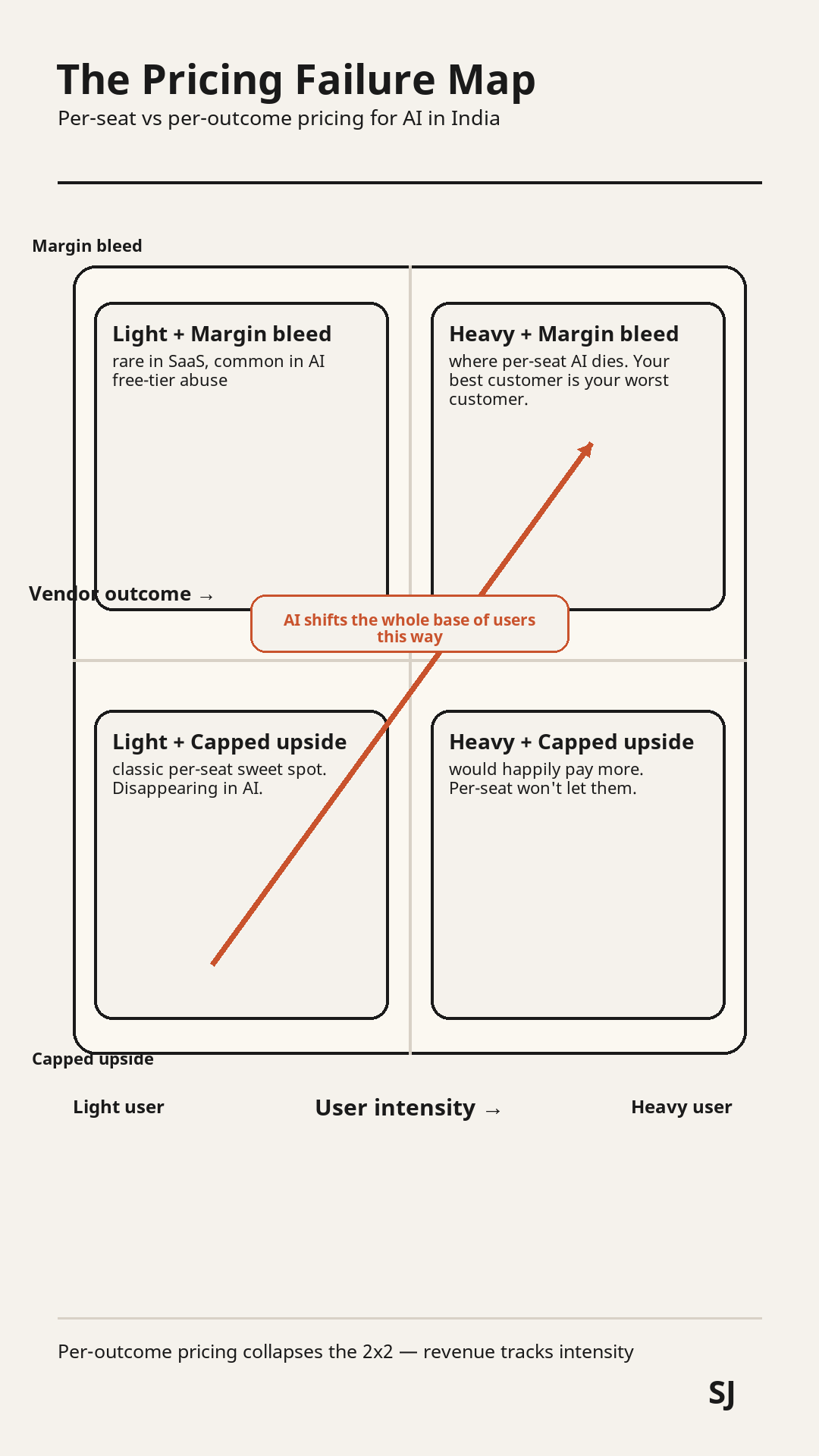
Per-seat pricing has one beautiful property for a SaaS vendor: cost and price are decoupled. A Zoho seat costs nearly nothing at the margin; the 50th user on an account is pure profit. That decoupling is the entire reason SaaS gross margins sit at 75–85%.
AI inverts it. Every unit of value an AI feature delivers has a real, variable cost underneath — tokens, GPU time, retrieval. The 50th user who actually *uses* the AI heavily costs you real money. So per-seat pricing now does the worst possible thing: it caps your upside on the light users (who'd happily pay for outcomes) while bleeding margin on the heavy users (who consume far more than their seat price covers). You have built a plan that loses money on your best customers and leaves money on the table with everyone else.
The Indian context makes this worse, not better. Indian buyers are seat-minimisers by reflex — they will buy three seats and share logins across a 30-person team. That habit was survivable in classic SaaS. With AI underneath, three shared seats can drive the inference load of fifteen. Your unit economics quietly invert and you don't see it until the cloud bill lands.
What the Indian buyer is actually willing to pay for
Here is the part global pricing playbooks get wrong about India. The Indian CXO is not cheap — that's a lazy read. The Indian CXO is *outcome-literate to the point of suspicion*. Years of being sold "platforms," "transformations," and "enablement" that never showed up in a P&L number have produced a buyer who trusts a metered, attributable outcome far more than a flat subscription.
That suspicion is your pricing opportunity. The Indian buyer will pay — sometimes premium prices — for:
- A resolved support ticket, not a support-AI seat. ₹4 per AI-resolved ticket is an easy yes for a D2C ops head who knows their human-resolution cost is ₹22. (See the support line item in [Post 005](005-indian-d2c-first-10-lakh-on-ai.md).)
- A qualified lead delivered, not a sales-AI licence. Per-lead pricing maps to a number the CMO already reports.
- A document processed, a reconciliation closed, a contract reviewed — the unit of work, priced.
- A guaranteed deflection rate, where you put your own margin on the line against the outcome.
Notice what these have in common: each maps to a line the buyer is already measured on. That is the whole game. Per-seat asks the buyer to translate your price into their P&L. Per-outcome does the translation for them — which is exactly why it closes faster and churns less.
The objection, and why it's overrated
Every founder I say this to raises the same objection: per-outcome pricing is operationally hard. You have to instrument the outcome, attribute it cleanly, defend it when the customer disputes the count, and forecast revenue that now wobbles with usage. All true. All also solvable, and all worth solving.
The dirty secret is that per-seat *feels* predictable but isn't — in AI, your costs swing with usage even when your revenue doesn't, so you've simply moved the volatility from the top line to the margin line, where it's far more dangerous. At least with outcome pricing, revenue and cost move together. A quarter of heavy usage is a quarter of high revenue. Your gross margin becomes a designed number instead of a surprise.
The instrumentation problem is also a moat. Once you've built clean outcome-attribution into a customer's workflow, you are wired into how they measure success. That is a far harder thing to rip out than a seat-based contract at renewal.
How to actually price it in FY27
Not every product can go pure per-outcome on day one. The transition path that works for Indian buyers can be something like this:
1. Find the atomic outcome - The smallest unit of value the buyer already counts. Ticket, lead, document, claim, reconciliation. If you can't name it in the buyer's own metrics, you're not ready to price it.
2. Floor + meter, don't go pure usage - A small platform floor (covers your fixed serving cost and gives the CFO a predictable line) plus a per-outcome meter above it. Pure usage-based pricing terrifies the Indian buyer's procurement team — they've been burned by cloud bills. The floor is the trust anchor.
3. Price the meter off the buyer's avoided cost, not your token cost - Your cost sets the floor of what's viable; the buyer's avoided cost sets the ceiling of what's payable. Anchor to theirs. The gap between ₹4 charged and ₹0.40 in tokens is your margin and your moat, not your guilt.
4. Build the cost-to-serve model before the pricing page - You cannot price an outcome whose cost you can't predict within a band. Know your cost-per-outcome at p50 and p95 usage before you quote anyone.
5. Cap the downside for both sides - A usage ceiling protects the buyer from a runaway bill and protects you from a renegotiation. Caps close enterprise deals in India.
The strategic read
The shift from per-seat to per-outcome is not a pricing-page tweak. It changes what your company is. A per-seat company sells access and optimises for logos and seat-expansion. A per-outcome company sells results and optimises for the customer's actual P&L — which means your roadmap, your support, and your data flywheel all reorient toward making the outcome cheaper and more reliable to deliver. That is a better company, and in India it is a more *defensible* one, because you're now embedded in how the customer keeps score.
The window matters. For the next two to three quarters, most AI features in the Indian market are still being sold as a per-seat add-on. The first credible vendor in each category to price the outcome cleanly will reset buyer expectations — and once a CFO has bought one tool on resolved-tickets, the per-seat pitch from the next vendor starts to sound like the vendor is hiding something. Pricing is becoming a positioning weapon. Most Indian operators are still treating it as a spreadsheet decision.
Per-seat asks the Indian buyer to take your value on faith. Per-outcome puts your margin where their P&L already is — and in a market this suspicious of software promises, that is the most persuasive pricing page you can build.
Written by Siddhesh Joglekar
Fractional CMO and AI marketing consultant Siddhesh Joglekar helps founders and growth-stage teams build marketing engines that compound.