AI
WhatsApp AI agent for business: Meta's own agent, a partner chatbot or your own build
WhatsApp AI agent for business in India: Meta's own agent, a partner chatbot or your own build, priced per conversation after the 1 October 2026 change.

· 10 min read
In a WhatsApp AI reply, the message is now the cheap part. Meta's developer pricing lists ₹0.115 a service reply from 1 October 2026. Meta's own agent costs about ₹3.8–4.7 a reply on its business platform, in tokens. A WhatsApp AI agent for business comes from Meta, a partner or your own build, and each prices the AI differently.
What does a WhatsApp reply cost in India since 1 October 2026?
WhatsApp Business API pricing in India is per delivered message, by category. Meta's pricing page is plain: "Meta does not charge for messages from users to businesses." Your customers' questions are free. Your replies are not.
Meta's India list rates, from its rupee rate card "effective October 1, 2026" (the "INR list rates" file on that page):
Service (any non-template reply, from a person or a third-party AI): ₹0.115
Utility and authentication templates: ₹0.115 each
Marketing templates: ₹0.8631
Meta Business Agent: "$2.00 USD / 1 M (million) tokens"
Meta's developer page lists these changes from 1 October:
Service replies are charged again, after 1,000 free a month "for each business phone number". The free ones "do not roll over but reset monthly".
Utility messages sent inside an open customer-service window are charged again. They had been free since 1 July 2025.
With no payment method on file, Meta "will deliver service messages within the free tier but not deliver them after the free tier has been used".
Meta's WhatsApp Business pricing page says the opposite: "we do not charge for service messages, or for utility messages businesses send in response to users". My IIM Calcutta session sheet flags the same disagreement for utility messages. Budget as if both are charged, then check your first invoice since 1 October.
You may have seen ₹0.145 quoted as the new rate. That's one Indian partner's resale price, about 26% above Meta's list rate. Its page doesn't say whether the ₹0.145 includes GST.
Templates still matter: marketing costs about 7.5 times utility. For flow design, see how to split WhatsApp flows into utility and marketing. For opt-in under India's Digital Personal Data Protection (DPDP) Act, use the DPDP consent checklist.
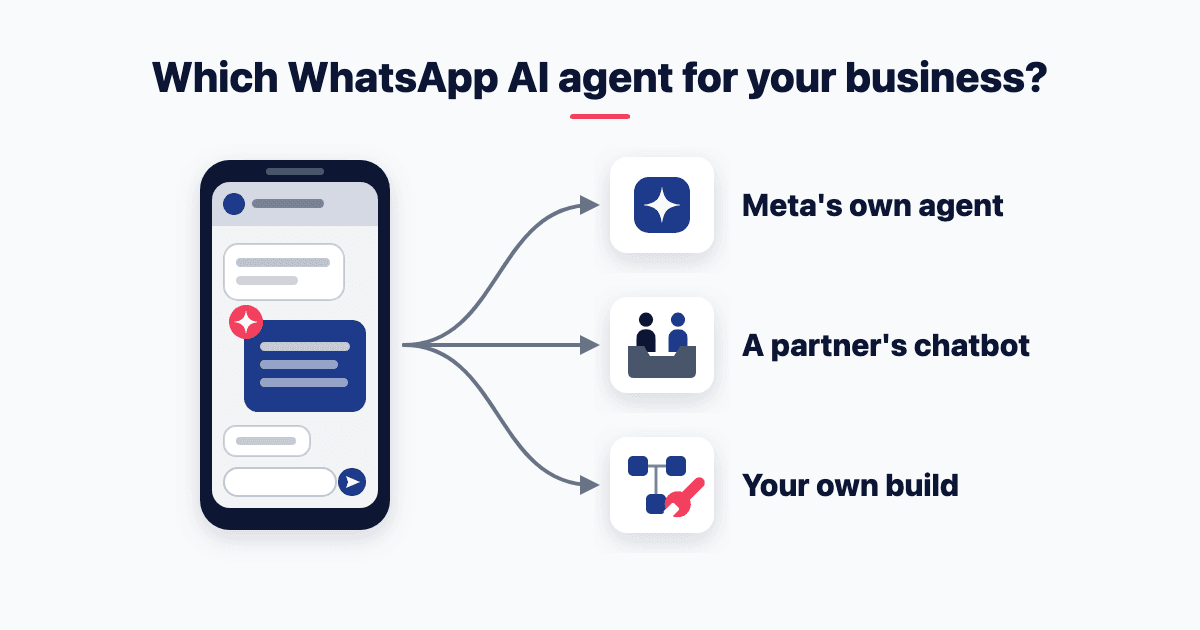
What are your three options for a WhatsApp AI agent?
Meta's own agent. Meta introduced Meta Business Agent on 3 June 2026 (WhatsApp's launch post). It runs in the free WhatsApp Business app or on the WhatsApp Business Platform.
A partner's chatbot. A Meta partner's platform: a shared inbox, campaign tools and an AI add-on, on a monthly plan.
Your own build. Meta's Cloud API, a workflow tool such as n8n, and a model you choose. The shape is the WhatsApp enquiry workflow in my n8n post.
One rule makes this a real choice. On the Platform, "an active authorized-agent integration blocks Meta Business Agent" (Meta's developer overview). Switch Meta's agent on, and it "becomes the primary responder for new conversations". Earlier responders "move to standby" (Meta's guide to enabling the agent). One number, one AI agent.
What does each option cost per conversation? A worked example
Take one number with 2,000 conversations a month and 5 business replies in each. That's 10,000 replies. It's an illustration, not a quote. Prices are list prices on 22 October 2026, before any tax. Dollars and euros convert at the 21 October reference rates on the Reserve Bank of India's home page: ₹94.7145 and ₹106.2839.
Meta's agent on the Platform: about ₹19–24 a conversation, or ₹37,900–47,400 a month. Meta's pricing page says one agent message "typically consumes 20,000–25,000 tokens, which translates to approximately 4–5 cents (USD) per message". That's ₹3.8–4.7 a reply. There's no free tier: "Volume tiers: Do not apply. Free messages: Do not apply."
Meta's agent in the free app: unknown until you test it. It's "free to use each month up to an included allowance, with more responses available through Meta One plans" (WhatsApp's Meta One page). Meta doesn't publish the allowance. The Essential plan was reported as starting at "Rs. 639/month" in India (Fonearena's launch report). Meta says pricing "may vary by region, by app, and by account" (Meta's Meta One announcement).
A partner's chatbot: at least ₹1.33 a conversation, plus the plan. After the free 1,000, 9,000 replies × ₹0.115 = ₹1,035, or ₹1,305 at the ₹0.145 resale rate. That partner's AI add-on is "₹1,350 Per Month (includes 1,000 AI messages)", "separate from" message charges. ₹1,305 plus ₹1,350 is ₹2,655 a month, or ₹1.33 a conversation. Its page lists no price per AI reply beyond the bundle, so treat ₹1.33 as a floor.
Your own build: about ₹3.5–4.4 a conversation, or ₹7,000–8,700 a month. Meta bills you the ₹1,035 directly. n8n's Pro plan is "50€/mo, billed annually" for 10,000 workflow executions, about ₹5,300. Model tokens add about ₹600–2,400.
The build rests on four assumptions of mine:
One n8n run per incoming customer message: 10,000 runs, exactly Pro's limit, at its annual price.
A small model at $0.10 per million input tokens and $0.50 per million output, such as Claude Haiku 5.5.
That model answering as well as Meta's agent. Test it on your own questions first.
5,000 input and 300 output tokens a reply at the low end; Meta's 25,000, all input, at the high end.
Then add the real cost: someone's time to build it and keep it running.
With Meta's agent, delivery is a rounding error: each agent reply costs 33–41 times the ₹0.115 service rate. In the build, n8n's plan is most of the bill. On tool costs alone, the build undercuts Meta's agent from roughly 230–300 conversations a month, even on n8n's Pro plan. Below that, or with nobody to own a build, Meta's agent or a partner wins.
Meta's own comparison, set in Brazil, assumes "high-complexity AI models" at "~9 ¢ per message". On my assumptions, a small model costs a fraction of a cent. Your model choice, not the logo, decides which route is cheaper.
Ad-led funnels get one more twist. When a customer messages you from a Click-to-WhatsApp ad, your reply opens a free entry point window. Meta's developer page says "up to 7 days"; WhatsApp's pricing page says 72 hours. Plan on 72 hours. Inside it, Meta charges nothing for marketing, utility, authentication or service messages. But "Meta Business Agent messages remain charged." So a coaching institute or direct-to-consumer brand running these ads pays for Meta's agent exactly where other replies are free.
Treat these as ranges: real use moves with the context each reply carries; see what AI tokens really cost an Indian marketing team. This summarises Meta's published pricing and terms on 22–23 October 2026; it isn't legal or financial advice.
Which option fits your business?
Meta's own agent: when it's enough
It fits a small business on the free app that answers the same questions all day. It "learns automatically from your Facebook Page, past chats, and website, if you have one" (WhatsApp's product page). Meta says it works in "all native languages in India" (Meta's India announcement).
One control matters for ad budgets: "Choose who your AI responds to: everyone, only new customers, or customers coming from ads."
Its limits are real:
Sectors. On the Platform, "all verticals are supported except Finance, Government, Health, Alcohol, Gambling, over-the-counter drugs, and matrimony services" (Meta's developer overview). Fintechs, clinics and matrimony apps are out.
Country. On the Platform, the business must be "based in a country authorized for Meta Business Agent". Meta's eligibility check confirms it.
A partner's chatbot: when you need a team around it
It fits a team that needs a shared inbox, customer relationship management (CRM) sync and campaigns, with no engineers. The trade-off is three charges: a platform fee, an AI add-on and a per-message price above Meta's list rate. Another Indian partner's price page lists service messages at ₹0.127–0.129, depending on plan, against Meta's ₹0.115.
My published stance is blunt. In my ₹10 lakh AI budget post from May 2026, I wrote: "Build this on the WhatsApp Business API with a Claude or GPT layer underneath. Avoid the temptation to use a generic chatbot SaaS that wraps an LLM — you'll be paying for someone else's prompt engineering plus margin." SaaS (software as a service) is a subscription tool; an LLM (large language model) powers Claude and GPT.
That was before 3 June, when Meta introduced a platform for enterprises to build and deploy their Business Agent at scale (WhatsApp's launch post). So run the sums above on your own volumes before you sign.
Four questions to ask a partner:
What do you charge per service message, against Meta's ₹0.115? Does that include GST?
How is each AI reply priced beyond the bundle?
Which AI agent runs on our number? Only one can.
If we leave, who keeps the number and the chat history?
Your own build: when volume and data justify it
It fits high volume, a sector Meta's agent excludes, or answers that must come from your own CRM or catalogue. Workflow 2 in my n8n post has the shape: "an AI step answering only from an approved answer sheet (fees, batch dates, timings), a CRM note and a handover". The rest goes to a person: "Anything off the answer sheet (complaints, refunds) goes straight to an agent."
I build with these tools, as the operations layer in my DocTutorials case study shows.
What you take on:
Billing. Meta bills you directly. If you're directly integrated and billed in India, Meta wants every account "migrated to INR by December 31, 2026". Miss that, and from 1 January 2027 Meta "will no longer deliver the messages" of accounts not yet moved to rupees.
The right plan. n8n prices by workflow executions, not seats. Its Starter plan is "20€/mo, billed annually" for 2,500.
Security. Read how to lock down an n8n WhatsApp agent before it goes live.
"Meta's agent is free, so why pay for anything?"
Free has limits. In the app, the agent is free only "up to an included allowance". On the Platform, it has no free tier. And the costliest reply is the wrong one.
You aren't choosing a chatbot. You're choosing who pays for the AI, and who answers when it's wrong.
My IIM Calcutta session sheet on conversational commerce (19 October 2026) gives a flow three jobs. The third: "hand over to a human before anything risky". Its list: "health or medical questions; dietary or certification questions we cannot confirm (Jain, halal); complaints about the product or packaging; bulk or corporate orders; address changes; anything involving personal data".
Read that list as the places where a confident wrong answer costs more than a slow human one. The sheet's warning is one line: "If the flow answers it, the flow is wrong, however polite it sounds." And where to start: "Start where a wrong answer is cheap: order status before health questions."
My IIT Kanpur session sheet puts the rule shortest: "Written hand-off rule + a named reviewer, or no agent." It holds for every route. Meta's agent supports it, by "flagging topics to avoid and manually stepping in as needed".
What to do this week, before you switch anything on
Open your first bill since 1 October. Count service replies past 1,000 and in-window utility messages.
Count last month's conversations, and the replies in each.
Price all three routes at your volume with the sums above.
Check eligibility: the app's Tools menu, or Meta's eligibility check on the Platform.
Write the handover list before any agent goes live.
If you're directly integrated and billed in India, move to rupee billing by 31 December 2026, or Meta stops delivering your messages.
Diary a re-check. Meta "may update pricing only on the 1st day of each quarter".
Do the sums favour a build? I can help you set it up through my AI automation for marketing service. Book a call and bring last month's WhatsApp bill.
Frequently asked questions
Is WhatsApp Business AI available in India?
Yes, for eligible businesses. Meta launched Business AI in India on 14 May 2026, saying it's "Available in all native languages in India". It added that Indian businesses "must meet certain criteria to be eligible" (Meta's India announcement). In the WhatsApp Business app, look for Meta Business Agent under Tools.
Why isn't Meta Business Agent showing in my WhatsApp Business app?
Meta hasn't switched it on for every business. WhatsApp says it's "Available to eligible businesses in select markets". And "Some Meta Business Agent features may not yet be available to all eligible businesses" (WhatsApp's product page). On a Platform number, another AI agent blocks it, and Meta's Eligibility endpoint is "the authoritative check".
Can we connect ChatGPT or Claude to our WhatsApp Business number?
Yes, if it answers questions about your own business. Meta's pricing counts replies from "a 3rd-party AI solution" as ordinary service messages. Since 15 January 2026, its terms restrict AI providers' general-purpose assistants to markets "where Meta is legally required to permit this use case" (Meta's AI Providers page). India isn't listed. This isn't legal advice.
- Customer support
- AI agents
Written by Siddhesh Joglekar
Fractional CMO and AI marketing consultant Siddhesh Joglekar helps founders and growth-stage teams build marketing engines that compound.