AI
AI training for marketing teams in India: what to teach, which format to pick, and what a half-day looks like
Your marketing team already uses AI. What team training should teach, which format fits, and a sample half-day built from real, published sessions.

· 10 min read
Good AI training for marketing teams teaches people to run their own recurring work (briefs, content calendars, competitor research, reporting) through AI, under shared data rules and a checking standard. Each person leaves with something that works, not a slide deck. That takes a hands-on build on your team's own work, then weeks of practice, not a one-off talk.
In BCG's AI at Work 2026 survey, 95% of frontline employees surveyed in India used AI at least several times a week. Yet only 36% of all respondents felt properly trained.
I have been guest faculty at IIM Calcutta for nine years, and my applied-AI sessions have trained 2,000+ senior professionals since 2024. That count is cumulative across institutions and corporates, and not limited to marketers.
What should AI training for marketing teams actually achieve?
AI training for a marketing team should turn private, uneven use into shared, checked workflows. Knowing the tools is a side effect, not the goal.
The problem is not access. Marketing is the second most AI-active of 11 functions in BCG's AI at Work 2026 slides, with 85% of frontline marketing staff using AI at least several times a week. BCG surveyed white-collar staff at companies with annual revenue of $100M or more across 14 markets, India among them, so these are large-company figures, not a ten-person startup's.
What should the curriculum cover?
Six modules cover it, each mapped to a published session sheet from programmes I teach. The two AI in Action sheets come from an IIM Calcutta leadership cohort; the mechanisms carry over to a marketing team.
Module 0: data rules, before anyone types
The AI in Action Session 1 sheet answers "Is my data safe?" before anyone types anything about their company, and so should you. Its red list includes customer personal data and "media plans, research verbatims, agency commercials". For everything else: "Labels, not names. Rounded numbers." The Session 2 sheet's lane rule adds that under a customer's non-disclosure agreement, or in a regulated or listed company, nothing internal goes into a personal account.
Whether chats are used to train models depends on the plan (checked 28 September 2026):
Claude Free, Pro, Max (personal): each user chooses, in privacy settings (Anthropic consumer terms update, 28 Aug 2025).
Claude for Work and the API: not by default; the exceptions are feedback you submit and data you opt in to share (Anthropic Privacy Center, updated 18 Aug 2026).
Gemini in a qualifying Google Workspace edition: not without the customer's prior permission or instruction (Google Workspace privacy hub, updated 14 Aug 2026).
Any other tool: ask whether it is trained on, how long it is kept, and which plan changes that (Session 1 sheet).
Personal plans suit public material and practice files, and it helps to know what one paid seat can ship. Customer work belongs on a company plan.
Section 8(5) of India's Digital Personal Data Protection Act, 2023 requires a Data Fiduciary to take "reasonable security safeguards to prevent personal data breach". The Schedule's penalty for breaching that duty "may extend to two hundred and fifty crore rupees". Both come into force in May 2027, eighteen months after the commencement notification, G.S.R. 843(E). This is not legal advice.
Module 1: briefing
Most people use AI like a search box; training should teach them to brief it. The DigiAIM 12 Session 2 sheet uses CRISP, a five-part brief:
Context and Role.
Instructions, with stop points where your approval gates the next step.
Specifics: formats, counts, word limits.
Pain points: "what must never happen: invented stats, ad-speak, broken naming conventions". For marketers, this is where brand guardrails live.
The Session 1 sheet adds two habits: open with "Ask me questions before you start" and close with "End with what you would verify first."
Module 2: checking
Checking needs its own module because AI's errors are uneven. In a Harvard and BCG field experiment with 758 consultants, GPT-4 users completed 12.2% more tasks, 25.1% faster, at more than 40% higher quality on tasks inside AI's capability. On a task outside it, they were 19 percentage points less likely to be correct (Dell'Acqua et al., 2023). They were consultants using an older model, but the lesson holds: the tool "sounds equally sure when right and wrong", as the Session 1 sheet warns.
The AI in Action Session 2 sheet names four ways AI work fails:
Invented action: it says it checked a figure and did not. Tell: round, tidy numbers.
Scope creep: it "cleaned" a column nobody asked about.
Silent failure: a step failed and it carried on. Tell: a missing month, or totals that do not match the source.
Format mismatch: right content, wrong shape, such as "₹ lakh labelled ₹ crore".
Its sign-off line is a good team standard: "Three numbers traced to source by me. One total re-added by me. Source file, date and tool named on the working paper. Then it carries my name."
Its marketing drill is worth copying. Rank channels on sell-out (sales to the end customer) per ₹ of spend, then on contribution per ₹, and reconcile the two: "the gap is where the judgment is, and the judgment is yours."
Module 3: the team's own workflows
The IIT Kanpur Session 1 sheet sets the rule: "never let the AI invent the source material." It runs one case through "spy → create → page → track":
Cluster 8–10 live competitor ads from the Google Ads Transparency Center, filtered to India, to find the angle nobody owns.
Generate on-brand creative from your real product shot, on that angle.
Test landing-page hero copy with the 5-second grunt test: a stranger must say what you sell, why it matters and what to click.
The DigiAIM sheet does the same for content, starting from three or four pillars, each "an ARGUMENT my brand repeats until it sticks, not a topic".
Module 4: automation with an approval gate
Once a workflow works by hand, automate it. The DigiAIM build is an n8n agent that drafts a post from a Google Sheet content queue, emails it for approval and waits before anything ships. The sheet's rule: "Automate the shipping, never the judging." Your strongest people can go further with AI coding for marketers.
Module 5: practice between sessions
Habits form between sessions, not in them. The AI in Action Session 2 sheet closes with a Monday Card, "one job handed over this week, with baseline minutes and a check".
What to leave out
Tool tours, 100-prompt lists, model trivia and anything not tied to a weekly job. On model choice, the AI in Action Session 1 sheet says simply: "Use the default."
Which format fits: a talk, half-day, full day or multi-session track?
A talk changes minds; only practice changes work.
Talk or keynote
Good for: A shared vocabulary, leadership permission, momentum
Not enough for: Changing how work is done
Published example: —
Half-day, hands-on (about three hours)
Good for: Data rules, one briefing method, one workflow on your material
Not enough for: More than one workflow, or lasting habits
Published example: IIT Kanpur Session 1; DigiAIM 12 Session 2 (three hours each)
Full day
Good for: Two or three workflows plus the checking module
Not enough for: Practice spread over weeks
Published example: —
Multi-session track
Good for: Behaviour change, with practice between sessions
Not enough for: Teams that cannot protect the calendar time
Published example: A three-session Claude track for 75 senior participants at IIM Calcutta; a four-Saturday DigiAIM module
A 2025 survey adds a yardstick: "Regular usage is sharply higher for employees that receive at least five hours of training and have access to in-person training and coaching" (BCG AI at Work 2025). That is a correlation, not proof of cause. One three-hour session falls short of that mark on its own.
The DigiAIM and AI in Action sessions ran hands-on over Zoom, so online works when it is designed for it: timed tasks, two devices and a private way to say you are stuck. Given BCG's in-person finding, get the team into one room if you can.
The head of marketing should attend the first session and sign off the data rules in person. In the same survey, the share of employees who feel positive about GenAI "rises from 15% to 55% with strong leadership support".
What drives the cost?
Four things move the price most: the number of sessions, whether it is built on your own jobs (which takes preparation), group size, and follow-through between sessions. Budget separately for company plans, priced per seat. To scope a hands-on AI workshop for your marketing team, share your audience, objectives, preferred format and group size, and ask for a quote.
What does a half-day AI workshop for a marketing team look like?
Here are the real timings of a three-hour session from the DigiAIM 12 Session 2 sheet, run on Zoom from 6:45 to 9:45 PM IST for an IIM Calcutta cohort; nothing is timed before 7:15. It is a programme session, so treat the times as a shape to adapt.
7:15, Build 1 (15 minutes): pillars, a pillar-by-format matrix that includes WhatsApp broadcast, then a 30-day queue of 8–12 concepts; reject at least one pillar.
7:35 (10 minutes): draft 5–7 posts in your voice, keeping every redline.
8:07 and 8:10, Part 2 (4 minutes each): a shot-list brief for a short video, then a 60-second script.
Break, then Part 3.
8:45, Build 2 (25–30 minutes): import and run the n8n agent; the evening's redlines become its rules.
9:15, the judgement loop (5 minutes): declare a kill threshold for each format before automating it, as a written keep, kill or rework rule.
Its stated floor: "a 30-day calendar + one video brief + your agent run once with the approval gate. Everything else is bonus."
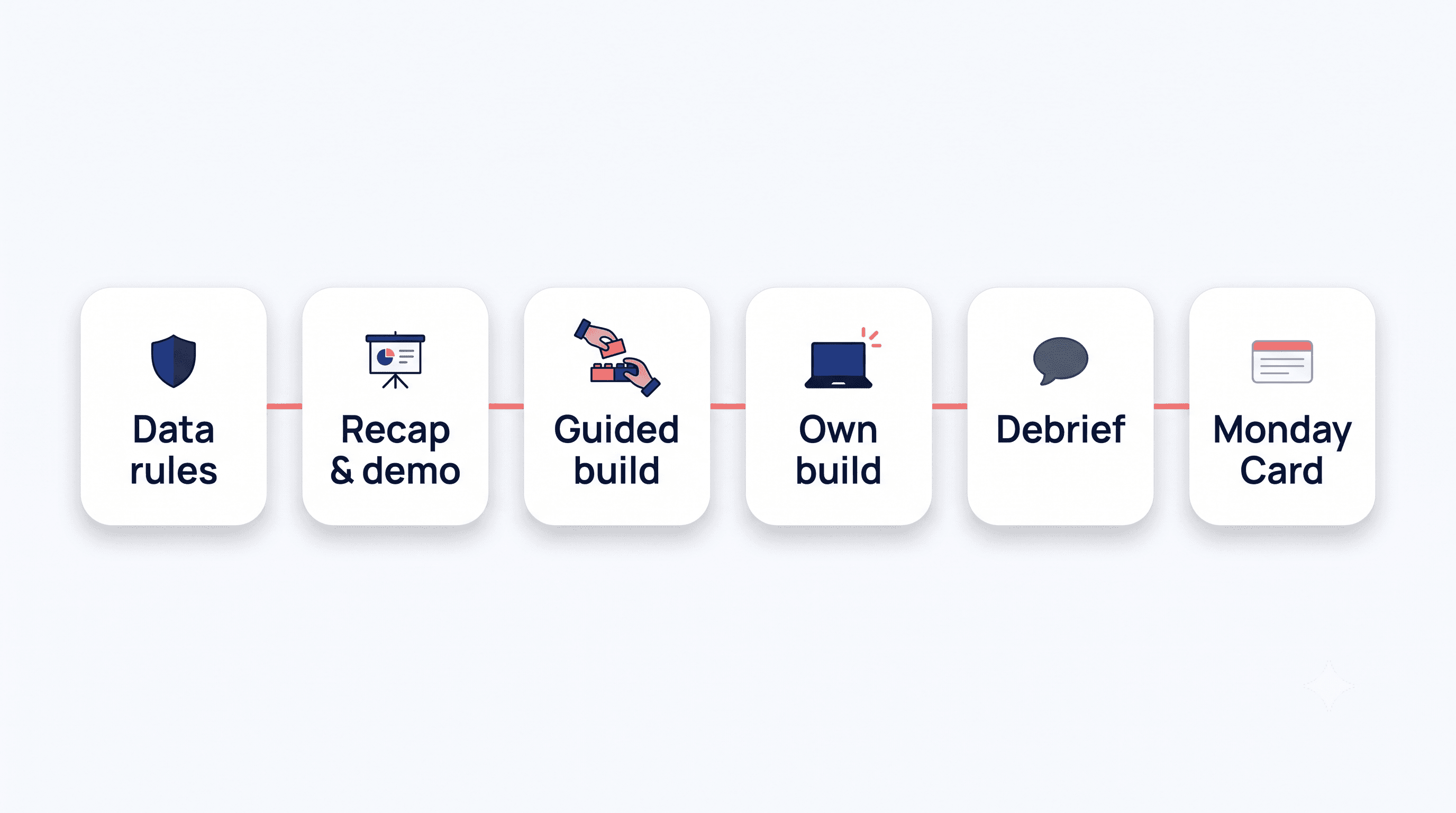
Underneath is the applied-AI case study's arc: "recap, demo, guided build, own build and debrief". For an in-house team, change three things:
Data rules before the first build, because your team will bring real brand material.
Your jobs, not a programme case: two recurring jobs per person, picked beforehand.
A Monday Card at the close (Module 5).
What should you expect afterwards?
On day one, expect one working artefact per person and a shared way of briefing.
After that, measure what you honestly can: minutes before and after for each job handed over, and whether the checking step still happens a month later. Be sceptical of anyone promising a percentage, and do not expect a workshop alone to move acquisition cost or revenue.
In BCG's AI at Work 2026 report, 60% of frontline marketing staff who use AI regularly report saving at least eight hours a week. Yet 66% of frontline regular users get limited or no guidance on what to do with that time. Both are self-reported. Put the hours into more tests, more creative variants or faster reporting, and say so before the session.
"Can't the team just take a free course?"
Free courses are good AI training for marketing professionals learning the basics on their own. HubSpot Academy's AI for Marketing course is free, and Salesforce Trailhead offers free AI for marketing courses. Send new joiners there.
A course cannot agree your team's data lanes, brief format, checking standard, approval gates and practice rhythm. In General Assembly's August 2025 survey of 300+ US and UK marketing and sales professionals, only 17% had comprehensive, role-specific training, and another 20% found theirs too generic. General Assembly sells training, so weigh it accordingly.
The honest concession: for a team of two or three, a free course plus one internal hour a week may be enough. Everyone brings one job, runs it, and someone else checks it. Team training earns its cost once the team is big enough that uneven practice shows up in the work.
What to do this quarter
Name two recurring jobs per person to change, and write down today's minutes for each.
Agree the data lanes with IT or compliance, and move customer work onto company plans.
Pick the format by goal, using the table above.
Ask any trainer for a timed agenda and a real sheet from a past session.
Before the first session, decide where saved time goes and what you will count.
If you want your marketing team to leave with working workflows rather than notes, invite me to run a session for your team.
- workshop
- Marketing teams
- AI training
- Marketing
Written by Siddhesh Joglekar
Fractional CMO and AI marketing consultant Siddhesh Joglekar helps founders and growth-stage teams build marketing engines that compound.