AI
ChatGPT prompts for sales: one prompt per deal stage, and what to keep human
ChatGPT prompts for sales, one per deal stage, for Indian B2B sellers: trigger, discovery, objections, proposal, close plan, CRM notes. Plus what to keep human.

· 11 min read
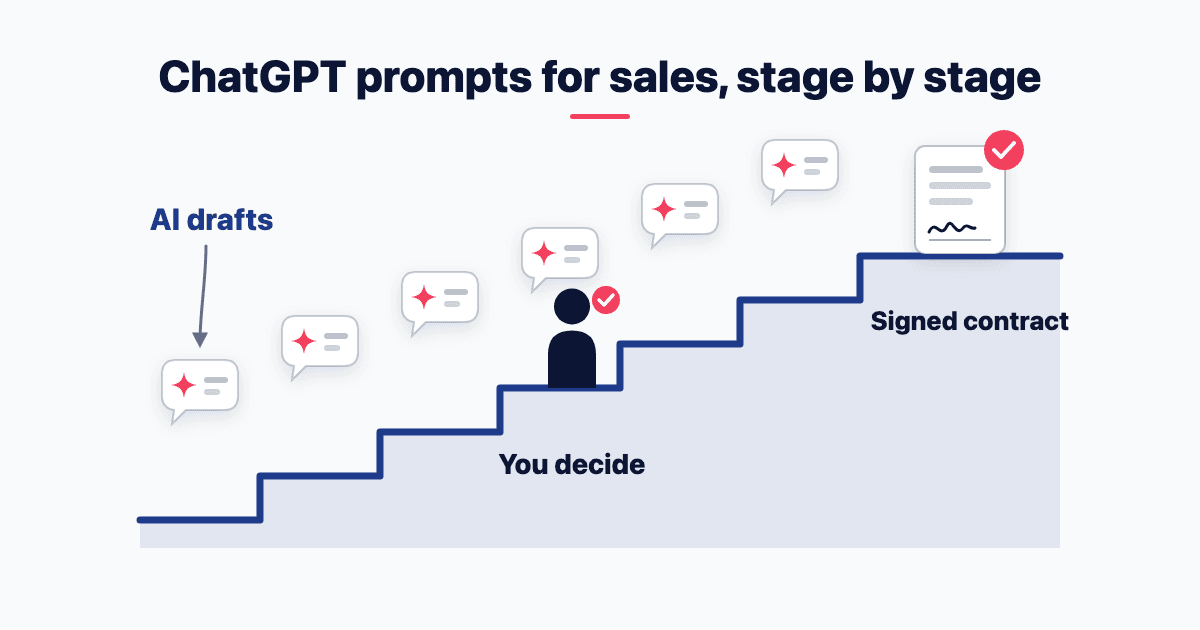
AI isn't coming for the seller. It's coming for the parts of selling that were never really selling: the research grind, the prep, the CRM hygiene, the 11 pm proposal formatting. So use ChatGPT prompts for sales one deal stage at a time. The AI drafts and checks. You decide which deal, what price and what to promise.
Which ChatGPT prompts for sales cover each deal stage?
Six stages, one job each:
Prospecting: find a trigger, pick an angle, write the first message.
Discovery: rank the questions for the first call.
Objections: prepare your answers before the meeting.
Proposals: map the customer's economics, then offer three options.
Closing: draft a mutual action plan the buyer owns.
CRM notes: keep your customer relationship management (CRM) records honest.
Three rules apply to all six:
Labels, not names. That's half the rule in my IIM Calcutta session. The other half: "Rounded numbers, never exact figures, never anything price-sensitive." Where policy allows, that sounds like "Dealer A, about ₹6 Cr a year, payments slowing." So the prompts below use rounded figures and leave prices blank. No ledgers or CRM exports, except the Friday Truth-Check on a company-approved plan, still with no names. Agree the data rules your team should set first before anyone pastes.
Every fact gets a source or a flag. Each prompt tells the AI to mark what it can't source.
The prompt stops where your decision starts. Each stage ends with what to keep human.
Vague answers usually mean a vague brief, and the CRISP prompt framework fixes that. Four more prompts live in my guide to AI training for sales teams. They are the labelled call-prep brief, the Silence Ladder follow-up, the AI-buyer role-play and the Promise Ledger.
Each prompt is new and rests on my Superhuman Sales frameworks. I taught parts of them to charter reps at OurBus Charters, a US coach-hire business. For a ready-made set, my Superhuman Sales page has 25 free AI prompts for every stage of a deal. The pack comes by email, as a PDF.
Prospecting: how do you find a trigger and write the first message?
Don't start with the email. Start a step earlier, with why now. Name something that just changed at the buyer's company, then ask one easy question. In my starter pack, those steps are Trigger Radar and the Angle Test.
Turn on web search if your tool has it, then paste:
Search the web. I sell [product, in one line] to [buyer's role] at [type of company] in India. Account: [company name and website]. Find three "why now" triggers in its public pages and recent news, each with a source link. Mark any you can't source UNVERIFIED. Test three angles on the strongest and pick one. Draft a first message under 80 words that names the trigger and ends with one question. Invent no figures or results.
My 12-Minute Account Brief adds a test for the angle: "Write the Angle as a question the buyer can answer in one breath."
Keep human: choosing the account, checking each trigger's source and pressing send.
Ranking inbound enquiries is a different job, covered in which enquiries to call first. Once a buyer replies, run the call-prep brief.
Discovery: what should you ask on the first call?
Ask more than you pitch. Rank the questions by what each answer would change in the deal:
Act as my sales coach. Trigger: [from the prospecting prompt]. Buyer's role: [for example, head of operations at a mid-sized manufacturer]. Draft 8 discovery questions, ranked by how much each answer would change this deal. Mark the 3 I must ask. Include one about their last attempt to solve this problem. Add one follow-up probe per question. Mark every assumption, and invent no company facts.
Why questions? A practice drill from one of my college sessions has the AI play a customer who says no. Reply with a pitch and "watch it score 4". Reply with a question back, "what went wrong with your last supplier?", and "watch it score 8". Those are expected scores in a classroom drill, not measured results.
Keep human: listening, and the follow-up nobody scripted.
Objections: how do you prepare answers before the meeting?
Write your answers before the meeting, while you can still check them. The Objection Grid is my format: "If they ask X, I'll say Y. Three columns, built in ten minutes."
Take price. On the grid page, "It's too expensive" can mean "No budget line yet; the champion can't justify it upward". The move: "Reframe to cost of status quo; offer a phased start."
Build an objection grid for my meeting with [Account A, a mid-sized distributor]. Columns: Objection, Real driver, My move. Six to ten rows. Use only what I paste: our product facts, the buyer's situation (labels only) and anonymised notes from lost deals [paste]. Name the real driver behind each objection. Never invent a price, discount, customer name or result. Write "check" wherever you need a fact I haven't given.
Read every move first. At that college session, a real app notification went into free AI on stage for three rewrites. My warning: "One version invents a discount. That gets you fired."
Keep human: the moves. As the grid page says, "You choose the moves." Its rule: "Pre-stage the response. Never volunteer the question." Rehearse the top three aloud in the role-play.
Proposals: how do you price from the customer's economics?
Price from the buyer's numbers, not your rate card.
The Customer Economics Sheet comes first: "Map their economics, not yours." Every line needs an owner, a baseline and a source. Its framework page adds: "Two or three defensible benefit lines beat eleven fragile ones." Build it with your champion: "Co-build, never deliver."
The Three-Proposal Frame turns those lines into options: "One number is a position. Three numbers are a conversation." Its framework page sets the tiers: a Compliance Floor, a Recommended option designed to be picked, and a Future-State version that carries your high anchor.
Two notes from that page matter in India: "Precise: price to the rupee." And, in my view, "in many Indian deals, the relationship sentence comes first and the number second."
Step 1: From my discovery notes [paste, labels and rounded numbers only], build a customer economics sheet: benefits, costs, flexibility, risk. Every line needs an owner (a role at the buyer), a baseline and a source. Turn any gap into a question for my champion. Step 2: Draft three tiers: Compliance Floor, Recommended, Future-State. Tie each to lines from step 1 and say what the buyer gets and gives. Leave each price as [price] for me to set to the rupee, and say whether GST is included. Invent no figures.
Then check your margin in your own sheet before the quote goes out. Your costs and final price are price-sensitive, so they stay out of the chat. As my first session for charter reps puts it: "A rep closes revenue. An owner keeps margin."
Keep human: the floor, the final number, and which trade you'll offer if they push.
Closing: how do you build a mutual action plan the buyer owns?
Most deals don't die on price, as I argue in Superhuman Sales. They stall in the gap between "we love it" and a signed contract. The Five Stalls names the causes: procurement, legal, exec, budget and ghost.
For all five, I use the Mutual Action Plan, or MAP: "Under all five stalls sits one cure." Build it backwards from the buyer's go-live date. "The buyer's milestones should outnumber yours." Its Authorship Test: "If the buyer hasn't edited it, it isn't a MAP."
Draft a mutual action plan for [Account B]. They want to go live on [date] because [their reason]. Work back through security review, legal, procurement, budget approval, exec sign-off and a pilot. Add a step: do we need a vendor code or supplier registration before they can raise a purchase order? Make every owner a buyer-side role and mark every date "to confirm". Flag any step you're guessing. Output an editable draft, plus one question for my champion.
Extend the plan past signature. My session 3 sheet calls for a handoff note to operations "within 48 hours of signing". Its first item: "why they bought — in the customer's own words". Next come the success measure they'll judge you on, the hard constraints and every promise you made. The note draws on the quote and the thread. So write it yourself, outside the chat.
Keep human: the plan itself. The buyer writes it, and the AI's dates stay guesses until the buyer confirms them.
CRM notes: how do you keep the pipeline honest?
Your forecast is only as true as your notes. After every call, have the AI turn rough notes into an update with the next step, stage evidence and open questions. Strip names and contact details, round any figures, and add the session 3 rule: "If anything is unclear, write it as a QUESTION for me — do not assume."
Every Friday, run the CRM Truth-Check:
Here are my open deals and the last 14 days of activity [paste: account label, website, stage, stage-change date, rounded value, last activity date, next step, economic buyer's role or "none", committee mapped yes/no]. Return four ranked lists. Stale: no activity in 21+ days. Duplicate: the same account entered twice. Missing: no economic buyer, committee map or next step. Lying: stage and activity have contradicted each other for 30+ days. Show each deal's evidence, and don't guess beyond the data.
The framework's warning: "These are ranked hypotheses, not verdicts. The AI proposes and you verify." Run it only on a company-approved plan, never a personal account, and export accounts, not people.
Why bother? Duplicate leads once hid the true win rate at OurBus Charters, and my guide to AI lead scoring shows the clean-up.
Keep human: what's true about the deal.
Can't I just copy a list of 50 prompts?
You can, and most lists are free. But a list gives you tasks. A stage tells you where the AI has to stop.
So the wrong question is "which prompt?". The right one is "which decision stays mine at this stage?"
Prospecting: the AI finds triggers; you pick the account.
Discovery: the AI ranks questions; you listen.
Objections: the AI drafts the grid; you choose the moves.
Proposals: the AI builds the tiers; you set the floor.
Closing: the AI drafts the plan; the buyer writes it.
CRM notes: the AI flags suspects; you decide what's true.
As the Superhuman Sales page puts it, "The human work of judgement, trust and the awkward question matters more, not less."
One limit, plainly. I haven't seen an independent trial showing that prompts like these lift win rates. They can cut prep time and catch errors before a buyer does. So measure your own team: prep minutes per call, proposal turnaround and win rate on quoted deals.
What to do this week
Pick one live deal to run these prompts on.
On Monday, run the trigger prompt on one new account.
Build the Objection Grid for your next meeting.
Turn your next proposal into three tiers.
On Friday, run the Truth-Check and fix or close the top five "lying" deals.
My sessions run one build-and-debrief arc, "whether the audience is a CXO cohort or a sales team", as in AI for Sales at Promega. Rolling this out to a whole sales team? I'd be glad to run a hands-on AI workshop built around your pipeline.
Frequently asked questions
Do these prompts work in Claude, Gemini or Copilot?
They should, because they're plain text with no plug-ins and no ChatGPT-only features. Output can differ between tools, so run each prompt once and check it before your team adopts it. For the prospecting prompt, turn on web search if your tool has it. To pick one tool for a team, see how ChatGPT, Claude and Gemini compare.
Can AI write a cold-calling script in Hindi?
Yes, as a first draft. With extended thinking, Claude Haiku 4.5 reached 92.4% of its English score in Hindi on a translated knowledge test (Anthropic's multilingual docs). That isn't sales writing or Hinglish, and Anthropic advises: "Test with any languages relevant to your specific use cases." So have a native speaker read your script aloud.
Which AI prompts should a sales manager use?
Start with the pipeline, not your reps' emails. Run the Friday Truth-Check across the team's open deals, then read the result like a CFO. My framework's version is "Six numbers, ten seconds": coverage, slippage, velocity, win rate, conversion by stage and cycle length. One rule: every flag is a question for the deal's owner, never a verdict.
Is a free AI plan good enough for sales prospecting?
For research on public information, often yes. Free Claude accounts can search the web, but searches count toward usage limits that "reset every five hours" (Claude Help Center). The page's tip: switch search off in chats that don't need it. Customer threads need a company plan under your team's data rules, with names stripped and figures rounded.
- Prompts
- Sales
- AI for sales
Written by Siddhesh Joglekar
Fractional CMO and AI marketing consultant Siddhesh Joglekar helps founders and growth-stage teams build marketing engines that compound.