AI
AI lead scoring for sales-led funnels: which enquiries to call first
AI lead scoring ranks enquiries by how likely they are to buy. Clean your CRM, start with rules, check the data a model needs, then test it against win rate.

· 8 min read
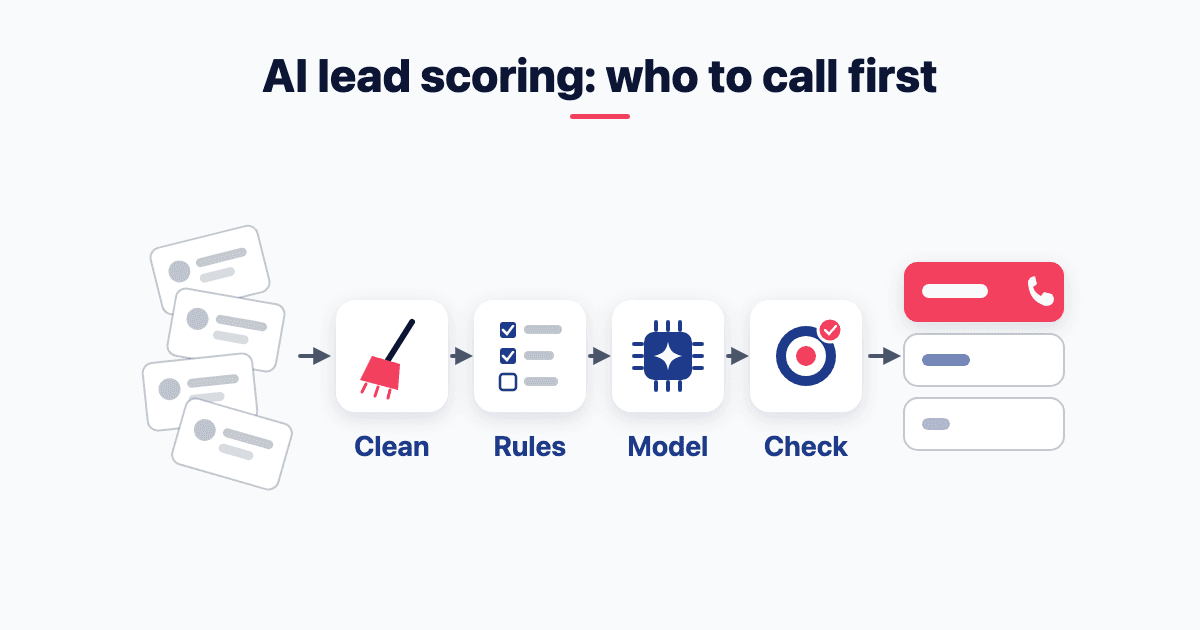
An AI lead score learns from your past wins and losses, so it is only as honest as your sales records. AI lead scoring ranks open enquiries by how likely each is to buy. Clean those records, then start with rules. Add a model once you have enough closed leads. Keep it only if top-scored leads win more.
Your reps call in the order leads arrive. A vendor is pitching an AI score, and nobody trusts the conversion number. Four steps fix that.
What is AI lead scoring, and how is it different from a rules-based score?
AI lead scoring, or predictive lead scoring, ranks open leads by how likely each is to buy. It learns the weights from the won and lost history in your CRM (customer relationship management system). Microsoft's Dynamics 365 guide says it "uses a predictive machine learning model to calculate a score for open leads based on historical data."
HubSpot's score is "the probability that your open contacts will close as customers within 90 days" (HubSpot Knowledge Base).
A rules-based lead scoring model is points you assign: say +20 for a booked demo, −30 for a wrong number. A predictive model finds the weights itself. Both read fit (who the person is) and intent (what they did).
In a sales-led funnel, the output is simply the order in which reps call. See also where AI actually moves cost per lead.
A four-step lead scoring framework for sales-led funnels
Four steps, in order: Clean, Rules, Model, Check. Skip one and the next inherits its mess.
Step 1. Clean: one person, one record
Rule: no score until every enquirer is one record, with a source and an outcome.
A model trained on duplicates learns noise, and a win rate counted on them is wrong.
I saw this at OurBus Charters, a US coach-hire business. It started with "Quote events double-firing in the CRM and a backfill duplicating leads, so nobody could state a true win rate." We "Rebuilt the event taxonomy, de-duplicated leads, and made win rate a number the business could defend."
The result was a win rate measurable for the first time: 17.7% closed-basis (Step 4 explains the term), on ~520 de-duplicated leads a week. Those funnel figures come from the client's PostHog analytics, de-duplicated.
For an Indian funnel:
Match on mobile number, not just email. One person may enquire by phone, on WhatsApp and through a lead form.
Record every outcome: won, lost or no answer. "Unknown" can't train anything.
Keep the source and the consent tick on each record. Scoring uses personal data, so check the consent checklist for marketers first.
To automate it, use a workflow that de-duplicates each lead and alerts a rep at once.
Step 2. Rules: score fit and intent before you buy a model
Rule: write 6–10 rules your best rep would agree with, and run them for a quarter.
An example for a phone-led Indian funnel follows. Adapt the points: they aren't a benchmark.
Fit: the payer or decider is reachable (+20); you serve their city (+10); the batch they asked about has seats (+10); the budget fits (+10).
Intent: answered the callback (+15); replied on WhatsApp (+15); booked or attended a demo (+20); asked about price or start date (+10).
Negative: a wrong number, outside your area, or a student's email when the parent pays (−30 each).
The payer rule comes from where enrolments leak between enquiry and a paid seat: ask who pays at the first touch.
Indian funnels differ here. HubSpot's documented inputs include "Number of page views" and "Number of email opens, clicks, and most recent reply". The lead's phone number counts only as "Whether or not the contact has a Phone number or Mobile phone number value".
When you sell on calls and WhatsApp, the best signals are call and chat outcomes, so log them as fields. A rule can't read a note that says "father keen, call after 7".
Speed matters too. Have the same workflow alert a rep the moment a high scorer arrives.
Step 3. Model: switch on predictive lead scoring only when you have the closed leads
Rule: check your CRM's documented minimum before you pay for AI. Below it, your rules are the model.
What four CRM vendors' help pages said in October 2026:
Zoho CRM (Zia), from India's Zoho: "Zia will need a minimum of 200 records to start scoring." Its conversion score also needs "a minimum requirement of 75 records" for each of the "ideal" and "non-ideal" outcomes you define, say won and lost (Zoho Help: Zia Scores).
Microsoft Dynamics 365 Sales: needs "at least 40 qualified and 40 disqualified leads" created and closed in the training window (Microsoft Learn).
Salesforce (Einstein Lead Scoring): "At least 1,000 leads must be created in the last 200 days", with at least 120 converted. Score all leads together without that data, and Einstein uses a global model built on "anonymous data from many Salesforce customers" (Salesforce Help).
HubSpot: the help page gives no data minimum. It says the model "uses blackbox machine learning to provide predictions", so you can't see the weights (HubSpot Knowledge Base).
A team closing a few dozen leads a quarter sits below most of these lines. It gets no model, or a global one built on other companies' buyers.
Separate AI lead scoring tools need the same history, so try your CRM's built-in model first. If you'd rather someone set up scoring and routing inside your CRM, that's part of my AI automation work.
At DocTutorials, a medical-exam edtech, the work included "Lead qualification and predictive scoring inside the CRM, so sales time goes to the students most likely to enrol."
Step 4. Check: does a high score actually win more?
Rule: keep a score only if its top band wins clearly more often than its bottom band, on leads that were actually worked.
Take last quarter's closed leads.
Split them into four equal bands by their score on arrival. HubSpot's tiers work this way: "Each tier contains 25% of your contacts".
Work out each band's closed-basis win rate: won divided by won plus lost.
If the bands are flat, the score is noise. Go back to Step 2.
Say you closed 400 leads, 100 per band. If the top band won 30 and the bottom 8, that's 30% against 8%: the score works. If every band won 12 to 15, it doesn't.
Dynamics has this check built in. Below an accuracy threshold, a model shows "Not ready to Publish". Publish anyway and "it will perform poorly" (Microsoft Learn).
One trap: a model learns from the leads your reps chose to call. If they only called metro leads, it learns that metro leads win. Compare only leads that got a real attempt.
Then close the loop. Google Ads Help says: "The best practice is to choose either qualified lead or converted lead as your conversion goal when setting up enhanced conversions for leads." Your campaigns then learn from qualified enquiries, not every form fill.
As my IIT Kanpur session notes on auditing ad platforms put it, the AI "cannot see your margin or your lead quality — those calls stay yours."
"Once we score, can we stop calling low scores?"
A score isn't a filter for calling the top and binning the rest. It sets the call order and the channel. Low scores go to a cheaper path, such as a WhatsApp nurture or self-serve payment.
Shaadi.com ran on this split: "Two funnels, one revenue line: self-serve payment and assisted sale." Half the revenue "depended on a member completing a payment alone; the other half on a telesales agent reaching them." Decide which leads get a person, and give the rest a path that works without one.
There's a limit the other way too. In my edtech recovery playbook, under "Do Not Rebuild The BYJU'S Sales Machine With AI", I warned against "aggressive nurture sequences pressuring parents toward a loan-funded enrolment". A score picks whom to call first, never whom to pressure.
For the rep's side, see what to teach sales reps first, from call prep to AI role-play.
What to do in the next 30 days
Count last quarter's duplicates and unknown outcomes. Fix capture first.
Write 6–10 fit and intent rules with your best rep. Log call and WhatsApp outcomes as fields.
Check your CRM's documented minimum before you pay for a model.
Back-test the rules on last quarter's closed leads, band by band.
Send "qualified" from your CRM back to Google Ads as the conversion goal.
Route low scores to WhatsApp or self-serve, and review the rules every quarter.
Thinking of switching on a score? Book a call, and we'll run the band check on last quarter's closed leads, with names and contact details removed.
Frequently asked questions
Can you do lead scoring in Zoho CRM?
Yes, in two ways: manual scoring rules or Zia's AI scores. Zia is "Available for organizations with Professional and above editions", and Zoho says a first score typically takes "anywhere from a few minutes to 24 hours". Even with Zia on, "you can still setup Manual scores rules for the same module". Check the 200-record minimum in Step 3 first.
Is HubSpot's predictive lead scoring on every plan?
No. HubSpot lists predictive lead scoring for Marketing Hub Enterprise and Sales Hub Enterprise. Its score is the chance a contact closes "within 90 days", and you can't adjust it: the scoring properties "are automatically set by HubSpot and cannot be edited". On other plans, use Step 2's rules and Step 4's win-rate check.
What is an AI lead scoring agent?
It's a tool that scores a lead and then acts on it: it sends a message, places a call or books a slot. Let an agent sort the queue and draft messages. Keep a person on the first conversation for high-value sales. Before a voice agent calls anyone, read the regulators an AI deployment answers to.
How often should you retrain a lead scoring model?
Follow the vendor's cycle, then check it yourself. Dynamics 365 lets you "retrain the model every 15 days", and Salesforce says Einstein "reanalyzes your leads approximately every 10 days". HubSpot notes its tier ranges "may shift over time". For a rules-based score, re-check it against win rate every quarter and after any change to campaigns or price.
- CRM
- Sales
- Lead scoring
Written by Siddhesh Joglekar
Fractional CMO and AI marketing consultant Siddhesh Joglekar helps founders and growth-stage teams build marketing engines that compound.