AI
ChatGPT vs Claude vs Gemini: which should your marketing team standardise on?
For most Indian marketing teams, Claude vs ChatGPT for marketing is closer than the reviews suggest. On the vendors' own pages (checked 30 Sep 2026), both team plans list the same seat price and need at least two seats. Both offer single sign-on, and neither trains on your team's work by default.

· 11 min read
For most Indian marketing teams, Claude vs ChatGPT for marketing is closer than the reviews suggest. On the vendors' own pages (checked 30 Sep 2026), both team plans list the same seat price and need at least two seats. Both offer single sign-on, and neither trains on your team's work by default.
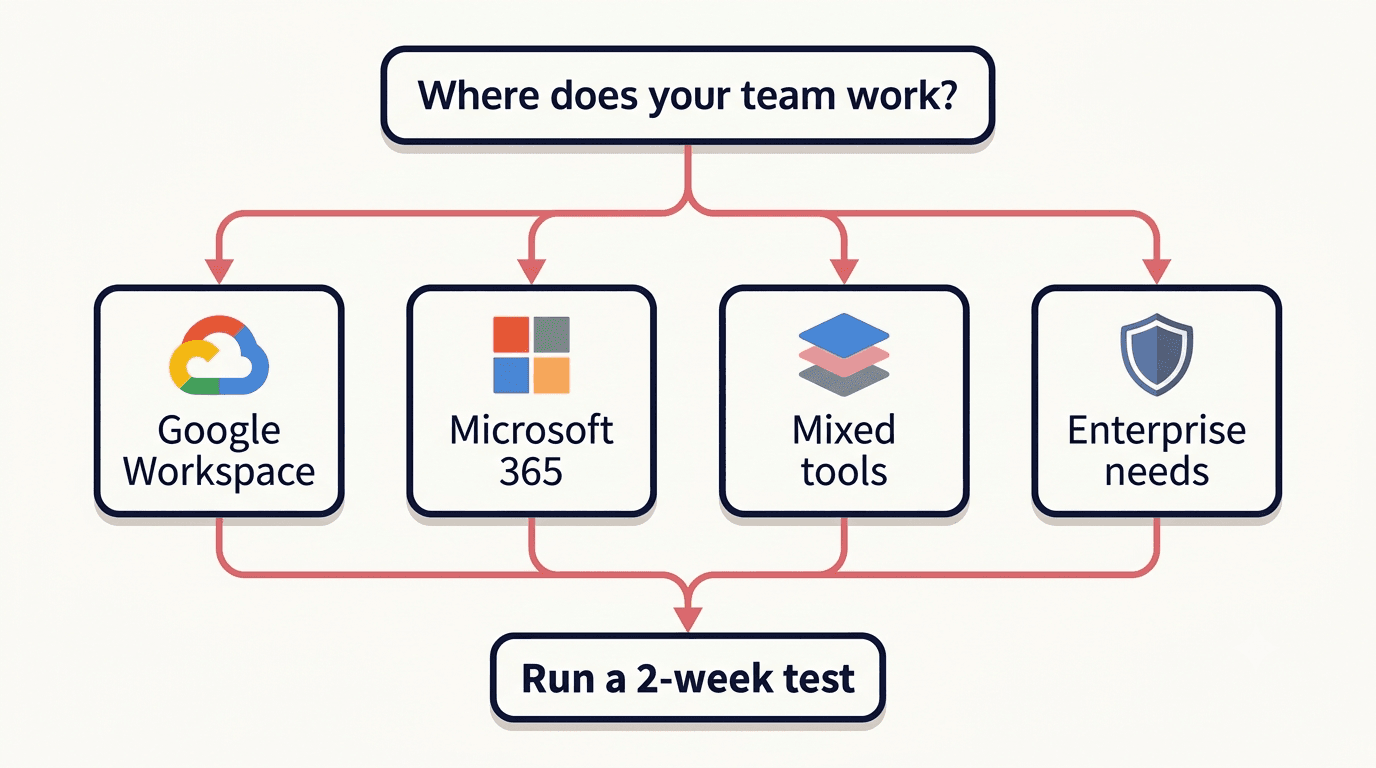
So decide on three other things: where your documents live, whether you need images from the same tool, and which admin controls you need. If your team already pays for Google Workspace Business Standard, Gemini is already inside Gmail, Docs and Sheets. Test it first.
A disclosure: I have taught a three-session Claude track to 75 senior participants at IIM Calcutta. So the prices and terms below come from the vendors' own pages (plus one labelled press figure), not my preference.
This post compares the company plans. For a single personal subscription, see what one personal seat can ship.
Claude vs ChatGPT for marketing: what actually differs at team level?
This is ChatGPT vs Claude vs Gemini on the plans a team buys. Gemini comes with the Google Workspace edition.
Seat price the vendor publishes
ChatGPT Business: US$20 a month billed annually, US$25 monthly; "pricing may vary depending on your country"
Claude Team: US$20 billed annually, US$25 monthly; US prices before tax, varying by region
Gemini in Google Workspace: Included in Business Starter ₹270 and Business Standard ₹1,080 a user a month, before tax
Team size
ChatGPT Business: From 2 seats; "for teams of 2–200 employees"
Claude Team: 2 to 150 seats
Gemini in Google Workspace: Up to 300 users on Starter and Standard
Trains on your team's work by default?
ChatGPT Business: No
Claude Team: No
Gemini in Google Workspace: No. Not used for training "outside your domain without permission"
Admin basics on this plan
ChatGPT Business: Single sign-on; admins "can view, access, export, and delete" members' chats
Claude Team: Single sign-on, central billing, admin controls for connectors
Gemini in Google Workspace: Admins can switch the Gemini app off, set how long Gemini chats are kept (90 days to never deleted) and search Gemini log events in the admin audit tool
Needs the top tier
ChatGPT Business: Enterprise, for automatic user provisioning (SCIM), compliance logs and role-based access
Claude Team: Enterprise, for user provisioning, audit logs, custom retention and role-based access
Gemini in Google Workspace: Enterprise editions, for the advanced security investigation tool
India data residency
ChatGPT Business: Enterprise only; India is one of ten regions
Claude Team: No, "data is stored in the US"
Gemini in Google Workspace: No. Data regions are the US or Europe
Images, and where it works
ChatGPT Business: Makes images. Connects to Google Workspace, Microsoft 365 and Slack
Claude Team: No photos or illustrations; charts, diagrams and Claude Design (beta). Connects to Google Drive, Gmail, Microsoft 365 and Slack
Gemini in Google Workspace: AI images in Slides on Standard, more with a paid add-on. Inside Gmail from Starter; Docs, Sheets, Slides and Meet from Standard
Sources, all checked 30 Sep 2026. ChatGPT: OpenAI's Business pricing page, Business overview and enterprise privacy page. Claude: Anthropic's pricing page, Team plan article, training policy, server locations, image article and Claude Design guide. Gemini: Google's Workspace India pricing, generative AI privacy hub, data regions, Gemini history settings and Gemini log events. Prices and terms change often.
On paper, ChatGPT Business and Claude Team are level on price, seat minimum, single sign-on and training terms. The real differences are images, the software your team already works in, and what moves to the Enterprise tier.
HubSpot's Claude vs ChatGPT guide (updated 17 Aug 2026) says ChatGPT's Team and Enterprise plans "both require opt-out for training exclusion". OpenAI's enterprise privacy page says business data isn't used for training by default.
Where each one is weaker, on its own vendor's pages:
Claude: it doesn't make photos or illustrations, and it stores Team and Enterprise data in the US, with no India option on those plans.
ChatGPT: India residency, user provisioning and compliance logs sit on Enterprise, which has no published price.
Gemini: it reaches Docs and Sheets only from Business Standard, and its data regions are the US or Europe.
ChatGPT vs Claude vs Gemini pricing: what will a 10-person team pay?
Take 10 standard seats on annual billing, before tax, at list prices as of 30 Sep 2026.
ChatGPT Business: US$20 × 10 seats × 12 months = US$2,400 a year (OpenAI's pricing page). OpenAI lists the rupee among its multi-currency billing options, so read your rupee price at checkout.
Claude Team: the same US$2,400 a year (Anthropic's pricing page). Anthropic says pricing, currency and tax handling "vary by region", and points you to claude.ai/upgrade for your local price (Team plan article).
Claude in rupees: TechCrunch reported on 13 Jul 2026 that Team plans start at ₹2,399 a seat a month in India, including local taxes. That is a press figure, not Anthropic's page.
Gemini: it comes with your Workspace edition (Google Workspace India pricing). On Business Standard, the extra cost is ₹0.
On Starter and need Gemini in Docs and Sheets? Moving 10 users to Standard costs (₹1,080 − ₹270) × 10 × 12 = ₹97,200 a year before tax. Google's ₹864 Standard price is an introductory offer for new customers: first 20 users, 12 months. The page also has an annual-commitment option, so confirm which billing your quote uses.
On Base (₹99)? Google's own table says the Gemini app there lacks "enterprise-grade security and privacy". Move up before anyone uses it for client work.
Three cost notes:
Mix seat types. OpenAI and Anthropic both sell premium seats at US$100 a month billed annually (OpenAI's pricing page, Anthropic's pricing page). Buy them only for heavy users.
Payment. Both self-serve plans are paid by card (OpenAI's pricing FAQ, Anthropic's Team billing FAQ). OpenAI says invoicing needs a contracted plan (ChatGPT Business overview).
GST. Google and Anthropic list prices before tax. Check whether the rupee price at checkout includes GST before finance compares quotes.
Which marketing jobs does each one cover?
These are documented capabilities. Output quality is yours to test.
Ad creative and visuals. ChatGPT Business makes images. On Business Standard, Gemini adds AI images in Slides. Claude "doesn't generate photos or illustrations the way image-generation tools do" (Anthropic), though it builds charts, diagrams and, in beta, one-pagers. My own IIM Calcutta session sheet lists image generation first under "Where Claude loses today".
Research with sources. ChatGPT Business has deep research (OpenAI's pricing page), Claude Team has Research (Anthropic's pricing page), and Workspace Starter and up has Gemini Notebook. Count the working links each returns.
Working inside your documents. Gemini is built into Gmail from Starter, and into Docs and Sheets from Standard. ChatGPT and Claude reach Google Drive and Microsoft 365 through connectors.
Finished files. Claude creates Excel, PowerPoint, Word and PDF files, on by default for Team (Anthropic's file guide). ChatGPT Business has Excel, PowerPoint and Google Sheets extensions.
So the Claude vs ChatGPT for marketing strategy question gets settled on your own briefs, not a reviewer's. That is the test two sections down.
ChatGPT Enterprise vs Claude Enterprise: when do you need the top tier?
You need it when a client or your IT team asks for user provisioning, audit or compliance logs, role-based access or India data residency. Neither team plan has these (OpenAI's pricing page, Anthropic's pricing page).
The top tiers price differently:
Claude Enterprise publishes "US$20/seat/month, billed annually. Usage cost scales with model and task". Budget for usage, not only seats.
ChatGPT Enterprise is "Custom pricing", with credit-based and token-based options.
Google's equivalent is a Workspace Enterprise edition, which the advanced security investigation tool needs. Gemini log events are searchable on every edition in the admin audit tool (Google admin help).
As of 30 Sep 2026, among the plans compared here, only ChatGPT Enterprise lists India among its data-residency regions. Anthropic says "data is stored in the US" (Anthropic privacy centre), and its developer docs list "us" as the only workspace location (Claude data residency docs). Google offers the United States, Europe or no preference (Workspace data regions).
Outside this comparison, Google's separate Gemini Enterprise product lists India as an in-country region, generally available with an allowlist (Google Cloud docs). Anthropic offers India residency only through cloud platforms such as AWS Bedrock, not on Team or Enterprise seats (Anthropic's regional compliance page).
The Digital Personal Data Protection Act, 2023 doesn't require personal data to stay in India. Section 16(1) lets the central government "restrict the transfer of personal data… to such country or territory outside India as may be so notified". Section 16(2) keeps stricter sector laws in force (the Act, on MeitY's site).
So residency matters when a client contract or your sector regulator asks for it. This is not legal advice, and it doesn't settle which data may go into which plan.
How to choose: a decision rule, not a verdict
Check these six rules in order. Hard requirements come first, because they remove options.
A client or regulator requires India residency: ChatGPT Enterprise, or ask Google about Gemini Enterprise. As of 30 Sep 2026, ChatGPT Enterprise is the only plan compared here that lists India (OpenAI's pricing page).
You need automatic user provisioning or audit logs on ChatGPT or Claude: price their Enterprise tier. Neither team plan includes them. On Workspace, Gemini's log events are already in the admin audit tool.
Your documents live in Workspace Business Standard or above: start with Gemini. You already pay for it. On Starter, Gemini covers Gmail, the Gemini app and Notebook, not Docs or Sheets.
Your company runs on Microsoft 365: ask IT whether Copilot Chat is on. Microsoft says Copilot Chat is "included with eligible Microsoft 365 licenses" (Microsoft Learn). Test it before you buy a second tool.
You need images and copy from one seat: ChatGPT Business, or Gemini on Workspace. Claude doesn't make photos or illustrations.
None of these decides it: run the four-week test below. Let your own work pick.
The objection: why not let everyone use what they like?
Because terms, admin access and data rules differ by plan, and personal accounts sit outside all of them. One standard gives you one data rule, one briefing method and one bill.
The concession: both OpenAI and Anthropic let you mix seat types, and a designer who needs images can hold a second licence. The standard is the team's default, not a ban.
How do you test them before you standardise?
Use the method from the IIM Calcutta session sheet, adapted for a team.
Pick three recurring jobs, such as a campaign brief, a competitor-ad teardown and the monthly report. Test on company seats, not personal accounts; until then, use public or made-up material under your data rules.
Same tier. "For any comparison, all tools must be on the same tier." Business against Team, not a paid seat against a free one.
Same brief, scored blind. The person who owns the output scores each answer against a key written beforehand, without knowing which tool wrote it. The sheet calls its own four-tool run "a demonstration, not a benchmark". So is yours.
Measure two things. Log minutes per job before and after, and count working links in research answers.
Decide at four weeks. The sheet's rule: "Run both on the same real work for four weeks. Keep the winner. Cancel the loser."
Then standardise the method, not only the tool. That is the point of the plain-text brief in my second session sheet. It says: "CLEAR briefs, the abort line, the second pass and the checking standard are plain text." They move with you if the company ever switches tools. Within the tool you pick, route by task, not by the newest model.
What to do this month
List who uses which personal account today.
Check your Workspace edition, or whether Copilot Chat is on in Microsoft 365.
Write down your control needs: user provisioning, audit logs, India residency.
Run the four-week same-tier test on three jobs.
Buy the standard, move customer work onto it, and train the team on one briefing and checking method.
Once you've picked the tool, the harder job is getting ten people to brief it and check it the same way. Invite me to run a hands-on AI training session for your marketing team on the tool you chose.
Frequently asked questions
Is Gemini free with Google Workspace?
Yes, on Business Standard and above: Gemini comes with the edition you pay for, so the extra cost is ₹0. On Starter (₹270 a user a month, before tax), Gemini covers Gmail, the Gemini app and Notebook, not Docs or Sheets. On Base (₹99), Google says its Gemini app lacks "enterprise-grade security and privacy" (Google Workspace India pricing).
Can a ChatGPT Business admin see team members' chats?
Yes. OpenAI's enterprise privacy page says workspace admins "can view, access, export, and delete" the conversations in the workspace. Tell the team before you roll it out. Keep client work on company seats, under your data rules, and personal questions off them.
Is Claude or ChatGPT better for email marketing?
Neither has a documented edge for email, so test both on your own campaigns. Gemini sits inside Gmail from Workspace Business Starter (Google Workspace India pricing). ChatGPT Business and Claude Team reach Gmail or Google Workspace through connectors (OpenAI's pricing page, Anthropic's Team plan article). Make an email campaign one of your three test jobs.
- Gen AI
- AI
- ChatGPT
- Claude
- Gemini
Written by Siddhesh Joglekar
Fractional CMO and AI marketing consultant Siddhesh Joglekar helps founders and growth-stage teams build marketing engines that compound.