AI
AI training for sales teams: what to teach first, and how AI role-play changes practice
What to teach a sales team about AI first, how to set up an AI buyer that pushes back, and how to give feedback reps can use. With Indian survey data.

· 10 min read
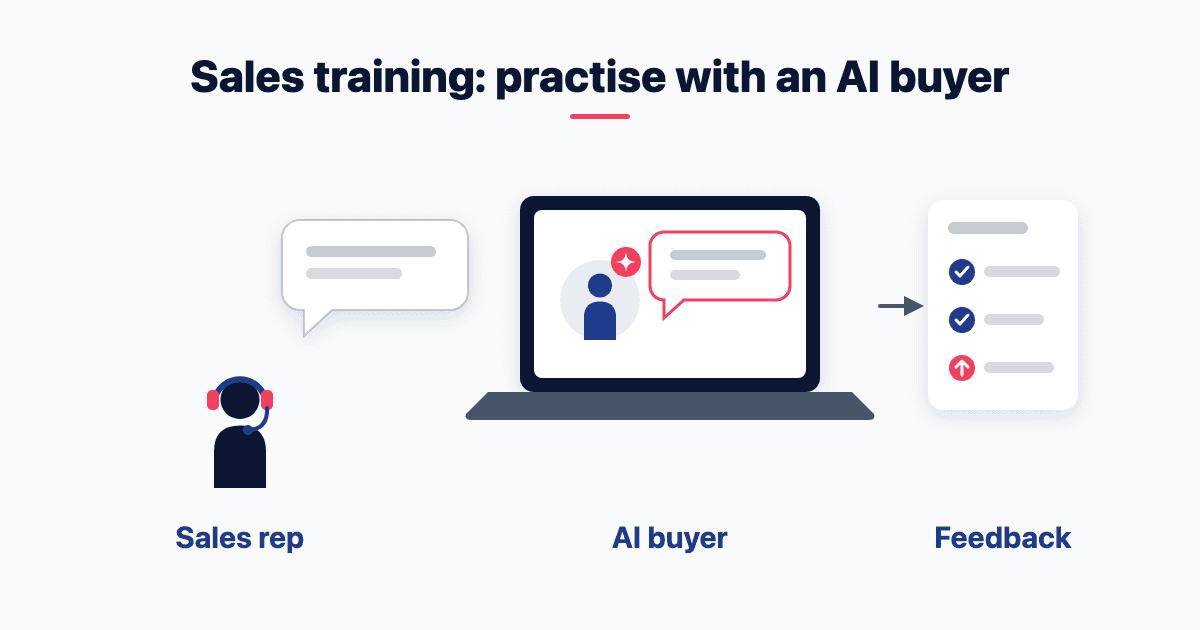
A rep can now rehearse a discount fight with an AI buyer in four minutes, on a phone. That's the exciting part, but it isn't where to start. Start AI training for sales teams with call prep, with every claim labelled. Next, follow-ups that read why a deal went quiet. Then role-play, against an AI told not to help.
The fourth step checks every promise before a quote goes out. Each step builds the habit the next one needs. Get the sequence right before you worry about the tool.
What should AI training for sales teams change?
AI training for a sales team should give every rep more prepared calls and more practice, not just faster emails. Use that as the test for any programme you buy or build.
Start with where the time goes. In Salesforce's 2026 State of Sales survey, the average Indian seller spends 41% of their time selling (Salesforce India press release). Indian reps spend 17% of their working week on prospecting alone (Salesforce India blog). And 54% of Indian sales professionals already use AI for prospecting.
Salesforce sells AI agents, so read these as a vendor's numbers. The survey had 250 respondents in India and ran in August and September 2025.
So access to AI isn't the gap. Practice and feedback are. In the same survey's global results, 47% of Gen Z sellers said they don't get enough role-play before customer calls (Salesforce global announcement). Their top obstacle was manager time.
That's a global figure, not an Indian one. AI removes the calendar limit on practice. It doesn't remove the need for a coach.
One more filter before you design a course: some lost time is admin, and tools fix admin better than training does. At Shaadi.com, I owned the in-house telesales and customer relationship management (CRM) tooling. Supervisory tools and automation delivered +94% telesales talk time, as reported during my tenure (Shaadi.com case study).
So fix the admin with tools, and train reps for the conversation. If you're rolling AI training out across the company, treat what follows as the sales track.
What should you teach a sales team first?
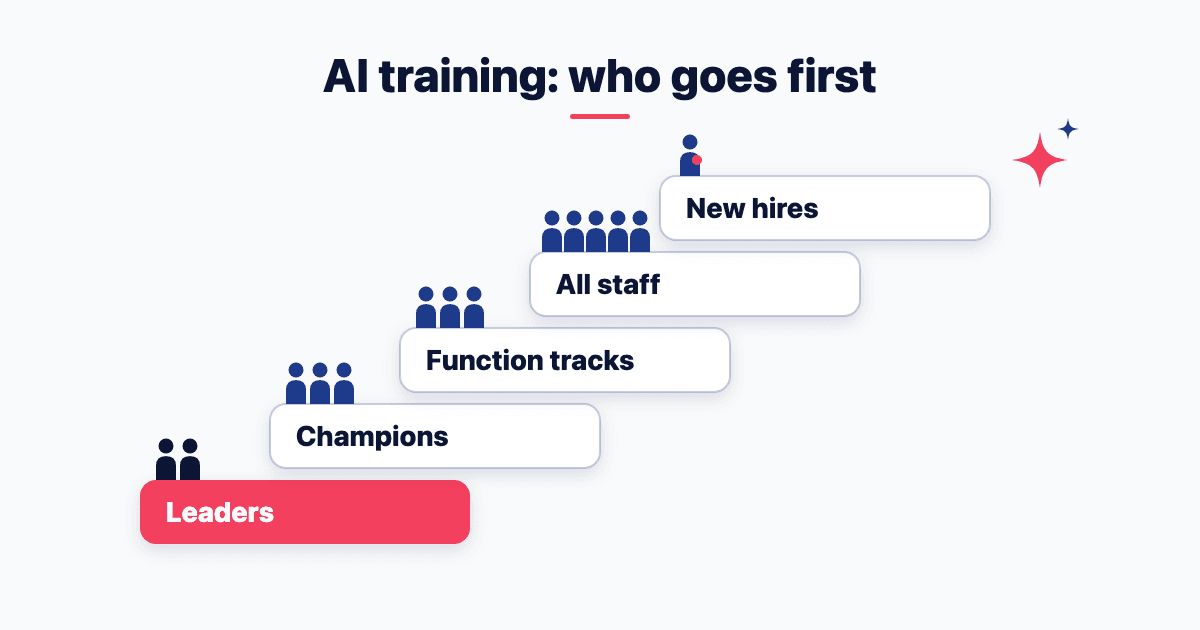
Teach call prep first: it happens before every first call and runs on public information. After that, order the jobs by how often reps do them and how much customer data they need. The promise check needs the whole deal record, so it waits until reps check AI output by habit and work on a company plan.
The drills below come from the Millionaire Club rep training at OurBus Charters. The case study calls it "a sales-skills programme for charter reps, built with the charter sales lead, so cheaper leads also close." OurBus Charters is a US business, but prepping calls, chasing quiet deals and holding price are the same jobs in India.
The format isn't charter-specific either. My sessions run the same build-and-debrief arc "whether the audience is a CXO cohort or a sales team". One corporate track ran as AI for Sales at Promega.
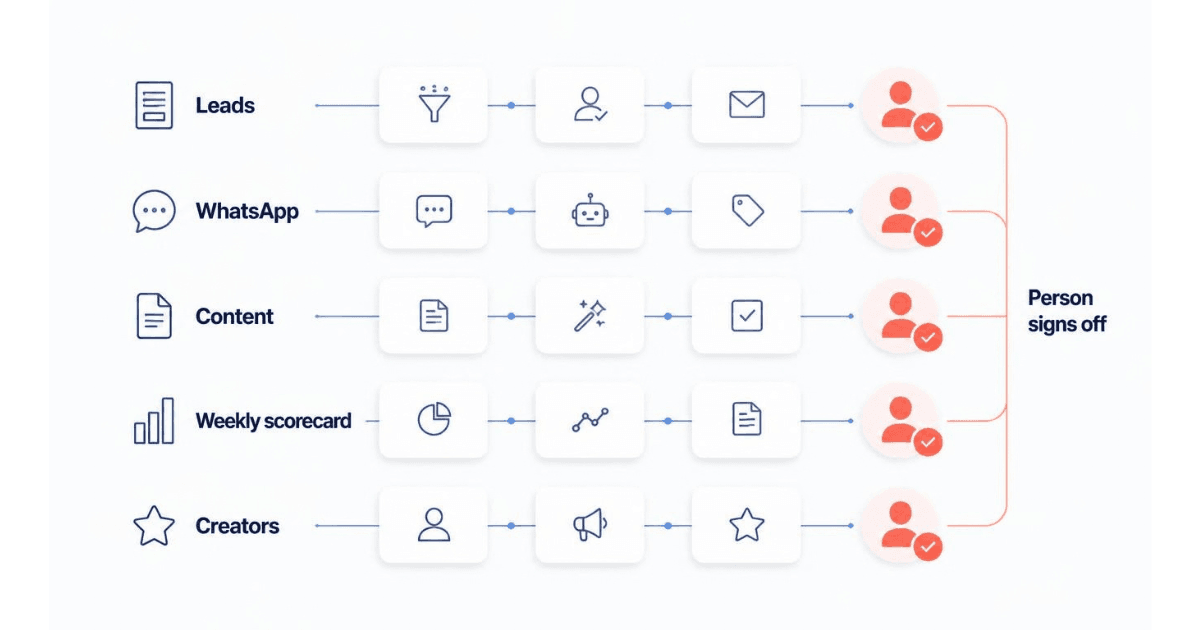
Prep every first call, with every claim labelled. With the session 1 prep and follow-up prompts, the AI builds a one-page brief. It covers the account, the person, the trigger, your angle, a committee map (champion, blocker, supporter, ghost) and three likely objections. The rule: "Label every claim: Sourced / Inferred / Unverifiable." Done before every first call, it also trains the habit of doubting the AI.
Follow up stalled deals by reading the rung. The rule: "Respond to the rung, not the silence." The AI places a quiet deal on a Silence Ladder: No urgency / Maybe later / Competing priority / Budget / Procurement / Ghost / Lost. Then it drafts a reply that names the buyer's fear and offers one new, low-risk thing to say yes to. The prompt bans "just checking in." It comes second because it runs before every follow-up and needs one real thread, not a whole deal record. Run it on a company plan.
Practise against an AI buyer. This is the drill from the top of this post, and the next section shows how to brief it. It comes third for a reason: a rep who already doubts AI output reads the AI's score critically.
Check every promise before the quote goes out. The session 3 Promise Ledger runs "before the quote goes out, not after the signature". The AI lists "every promise I made — said or implied" and flags any "that contradicts another one, or that Operations never agreed to". It needs the full thread, the quote and the call notes, so it comes last. Run it under the data rules your team agrees before anyone types.
Notice what role-play needs: no customer's personal data, because the buyer is invented. That makes it the safest AI habit to scale across a team.
How does AI role-play change sales practice?
Practice stops waiting for a manager's diary. In the session 3 role-play sheet, reps "fight the AI (twice a week, 4 min)" on a live deal. The sheet's whole weekly routine runs "Under an hour a week."
The sheet's own note reads "Works in Claude or ChatGPT." So you can start role-play without buying a platform. What matters is the brief you give the AI.
How to brief an AI buyer that pushes back
Write your floor on paper first. That's the lowest price you'll accept. The AI's score later checks whether you stayed above it.
Give the buyer a role, a deal and a reason to push. The session prompt hands the buyer "a competing quote about 14% below mine" and makes them impatient.
Tell it not to help. Paste this as written: "Do not be helpful. Do not accept my first trade. Push at least three times. Stay in character."
Hide a fact the rep must earn. In a second drill, the AI customer invents a plausible problem and hides it "unless my questions earn it".
Make it break character and score. The prompt says: "After 8 exchanges, break character and score me out of 10 on each of the five rules". The five: floor held, a question first, an ask-back for every give, cheap-for-you trades before price, and a polite walk-away.
Ask for one fix. End with: "Quote my weakest sentence, word for word, and rewrite it stronger."
For new reps, start lighter. In a simpler version from an undergraduate session in Secunderabad, the AI plays a hostel warden who must "Say no three times". It scores each reply 1–10 in one line, and the prompt adds: "Do not help me." The sheet's lesson works for any rep: "Good salespeople don't pitch. They ask, then answer."
Sales is spoken, so practise out loud. Claude's voice mode is a beta feature on all plans, Free included, on mobile, desktop and the web (Claude Help Center). Support for languages other than English is also in beta. Check that your buyers' language is on the list, then let reps rehearse in it.
How should AI feedback reach the rep?
Deliver AI feedback in small doses, through a manager. That's the lesson of a 2020 Journal of Marketing study that ran randomised field experiments at two fintech companies (American Marketing Association summary). It compared an AI coach with a human one.
In the first experiment, 429 agents were randomly assigned. Middle-ranked agents improved the most; bottom- and top-ranked agents gained little extra.
Bottom-ranked agents hit "the most severe information-overload". Top-ranked agents showed "the strongest AI aversion problem".
Restricting the feedback helped. A separate group of 100 bottom-ranked agents showed "a substantial improvement in agent performance".
In a third experiment with 451 agents, managers passed on the AI's feedback themselves. That beat both the AI coach alone and the human coach alone.
There's a limit to how far this travels. That AI coach used speech analytics on agents' real conversations with customers. It wasn't a chatbot buyer, and the setting was fintech. The design lesson carries over; the size of the effect may not.
So build three rules into your drills:
Weaker reps get one fix per drill. The "weakest sentence" line does exactly that.
The manager reads one AI score per rep each week and discusses it face to face.
Top reps get the human conversation, with the AI as their sparring partner.
A 2023 study, in customer support rather than sales, points the same way. Across 5,179 agents, an AI assistant raised issues resolved per hour by 14% on average (National Bureau of Economic Research working paper). Novice and low-skilled workers gained 34%. The authors suggest it spreads the best practices of more able workers. So build your AI buyer from your best rep's real objections.
Is AI helping? Count it
Session 3 tests this with a drill that goes "humans first, then AI, then honest scoring". Reps check a risky charter booking without AI, then run the AI check. Then they count three things: "AI caught (that you missed)", "You caught (that AI missed)" and "AI false alarms". If false alarms outnumber catches, keep that task human for now.
Aren't AI buyers too polite to be useful?
Out of the box, often yes. A 2023 study found "five state-of-the-art AI assistants consistently exhibit sycophancy across four varied free-form text-generation tasks" (Sharma and colleagues on arXiv). Sycophancy means answers "that match user beliefs over truthful ones". Those were older models, and the paper calls sycophancy "a general behavior of state-of-the-art AI assistants".
That's why the brief above forbids helping, demands three pushes, hides a fact and scores against named rules. Each line works against the urge to please.
Keep the AI as the sparring partner, never the judge. The session 3 sheet puts it plainly: "AI does the analysis and plays the sparring partner. You make the call."
One gap is worth saying out loud. Vendor pages promise results from AI role-play, but I found no independent trial of chatbot role-play on win rates. Treat it as more practice, not proven pipeline, and measure your own team.
For each rep, track how often deals close below the floor, the average discount and the win rate on quoted deals. Record them before the drills start, then again after. If only some reps drill, pick them at random, not by who volunteers.
What to do this month
Pick one live deal per rep, and have each rep write the floor on paper.
For one week, run the labelled prep brief before every first call: Sourced, Inferred or Unverifiable.
Twice a week, for 4 minutes, run the AI buyer on that deal. Save the score and the weakest sentence.
Each week, the manager reviews one score per rep and agrees one fix, face to face.
Once this month, run the "AI caught / You caught / AI false alarms" count on a real quote.
Before anyone pastes a real email thread, agree the data rules and move that work to a company plan.
Session 3's commitment card asks for the same spirit in three words: "Small. Specific. Checkable."
If you'd like your reps to run these drills on their own live deals, I'd be glad to help. My hands-on sessions end with something every rep has built live and takes home. Invite me for an AI training session.
Frequently asked questions
Is there a free AI role-play tool for sales training?
Yes: a general AI assistant with a good prompt. The session 3 prompts work in Claude or ChatGPT, and the undergraduate sheet uses free Claude, "no app, no card". Claude's voice mode is on all plans, Free included, and counts toward usage limits (Claude Help Center). Paid platforms add scenario libraries and rep dashboards.
Which AI tools should a sales team standardise on?
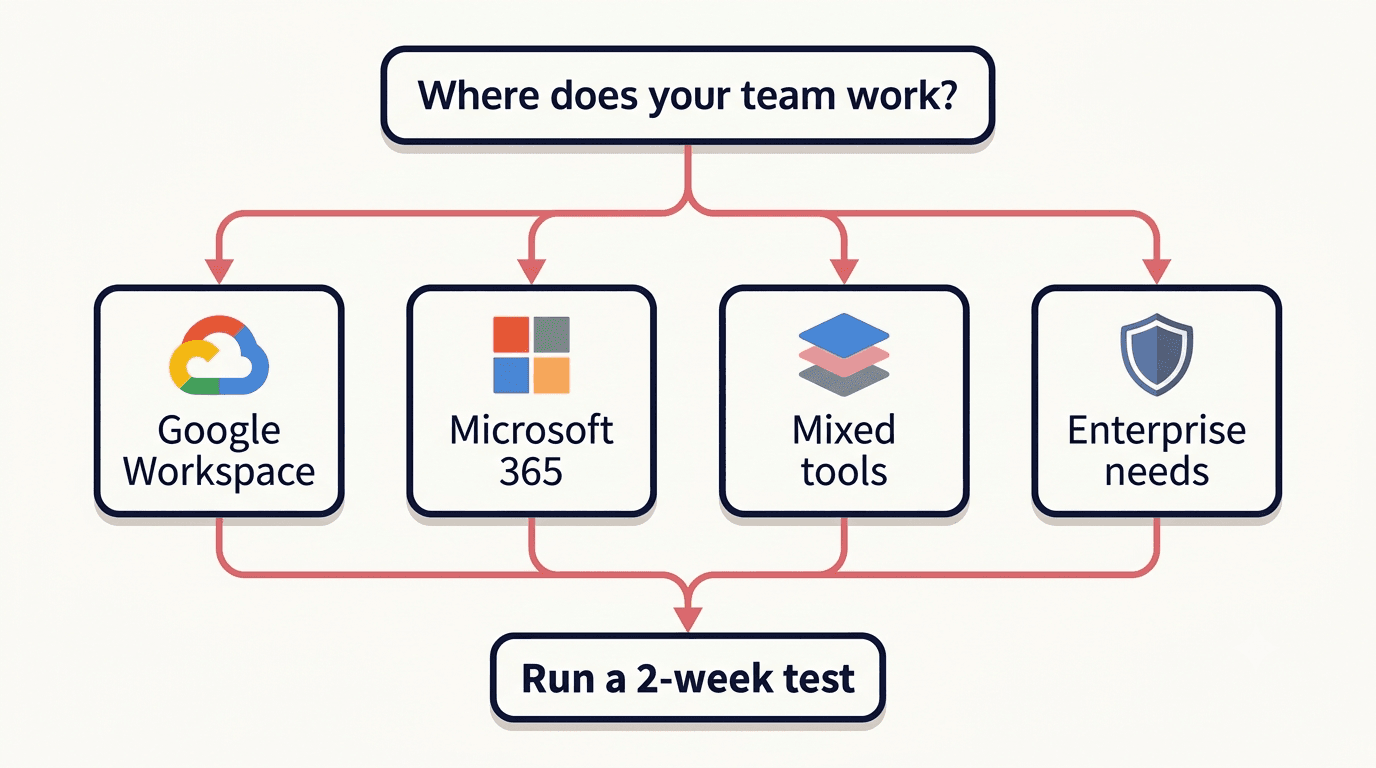
Start with one general assistant on a company plan, plus the AI inside your CRM. Specialist tools come later. Connected data beats tool count. In Salesforce's 2026 India survey, 66% of sales leaders with AI say disconnected systems slow their AI work (Salesforce India press release). To pick the assistant, see which assistant to standardise on.
Can sales reps paste customer details into ChatGPT or Claude?
Not into personal accounts. Use a company plan and check its terms; Anthropic won't train on its commercial products' inputs by default (Anthropic Privacy Center). From 13 May 2027, the Digital Personal Data Protection Act, s.8(5), requires "reasonable security safeguards" (commencement notification). See the consent checklist for marketing data. This is not legal advice.
Will AI replace salespeople?
I don't think so, not where a sale rests on trust. The average Indian seller spends just 41% of their time selling (Salesforce's 2026 India press release). AI's job is to win back the rest from research, drafting and admin. Session 1's commitment card says it best: "AI took the busywork. The trust is still yours to build."
- AI training
- Sales teams
- Role-play
Written by Siddhesh Joglekar
Fractional CMO and AI marketing consultant Siddhesh Joglekar helps founders and growth-stage teams build marketing engines that compound.