AI
The CRISP prompt framework: how to brief ChatGPT and Claude so the first answer is usable
CRISP is a five-part prompt framework: Context, Role, Intent, Specifics, Parameters. Learn each letter, see a worked brief, and fix a bad answer fast.

· 10 min read
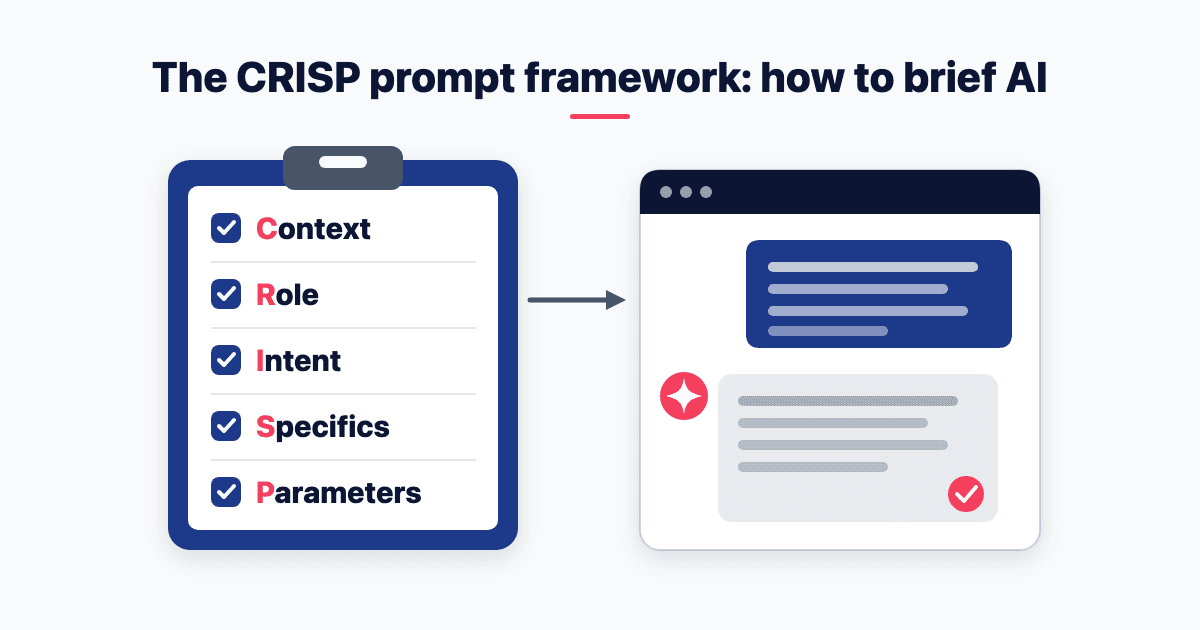
A question gets a guess. A brief gets work. CRISP is a prompt framework that turns the first into the second, in five parts. Context gives the facts the AI cannot invent. Role sets the standard it holds. Intent names one job. Specifics fix length, format and audience. Parameters say what it must not invent, and what to show you first.
Those first two lines come from the first rule on my KIMS AI 101 sheet, a six-hour AI primer for students. This page teaches the version from my Great Lakes product-management class. The idea behind it: "The model is the same for everyone. The brief is yours."
I teach CRISP in my AI training sessions. Since 2024 I've trained 2,000+ senior professionals in applied AI, a count summed across institutions and corporates.
What is the CRISP prompt framework?
A CRISP prompt is a brief, not a wish. My DigiAIM session for IIM Calcutta gives the reason: "The brief is where the quality is decided." Here are the five letters as I teach them at Great Lakes:
Context: "Who you are, the situation, the real goal, and raw facts the AI cannot invent."
Role: "Who the AI should be: expertise, perspective, the standard it holds."
Intent: "The single job for this prompt. One job. Never a list of five."
Specifics: "Length, format, audience, tone, include, exclude. Yours, not a template's."
Parameters: "What it must not invent, what it must show before proceeding, output shape."
The letters vary, and that's fine. A US university's Copilot guide teaches CRISP-E: Context, Role, Instruction, Specification, Performance and Example. CRISPE is a different framework again (see the FAQ).
My DigiAIM and KIMS sheets, and my earlier guide to AI training for marketing teams, use Instructions and Pain points. Their Instructions letter sets out a task in steps, with stop points for your approval. Intent cuts that to one job. Their Pain points letter lists what must never happen. Parameters keeps those must-nots, and adds what to show first and the output shape. This page teaches Intent and Parameters.
The vendors ask for the same parts, in their own words. None of their guides uses the acronym. OpenAI's prompt engineering guide lists the sections of a developer message as Identity, Instructions, Examples and Context. Anthropic and Google say similar things, quoted under each letter below. So one prompt framework can serve ChatGPT, Claude and Gemini alike.
How do you write each letter?
Each letter gets one rule and the reason behind it.
C: Context. Give it the facts it cannot invent
Say who you are, the situation and the real goal. Then paste the raw material. I put it bluntly to students: "Context is the one people skip."
Anthropic's prompting best practices say to treat Claude as "a brilliant but new employee who lacks context on your norms and workflows". Its test: would "a colleague with minimal context" be able to follow your prompt? Google's Gemini prompt design guide agrees: give the model what it needs "instead of assuming that the model has all of the required information".
The line to copy: "Raw material you must use (do not invent beyond this)." Use labels, not names ("Client A", "the weekly report"). For what may go in at all, see the data rules in what a marketing team's AI training should cover first. If you paste the same context every week, keep your brand context in a Claude Project.
R: Role. Set the standard, not the IQ
Name the expertise, the perspective and the standard it must hold. My example for product managers: "a PM who has run [domain] at an Indian [marketplace / bank / SaaS] and distrusts vanity metrics."
You've probably been told to open with "Act as an expert". But a role changes how the AI answers, not what it knows. Anthropic says a role "focuses Claude's behavior and tone". A peer-reviewed study tested 162 roles on 2,410 factual questions across 4 model families. Adding a persona "does not improve model performance" against no persona, and each persona's effect "can be largely random" (Zheng and colleagues, Findings of EMNLP 2024).
The evidence is thinner than it sounds. The study was first posted in November 2023 and used factual questions, not today's assistants on marketing work. It also found a persona may help "in certain settings". So use Role for standards and scepticism ("sceptical of generic advice"), never as a stand-in for Context.
I: Intent. One job per prompt
State one deliverable. "Never a list of five." Google's guide puts it simply: "Instead of having many instructions in one prompt, create one prompt per instruction." OpenAI's reasoning best practices add: "Be very specific about your end goal".
Five jobs in one prompt tend to come back as five thin answers. Split them, and run them in order.
S: Specifics. Yours, not a template's
Set the length, format, audience and tone, plus what to include and exclude. My rule: "The template is scaffolding; the specifics are the skill." Anthropic agrees: "Be specific about the output format and constraints you want."
One example can do more than a paragraph of description. Anthropic calls examples "one of the most reliable ways to steer Claude's output format, tone, and structure".
P: Parameters. Rules, a plan first, and the reason why
Say what it must not invent, what it must show before it proceeds, and the shape of the output. OpenAI's guide asks the same question: "What should the model do, and what should the model never do?" Three lines from my template do most of the work:
"Do not invent facts, stats, names, or citations."
"Before you output anything, list your plan and wait for my go."
"State your assumptions. Mark what you are unsure about."
Give the reason with each rule. In Anthropic's example, "NEVER use ellipses" works less well than "Your response will be read aloud by a text-to-speech engine, so never use ellipses". Why? "Claude can generalize from the explanation."
A worked example: the same task, briefed twice
This one is a teaching case from my Great Lakes product-management class on 3 Oct 2026. The numbers belong to the case, not to a real company.
The wish: "Write a PRD for reducing drop-off in UPI onboarding." A PRD is a product requirements document; UPI is India's Unified Payments Interface.
The brief, condensed:
C: a fintech app with 2.1 lakh monthly sign-ups. 38% of users drop at the PAN (Permanent Account Number) step. Most are Tier-2 users on Android, and the team is three people. The funnel spreadsheet is attached: "use it as the only source of numbers."
R: "a senior fintech PM who has shipped KYC flows under RBI norms and is sceptical of generic advice". KYC means know-your-customer checks; RBI is the Reserve Bank of India.
I: "five testable hypotheses for the PAN-step drop. Nothing else."
S: a table with three columns (hypothesis, evidence needed, cheapest test), under 200 words, for the chief technology officer.
P: no invented numbers, so use the file or write "unknown". Plan first. Mark anything uncertain with [UNSURE].
Notice what changed. The wish left everything to the AI. The brief leaves it one job, real facts and a shape. Then comes the move I teach: "show the plan, reject one item, then let it run."
The same five letters for a seller
Here is an illustrative brief for first-call prep:
C: what you sell, to whom, and your raw call notes, with an instruction not to invent beyond them.
R: a sales coach who distrusts generic openers.
I: three questions to ask in the first ten minutes.
S: under 120 words, numbered.
P: no invented company facts, mark guesses, show the plan first.
Beyond the first call, my 25 free AI prompts for every stage of a deal cover the rest.
Why did I get a bad answer? Name the missing letter
When an answer disappoints, don't polish it by hand. Name the missing letter, and fix that letter in the brief. My diagnostic tree:
Generic: Context is missing.
Wrong voice: Role.
Five things, all done badly: Intent.
Wrong shape: Specifics.
Invented facts: Parameters.
Then send the override: "You got this wrong: [name the invented or wrong claim]." Tell it to add the corrected fact or rule to the brief, under Context or Parameters. Last, ask it to "regenerate only the section that depended on it."
Iterate one job at a time. "Never 'make it better'." If you asked for questions first and it wrote anyway, reply: "You skipped my questions. Ask them now."
Then look hard at what comes back. My assignment rule for that class: "'Nothing went wrong' is an automatic fail. It means you didn't look."
When is a prompt framework overkill?
Not every prompt needs five letters. Skip the full brief for one-line lookups and quick rewrites. For a follow-up in the same thread, Context is already there. Send a mini-CRISP: "one job, one shape".
Reasoning models need less scaffolding, but they still need a brief. OpenAI's guide says: "A reasoning model is like a senior co-worker. You can give them a goal to achieve and trust them to work out the details." Its reasoning guide says "Keep prompts simple and direct". It says asking these models to "think step by step" is "unnecessary".
So cut the scaffolding lines. Keep Context, because no model knows your numbers. Keep Parameters too: the same guide says to "explicitly outline those constraints in the prompt".
Where CRISP stops. When AI works through files or tools in many steps, you need a different brief. My session on handing over work to AI covers that one.
If five letters still feel heavy, start smaller. In November 2025 I built a Marketing Prompt Enhancer for marketers who "just want to describe their goal". At launch, its optional fields asked for your brand, tone of voice, call to action, audience and output size. That's Context and Specifics under other names.
What to do this week
Start with the blank template from my Great Lakes sheet, copied here:
C: "I am a [role] working on [product / company type]. Situation: [one paragraph of real facts — numbers, constraints, audience]. Goal: [real goal]. Raw material you must use (do not invent beyond this): [bullet facts]."
R: "Act as [specific expertise + perspective + standard you hold]."
I: "Your single job in this prompt: [one job only]."
S: "Length: [e.g. under 250 words / one page]. Format: [bullets / sections / table]. Audience: [who reads it]. Tone: [plain / formal / sceptical]. Must include: […]. Must exclude: […]."
P: the three lines from the P section above, plus "Output shape: [sections / labels]."
Copy the template into a note.
Take the last prompt that disappointed you. Rewrite it letter by letter, then ask two questions: "Is your Context real? Is Intent one job?"
Run the old and the new prompt in two fresh chats, and compare.
When an answer is wrong, name the missing letter and fix the brief, not the answer.
Save the brief that worked as a note on your phone, ready to reuse.
If you want to go beyond one good brief, my AI marketing course is a complete guide to AI across ads, SEO, content and analytics.
Frequently asked questions
What is the CRISPE prompt framework?
CRISPE is a separate framework: the same five letters plus an E, with different meanings. One open prompt tutorial expands it as Capacity and Role, Insight, Statement, Personality and Experiment, where Experiment means "Ask for multiple answers". In my reading, it has no letter for one job, or for what the AI must not invent. CRISP-E is a third variant.
Does CRISP work in Gemini and Copilot too?
Yes, because the parts aren't tied to one tool. Google's own Gemini guide covers clear and specific instructions, constraints, response format, context and examples. A US university's Copilot guide teaches CRISP-E, a close cousin. Still, test your own outputs in each tool. For choosing one, see which assistant your team should standardise on.
Is the CRISP prompt framework the same as CRISP-DM?
No. CRISP-DM is the Cross-industry standard process for data mining, an open process model conceived in 1996. It breaks a data-mining project into six phases, from business understanding to deployment (Wikipedia's entry on CRISP-DM). It plans a whole analytics project. The CRISP prompt framework briefs one AI request. They share a name and nothing else.
Can ChatGPT or Claude write the prompt for me?
Partly. Anthropic points developers without a first draft to a "metaprompt" that generates one (Anthropic's prompt engineering overview). A tool can draft the structure. But only you have the Context: your numbers, your customer, your rules. So let it draft the five letters, then fill in the facts yourself before you run it.
- Prompting
- AI training
- CRISP
Written by Siddhesh Joglekar
Fractional CMO and AI marketing consultant Siddhesh Joglekar helps founders and growth-stage teams build marketing engines that compound.