The Indian AI Playbook Isn't a Translation: Five Frames Operators Are Still Getting Wrong
Five things Indian operator boards are getting wrong about AI in 2026. None of them are technical. All of them are framing errors. The framing errors are the expensive ones. This publication is built on a single bet…
· 5 min read
Five things Indian operator boards are getting wrong about AI in 2026. None of them are technical. All of them are framing errors. The framing errors are the expensive ones.
This publication is built on a single bet — that the Indian operator needs a different starting point than the one most global AI commentary offers. We will cover Claude, Codex, every cloud giant, every meaningful launch from Anthropic, OpenAI, Google, Microsoft, AWS, Sarvam, Krutrim. But through an Indian lens — regulators, languages, sectors, IPO timelines, the markets that fund all of it. Five frames to begin with.
Frame 1: AI is not SaaS
The reflex in most Indian companies is to buy Claude or GPT or Bedrock the way they bought Salesforce — quarterly POC, annual licence, IT-led rollout, fixed-cost line in the FY27 budget. The framing breaks the moment it scales. AI cost moves with usage, not with seats. A 2,000-employee company can spend more on inference in one quarter than it spends on the entire Microsoft suite in a year. And unlike SaaS, that spend correlates directly with revenue activity — more customers served means more tokens consumed. The licence sticker is the smallest number you will ever forget to worry about.
The right procurement frame is closer to electricity. Metered consumption, with a finance-and-ops governance layer, not a one-time IT decision. The CFOs who model AI as a fixed-cost line in FY27 will overspend in H1, panic-cut in H2, then under-invest at exactly the wrong moment. Build a per-use-case unit economic model on day one. The number you care about is cost-per-resolved-ticket or cost-per-generated-asset, not the per-seat sticker.
Frame 2: India's regulators aren't slow — they're sequential
There is a fashionable view that RBI, SEBI, IRDAI, and TRAI are behind on AI. That misreads the pattern. India's regulators move like a Mumbai local — slow starting, terrifying once they're at speed. The cycle is always three beats: discussion paper, market watch, master direction with enforcement teeth. Eighteen to thirty months end-to-end. We have been in the discussion-paper phase across most regulators since 2023.
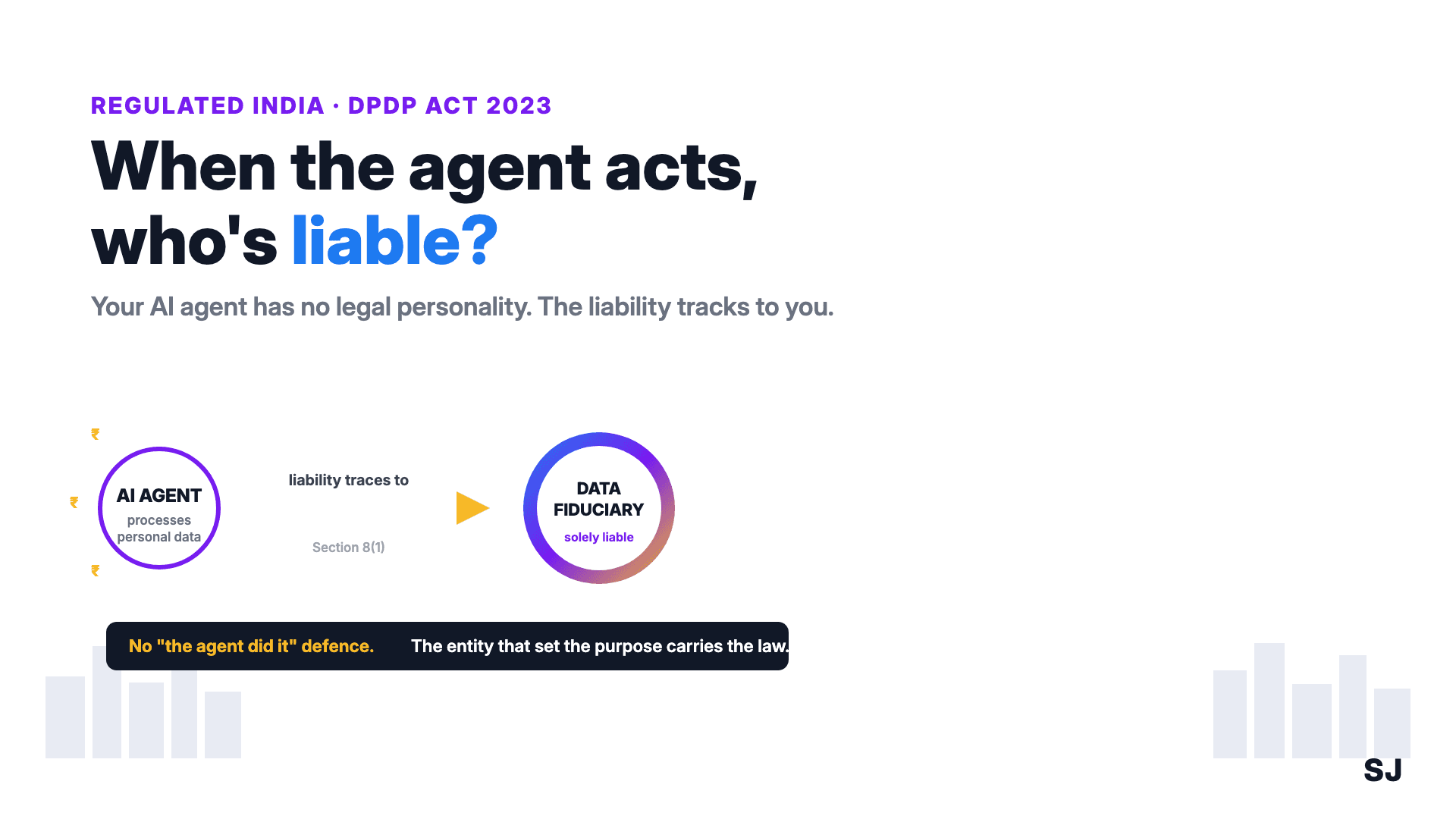
The implication for FY27 is straightforward. Master directions are coming. SEBI has telegraphed it on algo trading and AI-driven advisory. RBI has telegraphed it on fraud, model risk, lending. IRDAI is moving on claims and underwriting. DPDP is the floor under all of it. By H2 FY27, expect enforcement, not consultation. Indian operators planning AI deployments without a regulator-specific compliance map are building on a moving floor — and the floor moves up, never down. The companies that wait for the master direction to act will be 12 months behind the ones that read the discussion papers carefully today.
Frame 3: Vernacular AI is not a translation problem
Most Indian AI vendor pitches still treat Hindi or Tamil as a translation layer wrapped around an English model. That is a UX bug masquerading as a strategy. The companies actually winning in Tier-2 and Tier-3 — Meesho, Sharechat, Glance, Sarvam, Krutrim — built vernacular-first models, vernacular-first interfaces, vernacular-first evaluation sets. Translation is a 2024 frame. Vernacular-native is the 2026 one.
I spent enough years inside Indian edtech — BYJU'S in scale mode, Programming Hub running lean — to recognise the pattern. The teams that got vernacular right treated it as a product decision, owned by product. The teams that got it wrong shipped an English product first, called it "core", then handed a small team a translation budget six months later. By then, three vernacular-first competitors had usually eaten the segment. The test is simple. If your AI product roadmap has Hindi listed as a Q3 milestone after the English version stabilises, you have already lost the bet — and Meesho's evaluation set has quietly won it.
Frame 4: AI for Bharat is not AI for India
The AI market LinkedIn talks about — enterprises, fintechs, urban consumers — is generously 50 million users. Bharat is the 700 million underneath. They will not pay $20/month, will not type fluently, will not engage with English-first interfaces. They live on voice and WhatsApp, on metered data, on last-generation Androids.
Operators serving Bharat need different unit economics (sub-₹100/month tolerable, ad-supported preferred), different infra (voice-first, low-bandwidth, edge-cached), different distribution (WhatsApp Business, missed-call IVR-AI hybrids, not App Store). The companies that conflate the two markets optimise for the wrong customer and then wonder why the funnel breaks at activation. Pick one. Build for that one. The middle is empty.
Frame 5: The IPO window is the wrong AI deadline
A common board reflex in Indian companies eyeing an FY27 or FY28 listing is to "have an AI story" by the DRHP. That is the wrong forcing function. DRHP-AI is the corporate equivalent of cramming the night before — and the analyst is the invigilator who has read this paper before. The output is usually a vendor logo slide and one weak customer case study, both visible from a kilometre away.
AI that compounds — proprietary data flywheels, distribution moats, cost-line transformation — takes 18 to 24 months minimum to show up in audited numbers. If a company is going public in 12 months, its AI investment isn't really about the IPO. It's about year three post-listing, when the analyst questions sharpen, when growth deceleration shows up, when the AI line item on the deck has to justify itself with a margin number. The companies that understand this build AI for the post-listing story, not the DRHP cover.
The map this publication is going to draw
These five frames are scaffolding for what comes next. Over the next thirty days, this publication will publish 28 posts across seven pillars — Regulated India, Sector Playbooks, the Feature Desk for every meaningful launch, Builders' Bench tutorials with GitHub code, Strategy Room essays like this one, an IPO Watch India desk covering 24-month windows in both directions, and a Markets & Money pillar that talks asset-class and thematic views without ever naming a stock or a fund to buy.
The Indian operator does not need more AI commentary. The Indian operator needs an AI map drawn for Indian terrain. That is what this publication is for.
Written by Siddhesh Joglekar
Fractional CMO and AI marketing consultant Siddhesh Joglekar helps founders and growth-stage teams build marketing engines that compound.