Startups
Marketing strategy for startups in India: what to do before and after product-market fit
Before product-market fit, startup marketing is a learning budget. After fit, it is one channel that pays back. A stage test, Indian examples, a one-page plan.

· 10 min read
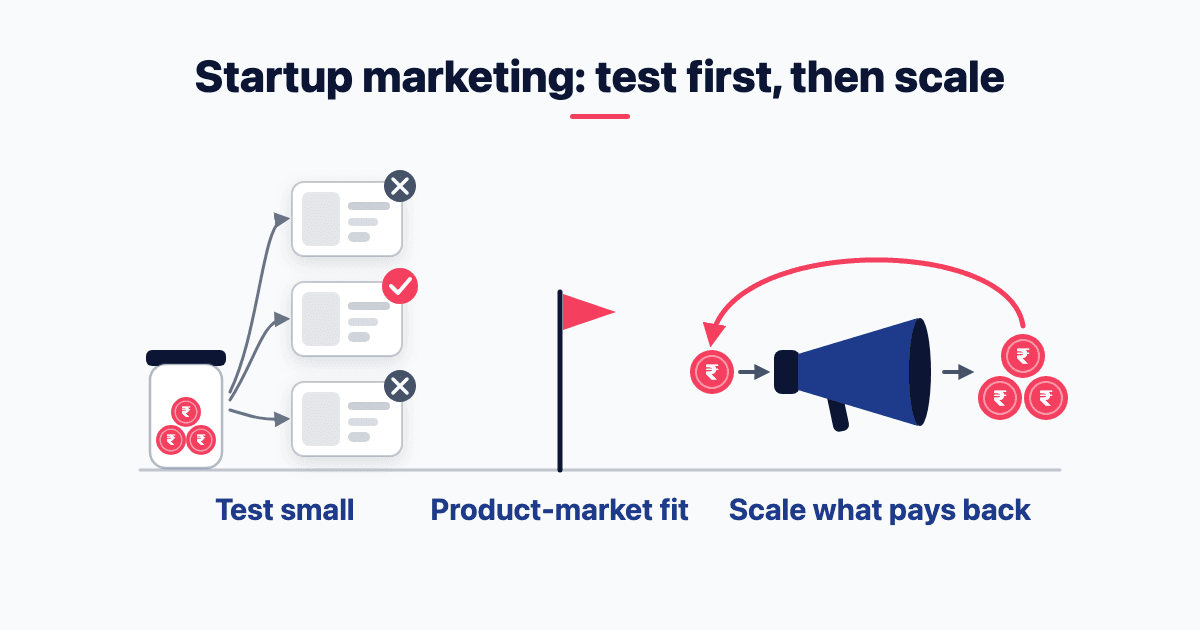
Search for marketing strategies for startups in India, and most guides hand you a list of tactics. Few tell you which ones fit your stage. You need two strategies, split at product-market fit. Before fit, marketing is a learning budget: find the customers who stay. After fit, scale one channel that pays back, then the next.
I've run marketing both ways: bootstrapped, as CEO of Programming Hub, and at national scale, as vice president of marketing at BYJU'S. Here is the stage test, the job at each stage, and a one-page plan.
What is a marketing strategy for a startup?
A startup's marketing strategy is four choices: who you serve, what you promise, where you reach them, and which number proves it works. Size each choice to what you've already proven. A marketing plan is different. It's the calendar and budget that carry the strategy out.
Product-market fit sets how big those choices can be. Marc Andreessen's 2007 essay defines it: "Product/market fit means being in a good market with a product that can satisfy that market."
So the first question isn't "which channels?" It's "what job does marketing have right now?" Before fit, the job is to learn. After fit, the job is to scale what already works.
How do you know if your startup has product-market fit?
Run the fit test: four questions. If any answer is no, you're still before fit.
1. Do they stay?
Pick the repeat signal your business lives on. That's a second order for a D2C brand, use in week four for an app, or a renewal for B2B. A retention curve that flattens out beats sign-ups that keep climbing.
2. Would they be very disappointed without you?
Ask active users one question: "How would you feel if you could no longer use the product?" Then count the share who answer "very disappointed". Superhuman's founder, Rahul Vohra, borrowed this survey from the man who ran Dropbox's early growth. Across nearly a hundred startups, the Dropbox growth lead's benchmark was 40% (Rahul Vohra in First Round Review, 2018).
Superhuman surveyed only users who "used the product at least twice in the last two weeks". It scored 22%, then 33% after narrowing to its keenest users, then 58% "within just three quarters". Treat 40% as a benchmark, not a law. Vohra adds that results turn "directionally correct" at around 40 respondents, so even a small startup can run it this month.
3. Do customers arrive without you pushing?
Andreessen's signs of missing fit include "word of mouth isn't spreading, usage isn't growing that fast" (Andreessen, 2007). If every customer arrived because you paid for them or called them, you're not there yet.
4. Can you say who buys and why in one line?
My IIM Calcutta session sheet from September 2026 has a blank to fill: "Positioning (from my site brief): [one line — who you help, to what outcome]." If you can't fill that bracket honestly, you're still before fit.
A third state: fit, but leaking
Some startups pass the test and still stall. At The 1970 Shop, an Indian D2C snacks brand, the case study says it plainly: "Product-market fit was not the question. Distribution hygiene was: what customers could find, what was in stock, and what Google could see." Fix the leaks before you buy more traffic. That programme is still in progress, with outcome figures to follow, so I claim no results from it.
What should marketing do before product-market fit?
Before fit, marketing's job is to learn fast and spend little. Three moves do most of the work.
Narrow to one customer and one problem
Start from the people who'd be very disappointed without you. Superhuman did exactly that. It focused on the roles in that group, "temporarily ignoring all other personas" (First Round Review).
In India, "one customer" also means a language, a town tier and who pays. In edtech, the payer may be a parent, not the student (edtech marketing strategy for India). Town tier matters at scale. Rural India accounts for 57% of active internet users, says an Internet and Mobile Association of India report covered by Tele.net in January 2026.
The same IIM Calcutta sheet asks for "one named reader": a person, with an age, role, city and the time they scroll. Write that person down before you write a single ad.
Sell it yourself first
Founder-led selling comes before any agency. Have the first conversations yourself, on WhatsApp, LinkedIn and calls. You'll hear objections in the customer's own words, which no dashboard shows. Those words become your ads later.
Keep a consent record from your very first list. Here's a consent checklist for India's data protection law.
Test the message, not the budget
My IIT Kanpur session sheet from June 2026 has a five-second "grunt test": "show a stranger the hero for 5 seconds, then take it away." The hero is the top section of the page. Run it on your homepage and your first ad, with people who've never heard of you. If they can't say what you sell, why it matters and what to click, no budget will fix it.
The same sheet adds: "Everyone's ad says the same three things. The money is in the fourth thing nobody is saying."
Small paid tests are fine at this stage, to learn which message pulls. Cap the spend, write the kill rule before you start, and judge on repeat use, not sign-ups.
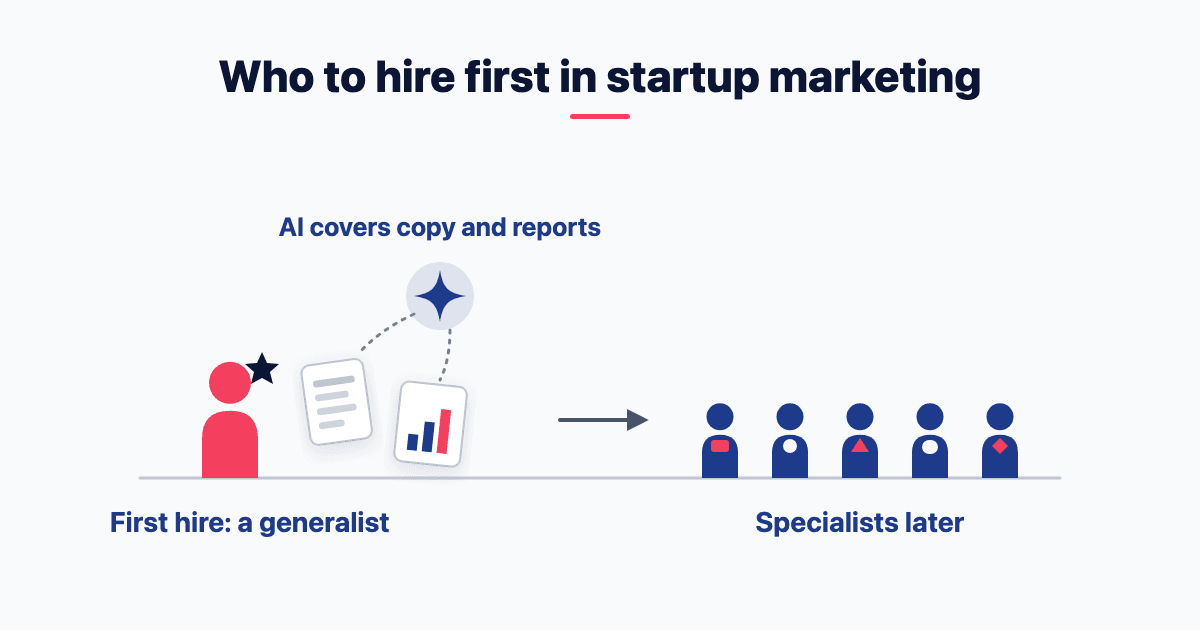
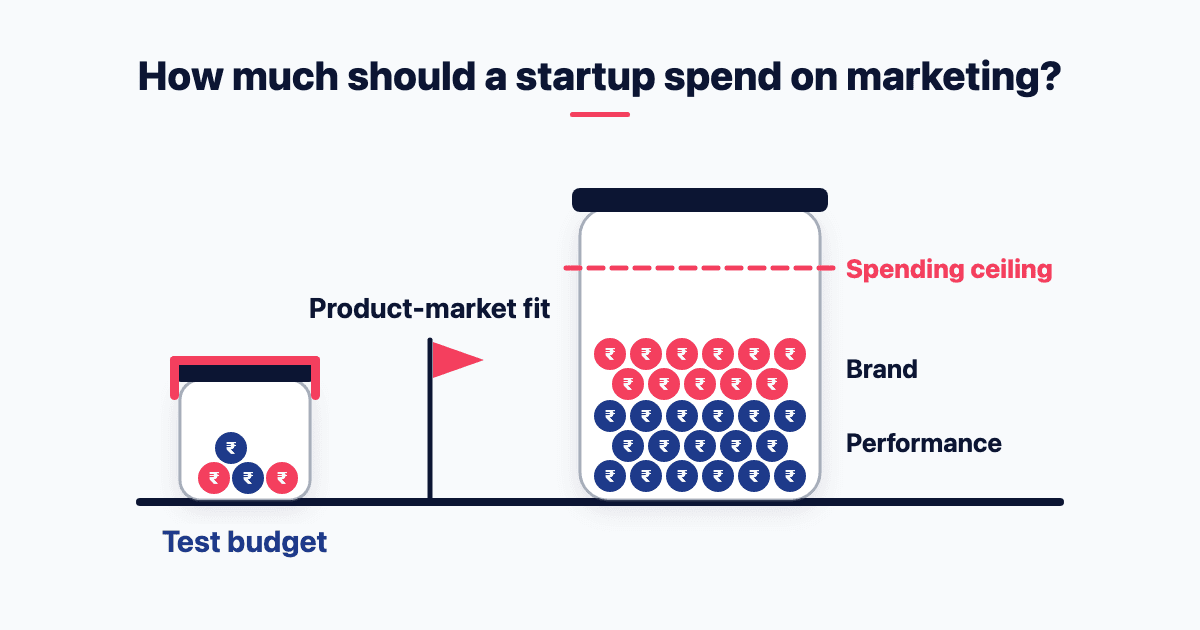
What not to buy yet: brand campaigns, a big agency retainer and a senior marketing hire. Deciding who should lead marketing at your stage is a separate choice.
What changes in your marketing after product-market fit?
After fit, marketing's job is to find one channel that pays back, then build the system around it.
Pick the channel that pays back on one order, unless you can fund a wait
My IIT Kanpur paid-search session from June 2026 starts with one gate: "estimate whether Search can pay back inside one purchase". Use your margin after failed cash-on-delivery orders (returns to origin), not gross margin. The sheet calls using gross margin the number-one mistake, because "it flips the verdict".
An illustrative example:
Average order: ₹1,000.
Contribution after product, shipping, payment fees and failed cash-on-delivery orders: ₹250.
Cost per click ₹15, landing-page conversion 2%.
Cost per order: ₹15 ÷ 0.02 = ₹750, three times the first order's margin.
Search fails the one-order test here. Either a second order must arrive fast, the basket must grow, or a cheaper channel goes first. One order is the default test. If you can fund a longer wait, relax it and test contribution inside that payback window. For B2B, run the same test per won deal, not per meeting. Divide cost per qualified meeting by your close rate, and compare that with a deal's margin. The D2C marketing strategy guide works through the full one-order maths.
The session's coach's note is about keywords, but it fits every channel choice: "The AI will give you 30 keywords in 20 seconds. Your skill is knowing which 8 deserve your first ₹10,000."
Know which demand your spend creates
At OurBus, a US intercity coach operator, the gap was "an acquisition machine that could tell the difference between demand it created and demand it merely collected". The case study's verdict travels well: "If revenue only grows as fast as the money behind it, nothing has been built—it has been rented." At BYJU'S, the Indian version was "to build the offline surfaces that create demand and the digital surfaces that capture it, at a cost the unit economics could carry" (BYJU'S case study).
Build systems, not departments
At Programming Hub, a coding-education app, the result was +40% revenue in 18 months (May 2023 → Nov 2024), profitable, bootstrapped. Those figures come from my tenure as CEO. The method fits one line of the case study: "Rebuild content and marketing as systems, not departments." In practice, that meant AI-powered content pipelines and one content strategy across iOS, Android and a course marketplace.
Spend should grow as fast as the channel's payback proves, and no faster. If you bring in outside help, here's what a fractional CMO does in the first 90 days. Building that system is part of the marketing strategy work I do with startups.
"Investors want growth now": when early spending is right
Your board wants a curve, and competitors are spending.
Spending before fit is fine when it buys learning. Scaling spend before fit is what Startup Genome calls premature scaling. One of its examples is spending too much on customer acquisition before product-market fit. Its headline finding: "74% of high growth internet startups fail due to premature scaling." Startups showing those signs were 2.3 times more likely to spend well above the average on customer acquisition (Startup Genome report on premature scaling).
Treat that as a direction, not an Indian benchmark. It's a 2011 report on more than 3,200 high-growth tech startups, built from the project's own survey.
So the real choice isn't growth versus caution. Growth bought before fit isn't growth. It's rent.
The "growth now" objection is right in one case. A marketplace may need to seed one side, such as sellers or tutors, before it can learn anything at all. Cap that spend, and name the signal that ends it before you start.
What to do this quarter: your one-page startup marketing plan
Fit it on one page, and write it this week.
Write your stage in one line, using the four fit questions.
Pick one customer and one problem, and write one line of positioning.
Choose the quarter's work. Before fit: founder conversations and two message tests. After fit: put one channel through the payback check.
Set one number. Before fit: the very-disappointed share, or the repeat rate. After fit: cost per new customer against contribution per customer.
Write the kill rule before each test. Decide in advance what result ends it.
Hold a 30-minute weekly review: what to keep, what to kill, what to try next.
Keep a consent record from the first list onward.
Not sure which stage you're in, or which channel should get the next rupee? Book a free strategy call, and we'll work it out from your numbers.
Frequently asked questions
What is the difference between a marketing strategy, a go-to-market strategy and a customer acquisition strategy?
A go-to-market strategy is the launch plan for one product in one market: who buys, at what price, through which channel and sales motion. A marketing strategy is the standing set of choices across products and stages. A customer acquisition strategy covers the channels that bring buyers in, which is the part the payback check tests.
How can an Indian startup market itself with almost no budget?
Spend time where you can't spend money. Sell it yourself on WhatsApp, LinkedIn and calls, publish content that answers buyers' real questions, and ask happy customers to refer others. As the Programming Hub case study puts it: "Bootstrapped companies do not get to buy growth. They have to build the machine that produces it."
How is marketing different for a B2B or SaaS startup?
The stages are the same; the signals differ. Andreessen's signs of missing fit include "the sales cycle takes too long, and lots of deals never close" (Andreessen, 2007). Founder-led sales comes first. After fit, the payback check becomes cost per won deal against the deal's margin.
Does offline marketing still work for Indian startups?
Yes, when it feeds a digital funnel you can measure. At BYJU'S, "Digital alone could not reach the parent who decides", so offline surfaces created demand and digital ones captured it. Start with one event, school or community. Judge it by what it does to digital enquiries and their cost before you take it to a whole city.
- Marketing strategy
- Startups
- Product-market fit
Written by Siddhesh Joglekar
Fractional CMO and AI marketing consultant Siddhesh Joglekar helps founders and growth-stage teams build marketing engines that compound.