Growth
Edtech marketing strategy in India: two deciders, one exam calendar, and a CAC that pays back
Edtech marketing strategy for India, built on how families buy: student and parent deciders, the exam calendar, CAC vs LTV, creators and coaching-ad rules.
· 16 min read
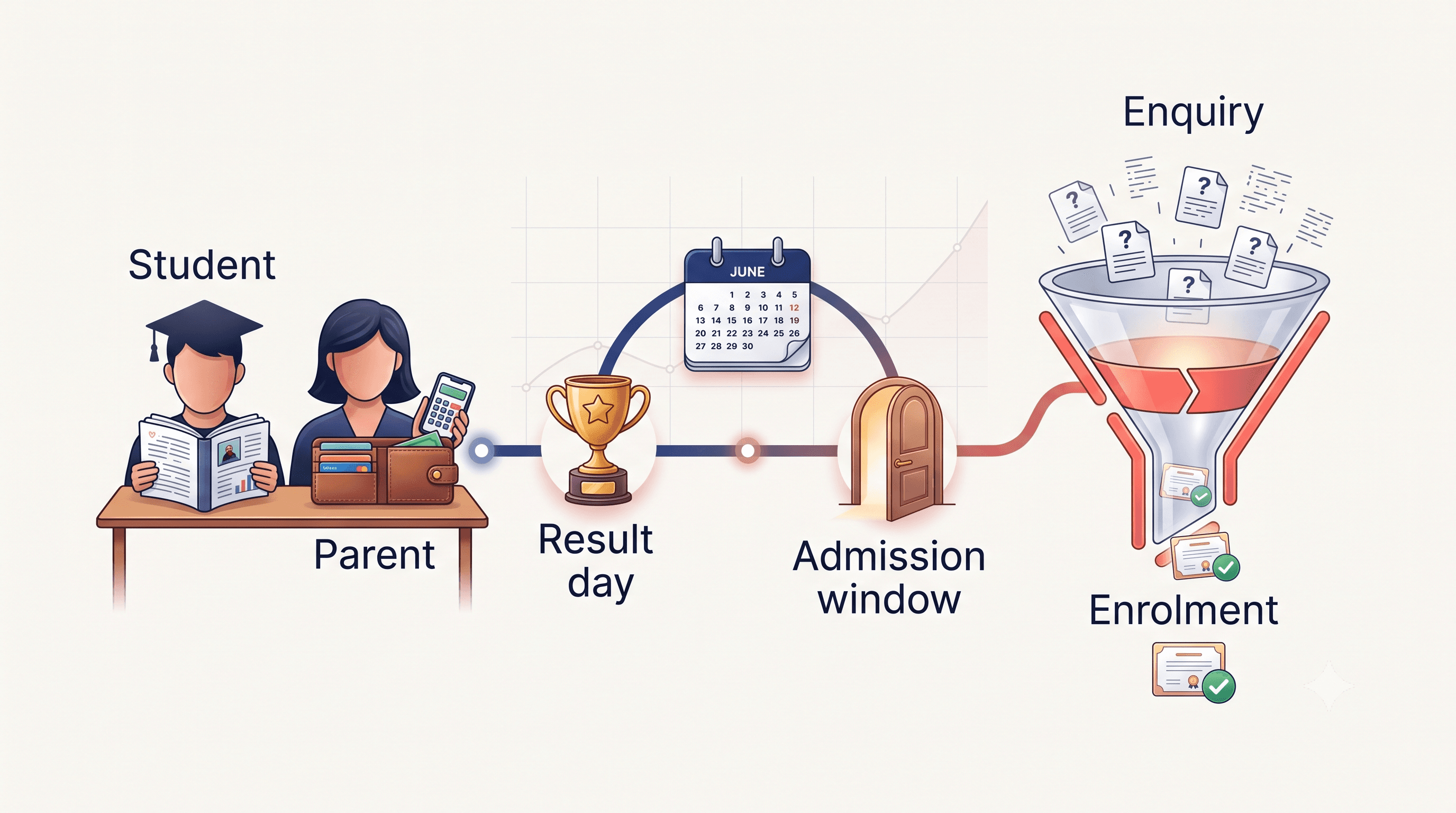
An edtech marketing strategy in India is a plan to win a purchase that two people usually make: the student who uses the course and the parent who pays for it. It has to win inside a window the exam calendar sets, at an acquisition cost the student's fees can repay. The usual point of failure is that last test: the plan buys leads faster than counselling, payment and retention can turn them into students who pay and stay.
So work out what a student is worth in your segment and time your spend to the exam calendar. Borrow trust from teachers, creators and schools before you buy it in an auction. I ran offline-to-online acquisition at BYJU'S for seven and a half years, and I now advise DocTutorials, a NEET PG and FMGE prep brand, on marketing.
Who is the customer: the student, the parent or the professional?
Start with the decider: it shapes the creative, channel, counselling script and refund policy. Check this map against your own enquiry and payment data.
K-12 learning
Who uses it: The child
Who pays and decides: The parent
When they buy: A new session, a weak result, a board year
What they must believe: My child will do better at school, safely, at a fair price
Trust route: The school, teachers, other parents
Entrance test prep (JEE, NEET UG, CUET)
Who uses it: A Class 11 or 12 student, or a dropper
Who pays and decides: The parent pays; the student often picks the teacher
When they buy: Before Class 11 (two-year courses), after results (repeat attempts), the final months (crash courses)
What they must believe: This teacher and batch can get my child a seat, and the fee is safe
Trust route: Named faculty, free lectures, consented toppers, the local centre
Graduate and professional exams (NEET PG, FMGE, UPSC, government jobs)
Who uses it: A graduate aspirant
Who pays and decides: Often the aspirant, sometimes the family
When they buy: After graduation or internship, after each result
What they must believe: This course fits the exam pattern and my timetable
Trust route: Faculty, seniors who cleared it, exam-niche creators
Upskilling
Who uses it: A working professional
Who pays and decides: The learner, sometimes the employer
When they buy: Less tied to a public calendar
What they must believe: This will change my job or pay
Trust route: Search and YouTube research, alumni outcomes, employers
Language learning
Who uses it: An adult, or a child
Who pays and decides: The learner, or the parent for a child
When they buy: When a goal has a date: a move, a job, a test
What they must believe: I will actually speak or pass, not just finish lessons
Trust route: Free lessons, creators, app ratings
The two-decider problem. In K-12 and entrance test prep, the student buys the teacher, the peer group and the rank story. The parent buys safety, outcomes, value and a fair refund. Your creative, counselling and landing pages must serve both: the student asks and the parent signs off. As the BYJU'S case study puts it: "Digital alone could not reach the parent who decides."
Upskilling is the exception: the learner usually researches and pays alone. In a Google/Kantar survey of 1,000 Indian learners aged 18 and over (2025), 77% of professionals used Google Search and/or YouTube for initial discovery, and 63% of learners felt "overwhelmed by the number and similarity of course options" (Think with Google India, January 2026). Treat Google's research on Google's products as directional. The second number is still your positioning brief: be distinguishable, not louder.
Children's data changes whom you can target. Under section 9 of the Digital Personal Data Protection Act, 2023, a business must obtain verifiable parental consent before processing a child's personal data (a child is anyone under 18), and "shall not undertake tracking or behavioural monitoring of children or targeted advertising directed at children". These duties apply from 13 May 2027, eighteen months after the commencement notification G.S.R. 843(E).
A Class 11 student enquiring about a two-year course is usually a child in law. So from that date, targeted paid media for K-12 and most entrance test prep should address the parent.
The DPDP Rules, 2025 exempt an "educational institution" only for tracking and behavioural monitoring for its educational activities or children's safety (Fourth Schedule, Part A, item 3), not for targeted advertising. Whether your company is one is a question for counsel. The operational detail is in our DPDP consent checklist for marketers.
When do they buy? Planning marketing around the exam calendar
Test prep runs on a timetable, not a demand curve. Each exam produces a fixed cohort on a known date, so marketing competes for share of a known pool inside a window that a government agency sets.
Close to 20 lakh candidates appeared for NEET UG 2026 and 11.21 lakh qualified (National Testing Agency press release, 16 July 2026). Over 2.65 lakh candidates appeared for NEET PG 2026 (Careers360, citing NBEMS, 24 September 2026).
Plan from notifications, not from last year's calendar. NEET UG 2026 was first held on 3 May; NTA then conducted a re-examination on 21 June and declared results on 16 July (NTA's NEET (UG) 2026 notices). Each shift moves your crash-course window, your result-day campaign and your counselling rota.
After the cycle closes: build an audience with free lectures, solved papers and analysis of the paper just held. Watch returning viewers, not leads.
Result day and the week after: repeaters decide whether to try again and the next cohort starts looking. Offer result analysis and a clear repeat-attempt course.
Admission window: capture and counsel. Leads cost the most now, because every competitor bids for the same families at once. Watch counselling capacity.
Course running: retention does the work.
Exam notification to exam day: sell crash courses, mock tests and test series, including to other brands' students. Watch mock-test sign-ups from non-students.
Next step: offer the next class, exam or repeat attempt before the student leaves; in test prep, that sale happens around result day or not at all. Watch the share who buy the next course.
Plan upskilling as always-on demand with monthly budgets.
What is a student worth, and how much can you pay to win one?
Customer acquisition cost (CAC) in edtech has a hard limit: the exam ends the relationship. A test-prep student is a customer for one or two seasons. A K-12 student can stay for years but can leave at every grade, and an upskilling learner often buys one course. Fees tend to arrive up front while the cost to serve and refunds follow, so acquisition cost must be recovered inside the student's own cycle.
PhysicsWallah published what that looks like in its Red Herring Prospectus filed with SEBI, dated 4 November 2025. The figures are for FY25; those marked "our calculation" are derived from them.
Revenue from operations: ₹2,886.6 crore (p. 54).
Advertisement and publicity: ₹276.2 crore, or 9.57% of revenue (p. 65).
Total paid users: 4.46 million, made up of 4.13 million online transacting users and 0.33 million offline enrolments; the prospectus notes the total includes some duplicates (pp. 13 and 54).
Offline enrolments: 7.4% of paid users, but 46.8% of revenue (our calculation).
Revenue per student, by channel: about ₹41,000 per offline enrolment against about ₹3,400 per online user, roughly 12 times. Revenue, not margin (our calculation).
Dropouts: 1.03% of paid users, with refunds to dropouts at 0.91% of revenue (p. 54).
"A student" is not one number. A centre carries costs an app doesn't (rent, in-person faculty, staff), so the right acquisition ceiling differs by channel as much as by segment.
Your edtech customer acquisition cost only means something against that worth. Quoted benchmarks rarely say where they come from, so build your own ceiling. This is a working method, not a benchmark:
Count what a paying student brings in within the cycle you can rely on: the fee, plus any test series, renewal or next course students have actually bought.
Take off expected refunds and the cost to serve: faculty, centre or platform, content, doubt support, payment charges, and the counsellor's time or commission.
The remainder is the contribution per student. Your ceiling is that contribution minus the margin the business needs, recovered before the student leaves (in test prep, before the exam).
Work it out separately for each channel and segment.
Convert it into cost per enrolment: cost per lead divided by the lead-to-enrolment rate. A lead at half the price that converts at half the rate saves nothing.
Four habits inflate the ceiling: blending channels into one number, counting fees before the refund window closes, leaving counselling salaries and commissions out, and assuming a second year the data hasn't shown. If no one owns this number end to end, from the ad account to the refund ledger, that is the gap a fractional CMO fills.
Whose trust can you borrow: teachers, creators or schools?
Indian families buy education on trust, which is slow and expensive to build from nothing. Most lists of edtech marketing ideas are channel lists, but the engines that work borrow trust from someone the family already believes. Build one engine first, because three half-built engines cost more than one that works.
Teachers and free content
In test prep, the faculty is both the product and the marketing. PhysicsWallah had 207 active YouTube channels with 98.80 million subscribers across them at 30 June 2025. It says it built that community "by offering several of our courses and content for free on YouTube" and on its other social channels, website and apps (PhysicsWallah prospectus, p. 260). Free teaching lets a student sample the teacher before a parent pays.
AI lowers the cost of producing that content, in volume and in more languages; it changes the engine's cost, not the principle. For more, read how a coaching business should point AI at its margins.
Creators
When incumbents out-bid you in search, creators are the trust you can still reach. DocTutorials prepares MBBS students and foreign medical graduates for NEET PG and FMGE, where large, well-funded incumbents buy the same keywords. Its answer was an influencer engine: daily automated discovery of nano and micro medical-education creators, scored for trend and exam fit; a drafted message for each; a never-pitch roster of competitor-affiliated accounts; and collaborations tracked to outcome, so the roster improves rather than simply growing.
The engine produced hundreds of signed creator collaborations. Paid enrolments multiplied between FY25 and FY26, and cost per acquisition fell by roughly a third in the same period (at the client's request, the case study gives no absolute figures).
Creators now carry legal weight. The 2024 coaching guidelines from the Central Consumer Protection Authority (CCPA) make endorsers responsible for verifying the claims they promote (Press Information Bureau, 13 November 2024). The influencer advertising guidelines of the Advertising Standards Council of India require the ad disclosure to be "upfront and prominent". Give every creator, in writing, the claims they may and may not make.
Schools, events and centres
At BYJU'S, the Discovery School Super League, a "critical thinking, aptitude and general knowledge quiz" for school students (BYJU'S DSSL page), reached 25,000 schools and 70 lakh students per DSSL season. With above-the-line, digital and below-the-line marketing "managed against one cost-per-lead target", cost per lead came down 70% across the tenure. (Figures from public record and the author's tenure; scale is per season at peak.)
The case study's summary is the test: the offline machine "made the digital funnel cheaper, not more expensive". If an event, school programme or centre can't show that in the lead data, budget it as brand spend.
Even the YouTube-first leader went offline: PhysicsWallah grew from 28 offline centres at the end of FY23 to 303 across 152 cities in India and the Middle East by 30 June 2025, and says it uses data from its online community to decide where to open them (PhysicsWallah prospectus, pp. 60–61 and 163).
Search and paid social: collecting the demand
Search and YouTube are where learners compare, so paid search and social belong in every plan. They collect the demand the engines above created: searches for your brand and teachers' names, remarketing to viewers of your free lessons, lead forms at the moment of decision. Judge them on cost per enrolment, never cost per click.
Where do enrolments leak between the first enquiry and a paid seat?
A lead is a phone number. An enrolment is a family that paid and stayed past the refund window. Five stages sit between the two.
Enquiry
Where it leaks: The student enquires but the parent decides; junk and duplicate leads
What fixes it: Ask who pays at the first touch; de-duplicate before you count
What to watch: Share of leads with a reachable decider
Counselling or demo class
Where it leaks: Slow callback; pitching the wrong decider; pressure selling
What fixes it: Same-day callback; a demo for the student, a separate talk with the parent
What to watch: Callback time, demo-to-payment rate
Payment
Where it leaks: Price shock; confusion over instalments or loans; failed UPI or card payments
What fixes it: Show the fee and the instalment plan before counselling ends; state any loan terms plainly
What to watch: Payment-page drop-off, failure rate by method
First two weeks
Where it leaks: One onboarding for every level and language; no early win
What fixes it: Onboard by level and language; aim for a first test or a resolved doubt in week one
What to watch: Week-one attendance and activity
Refund window
Where it leaks: An unclear policy turns refunds into complaints
What fixes it: Publish the refund policy in plain words, with dates
What to watch: Refund requests and their reasons
Payments. Under the Reserve Bank of India's Digital Payments – E-mandate Framework, 2026 (21 April 2026), once a mandate is registered and the first payment authenticated, recurring card, UPI or wallet debits of up to ₹15,000 per transaction can run without an additional factor of authentication. Above that, every debit needs one. The ₹1,00,000 limit covers only insurance premiums, mutual fund subscriptions and credit card bills, and customers are notified at least 24 hours before each debit. Design monthly and instalment plans with the ₹15,000 line in mind.
Refunds. This is where parent trust is lost in public. The National Consumer Helpline ran a drive that got ₹1.15 crore refunded to coaching students and aspirants whose fees had not been returned (Press Information Bureau, 17 December 2024). A precise, published policy is the cheaper fix. PhysicsWallah's offline policy is specific: students who withdraw within six weeks get a partial refund that depends on the week (PhysicsWallah prospectus, p. 54).
Onboarding in the student's language. The IAMAI–Kantar Internet in India 2024 report counts 870 million people, 98% of India's internet users, who accessed the internet in Indic languages in 2024; 57% of urban users prefer Indic-language content (IAMAI–Kantar report, p. 13). Translating the English flow isn't enough, because vernacular is not a translation problem.
Iqra, a trilingual Baccalaureate exam-prep app in Morocco, shows the order that works on a funnel that "had never been instrumented": an event taxonomy first, then onboarding personalised by level and language, then a notification lifecycle tied to exam dates.
What can you claim in an ad? Earning trust under the 2024 coaching rules
CCPA's Guidelines for Prevention of Misleading Advertisement in Coaching Sector, 2024 are the rulebook for coaching and test-prep creative. The government's summary (Press Information Bureau, 13 November 2024) sets out what matters for marketing:
Scope. A coaching centre is one run for "more than fifty students". Coaching covers academic support, tuition and study programmes, but not counselling, sports or creative activities. The guidelines also cover endorsers.
Prohibited claims. False claims about courses, duration, faculty qualifications, fees and refund policies; about selection rates, success stories, exam rankings and job security; and about "assured admissions, high exam scores, guaranteed selections or promotions".
Toppers. Names, photos and testimonials only with written consent obtained after the student's success. The ad must show the name, rank and course taken, and say whether the student paid for it.
Disclaimers. The same font size as the other important details.
Urgency. No false urgency or scarcity, such as implying limited seats.
By 17 December 2024, CCPA had issued 45 notices to coaching centres over misleading advertisements and imposed penalties of ₹61,60,000 on 19 institutes (Press Information Bureau, 17 December 2024).
The summary does not settle whether every online-only platform is a "coaching centre". It defines the term by student numbers and says the guidelines apply to "every person engaged in coaching". The prudent reading is to hold your ads to them anyway. This is not legal or financial advice: read the linked instruments, or ask counsel, before you change a claim, a consent flow or a payment plan.
Replace rank collages with outcomes that carry a denominator: how many students took which course, in which year, and how many cleared. Make faculty credentials checkable, and replace "limited seats" with a real date, such as the day the batch starts.
How does one enrolment become the next one?
Retention in edtech runs on the calendar too: the next class, the next exam, the repeat attempt after a result, the younger sibling. Referrals travel inside a batch, so enrolled students are your cheapest channel for the next cohort.
PhysicsWallah's prospectus lists why students leave: exam results that disappoint, dissatisfaction, and reasons such as "financial constraints, change of career path" (PhysicsWallah prospectus, p. 54). Marketing can't fix a bad result, but it can show the student and the parent the progress being made, long before the exam passes judgement. Three levers do most of that:
Lifecycle messages tied to exam dates, not to the sign-up date.
Doubt resolution fast enough that a stuck student keeps studying.
Parent updates that show progress against the cohort, so the payer sees the value before the renewal conversation.
The objection: "Edtech marketing is just buying leads until the funding runs out"
The worry is fair: boards want profit rather than reach, and acquisition spend can outrun the money behind it.
The prospectus points the other way. PhysicsWallah's advertisement and publicity spend was 9.01%, 10.08% and 9.57% of revenue in FY23, FY24 and FY25, while paid users grew from 1.76 million to 4.46 million (PhysicsWallah prospectus, pp. 54 and 65). The company credits the FY25 dip in that ratio to brand affinity from student outcomes and affordable prices, "leading to word-of-mouth marketing" (p. 496). The ratio was higher, 13.91%, in the quarter to June 2025, which the company ties to expanding operations.
The filing does not show that the company's economics are solved. The lesson is not to stop marketing. It is never to pay more for a student than the student is worth.
Your edtech marketing strategy in India: what to do before the next admission window
Write your segment's decider map: who uses, who pays, and what each must believe.
Put the official exam and result dates into the marketing calendar, and recheck the notices monthly.
Set a CAC ceiling, by channel and segment, that the student's own cycle can repay.
Fund one trust engine (teachers, creators, or schools and centres) for twelve months.
Walk the funnel from enquiry to refund window and fix the worst leak first.
Audit every topper, result and urgency claim, including creators' posts, against the CCPA guidelines.
List every flow that touches under-18s' data (forms, pixels, ad audiences, WhatsApp lists) before 13 May 2027.
If your cost per enrolment is rising faster than what a student is worth to you, book a call.
Frequently asked questions
What is the difference between edtech marketing and edtech sales?
Edtech marketing wins the enquiry; edtech sales turns it into a paid enrolment. Marketing decides whom to reach, when in the exam calendar, and with which promise. Sales, usually counsellors and demo classes, then closes with both the student and the parent. Judge both on cost per enrolment: cheap leads that counsellors can't convert save nothing.
Should an edtech startup spend on marketing before product-market fit?
Yes, but spend to learn, not to scale. Until students stay past the refund window, you can't know what a student is worth, so you can't set an acquisition ceiling. Fund free lessons and small paid-media tests; watch returning viewers and week-one activity. Scale paid media once enrolments repay their acquisition cost.
Can an edtech brand market to students on WhatsApp?
Yes, to families who opted in. From 13 May 2027 (commencement notification), section 9 of the Digital Personal Data Protection Act, 2023 requires verifiable parental consent before processing a child's personal data, and bars targeted advertising directed at children (anyone under 18). For K-12 and most entrance prep, build WhatsApp lists around the parent's number and consent.
- Edtech
- Parents
- Customer acquisition
Written by Siddhesh Joglekar
Fractional CMO and AI marketing consultant Siddhesh Joglekar helps founders and growth-stage teams build marketing engines that compound.