Leadership
What does a fractional CMO actually do? The first 90 days, week by week
What a fractional CMO does in the first 90 days, week by week: what founders must provide, and how to judge progress at day 30, 60 and 90.

· 10 min read
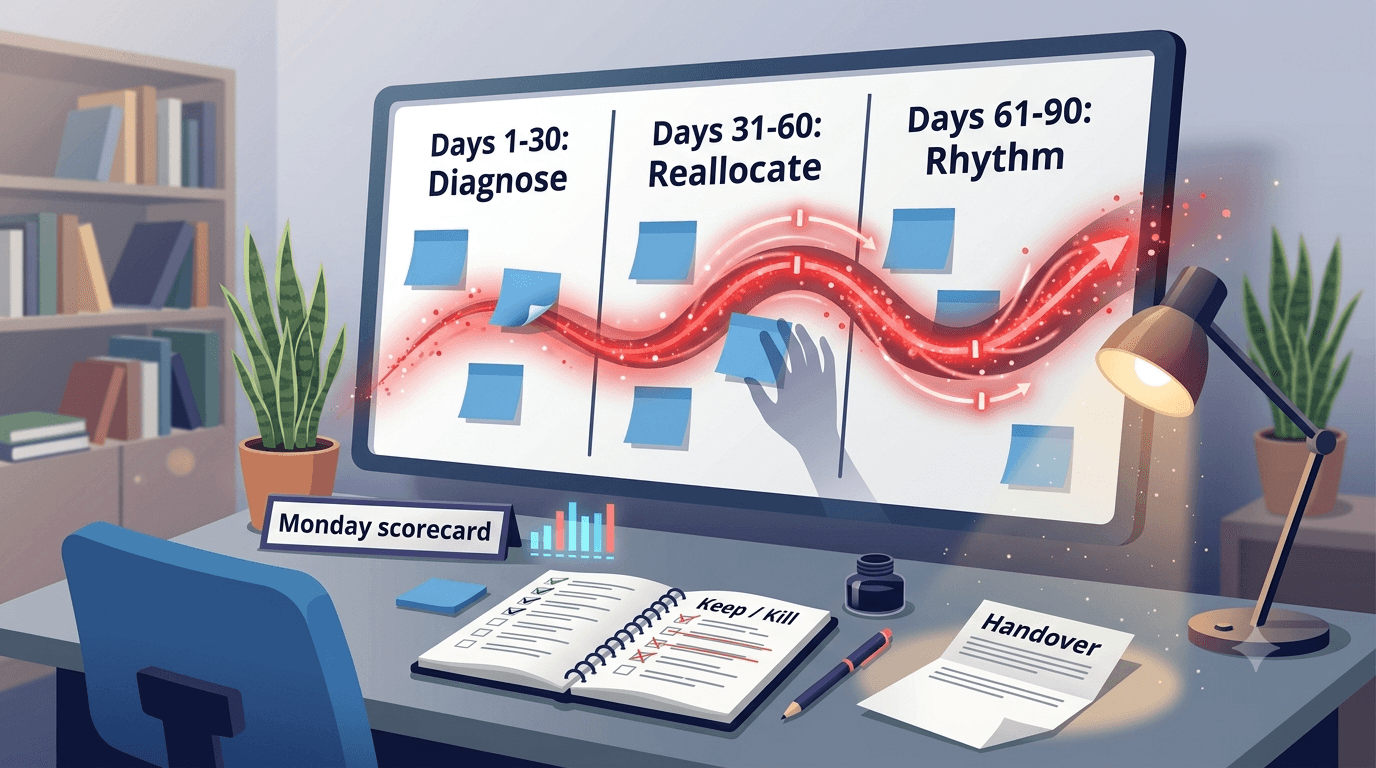
A fractional CMO is a part-time marketing leader. The role ranges from advising the founder to owning the marketing plan and its results. So what does a fractional CMO do in the first 90 days when they own the plan? In weeks 1–4, diagnose before spending. In weeks 5–8, make the few decisions that move money and launch tests with written kill rules. In weeks 9–13, install a weekly rhythm your team can run without them.
By day 90 you should have a scorecard you trust, two or three bets with a verdict date, and a plan for the next quarter. The order matters because this person is with you for only part of the week. The rhythm they leave behind is the real deliverable.
What does a fractional CMO do?
The fractional CMO role is a chief marketing officer's job, done part-time. These are the five core fractional CMO responsibilities:
Set direction. Which customer, which message, which two or three channels, and why.
Own the plan and one number. For example, cost per qualified lead, or contribution after ad spend.
Make the measurement trustworthy before anyone uses it to decide.
Decide where the money goes, and stop what isn't earning.
Run the operating rhythm, and direct the team and agencies who execute: brief them, and hire or replace them where needed.
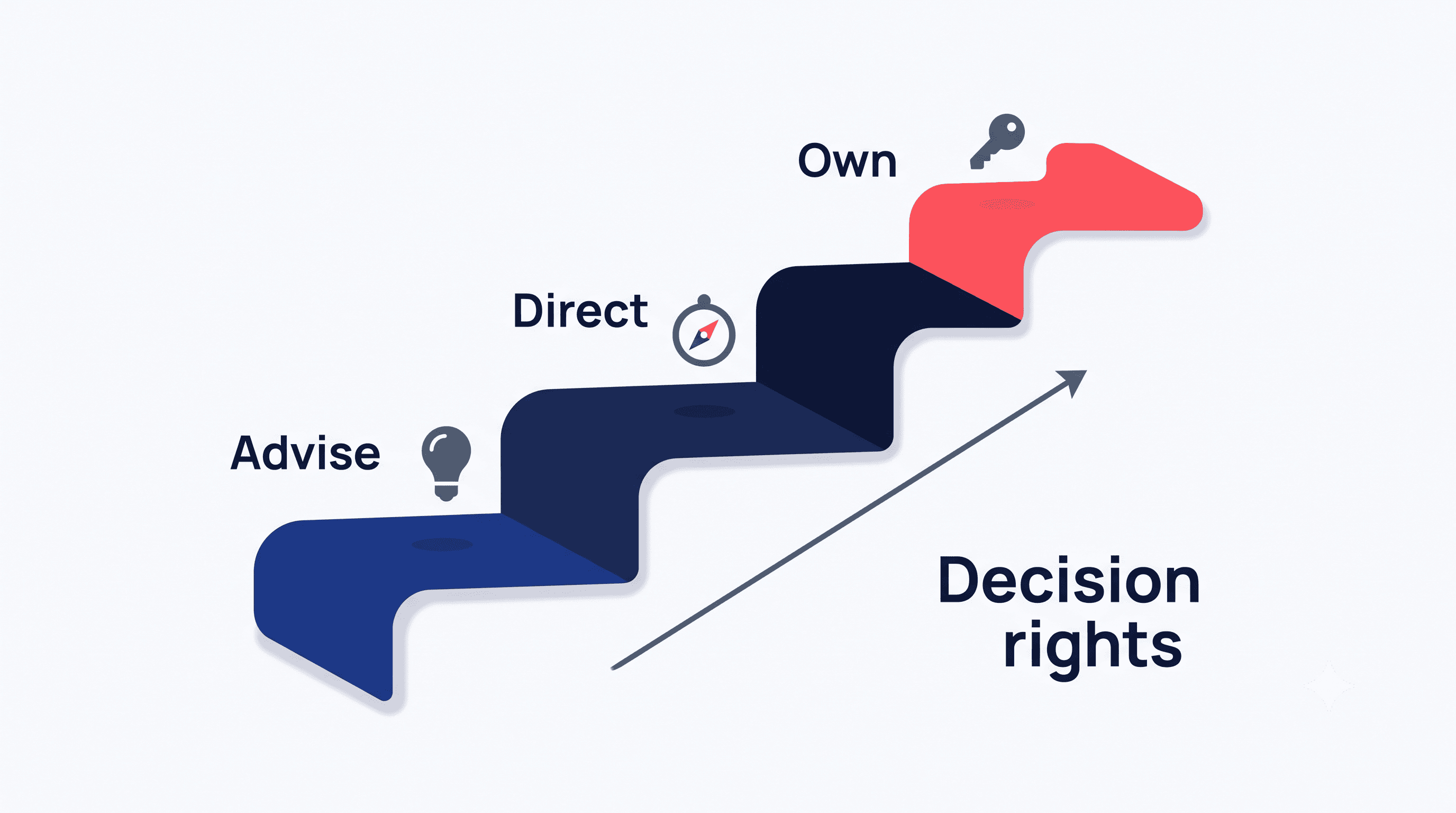
How much of this they decide alone depends on the decision rights you agree in the contract, not on the hours they bill.
What they don't do is run the campaigns themselves. That is why a fractional CMO isn't your execution team: you still need an agency or people in-house to do the work.
If you are writing a fractional CMO job description, these five lines, the decision rights and the day-90 test below are its core.
Weeks 1–4: what is really happening, and which numbers can you trust?
The first month is diagnosis: who buys, why they buy, and whether the numbers can be trusted. Nothing should be scaled until that is known. The week numbers here are a working guide, not a fixed timetable.
Weeks 1–2: access, conversations and the money trail
Start with access. On day one, hand over the ad accounts, analytics, the CRM, order or payment data, agency contracts and briefs, and 12 months of spend by channel.
Match each access level to the decision rights you agreed. Google Ads has five access levels: Email-only, Billing, Read-only, Standard and Admin. Only Standard and Admin "can edit campaigns". Only Admin can give account access or change access levels. Linking the account to Google Analytics to import conversions is Admin-only too (Google Ads Help, "About access levels in your Google Ads account"). So:
give Read-only to someone who advises;
give Standard to someone who will restructure the account;
keep Admin inside the company, and plan for that person to make the Google Analytics link during the measurement fixes.
Then listen. The fractional CMO should talk to the founder, the sales team or counsellors, customer support and the agency. Sitting in on real sales calls tells you more about why people buy than any brand deck.
Finally, follow the money. Map every channel's spend over the last 12 months to the outcome it produced: leads, orders or enrolments. The question is not where the rupees went, but what each channel's rupees brought back.
Weeks 3–4: check the measurement, then rank the fixes
A plan is only as good as the numbers under it. Of the six client case studies published on siddheshj.com (September 2026), five list a measurement gap where the work started: OurBus, OurBus Charters, DocTutorials, Iqra and The 1970 Shop. The sixth, Rally, started with a problem on its payment screen.
The gaps are ordinary. At OurBus Charters: "Quote events double-firing in the CRM and a backfill duplicating leads, so nobody could state a true win rate." At OurBus: "No separation between brand and generic demand, so brand traffic flattered everything else."
Before anyone plans, check four things:
Does each conversion event fire once?
Are brand and non-brand searches reported separately?
Does the revenue the ad platforms report match your orders or payments?
Are duplicate leads removed?
The output is a written diagnosis and a ranked fix list. The 1970 Shop, an Indian D2C snacks brand, shows what that list looks like: 10 revenue leaks found in 6 weeks. They were ranked "by revenue at stake and effort to fix, most of them fixable without new spend" (The 1970 Shop's revenue leaks). It started with Google Analytics and Meta not connected to Shopify. Revenue scale is withheld. The programme is still in progress, with outcome figures to follow, so there are no results to claim yet.
In a messy business, diagnosis can run past day 30. That is fine, as long as the ranked list arrives.
Weeks 5–8: which few decisions will move the number?
Month two is for decisions, and there should be only a few of them.
Weeks 5–6: move the money you already spend, and stop what isn't earning
The first big decision is usually to reallocate and to stop things, not to add new channels.
At OurBus, a US intercity coach operator, the before and after of this kind of reallocation looked like this (over the engagement, not in two weeks). Before: route search at 47% of spend, 25% of bookings. After: Performance Max plus brand search at 46% of spend, 70% of bookings. The channel shares come from the account's own scorecard.
The engagement notes put it plainly: "The channel that felt most like doing marketing was the one doing the least work per dollar." The market is American; the lesson isn't. Question the biggest line in your budget first.
Sometimes the fix isn't media at all. At Rally, an event and community group-travel company, the drop was traced "to one screen and one word" (Rally's payment screen).
If these weeks cross Diwali, exam results or a sale season, don't compare with last month. Compare with the same stretch around last year's festival, results day or sale, not the same calendar weeks, because these dates move every year. Otherwise a festive spike will look like the new plan working.
Weeks 7–8: launch two or three tests, with the kill rule written first
Now test, but write the kill rule before launch. The kill-threshold declaration from my IIM Calcutta DigiAIM session (September 2026) was written for content formats. Adapted for any test, it has four lines:
the one metric that matters;
the floor: the number below which the test isn't working;
the window;
the decision date.
The session page is blunt: "Declared BEFORE launch. Renegotiating the floor after the numbers arrive is the failure mode." On the decision date there are three verdicts: "KEEP / KILL / REWORK. There is no fourth option."
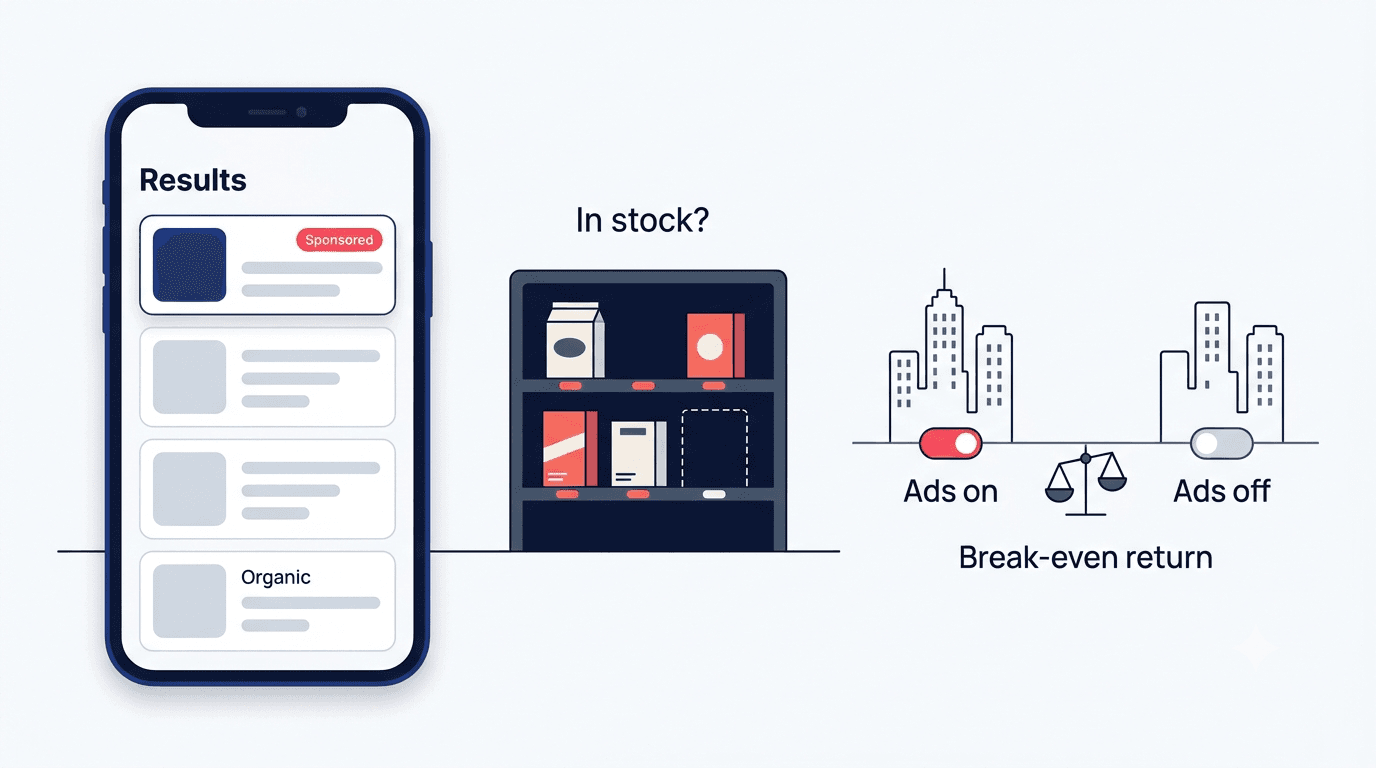
Make the window no shorter than the platform's learning period. After a change to an automated bid strategy, Google says the campaign "needs some time to calibrate towards the new goal", and how long depends on how many conversions you get and how long your conversion cycles are (Google Ads Help, "Duration of the learning period for campaigns and what affects it"). So count the window in conversions or conversion cycles, not calendar days.
By day 60, money has moved, at least one thing has stopped, and two or three tests are running with written floors.
Weeks 9–13: what should run without the fractional CMO in the room?
The last month builds what keeps working on the days the fractional CMO isn't there.
Weeks 9–10: install the weekly rhythm
Because a fractional CMO is part-time, the rhythm is the product.
Two of the case studies describe their rhythm like this:
OurBus: "Three flag signals every Monday, a Friday deep dive on anything flagged, and a correction for conversion data that matures over two weeks."
OurBus Charters: "A standing fortnightly pulse. Charter costs drift upward quietly; the only defence is measuring them on a schedule someone keeps."
A good scorecard has:
one page;
one number, plus three to five inputs that drive it;
a flag threshold on each line;
one owner per line;
a log of the decisions taken.
Weeks 11–13: the next-quarter plan and the handover test
The handover test is simple: can your team run the Monday review without the fractional CMO? DocTutorials is an Indian edtech for NEET PG exam preparation. Its case study describes weekly cost-per-acquisition reporting that the company's own marketing team can run without me.
Judge the mechanism, not a single month. Rally's case study puts it this way: "A single record month is an anecdote. Two months after it above the old ceiling is the signature of a fixed mechanism, not a lucky calendar." Rally had a record month 1.5–2× the previous best (June 2026 gross booking value), then held above the old ceiling in July and August 2026. Those growth figures are indexed (shown relative to the previous best month) and supplied by the client.
Then choose the next quarter: continue, change the scope (for example, down to advisory), or hand over to a full-time hire. If you want someone to lead these 90 days with your team, I take on that role as a fractional CMO.
How do you judge progress at day 30, 60 and 90?
Judge the engagement by what exists, not by how busy it looks.
Day 30
Should exist: a written diagnosis, a baseline you trust and a ranked fix list.
Red flag: campaigns launched before anyone checked the measurement, or a deck with no numbers.
Day 60
Should exist: money moved or stopped, and two or three tests with written floors and verdict dates.
Red flag: everything is "still being tested", and nothing has a floor.
Day 90
Should exist: a weekly rhythm your team runs, a next-quarter plan, and one leading number moved, or a clear reason why not.
Red flag: nobody else can run the review.
Write these checkpoints into the contract, so both sides know on day 30 what "on track" means.
What does the founder have to do?
A fractional CMO can't do this alone. The founder's side of the 90 days is six things:
Give access in week 1, at the right level.
Protect a fixed weekly slot for the review.
Decide within the week when asked. A part-time leader can't wait a fortnight for an answer.
Name an executor for every line of the plan.
Don't renegotiate the floors once the numbers arrive.
Share the product and pricing roadmap, because some fixes sit in the product, as Rally's did.
"Ninety days and nothing to show for it?" The objection, and where it's right
The objection at full strength: you pay for three months, and revenue may not have moved.
The answer: by day 60 you should see money moved and tests running. That is visible progress before revenue shifts. Revenue takes longer to prove, because one record month could be luck. That is the Rally test above: the months after it have to hold above the old ceiling.
Where the objection is right: if nothing has been stopped or reallocated by day 60, or the only output is a document, re-scope the engagement or end it.
What to do this week
List every ad, analytics and CRM account, and decide who gets which access level.
Export 12 months of spend by channel.
Pick the one number the next 90 days must move.
Book a fixed weekly review slot.
Draft your first kill threshold: metric, floor, window and decision date.
Want to know what the first 30 days would find in your marketing? Book a free strategy call: tell me where you're stuck, and I'll tell you what I'd check first.
Frequently asked questions
Will a fractional CMO work with your existing marketing team?
Yes. They should work through it, not around it. The fractional CMO reports to the founder or CEO. Your marketing head keeps running the team and agencies day to day, takes direction from the fractional CMO (in an advisory engagement, from you) and joins the weekly review. Plan for that head to run the review once the engagement ends.
Does a fractional CMO work remotely?
Mostly, yes. The weekly review, the scorecard and most analysis work well on a video call. Time on site pays off early, when they meet the team and hear how sales handles customers, and on a planning day each quarter. Agree those days, and how fast they reply between meetings, before work starts.
Does a fractional CMO need experience in your industry?
Not necessarily: experience with the way you sell matters more than your industry. A D2C brand living on repeat orders, an edtech selling through counsellors and a B2B firm with long sales cycles need different scorecards and channels. Ask for a published example close to your model, and expect the first month to go on learning your customers.
- Leadership
- Founders
- Fractional CMO
- First 90 days
Written by Siddhesh Joglekar
Fractional CMO and AI marketing consultant Siddhesh Joglekar helps founders and growth-stage teams build marketing engines that compound.