Startups
How much should a startup spend on marketing? A budget method for Indian founders
How much should a startup spend on marketing? A method for Indian founders: a test budget before product-market fit, a payback ceiling after.

· 10 min read
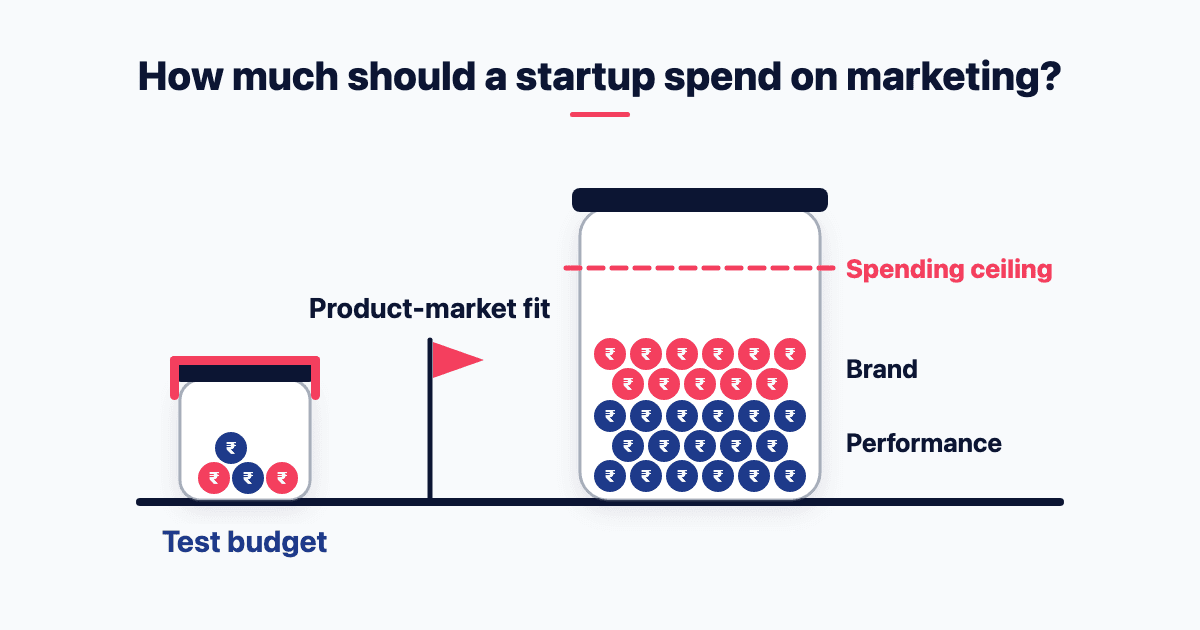
Two Indian e-commerce startups, same year, similar space: Cars24's ad spend was 4.41% of revenue, Spinny's 201.1% (Inc42's 2021–22 analysis). So how much should a startup spend on marketing? Don't start from a percentage. Before product-market fit, fund a test budget sized to what you must learn. After it, keep spending while each new customer still pays back.
Why don't percentage-of-revenue rules work for startups?
Because the percentages come from companies that aren't you. Most budget advice is a percentage of revenue, and most of those percentages come from big-company surveys like Gartner's.
Gartner's 2026 CMO Spend Survey put budgets at 7.8% of company revenue, up from 7.7% in 2025. Now look at who answered. It surveyed 401 marketing leaders in North America, the UK and Europe, "the vast majority" at companies with over $1 billion in revenue. That's a big-company average, not a startup plan.
Another rule is harder to trace. One US spend-management vendor's startup guide credits "approximately 7-8 percent of gross revenue" to the US Small Business Administration. That figure isn't in the agency's own marketing and sales guide (checked 11 October 2026).
Indian data shows a spread, not a norm. Inc42's study of 19 large e-commerce startups found Udaan's marketing at "a minuscule 0.68%" of revenue, against Spinny's 201.1%. These were funded, scaled companies, and still no standard emerges. A pre-revenue startup, meanwhile, has no revenue to take a percentage of.
A percentage is a result to track, not a plan to follow. Take OurBus, a US intercity coach operator I advise. Its marketing cost fell from 5.34% to 4.76% of revenue between June 2025 and June 2026. Revenue grew 46.9% year on year, on 30.8% more spend.
The share fell because every revenue channel grew faster than spend. The ratio reported the progress; it didn't cause it. (The client supplied these figures as ratios and kept absolute revenue private.)
Before product-market fit: how big should your test budget be?
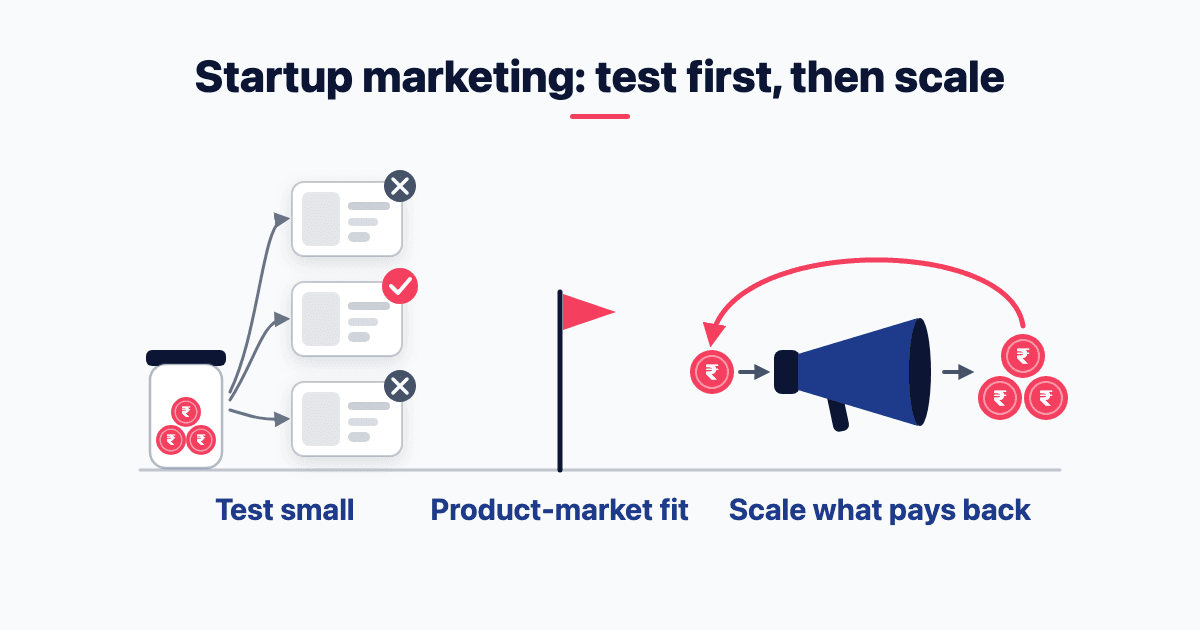
Before product-market fit, money buys learning, not growth. So size the budget by what you need to learn. My guide to marketing strategy for startups covers what marketing should do at this stage. This section covers only the number.
Ask one question per test. Before fit, it's about the message and the customer, not the channel's cost. For example: "Which of two messages brings paying customers who come back, at ₹2,000 or less each?"
Pick the event you'll count. A paying customer who comes back within one repeat cycle (your usual gap between orders), or a qualified lead. Never a click.
Decide how many conversions you need to trust the result. My rule of thumb is about 30, the same floor Google suggests for judging Smart Bidding results (Google Ads Help). It isn't a statistical test, but below it a lucky week can look like a winning message.
Multiply. Conversions × the cost per conversion you can afford = your media budget.
Add goods and services tax (GST), and budget in cash. Buying from Google India Private Limited, most advertisers pay 18% GST, per Google Ads Help on taxes. So ₹1 lakh of media is ₹1.18 lakh out of the bank. Ask your chartered accountant whether you can claim it back as input tax credit; this isn't tax advice.
Time-box it. Set a decision date a few weeks out, or after one repeat cycle, whichever is later. On that date, keep, kill or rework.
Here's an illustrative example. Say you can afford ₹2,000 per paying customer. Thirty customers means ₹60,000 of media, or ₹70,800 in cash with GST. Run two tests at most, and the round costs about ₹1.42 lakh.
Why two at most? Splitting a small budget starves every part of it. Take my IIT Kanpur session sheet of 20 September 2026, The Morning After the Machine. It works through ₹1 lakh a month for a brand with a ₹799 average order. About ₹60,000 on Meta, at about ₹320 per customer, buys "~185 purchases / month".
Spread across three ad sets, that's about 14 purchases a week in each. The sheet's verdict: "Permanent learning. Erratic and expensive." None of the three gets enough data to settle. It's a worked teaching example, so run your own numbers.
After product-market fit: how do you find your spending ceiling?
Your spending ceiling is the most one new customer can cost and still pay back inside the window you can fund. Once you have product-market fit, that's the number to manage.
Start with contribution: what one customer leaves you after product cost, channel and payment fees, and returns. Multiply the monthly contribution by the months of payback you can carry. That's the ceiling. For example, ₹500 a month over a six-month window gives a ceiling of ₹3,000 (illustrative).
If nobody on your team owns the unit economics, close that gap first, with outside help if you need it. Every other number rests on it.
Then the budget follows. Count the new customers you can win while each one stays within the ceiling. Multiply that by what they cost, then add the fixed lines: people, tools and production. That's the honest answer on ad spend too: as much as keeps the next customer under the ceiling.
Raise the budget in steps. Watch what the last step bought, not the average. The average hides the point where extra spend stops paying back.
Price every channel against that one ceiling. OurBus is now run as "a six-channel portfolio managed against one blended cost target, each channel priced" (OurBus case study).
Write down what makes you act before you spend. The override rule in my IIT Kanpur sheet starts with a ceiling on cost per acquisition (CPA). Then it says act "if CPA runs above 1.3× the ceiling for 3 days". Use it, or write your own.
Running a D2C brand? First orders and repeat orders give you different ceilings. The D2C ceiling maths works through both.
How does the budget change for SaaS, apps, services and marketplaces?
The method stays the same. What changes is the unit you budget against.
B2B SaaS: budget against a paying account, not a demo. The ceiling is monthly gross margin per account × the payback months you can fund. Count sales salaries in the cost, because a demo isn't a customer.
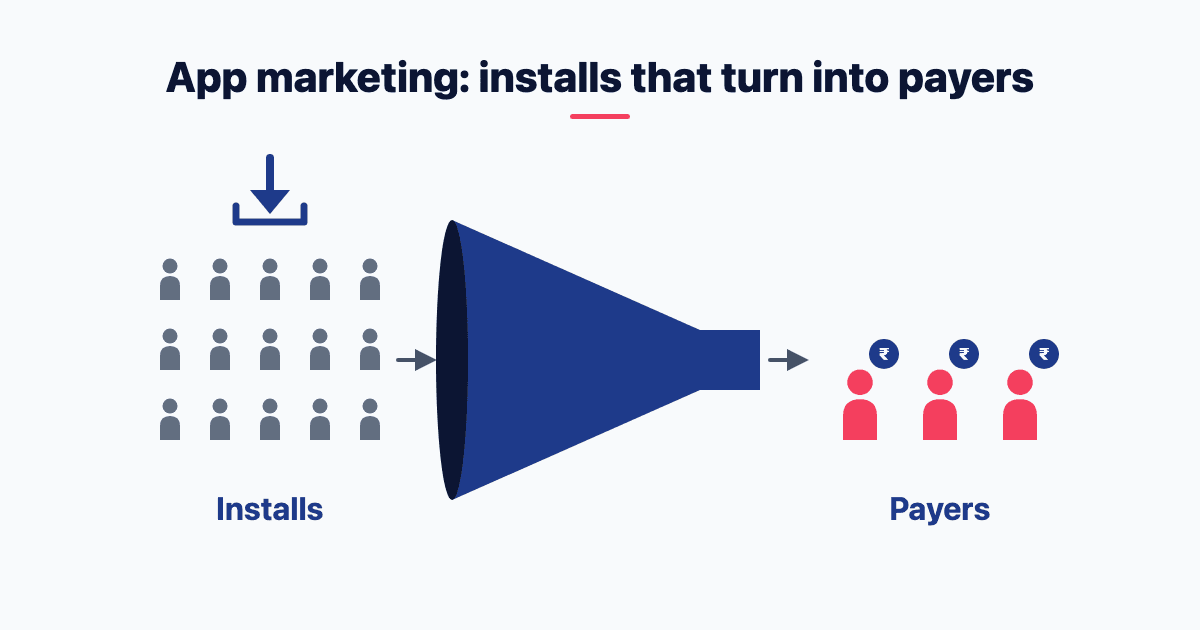
Consumer app: budget against a payer, not an install. Your ceiling per install is your ceiling per payer × your free-to-paid rate. A ₹1,000 ceiling per payer at a 5% rate allows ₹50 per install (illustrative).
Services and lead-generation businesses: budget against a closed deal. Your ceiling per lead is your ceiling per deal × your win rate.
Marketplace: two sides, two ceilings. Fund the scarce side first.
The trap is putting two business models under one target. OurBus Charters, the group and corporate coach-hire business, shares an ad account with the scheduled-coach business. Its cost per conversion was 6.5× the cost of a scheduled-coach seat, a ratio from the client's Google Ads scorecard.
The case study's point: a far bigger booking justified the higher cost; not knowing the ratio was the failure.
So blend channels within a business model. Never blend two models.
How should you split brand and performance spend?
The best-known answer is 60:40. It comes from The Long and the Short of It, presented by the UK's Institute of Practitioners in Advertising. Its slides describe a meta-analysis of "996 campaigns", "700 brands" and "83 categories" in its Effectiveness Databank.
The slides put the best "activation share of budget" at about 40%: "The 60:40 rule". So roughly 60% goes to brand and 40% to short-term sales activation, which is where performance marketing sits.
Read it for what it is. These are established brands, measured over years. Before product-market fit, you have no brand to compound yet, so the split is a later question.
A more useful question for a startup: what single target will every rupee be judged against? I saw this work at BYJU'S, where I was Vice President, Marketing. Mass media, digital and on-ground activity ran as one mix, "managed against one cost-per-lead target".
Cost per lead fell 70% over my tenure (figures from public record and my tenure). That was national scale, not a seed budget. But the principle travels.
You can also see brand spend working without a brand study. The same IIT Kanpur sheet says: "Watch brand queries in Search Console the week after Meta goes live. That is Meta's work showing up in Google's report." Its rule: "Budget for the loop, not for the channel."
Then judge performance spend net of brand demand. OurBus once mixed the two in one number. Searches for your name are demand you already earned, not demand your ads created.
The objection: "We need to outspend our rival, even past the ceiling"
Sometimes spending past the ceiling looks like the only way to keep up.
Spending to grow is fine while the next customer still pays back under the ceiling. Past it, each extra customer costs more than they bring back inside the window you can fund. The OurBus case study sets the same bar: revenue has to outgrow the spend behind it.
There, revenue grew 46.9% on 30.8% more spend. That gap between growth and spend is the story an investor should want to hear.
What to do this quarter: your marketing budget worksheet
Write down your stage: before or after product-market fit.
Before fit: for at most two message tests, write the question, the event, the conversions needed and the cost you can afford. Multiply.
After fit: write contribution per customer and your payback window. Work out the ceiling.
Add GST to every media line, and budget in cash.
Write your override rule (1.3× the ceiling for 3 days, or your own) before you spend.
Track marketing cost as a share of revenue every month, as an output.
Setting next quarter's number? Book a call and I'll check your ceiling maths with you.
Frequently asked questions
Does a marketing budget include salaries?
Yes, for the spending decision. Your ceiling needs the all-in cost of a customer: people, agency or fractional fees, tools, production and media. Track media on its own line too, so you can see what moves with spend. If you're weighing part-time leadership, here's what a fractional CMO costs in India.
Is GST charged on Google Ads in India?
Yes. For purchases from Google India Private Limited, Google Ads Help lists 18% integrated GST, or 9% central plus 9% state GST for Haryana bill-to addresses. Special economic zone advertisers pay 0%. Tax deducted at source (TDS) on ad payments is "2% excluding GST", "subject to change". Ask your chartered accountant what you can claim back.
What is a good marketing budget for an e-commerce startup in India?
There's no honest single number. Inc42's 2021–22 data on large, funded companies shows ad spend at 15.61% of revenue for Lenskart, "around 42%" for Mamaearth and 80% for Purplle. Set yours from your payback ceiling instead. My D2C guide shows how first and repeat orders change the ceiling.
How much should a small business spend on marketing per month?
Work backwards from one customer. Multiply the customers you need this month by what one may cost under your ceiling. Add fixed costs such as tools and people, plus GST on media. For example, 20 customers at ₹1,500 each is ₹30,000 of media, or ₹35,400 in cash with 18% GST (illustrative).
How much of a funding round should go to marketing?
There's no rule. Writing on Inc42 in 2012, a guest author said most startup plans he saw "keep aside 40% of their raised capital for 'marketing' costs". That's one observer's 2012 view of other people's plans, not a benchmark. Fund the test budget first, protect your runway, and raise spend only once customers pay back.
- Founders
- Startups
- Marketing budget
Written by Siddhesh Joglekar
Fractional CMO and AI marketing consultant Siddhesh Joglekar helps founders and growth-stage teams build marketing engines that compound.