Marketing
D2C marketing strategy in India: start with the P&L of one order
D2C marketing strategy for Indian brands, read off the P&L of one order: channel fees, returns, the most a customer can cost, and what earns the repeat.

· 15 min read
D2C marketing in India is the set of decisions about where a brand sells (its own website, Amazon and Flipkart, quick-commerce apps, WhatsApp), what it pays to win each customer, and what brings that customer back. The clearest way to build a D2C marketing strategy in India is to read those decisions off the profit and loss (P&L) of one order. Every marketing rupee should improve one of its lines. Fix the revenue you are losing, work out the most a new customer can cost, then scale ads and creators.
I'm guest faculty at IIM Calcutta, teach the IIT Kanpur digital marketing sessions quoted below, and work with The 1970 Shop.
The guide takes seven lines in turn: leaks, channel take, cash on delivery and returns, the acquisition-cost ceiling, ads and creators, repeat orders, and free demand.
Where does the money from one D2C order actually go?
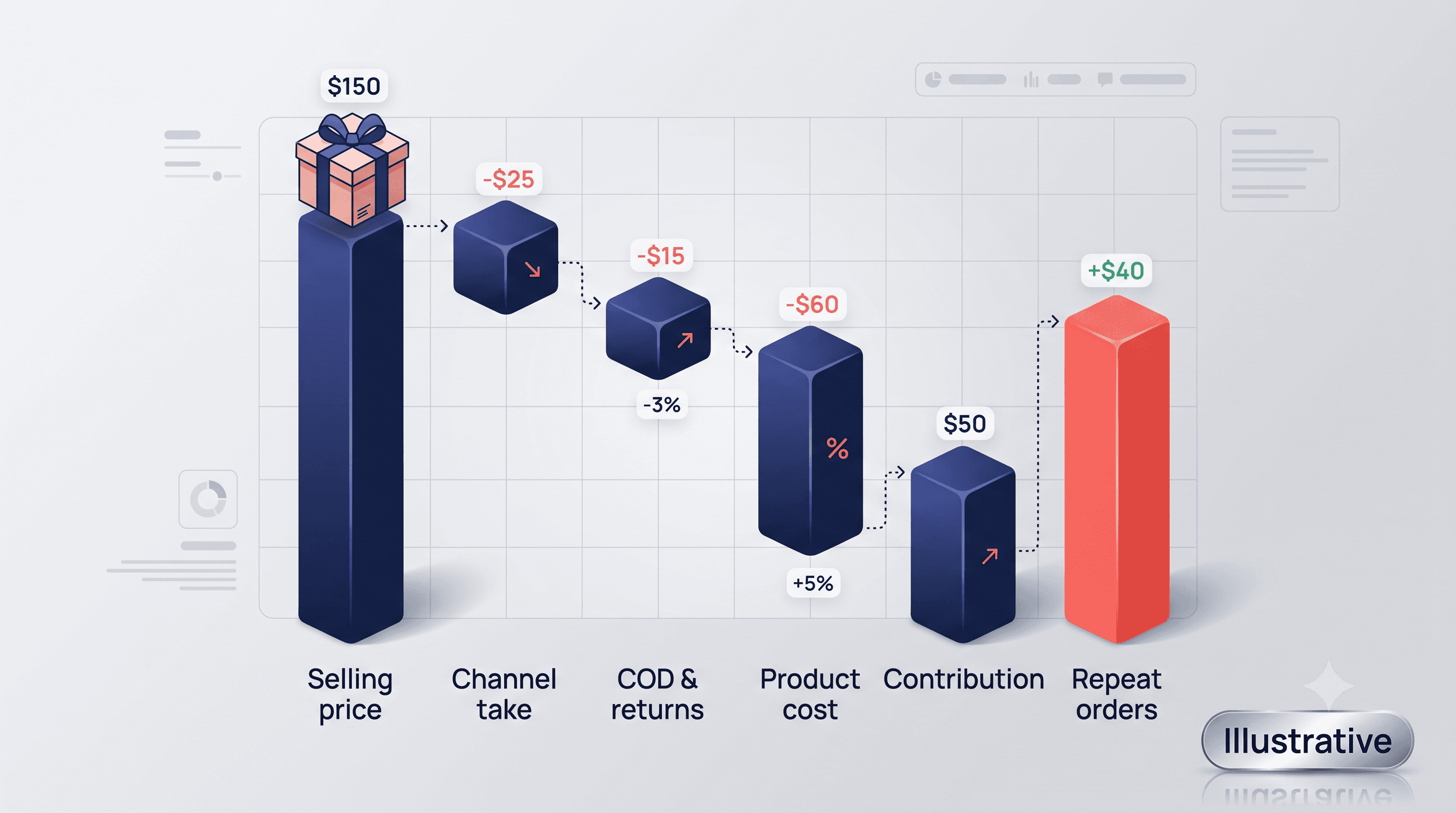
Follow a new customer's first order on your website. The numbers are illustrative, not a benchmark.
Net selling price (after GST and discounts): ₹800
Minus channel take (gateway fee and shipping): −₹120
Minus cash-on-delivery and returns allowance: −₹60
Minus product and packaging cost: −₹300
Contribution before marketing: ₹320
Minus the cost of winning this new customer: −₹400
Contribution after marketing, first order: −₹80
Plus repeat orders in six months (0.6 orders × ₹300 each): +₹180
Contribution per customer after six months: +₹100
This order loses ₹80 the day it ships and makes money only if the customer comes back. Marketing moves most of these numbers, not just acquisition.
Leaks (line 1) and free demand (line 7) sit outside a single order, but both change what every customer costs. That is why a D2C marketing strategy is a P&L exercise before it is a channel list.
How much revenue are you already losing before you spend a rupee?
Line 1 of 7.
A shopper sees your Reel, searches for you on Amazon and finds a dead listing: demand you created, often paid for, then lost.
Two findings from my audit of The 1970 Shop, a nostalgia-snacks brand selling on Shopify and Amazon: 10 revenue leaks found in 6 weeks, and 8 of 10 Amazon listings inactive. These are findings from the July 2026 audit, not results. Revenue scale is withheld, and the programme is in progress with outcome figures to follow.
The audit also found that Google Analytics 4 and Meta were not connected to Shopify, so no ad decision could be checked against revenue. The leaks were ranked by revenue at stake and effort to fix, and most were fixable without new spend.
Check your own brand:
Listings: is every marketplace listing live, buyable and at the right price?
Stock: is every advertised product in stock wherever you send traffic, including your Google product feed?
Measurement: do purchases (not clicks) flow from your store back to Google Analytics and Meta?
Product data: can Google read your prices, availability and review counts?
Checkout: where do orders fail: payment, pincode serviceability or cash-on-delivery rules?
Rank yours the same way; close the cheap, high-stakes ones first.
Own site, marketplace or quick commerce: which channel takes the smallest cut?
Line 2 of 7.
Channel take is everything a channel keeps before the money reaches you, including the ads you must buy there to be seen. It is easy to under-count: fees sit in settlement reports, in-platform ad spend in the marketing budget.
Own website
What it takes: Gateway fee, shipping, apps, and every visitor you pay to bring
What you get back: The customer's data and consent, pricing control, retargeting and WhatsApp
Suits, and when to add it: Brands with a story, bundles, subscriptions, repeat categories. Add from day one
Amazon, Flipkart
What it takes: Commission and fixed fees, shipping, sponsored ads to stay visible
What you get back: Existing search demand, trust, delivery
Suits, and when to add it: Products people search for by name or need, and gifting. Add once listings stay live and in stock and your price survives the fees
Quick commerce (Blinkit, Zepto, Instamart)
What it takes: Platform terms, in-app ads, stock held in dark stores
What you get back: Impulse and top-up demand, delivered in minutes
Suits, and when to add it: Low-ticket, frequent consumables and impulse buys, once they pass the test below
Amazon.in's seller fees page lists referral, closing, weight-handling and other fees. Its category tables show a zero referral fee at or below ₹1,000 in many categories (dried fruits and nuts, for example, move to 9% above ₹1,000). Pull your category's row before you price a combo pack.
On quick commerce, a growing share of the take is advertising, because visibility on the apps is increasingly bought. An industry insider quoted by Storyboard18 in June 2026 puts search clicks at anything from low single-digit rupees in niche categories to ₹10–25 in competitive fast-moving consumer goods and impulse categories. In Storyboard18's August 2026 report, Gopa Menon, co-founder and chief operating officer of theblurr, says premium placements can cost 30–40% more during Diwali than in a regular month.
Quick commerce earns a place when all four hold:
The product is an impulse or top-up buy, priced for a small basket.
You can keep every dark store you're listed in stocked. As the scorecard on Zepto argues, the hardest problem in quick commerce is inventory, not delivery.
Contribution per order still clears after the platform's terms and ads.
You get sales and stock data by city and product often enough to act on. Ask before you sign.
What do cash on delivery and returns really cost?
Line 3 of 7.
A cash-on-delivery order refused at the door, or impossible to deliver, comes back as a return to origin (RTO). You pay shipping both ways and lose the packaging, sometimes the product too, especially food with a shelf life. Returns after delivery add their own reverse shipping and write-offs. Price it into every order:
Allowance per order = share of orders that fail or come back × cost of each failure (two-way shipping, packaging and stock written off).
In the illustrative order, ₹60 is that allowance: one order in eight failing, at ₹480 a failure. Take your own share from your shipping partner's reports and your returns log, not an industry average. The IIT Kanpur session notes put it bluntly: "Use net-of-RTO contribution margin, not gross. This is the #1 mistake — it flips the verdict" (Buy Intent, Not Clicks).
The levers, easiest first:
A prepaid incentive that costs less than the failure it avoids.
Confirmation before dispatch. A WhatsApp order confirmation is a utility message (see line 6). Hold or call the orders nobody confirms.
Address and pincode checks at checkout.
Product-page guidance: size and fit for apparel, usage and shelf life for food and personal care.
What is the most a new customer can cost you?
Line 4 of 7.
The most you can pay to win a customer is arithmetic, not a benchmark:
Contribution per order = net price − channel take − cash-on-delivery and returns allowance − product and packaging cost.
First-order ceiling = contribution per order. Pay more and the first order loses money.
Payback ceiling = first-order contribution + (repeat orders expected in your payback window × contribution per repeat order).
Paying ₹400 for a customer whose first order earns ₹320 loses ₹80. Whether that is a mistake depends on the second order:
0.2 repeat orders in six months: ceiling ₹320 + 0.2 × ₹300 = ₹380, so you lose ₹20 per customer.
0.6 repeat orders: ceiling ₹500, so you make ₹100 per customer.
1.0 repeat order: ceiling ₹620, so you make ₹220 per customer.
A repeat order earns ₹300 rather than ₹320 because reaching an existing customer still costs something. All figures are illustrative.
The payback window is a cash decision: a brand with a year of runway can wait longer for the second order than one that must raise in three months.
There is no trustworthy public average acquisition cost for Indian e-commerce. The figures on the agency blogs that rank for D2C marketing strategy mostly carry no source, and cost swings with category, price, channel and season, so manage to your own ceiling. Building that model from settlement data, return-to-origin reports and cohort repeat rates is the core of unit economics work.
How should you buy customers: performance ads and creators?
Line 5 of 7.
Meta and Google sit at different points of the D2C marketing funnel. Meta (Instagram and Facebook) interrupts people who weren't looking and creates demand; Google Search and Shopping intercept people already looking and collect it.
Separate demand you create from demand you collect
Blended return on ad spend flatters an account by mixing in customers who would have bought anyway: brand searchers, retargeted visitors already on their way back, existing customers who only needed a discount code. Your ceiling needs new-customer acquisition cost: prospecting spend divided by first-time buyers.
OurBus, a US intercity coach operator, started with no separation between brand and generic demand, so brand traffic flattered everything else. Splitting the paid account into channels and pricing each one made every channel's real contribution visible. The method transfers to D2C because every blended number mixes demand created with demand collected.
To test retargeting, use the pause test from the Build the Machine session notes: switch it off for a window and divide the rupees saved by the orders lost. That is retargeting's real acquisition cost. Far above your prospecting cost? It was claiming sales, not making them.
The same notes say to plan creative as concepts, not versions: eight different arguments (problem, proof, price, how-to, objection, comparison, confession, social proof), not eight colour variants of one. If AI will produce them, see spending your first ₹10 lakh on AI. And optimise for the event you actually want: as the IIT Kanpur Intercept → Interrupt notes put it, "a 'cheap' cost on the wrong event is the most expensive number in marketing."
Creators: two jobs, one set of rules
Creators create demand with their own audience and supply raw material for your ads, provided the contract gives you usage rights. Write the usage terms before the shoot.
The disclosure rules reach the brand as well as the creator:
Department of Consumer Affairs. Its "Endorsement Know-hows!" (Press Information Bureau, 20 January 2023) require creators to disclose any material connection with the advertiser, including free products, discounts, barters and gifts. Terms such as "advertisement", "sponsored" or "paid promotion" can be used, and the disclosure must be "extremely hard to miss". The same release notes that the 2022 misleading-advertisement guidelines set out responsibilities for manufacturers and advertisers too.
Advertising Standards Council of India. Its influencer advertising guidelines say the label must be upfront and prominent, and not buried in a group of hashtags or links. On picture or video posts without text, it must sit on the image: at least 3 seconds for videos of 15 seconds or less, a third of the length for videos under 2 minutes, and the whole promoted section for longer ones.
Health and nutrition claims. If your creator makes prevention, treatment or cure claims for a health or nutrition product, the same guidelines require relevant qualifications, stated upfront. Creators without them can still share generic information that isn't technical advice; the guidelines' own example is a health-food company working with a chef or food blogger to promote a meal service.
These are summaries of the primary texts, not legal advice.
How do you earn the second order on WhatsApp without burning your list?
Line 6 of 7.
Opt-in is a platform rule
WhatsApp is the obvious place to earn the second order in India. But the WhatsApp Business Messaging Policy (last updated 23 September 2026) lets you contact people only if two things are true. They have given you their number, and you have "received opt-in permission from the recipient confirming that they wish to receive subsequent messages or calls from you". You must honour opt-outs, and Meta's systems "may limit the amount of messages a business can send" based on blocks and reports.
The IIT Kanpur Build the Machine notes specify one unticked box per channel, not required to submit the form, because "a WhatsApp chat is a conversation, not consent. The tick is the consent."
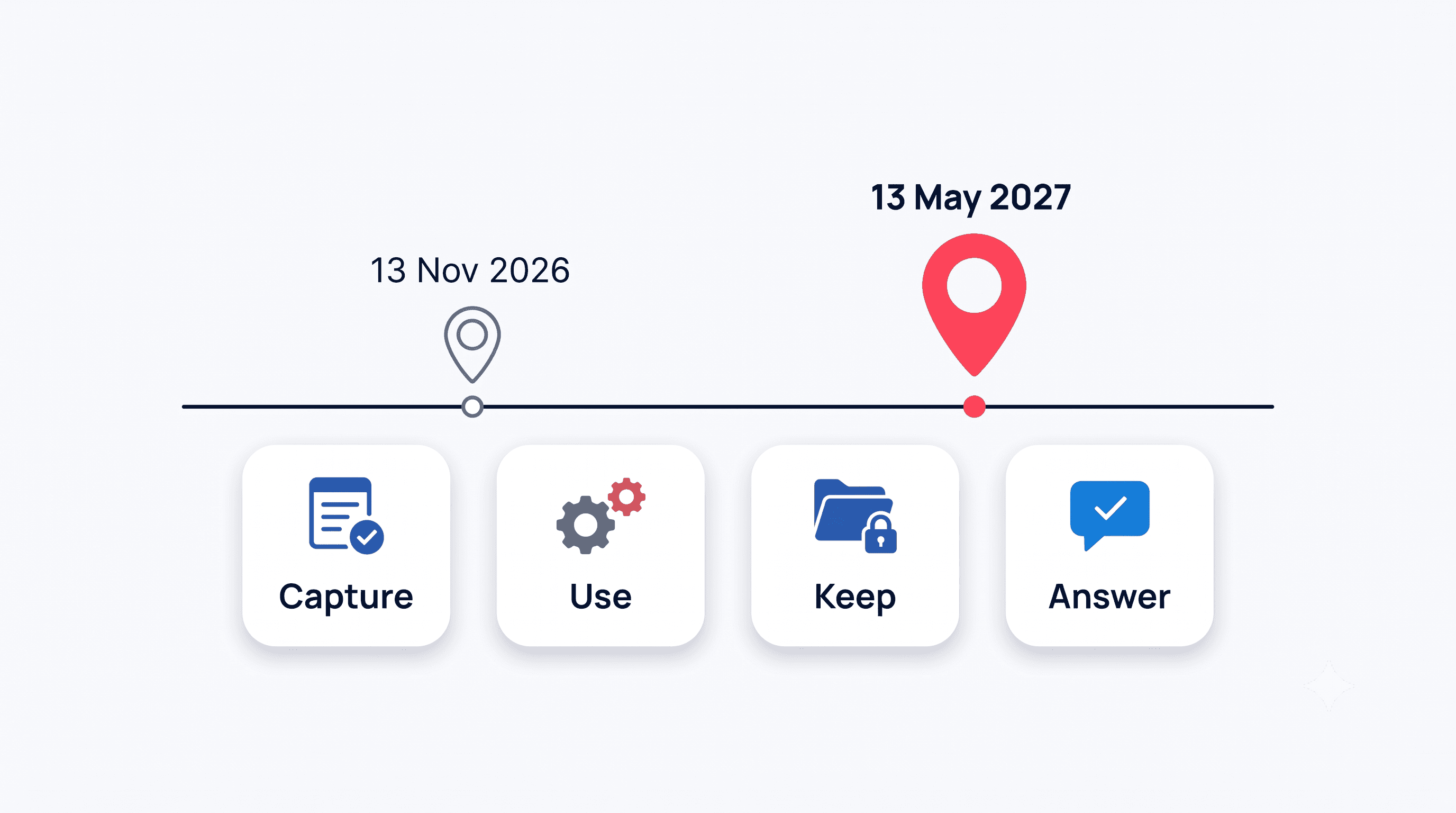
The Digital Personal Data Protection Act, 2023 points the same way. Its Section 6(1) requires consent to be "free, specific, informed, unconditional and unambiguous with a clear affirmative action". That duty comes into force on 13 May 2027 (G.S.R. 843(E), 13 November 2025).
Price the flows, then design them
Per Meta's WhatsApp pricing documentation, businesses have been charged per delivered template message since 1 July 2025, at rates that differ by category (marketing, utility, authentication). From 1 January 2026, a higher India marketing rate took effect.
From 1 October 2026, Meta also charges for utility templates sent inside an open customer-service window. From the same date, it charges for free-form service replies beyond 1,000 delivered a month per business phone number. Read the current rate card before you model it.
So split your flows:
Utility: order and cash-on-delivery confirmations, and dispatch updates. They cut failed deliveries and "where is my order" queries.
Marketing: reorder reminders timed to when a pack runs out, and offers to opted-in buyers. They earn the repeat order; overuse invites blocks and reports.
For an eligible small brand without an API setup, Meta introduced Business AI for the WhatsApp Business app in India in May 2026 (Meta's announcement). Meta said it can answer customers and recommend products, with UPI payments in the chat "starting soon".
Where does free demand come from?
Line 7 of 7.
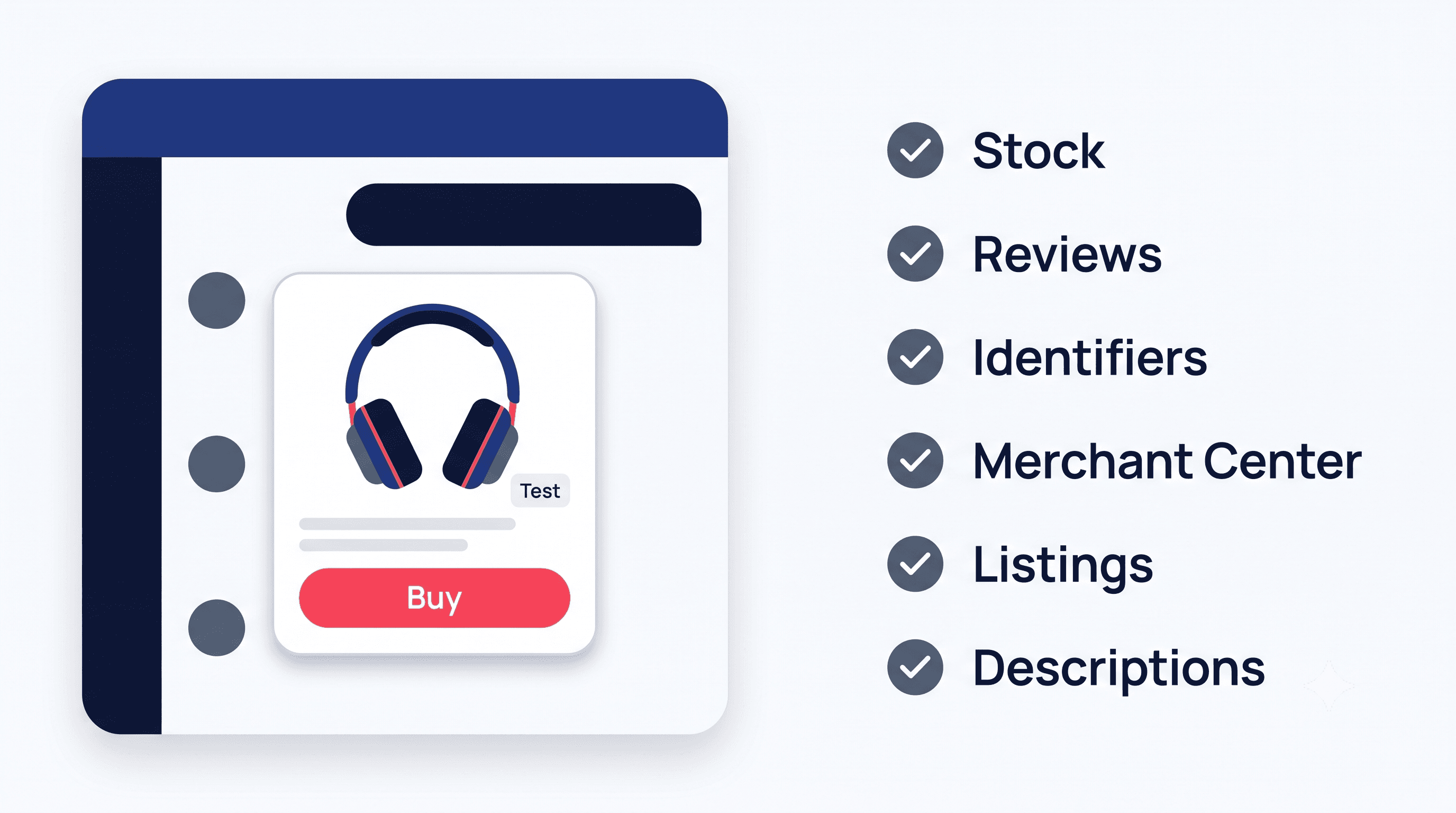
With a Merchant Center free listing, "the products you sell can appear at no cost on Google Search, Google Maps, Gemini, YouTube, the Shopping tab, Google Images, and Google Lens". Approval doesn't guarantee your products are shown; Google matches on the data you provide. Gemini is on that list, so the same product data now reaches AI answers too.
On Shopify, the Google & YouTube channel syncs the products available in your online store automatically. On the product pages, Google's product structured data guide says providing both structured data and a Merchant Center feed "maximizes your eligibility". For star ratings, review snippet markup needs a ratingCount or reviewCount, and Google doesn't guarantee the stars will show.
Broken review markup is a quiet leak: at The 1970 Shop, reviews Google could not read were on the leak list. If you collect and publish reviews, the Bureau of Indian Standards' IS 19000:2022 applies to "any organization that publishes consumer reviews online, including suppliers/sellers of products and services that collect reviews from their own customers" (Press Information Bureau, 12 December 2022). Read it before you build a review flow.
How do you read this P&L every week?
First, wire the store. The same Google & YouTube channel lets you connect an existing Google Analytics 4 property or create one. Meta's Conversions API is switched on by choosing the "Enhanced" or "Maximum" data-sharing level (Shopify Help Center). In Shopify's words, "data sent from server to server can't be blocked by browser-based ad blockers."
Shopify says both levels collect the customer's name, location, email address and phone number as well as browsing behaviour, so make sure your privacy notice and consent cover that.
Then track one number per line (the Monday check lists them). Borrow the rhythm used at OurBus: three flag signals every Monday, a Friday deep dive on anything flagged, and a correction for conversion data that matures over two weeks. Don't judge a D2C campaign on numbers still coming in: new cohorts are still buying, and failed deliveries return days after dispatch.
How should a D2C marketing strategy in India change from ₹1 crore to ₹50 crore?
What needs the founder's attention changes with scale. Treat the table as guidance, not a benchmark; the bands are rough.
Around ₹1 crore
Job of marketing: Prove customers come back and find one channel that pays back inside the ceiling
Who can run it: Founder, with freelancers
Number that governs: Contribution per order and 90-day repeat
Around ₹10 crore
Job of marketing: Scale what pays back and add marketplaces or quick commerce on purpose
Who can run it: A marketing head or a fractional CMO, with specialists
Number that governs: New-customer acquisition cost by channel
₹50 crore and above
Job of marketing: Lower the average cost per customer through brand, retention and search, negotiate channel take, and test what is truly incremental
Who can run it: A full-time marketing leader with in-house performance and retention teams
Number that governs: Contribution after marketing, by cohort
For the middle row, see what a fractional CMO costs in India.
How much should you spend? Set the budget from the ceiling, not a percentage of revenue. It is the new customers you can buy below your payback ceiling, times what they cost, plus the retention work that earns repeat orders. A borrowed percentage imports another brand's margins, repeat rate and channel mix.
For monthly paid budgets, the Intercept → Interrupt notes teach a ladder. Under ₹1 lakh a month: Meta conversion campaigns plus Google brand defence only. From ₹1–3 lakh: add retargeting depth. From ₹3 lakh: YouTube top-of-funnel earns a seat. It is a teaching rule of thumb; run the maths on your own numbers.
The objection: "Grow first, fix the plumbing later"
The strongest counter-argument: festive season is when Indian shoppers spend, investors want a growth curve, and competitors buy attention while you audit.
Parts of that are right, and a fix list can become an excuse never to spend. But scaling spend on a leaking order multiplies the leak: each extra rupee sends more traffic to the dead listing, the out-of-stock product and the unconfirmed cash-on-delivery order. Festive season is when those leaks cost most, because premium quick-commerce placements cost more during Diwali (see line 2).
The answer is sequence, not "stop". Fix the leaks that multiply spend first (stock on advertised products, measurement, cash-on-delivery confirmation), then raise the budget. At The 1970 Shop, the fixes were sequenced before any increase in media budget. For a fundraise, contribution after marketing by cohort answers what top-line growth can't: what does a customer actually earn you?
Your Monday P&L check
Do these this week, one per line, then track the numbers every Monday.
Listings and stock: every listing live, every advertised product in stock. Weekly: stock-outs on top products.
Channel take: per order, by channel, in-platform ads included. Act if a channel's take rises two weeks running.
Cash on delivery: orders confirmed before dispatch. Track cash-on-delivery share and return-to-origin rate; act if either jumps after a campaign or in a new region.
Contribution: per order, net of failed deliveries and returns, with your payback ceiling next to it. Act if it falls below what the ceiling assumed.
Acquisition: new-customer cost, separated from brand search, retargeting and discount-code sales. Act if it crosses the ceiling.
WhatsApp: every number traces to an opt-in; flows split into utility and marketing. Track 60- and 90-day repeat rate by monthly cohort; act if a new cohort repeats less than the last.
Free demand: Merchant Center feed approved, no markup errors in Search Console. Act if clicks from free listings and organic search fall while spend is flat.
If you want a second pair of eyes on your order P&L before you raise the ad budget, book a call.
- Unit economics
- D2C
- Quick commerce
- Marketing
Written by Siddhesh Joglekar
Fractional CMO and AI marketing consultant Siddhesh Joglekar helps founders and growth-stage teams build marketing engines that compound.