Marketing
Google Ads vs Meta ads: which should an Indian business start with, and what each costs
Google Ads vs Meta ads for an Indian business: which to start with by category, the payback test for Search, and the minimum spend each needs to learn.
· 11 min read
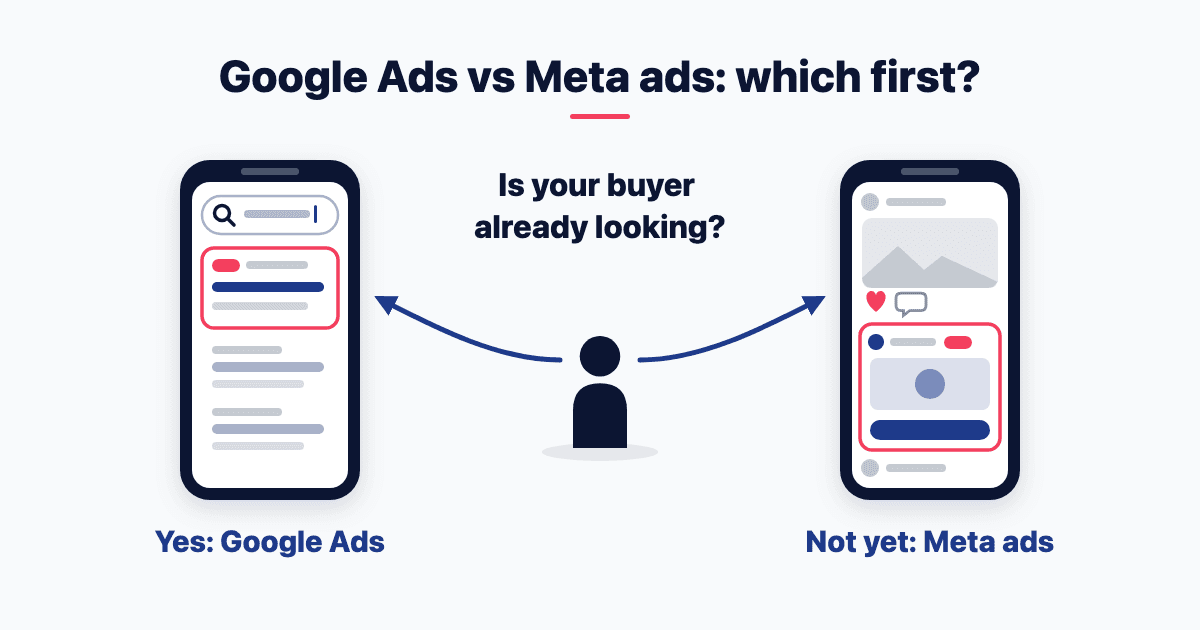
Meta plants. Google harvests. So the Google Ads vs Meta ads choice turns on one question: is your buyer already looking? If they search for what you sell, and one sale pays for its clicks, start with Google Ads. If nobody searches yet, start with Meta. Add the second only when your budget can feed both enough sales to learn.
What's the difference between Google Ads and Meta ads?
Google Ads intercepts demand. On Search, your ad appears when someone types what you sell. With cost-per-click bidding, "you pay for each click on your ads" (Google Ads Help on cost per click).
Meta ads, still often called Facebook ads, interrupt. Your ad appears to people scrolling Facebook and Instagram who weren't looking for you.
That opening line is from my Morning After the Machine session sheet, taught to an IIT Kanpur cohort in September 2026. It adds: "Google targets the query. Meta targets the person." Someone who types "buy millet snacks online" already noticed the product and wanted it, somewhere else. "Somebody paid for those steps."
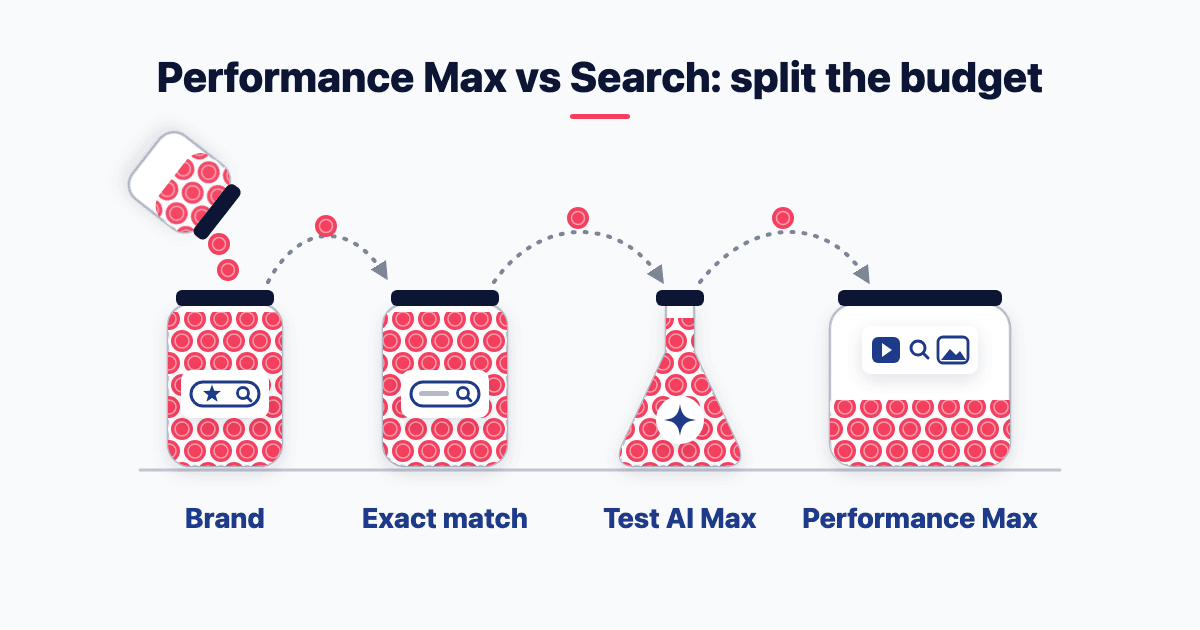
So the real split is search ads vs social ads, not Google vs Meta. Google sells feed-style reach too. A Performance Max campaign can "access all Google Ads inventory, including YouTube, Display, Search, Discover, Gmail, and Maps, from a single campaign" (Google Ads Help on Performance Max). My Intercept → Interrupt session puts it in one line: "Search captures demand; YouTube and Meta create it."
Neither platform lacks reach in India. Google had 96.63% of India's search-engine market in September 2026, per StatCounter. Meta's ad tools showed 481 million Instagram users and 403 million Facebook users in India in late 2025. Google's showed 500 million on YouTube (DataReportal, Digital 2026: India). Those are ad-reach figures, not monthly active users. Intent is the difference, not size.
Google Ads vs Meta ads: which is better to start with?
Answer three questions in order, with your own numbers. They're the exercises I run with my IIT Kanpur cohorts.
Does anyone search for what you sell?
Start with my search-volume prompt: "Is my category search volume big enough to grow on Google Search alone? Show the math: searches × realistic click share × conversion rate."
Take the searches from Google's Keyword Planner, with the location set to India (Google Ads Help on Keyword Planner).
An illustrative example: 8,000 searches a month × 5% clicking your ad × 2% buying = 8 sales a month. If you need 200, Search alone can't carry you, however well the account runs.
Can Search pay back inside one purchase?
At a 2% landing-page conversion rate, one sale takes 50 clicks, and those clicks must pay back on one order.
My Buy Intent, Not Clicks session sets teaching bands for a search click. They're ₹8–30 for direct-to-consumer (D2C) products, ₹15–60 for edtech commercial terms and ₹150–500+ for financial services. These are June 2026 teaching estimates, not market data. At 50 clicks, one sale costs:
D2C product: ₹400–1,500.
Edtech, where the page sells the course directly: ₹750–3,000.
Financial services: ₹7,500–25,000 or more.
Compare that with what one first order leaves you, after you count failed cash-on-delivery orders. An illustrative ₹1,200 D2C order that leaves ₹300 fails across its whole band. A ₹15,000 course that leaves ₹6,000 passes.
For lead generation, divide again by your close rate. Illustrative: ₹40 a click at a 5% form-fill rate is ₹800 a lead. If 10% of leads enrol, each enrolment costs ₹8,000, and the same course fails. So judge Search on cost per closure, not cost per lead. If your page converts below 2%, start with landing-page conversion fixes.
Can you feed the platform's learning?
Last, the floor. My rule: "don't run a channel your runway can't wait out or your pixel can't feed." The minimum-spend section below has the sum.
What the three tests usually say, by category (my guidance, not a rule):
Local and urgent services (a clinic, repairs, a coaching centre near you): Search first. India's medical regulator allows clinics only factual ads. A doctor's own ads are an open question: see my guide for doctors.
High-ticket lead generation (loans, insurance, real estate, business-to-business sales): Search first for buying terms, if the gate passes on cost per closed deal.
Low-ticket D2C and e-commerce: usually Meta ads before Google Ads, because Search fails the one-order test. See the D2C budget ladder and order maths.
A new category nobody searches for: Meta or YouTube first. There's nothing to intercept yet.
Edtech: Search for commercial terms around exam dates, and Meta to reach the parent or learner. See planning paid media around the exam calendar.
Google Ads vs Meta ads cost in India: what will you pay?
I couldn't find a neutral, published Indian benchmark for either platform, and the agency pages that rank give no source for their figures. So start from my June 2026 estimates, and replace them fast:
Google Search, per click: the bands in the payback test above.
Meta, per thousand impressions: ₹150–400 for D2C conversion campaigns.
Meta, per lead: ₹40–150 for edtech, up to ₹200–600 for high-ticket offers.
They're classroom estimates, not market averages. Within three weeks, your own account's numbers outrank every band here.
For Google, you can see real bid ranges free, before you spend. In Keyword Planner, set the location to India. "Top of page bid (low range)" is about the 20th percentile of what advertisers paid; the high range is about the 80th. Both use bids from the last 30 days (Google Ads Help on Keyword Planner).
What you bid isn't always what you pay. Your maximum bid is "the most you'll typically be charged for a click, but you'll often be charged less" (Google Ads Help on cost per click).
On Meta, your real number appears once you spend. Treat your first two to three weeks as the benchmark.
Then add tax. Buying from Google India, most advertisers pay 18% GST (Google Ads Help on taxes in India). My startup budget guide covers the GST detail. For Meta, check the tax line on your invoice. Ask your chartered accountant; this isn't tax advice.
What's the minimum spend each platform needs to learn?
A budget that can't buy enough conversions can't learn. But the two platforms publish different kinds of number. Meta gives a weekly count for leaving learning; Google gives a learning time, then a sample size for judging. Each is a floor for one platform; how much to spend in total is a separate question.
Google. Smart Bidding is Google's automated bidding: it uses Google's AI to bid for conversions in every auction. Its learning page gives a time, not a count.
The "Learning" status "never lasts more than 7 days". But performance "typically converges to your new goal within 1 to 2 conversion cycles", sooner with more conversion data. A conversion cycle is the time a click takes to turn into a sale or lead (Google Ads Help on Smart Bidding learning).
After that period, the same page says to evaluate "over 2 conversion cycles or a 2 week window (whichever is longer)". For an accurate read, Google recommends a period with "at least 30 conversions, such as a month or longer (50 conversions for Target ROAS)" (Google Ads Help on Smart Bidding). Target ROAS is a return-on-ad-spend target. So 30 is a sample for judging, not a learning threshold.
Illustrative: at ₹400 a conversion, those 30 cost ₹12,000 over a month or more, or ₹14,160 with 18% GST.
Meta. Each ad set learns on its own, and a significant edit sends it back into learning (Meta's developer documentation).
Meta's learning-phase help page says the exit "usually occurs after about 50 results in the week after the ad set's last significant edit". That's an exit threshold, counted per ad set, per week.
Note the "usually". Meta's developer documentation also lists a "dynamic learning phase" threshold for each ad set. So trust the learning status in Ads Manager over the round number.
Illustrative: at the same ₹400 a purchase, those 50 results cost ₹20,000 in that week, before tax, for one ad set. I plan budgets to feed that pace every week, so about ₹86,000 a month (50 × 4.3 weeks × ₹400).
My warning: "If you fire ~100–160 Purchases/month total, optimising on Purchase starves the algorithm." So when results stall, count conversions per ad set before you add rupees.
The fix: one ad set, or a higher-volume event such as initiate checkout until purchases clear the floor. Write down the weekly number at which you'll switch back.
Splitting multiplies the floors. Google's Smart Bidding learning page advises: "Consolidate ad groups and campaigns where possible to pool conversion data". On Meta, two ad sets mean two floors. Meta's help page agrees: "By combining similar ad sets, you also combine learnings."
One caution: the Google and Meta sums above measure different things, so don't rank the platforms on them.
Is Meta cheaper than Google Ads? Price the sale, not the click
Meta often looks cheaper per click or per thousand impressions. But a cheap click isn't a cheap sale. The question is which demand you're buying, and what one sale costs.
The Add-to-Cart trap I teach shows the gap, with illustrative classroom numbers. Optimised for add-to-cart, a campaign shows a cheap ₹180 per thousand impressions and ₹40 per add-to-cart. Only about 6% of those carts buy, so each buyer really costs about ₹670. Against a ₹275 net margin, it "loses ₹395 per buyer".
Optimised for purchase, it pays ₹320 per purchase and "loses ₹45 on order 1 — pays back on order 2". Meta gives you exactly what you optimise for.
Route search was "the most expensive way to buy a booking" at OurBus, a coach operator on the US East Coast. That expensive slice sat inside Google: 47% of spend for 25% of bookings. After I restructured the account, Performance Max and brand search carried the volume, with 46% of spend bringing 70% of bookings. Figures are the client's, and the shares come from the account's weekly scorecard.
Read the after share with care: it includes brand search. At the start, brand and generic demand weren't separated, "so brand traffic flattered everything else". Separate the two before you price any channel. Today OurBus runs six channels against one blended cost target, each one priced. Pricing your channels the same way is part of my performance marketing service.
What to do this quarter: one platform, then two
In Keyword Planner (India), pull monthly searches and bid ranges for your 20–30 buying terms.
Run the ceiling sum and the one-purchase gate, on what one order leaves you after failed cash-on-delivery orders.
Pick one platform and work out its floor: Meta's weekly learning count or Google's judging sample. If you can't fund it, change the event or narrow the campaign. Don't split.
Check the pixel first. Tracking must record your real sale or qualified lead before you spend.
Let it learn before you judge. On Google, allow 1–2 conversion cycles, then judge over two more cycles or two weeks, whichever is longer. On Meta, wait until the ad set leaves learning. Judge on cost per sale against your ceiling.
Add the second platform only when the first holds your target with money left above its floor. Then test whether the second channel adds sales with a holdout, not last click.
The cheapest time to run these sums is before the first rupee goes out. Book a call, and we'll put your margin, cost per click and conversion rate through the three tests.
Frequently asked questions
How much does Google Ads cost per day in India?
You choose it: each campaign runs on an average daily budget you set. Some days it "might spend up to twice" that. Over a month, it spends "no more than 30.4 times" your daily budget (Google Ads Help on overdelivery). Divide by 30.4: the illustrative ₹12,000 Google sample above is about ₹395 a day, before GST.
Which is better for real estate, Google Ads or Meta ads?
Usually Google Search first, for buyers who type a locality, a budget or a project name. Meta helps you reach buyers before they search, for example around a launch. Real estate is high-ticket lead generation, so judge both on cost per booking, not cost per lead. Site visits are your early signal while bookings build up.
Can I run Google and Meta ads together on ₹50,000 a month?
Usually not at full strength. At an illustrative ₹400 a sale, ₹50,000 buys about 125 sales a month before tax. Meta's half buys about 62, fewer than 15 a week. One ad set usually needs about 50 results in a week to exit learning (Meta's learning-phase guide). Put most on the platform that passes the payback test.
Does Google give free ad credit to new advertisers?
Sometimes, as ad credit, not cash. New-advertiser offers need an account under 14 days old at redemption, plus a set spend or action within a set time. Processing can take up to 35 days, and the credit can't cover the spend requirement itself. Terms vary, so read your offer's terms and Google Ads Help on promotional offers.
- Meta ads
- Google Ads
- Paid Media
Written by Siddhesh Joglekar
Fractional CMO and AI marketing consultant Siddhesh Joglekar helps founders and growth-stage teams build marketing engines that compound.