Marketing
Digital marketing for doctors in India: how to improve your online presence without breaking the 2026 rules
Digital marketing for doctors in India in five steps: be findable, checkable and bookable, educate, then run factual ads, inside the 2026 NMC rules.
· 15 min read
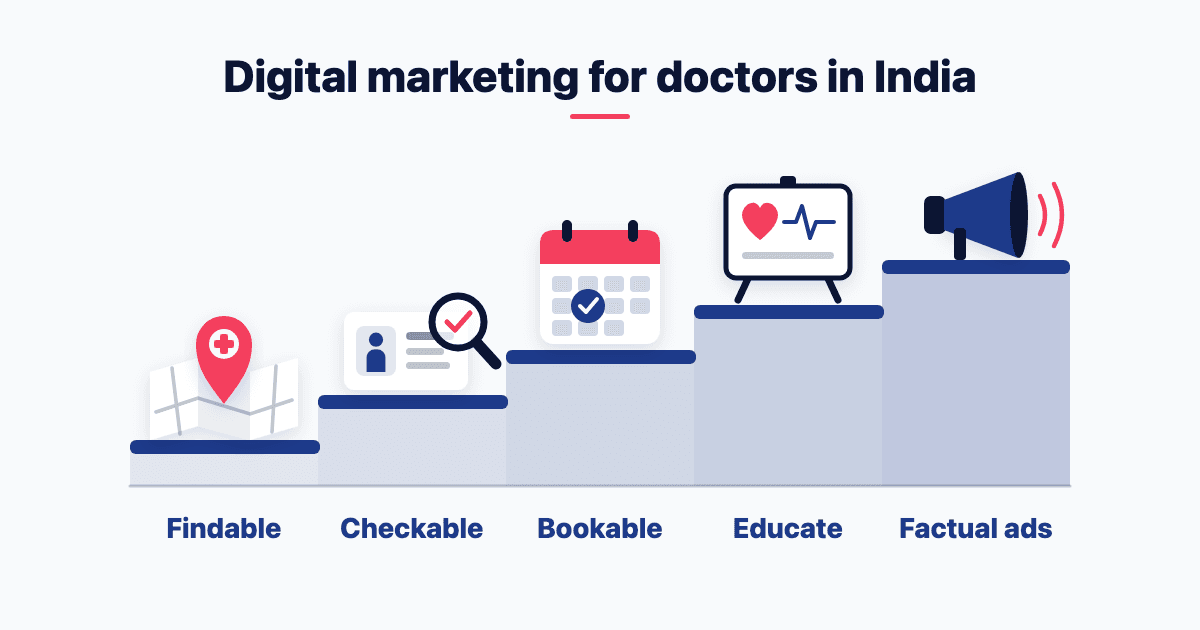
Start a clinic's online marketing with the boring part. Since 6 October 2026, the National Medical Commission's (NMC) advertising guidelines say a clinic "may advertise only factual information". So digital marketing for doctors in India now runs in this order: findable, checkable, bookable, education, and factual ads last. The first three need no ad budget.
Four agency guides came up in a web search for "digital marketing for doctors in India" on 26 October 2026. Three tell doctors to ask patients for reviews. One agency guide puts it plainly: "Ask your satisfied customers to write a review for you." Yet the guidelines say a doctor "shall not request or share patient testimonials, recommendations, endorsements or reviews for professional promotion on social media".
This guide is for general practitioners, specialists, dentists and clinic owners in private practice. Dentists follow their own 2014 Code, and each step notes where it differs. It's a careful reading of the rules, not legal advice.
What changed for doctors online in October 2026?
Two official texts came out, eight days apart: new guidelines for doctors and clinics, and an advisory for dentists.
For doctors and clinics: the NMC's Guidelines on Ethical Advertising and Public Communication, dated 6 October 2026. They "shall come into force with immediate effect".
For dentists: the National Dental Commission's (NDC) advisory of 14 October 2026. It "shall take effect immediately".
Clause 3.2 is the line that matters for marketing. It treats "digital, social-media, sponsored, targeted, influencer-led, search-engine, platform-based, audio-visual, AI-generated or AI-assisted promotional communications" as advertising "where their content or manner of dissemination has a promotional character". So if it promotes you, the rules apply, whatever the channel.
The short version is three things allowed, three banned. ("RMP" in the quotes means registered medical practitioner.)
Allowed: facts. A clinic "may advertise only factual information" (9.1), such as its contact details, facilities and "applicable fees". A doctor may make a "Public declaration of charge" (8.2(ii)(g)).
Allowed: education in your own name, if it doesn't promote your practice or solicit patients (5.1, 8.2(iii)).
Allowed: honest listings. Platforms hosting doctors must ensure "prohibition of paid ranking of doctors" (9.4). For dentists, a listing "on the internet is permissible" (Dentists Code 8.2.8).
Banned: testimonials, review requests and before-and-after. Requesting or sharing reviews "for professional promotion on social media" is out (Explanation V under 3.2). So are "before and after" photographs, outside strictly scientific or educational use (8.1(v)). "Patient consent shall not, by itself, make permissible any testimonial" (6.2). - Open: does asking for a Google review count as "social media"? The definition in 3.6 is wide, so the careful reading is not to ask.
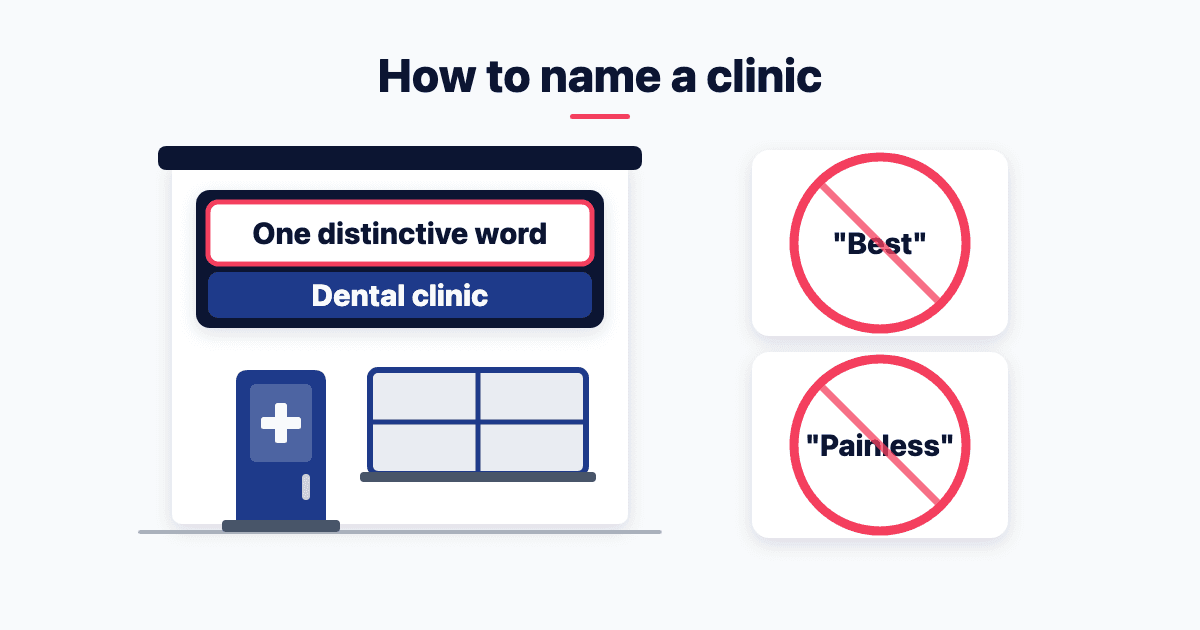
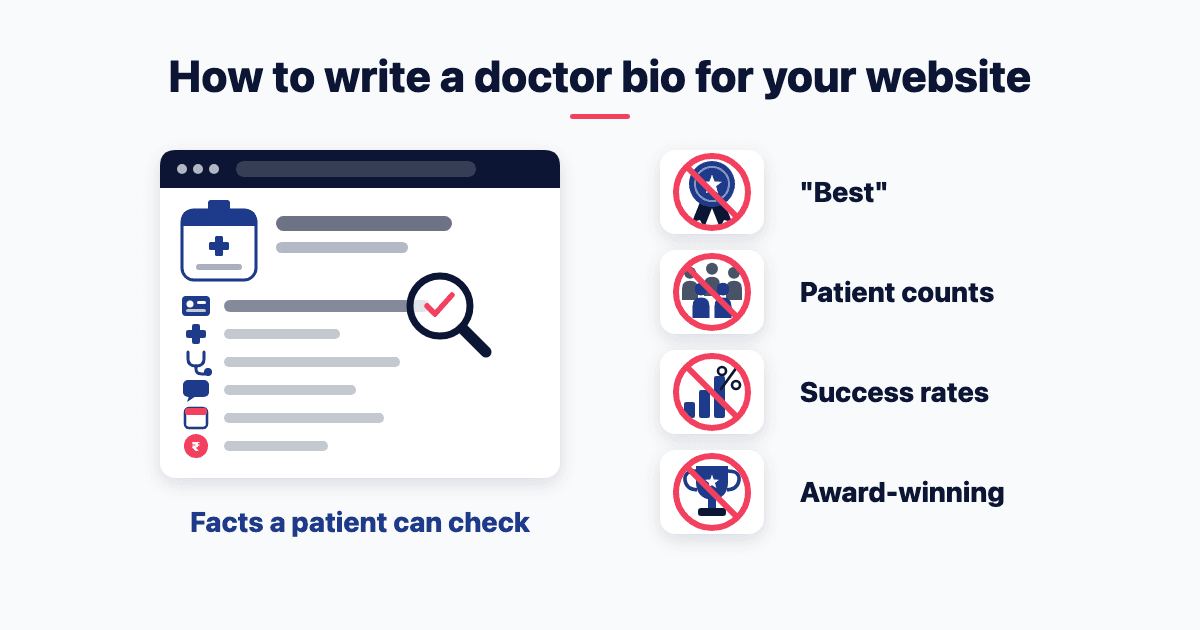
Banned: superlatives and inducements. "Best doctors", "No.1 Specialist", "100% success" and "painless treatment" are the guidelines' own examples (8.1(iii)). Discounts, coupons and "free procedures" are out where they are "likely to encourage unnecessary medical consultation" or amount to soliciting patients (8.1(x)).
Banned: paying per patient, or using a go-between. No "referral fee, lead-generation fee or other consideration" tied to getting patients (8.1(vii)). Nor may a doctor or clinic use a "third party as an intermediary to do indirectly what the RMP or institution is prohibited from doing directly" (8.1(xi)).
For dentists: the guidelines bind registered medical doctors and clinical establishments (3.4, 3.7). Dentists answer to the NDC under the 2014 Dentists Code. It continues "till new standards or requirements are specified" (National Dental Commission Act, 2023, section 59(2)). The advisory names "publishing patient testimonials and before-and-after photographs, making misleading treatment claims". Whether the doctors' guidelines also bind a dental clinic is open. The careful reading: follow them as your benchmark anyway.
In what order should a doctor build an online presence?
The agency guides in that search treat a clinic like a shop: reach, offers, reviews. The rules treat it more like an entry in a register: facts a patient can check. So build the facts first, and promote last.
Findable: a Google profile and listings with one name, address and phone.
Checkable: registration number, qualifications, fees and timings where patients look.
Bookable: a one-page phone site, a number someone answers, a WhatsApp button.
Educate: health posts in your own name, with no offer.
Factual ads: only once the first four are done.
Step 1. Can patients find you?
Claim your Google Business Profile, and use one name, address and phone everywhere. Make every directory listing match it, word for word.
Keep the name plain. Google's Business Profile guidelines don't permit "unnecessary information" in it, and adding some could get the profile suspended. So "Best Skin Clinic in [area]" fails twice. Google bars the extra words, and the NMC guidelines allow "best" only if "the claim is objectively verifiable" (8.1(ix)).
For dentists: "any claim to superiority or special skills over others will be construed as unethical practice" (Dentists Code 8.2.8).
Clinic profile or doctor profile? Google's guidelines say it's best for a solo doctor at a branded clinic to share one profile with the clinic. With several doctors who see patients, the clinic should have its own profile, separate from each doctor's.
Steps 1 to 3 are the organic search groundwork for a clinic, and you can do all three yourself. Before you hire anyone, read the five questions for marketers below.
Step 2. Can patients check you before they visit?
Put your registration number, qualifications, fees and timings where patients look: the Google profile, the website and every post.
A patient wants the fee, the hours and proof of registration before walking in. Try it: start typing "dentist near me with" into Google and see what it suggests.
The rules already ask for part of this:
On every post: "while publishing any Electronic media posts", a doctor "should transparently disclose their name, qualifications, registration status and SMR/NMR Registration number" (Explanation III). That's your State or National Medical Register number.
On a clinic's posts: each doctor's name, with the same details (Explanation IV).
In the clinic and on paperwork: the 2002 Code of Medical Ethics Regulations require the number "in his clinic and in all his prescriptions, certificates, money receipts" (1.4.1).
On your board: the same regulations say a physician "shall clearly display his fees and other charges on the board of his chamber" (3.7.1).
Online, a clinic may publish its fees too (9.1). The clause on offers ends: "Any lawful disclosure of charges, packages or fees shall be factual, transparent and not misleading" (8.1(x)). So publish the fee, and skip the festive offer.
Check that it all matches your entry on the NMC's Indian Medical Register (the FAQ shows how patients search it).
For dentists: display the number "accorded to him by the State Dental Council in his clinic and in all his prescriptions, certificates and money receipts" (3.4.1). "Websites can also carry details of treatment facilities available and the fees for the same" (8.2.9). And "There is no bar on the display of fees and other charges in the Dental Clinic" (5.7.1).
Step 3. Can patients book you in one tap?
You need three things: a one-page phone site, a number someone answers, and a WhatsApp button.
Here is a spec you can hand to whoever builds it, or paste into an AI tool. It comes from my AI 101 primer for KimsEducation students (free sign-up). Every demo there runs on Asha Clinic, a made-up clinic, "so nothing real goes on screen".
The brief asks for "a one-page phone website for Asha Clinic, Secunderabad". It lists the OPD (out-patient) timings, three services and "one big button 'Book on WhatsApp'". Then two lines do the real work: "Put [number] where the phone number goes; do not put a real number anywhere. Invent nothing beyond what I gave you."
The follow-up is a test. You correct one wrong timing and add "Fix only that." If it also changed colours or wording, it overstepped.
Swap in your own facts and keep that last line. An AI tool that adds a service you don't offer has written an ad you never approved.
What the page may carry: factual particulars only (9.1; Dentists Code 8.2.9). No testimonials section, no before-and-after gallery, no "best". For speed on a mid-range Android phone and short forms, work through the five landing-page fixes, in order.
If the page collects names or numbers, clause 7.6 points to the "Digital Personal Data Protection Act, 2023 and Rules made thereunder in 2025". Use the DPDP consent checklist before you launch.
Step 4. Educate, don't advertise: what can doctors post?
Education is the one kind of content the rules welcome. Clause 5.1 allows "academic discussions, educational content", provided such activities "do not promote personal practice, do not solicit patients and are not monetized through promotional marketing".
Talks and videos go out "in their own name and designation, without promoting their employer organization" (8.2(iii)). Every post also carries the identity line from step 2.
What never goes in:
Identifiable patients: no "names, faces, anomalies, etc., which can be identified publicly" (7.4).
Before-and-after, except "strictly for scientific or educational purposes with anonymized patient consent" (8.1(v)). Consent alone doesn't make it allowed (6.2).
Product endorsements, "whether or not monetary or other consideration is received" (8.1(iv)).
AI-made content needs care. Clause 7.2 bans an "AI Generated promotional campaign for furtherance of commercial interest". AI content that is allowed "shall compulsorily carry the source mark". Whether AI-assisted factual copy needs a mark is open, so label AI images, video and voice at least. Here is how to label AI-made content.
Greetings are allowed on "days of national importance or related to medical profession", as long as they don't advertise your practice (8.2(v)). The clause doesn't name festivals. So for Diwali, send a greeting with no offer and no service.
Is a booking link in an education account's bio soliciting? That's open. Until it's settled, keep education posts free of offers and booking prompts.
For dentists: the Code bars "surrogate advertisements in the garb of educating the public through TV programs, magazines or periodicals". Such information "should not carry addresses telephone numbers, e-mail addresses etc., of the Dental Surgeon or the clinic employing him to attract patients" (8.1.8). The clause names only TV and print; treat social posts the same way. The dentists' advisory also names "recording and broadcasting consultations and dental procedures". So no procedure videos.
Step 5. Should doctors run Google or Meta ads?
Maybe. First work out who is advertising, then check each platform's limits.
Who may advertise:
A registered doctor, as an individual: open. Clause 3.2 counts search-engine and sponsored ads as advertising when they promote. Clause 8.1(ii) bars "self-promotion" and soliciting patients "directly or indirectly". The careful reading: don't run ads promoting yourself until the Commission clarifies, which clause 12 lets it do.
A clinic: facts only (9.1). Under 8.3(ii), its communication must not contain "promotional portrayal of an individual RMP". And "The form, medium or frequency of communication shall not convert otherwise factual information into solicitation". An ad with the clinic's name, services, timings and fees fits. A doctor's face beside "most trusted clinic in town" doesn't (8.1(ix), 8.3(ii)). In a solo practice, though, the clinic's ad may be read as the doctor's own, so the open question above applies.
A dentist: allowed, with decorum. Dentists "may advertise provided that they maintain decorum" (Dentists Code 8.1). The limits: no superiority claims (8.2.8), no camps "in schools, colleges, old age homes", no "distributing handbills, claim vouchers" (8.1.2) and no TV "scrollers" (8.1.9).
Google's limits. Never upload your patient list. Google lists "Health" among its sensitive interest categories (Google Ads policy on restricted targeting). Advertisers promoting in them "are unable to use advertiser-curated audiences". Those include customer match, which aims ads using "customer information you've collected" (Google's Customer Match help). Location targeting and Google's own audience groups "can be used even if promoting in sensitive interest categories".
Google's definition of Health takes in treatment for chronic conditions, mental-health counselling and "invasive medical procedures, including cosmetic surgery". Many clinic ads fall inside it, so plan on location targeting and Google's own audience groups.
Meta's limits. Three rules matter for a clinic:
Lead forms: "Ads must not request health information, including physical health, mental health, medical treatments, medical conditions or disabilities without our prior permission" (Meta Advertising Standards).
Ad copy: ads "must not contain content that asserts or implies personal attributes", including "physical or mental health (including medical conditions)". Meta's unacceptable example is "Do you have diabetes?". Its acceptable one is "New diabetes treatment available" (Meta's personal attributes policy).
Before-and-after: Meta allows "General cosmetic products, procedures, surgeries depicting before and after transformation", aimed at people "at least 18 years or older" (Meta's health and wellness policy).
That last one is a trap. A platform allowing something isn't professional permission. Clause 8.1(v) still bars promotional before-and-after photos, and the dentists' advisory names them.
Thinking about ChatGPT ads? My ChatGPT ads guide is blunt about health: "Hospitals, clinics, diagnostics: ask OpenAI first; expect a no".
Whatever you run, count booked and attended appointments, not likes or clicks. Here is how to measure what your marketing actually added.
What do AI assistants say about your clinic?
Ask an AI assistant about a clinic that doesn't exist, and watch what it does. It's a demo in my AI 101 session sheet (free sign-up). The sheet is plain about it: "Asha Clinic does not exist".
The prompt: "What are the OPD timings of Asha Clinic, Secunderabad? Answer in two lines and say where you got it."
Search off: "the honest answer is 'I do not have information about this clinic'. If it gives timings, it invented them."
Search on: "it should say it found nothing, or name a different clinic with a similar name. Watch whether it says so, or quietly describes the other one."
Now run it on your own clinic. Ask two assistants for your timings and fees, once with search off and once with search on. Note every wrong detail.
The fix is the work from steps 1 and 2. Use the same facts, in the same words, on every page you control: the Google profile, the website, the listings. As the sheet warns, "search on means it read a page, not that it read the right page". So make every page it might read say the same thing.
What should you ask anyone who markets your clinic?
Ask five questions before you sign anything.
"How are you paid?" The answer must be a flat fee, never per patient, per lead or per booking. Clause 8.1(viii) says an agency's pay must not be "linked to the procurement or referral of individual patients".
"Who approves each post?" You do. Clause 4.4 says that posting through an agency "shall not, by itself, absolve" you of content you approved, paid for or knowingly allowed.
"Will you ask my patients for reviews or testimonials, or post them?" If yes, walk away: the rule binds you even through a go-between (8.1(xi), Explanation V).
"Will you use 'best', 'No.1', 'painless' or before-and-after?" Same answer (8.1(iii), 8.1(v)).
"Where does patient data go?" Get it in writing, and check it against clause 7.6 and the consent checklist from step 3.
One question is genuinely open. Clause 8.1(ii) says a doctor shall not "engage any third party for marketing medical services". Yet 8.1(viii) and 4.4 assume agencies are engaged. One reading: an agency may publish only what the doctor may publish, for a flat fee. That's unresolved. A doctor in individual practice should get a health-law opinion before signing a marketing retainer.
For dentists: the Code bars employing "any agent or canvasser for the purpose of obtaining patients in a manner that is commercial" (8.1.4). It also bars any "gift, gratuity, commission or bonus in consideration of or return for the referring, recommending or procuring of any patient" (8.6.1).
Won't a facts-only clinic lose out to louder rivals?
It's a fair worry. Rivals still post offers and testimonials, and nothing seems to happen to them.
Three answers:
The responsibility is yours. An agency can't take it off you (4.4).
Facts are what patients check anyway: the fee, the hours, the registration number.
Dentists have been told in writing. Their advisory names testimonials and before-and-after photos.
Still, hold this reading lightly. By 8 November 2026 the guidelines are only about five weeks old. As of 26 October 2026, the NMC's What's New list showed no clarification on advertising under clause 12. Several lines are open.
Your checklist for this month
Claim and verify your Google Business Profile, with a plain name.
Match the name, address and phone on every listing.
Add your registration number, qualifications, fees and timings to the profile, the site and your post template.
Publish a one-page booking site.
Remove testimonials, before-and-after, "best" and offers from everything you control.
Write one education post in your own name, with no offer.
Ask two AI assistants for your timings, with search off and on.
Put the five questions to whoever markets you.
Want a hand with steps 1 to 3? I can help a dental clinic, or a clinic with several doctors. The work is factual: the website, your Google Business Profile, and the fees, timings and registration details patients check. I charge a flat fee, never per patient, per lead or per booking. If you practise alone, read the open question on clause 8.1(ii) above first. Book a call, or read about my organic marketing work.
Frequently asked questions
Do doctors need a website?
Patients can find you through your Google profile, but a website is the one page you fully control. The NMC guidelines let a clinic advertise "only factual information", including "applicable fees". The Dentists Code adds: "Websites can also carry details of treatment facilities available and the fees for the same." One phone page with timings, fees and registration is enough.
Should doctors use social media?
Yes, as a place to teach rather than sell. The NMC guidelines allow "educational content" that doesn't promote your practice or solicit patients (5.1). Each post should show your name, qualifications and registration number (Explanation III). Keep reviews, offers and identifiable patients out. And start only once your Google profile and booking page are done.
Is SEO allowed for doctors under the NMC rules?
Probably yes, if search engine optimisation makes factual pages easier to find. Faking standing is what's banned. The NMC bars fake "followers, likes, reviews, ratings, testimonials, comments, views", and any attempt to "manipulate search rankings, visibility or algorithms to create a misleading impression of professional standing". Google separately bars extra words in your profile name.
How do patients check a doctor's registration number online?
On the NMC's Indian Medical Register, which can be searched by name, year of registration, registration number or state medical council. Search your own entry. Then make sure every post shows the same name, qualifications and number, as Explanation III asks. A dentist's number is the one "accorded to him by the State Dental Council" (Dentists Code 3.4.1).
- Clinic marketing
- Doctors
- Digital marketing
Written by Siddhesh Joglekar
Fractional CMO and AI marketing consultant Siddhesh Joglekar helps founders and growth-stage teams build marketing engines that compound.