Growth
Landing page conversion rate: what's good in India, and the fixes that move it
Landing page conversion rate in India: why benchmarks mislead, and five fixes in order: match the ad, speed on Android, short forms, trust, no tricks.

· 9 min read
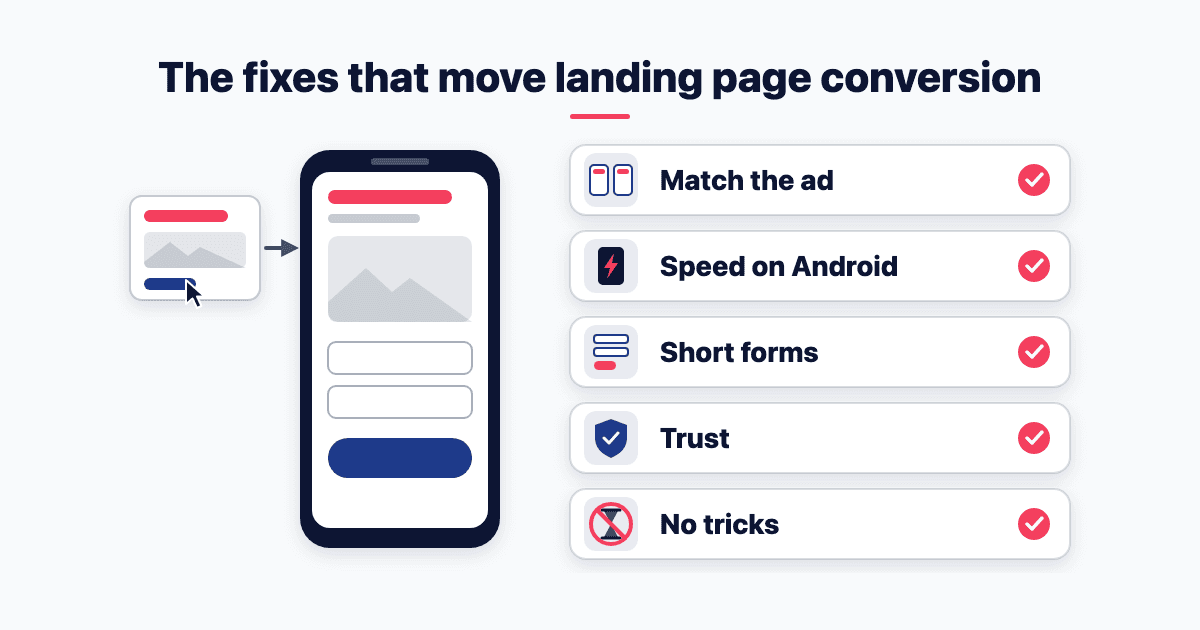
The Indian landing page benchmarks you'll find online come from agencies. Unbounce's 2024 median across all industries is 6.6%. Don't chase either: a good landing page conversion rate beats last month's, by traffic source and device. Five fixes move it, in order: match the ad, load fast on Android, shorten the form, show who you are, drop the tricks.
It's for Indian founders and marketers paying for clicks to a lead or order page.
What is a good landing page conversion rate in India?
A landing page conversion rate is the share of visitors who do what the page asks: fill in a form, start checkout, book a call.
Unbounce, which sells landing-page software, reports a 6.6% median "across all industries" (Unbounce's Conversion Benchmark Report).
One growth agency puts the "average website conversion rate for Indian startups" at "1.8% to 2.5%" (an Indian growth agency's benchmark report). It cites "50+ Indian startup funnels across 2024–2025", but no method. Treat it as vendor data.
Neither transfers to your page. Google Analytics divides by sessions or users, and Google Ads by ad interactions (see the FAQ). And a free webinar and a ₹30,000 course never share a rate.
"What's a good rate?" is the wrong question. Ask whether your rate is rising, by source and device, while cost per qualified lead holds. Even Unbounce warns that "our data only looked at conversion events—not the value per conversion event".
At an illustrative ₹20 a click, a 2% page costs ₹1,000 per lead. At 3%, it's about ₹667, a third less.
Which fixes move the rate, and in what order?
Run them in order, cheapest and surest first.
Check 1. Does the page say what the ad promised, in the same language?
Rule: one ad promise, one page, one language. The first screen repeats the ad's offer in its words.
Google's Quality Score already includes "Landing page experience: How relevant and useful your landing page is to people who click your ad" (Google Ads Help on Quality Score).
Google Ads Help on language targeting says that from September 2026, "Search ads will automatically match based on the language of your ads".
My IIT Kanpur sheet on closing the loop is blunt: "A Hinglish ad group needs a Hinglish landing page, or you have moved the mismatch one click later."
My hero-copy sheet sets the first screen's spec: "Headline 10 words or fewer, sub-head 20 words or fewer, outcome-led not feature-led."
Free check: read the "Landing Page Exp." column in Google Ads. Then show the first screen to a stranger for five seconds. They must answer "WHAT do you sell, SO-WHAT (why care), NOW-WHAT (what to click)".
Check 2. Does it load and respond fast on a mid-range Android phone?
Rule: judge speed on the phone your buyer owns, not on your laptop.
On the sites StatCounter tracks in India, mobile made up 77.3% of page views in September 2026 (StatCounter's device share, its method). Android ran 93.89% of mobile (StatCounter's mobile systems).
Google's "good" marks are main content within 2.5 seconds (Largest Contentful Paint) and a tap answered within 200 milliseconds (Interaction to Next Paint). Both are judged at "the 75th percentile of page loads" (Google's Web Vitals guide).
At redBus, the Indian bus-ticketing site, one search page's responsiveness to typing "improved by 72%". Google's 2023 case study reports "a 7% overall increase in sales", on the company's own figures (Google's redBus case study).
Layouts leak too. At Shaadi.com, "Payment flows built for desktop, leaking on mobile" were redesigned: +24% online payment conversion across web and mobile (lifts as reported during the tenure). The payment moment inside an app covers that step.
Free check: run PageSpeed Insights. Given enough traffic, it shows real visitors over the "previous 28-day collection period". In Meta Ads Manager, compare link clicks with landing page views. Meta built landing page views because "slow-loading mobile sites or poor connections" lose people (Meta's announcement). A wide gap means people left before the page loaded, or your tracking is broken.
Check 3. Does the form ask only what the next step needs?
Rule: ask only what the next conversation needs; the rest can wait.
At OurBus Charters, a US coach-hire business, the starting state included "44% of prospects abandoning the quote form" (funnel figures from client's PostHog, de-duplicated).
The lead-form spec I teach at IIT Kanpur has three fields: "name, phone (Indian 10-digit pattern), one dropdown" (my session sheet on building the machine). It adds two consent boxes, "UNTICKED by default and NOT required". For their wording, see the consent checklist for lead forms.
Add a second qualifying question only if lead quality, not volume, is your problem.
For checkouts, Baymard Institute's testing finds an ideal flow can be as short as "12-14 form elements". The US average is 23.48 (Baymard Institute's checkout research).
Free check: fill in the form on a mid-range phone and time it. Then submit a test lead. The sheet's pass mark: "one test submission appears in Netlify Forms with both consent fields (ticked or not) and a timestamp".
Check 4. Would a stranger trust it with a phone number or a payment?
Rule: show who you are and what it costs before you ask.
Among US shoppers who abandoned a cart, excluding those just browsing, 40% cited "Extra costs too high (shipping, tax, fees)". And 19% said "I didn't trust the site with my credit card information" (Baymard Institute).
If you sell online in India, the Consumer Protection (E-Commerce) Rules, 2020 require much of this. Show your "legal name", "principal geographic address" and grievance-officer contacts, "displayed prominently" (Rule 4(2)). Sellers of their own stock must show the "total price in single figure", with the breakup (Rule 7(1)(e)). From 1 January 2027, a discount must show the "prior price": the lowest price of the past 30 days (2026 amendment, Rule 4(13)).
So basic trust signals are partly legal duties, and the cheapest fix you have.
Free check: on your phone, as a stranger, can you find the legal name, address, complaint contact and full price before the last step?
Check 5. Are you using a trick the regulator now fines?
Rule: no fake urgency, no pre-ticked extras, and no "free" that hides a form.
The Central Consumer Protection Authority's Dark Patterns Guidelines, issued on 30 November 2023 (government release, 2023), "identify and prohibit 13 dark patterns", including False Urgency, Basket Sneaking, Forced Action and Drip Pricing (government release, 2025).
A 3 June 2026 release reports a ₹5 lakh fine on an Indian test-prep company (the regulator's release). A ₹10 donation "was automatically selected during checkout": Basket Sneaking. Its "free" courses "could only be accessed after users shared personal information such as their mobile number and email address": Forced Action.
If your "free" guide sits behind a phone-number form, read that twice. The release faulted calling courses free "without clearly informing users about mandatory registration and data-sharing requirements". It also found the data collection "was not essential for accessing the courses".
My reading: if an offer needs a form, say so before the click, and ask only what you need to deliver it. And consent "cannot be assumed through pre-selected options".
So remove countdowns that reset on reload, untrue "only 2 seats left" lines and fees that first appear at payment. A real webinar deadline is fine. This is general guidance, not legal advice.
Free check: list every timer, scarcity line, pre-selected box and fee. Keep only what's true and opt-in.
Does a higher rate just bring junk leads?
Partly. A shorter form or a "free" offer can lift the rate and lower lead quality. So judge each fix on cost per qualified lead or per order.
But four of the five checks don't attract worse buyers. They lose fewer good ones. That's my reasoning, not a measured result, so test it on your numbers.
Only the form needs a quality test: see how to improve lead quality. A growth strategy engagement reads the whole funnel, not just the page.
Your landing page checklist for this week
Write down last month's "Session key event rate" in Google Analytics, by source and device. That's your benchmark.
Run the five-second test on your top ad's page with three outsiders.
Make one page per ad promise and language.
Run PageSpeed Insights; compare Meta link clicks with landing page views.
Cut every field the next step doesn't need, then submit a test lead.
Show your legal name, address, complaint contact and full price on mobile.
Remove fake timers, pre-ticked extras and late fees.
Change one thing at a time; read two weeks by source and device. Then check payback with how to measure marketing ROI.
Pages getting clicks but not enquiries or orders? Book a call and bring the page behind your top ad.
Frequently asked questions
How do you calculate landing page conversion rate?
Divide conversions by visits, then multiply by 100. Google's example is "50 ÷ 1,000 = 5%" (Google Ads Help on conversion rate). Google Ads divides by ad interactions, and its rate "might be over 100%" if you count every conversion. Google Analytics divides by sessions or users (Google Analytics Help). Pick one denominator and keep it.
How do you track form abandonment in Google Analytics?
Use the two form events in enhanced measurement. "form_start" fires "the first time a user interacts with a form in a session", and "form_submit" fires "when the user submits a form" (Google Analytics Help on enhanced measurement). Abandonment is roughly one minus submits divided by starts, for the same page and dates. Switch enhanced measurement on first.
Which free tools show why a landing page isn't converting?
Three cover most needs. PageSpeed Insights shows real visitors' speed, given enough traffic. Google Analytics shows the rate and form drop-off by source and device. Microsoft Clarity adds heatmaps and session recordings, and Microsoft says "Clarity is 100% free - forever" (Clarity FAQ). Recordings capture what visitors do, so mention them in your privacy notice.
Does a lead form in India need a privacy notice?
Yes, today. Rule 4(1) of the Information Technology (Reasonable Security Practices…) Rules, 2011 requires any business collecting personal information to publish a privacy policy on its website. The Information Technology Act covers sole proprietors. From 13 May 2027, the notice duty in the Digital Personal Data Protection Act replaces that rule (Gazette notification G.S.R. 843(E)). Not legal advice.
- Growth
- Conversion rate
- Landing pages
- Lead generation
Written by Siddhesh Joglekar
Fractional CMO and AI marketing consultant Siddhesh Joglekar helps founders and growth-stage teams build marketing engines that compound.