Growth
How to improve lead quality: fewer junk leads from Meta and Google, measured by cost per closure
How to improve lead quality from Meta and Google ads, for Indian edtech and lead-gen teams: reach the payer, verify phones, judge on cost per closure.

· 11 min read
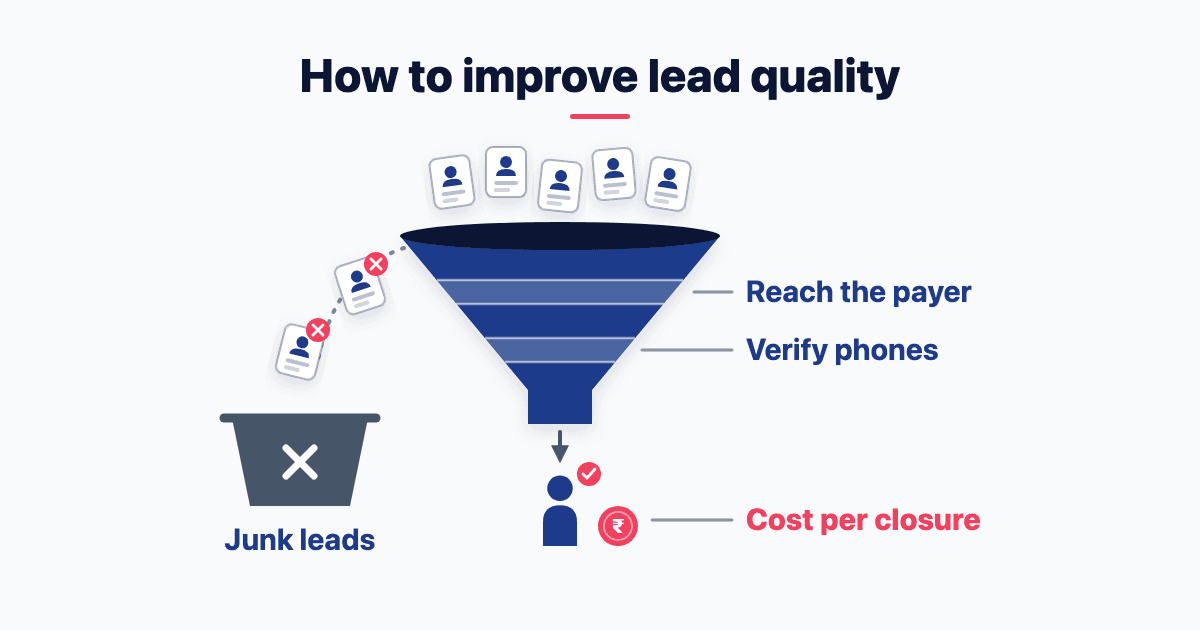
A cheaper lead that never turns into a sale is worthless. If you're asking how to improve lead quality, start where the lead is made. Aim your ads at the person who pays. Ask two questions a casual tapper won't answer. Verify the phone number, and tell Meta and Google which leads qualified. Then judge every source on cost per closure.
Your counsellors say the leads are junk. Your agency says cost per lead is down. Both can be true, because nobody has written down what a good lead is.
How do you measure lead quality? Cost per closure, not cost per lead
Lead quality is how often a lead becomes a paying customer, and at what cost. So the number that settles the argument is cost per closure: ad spend divided by the closures from that source. A closure might be a paid enrolment, a signed loan or a booked job.
My IIT Kanpur session sheet on closing the loop writes it as a chain: "Cost per closure = CPL ÷ MQL→SQL ÷ SQL→close". CPL is cost per lead; the qualified stages are defined below. If not every lead is marketing-qualified, use your lead-to-sales-qualified rate in the middle.
Here's how the cheaper source can lose. Take two sources with the same ₹1,50,000 quarterly spend. These are illustrative numbers, not benchmarks.
Source A: ₹150 per lead buys 1,000 leads. 8% become sales-qualified, so 80. A quarter of those close: 20 closures, or ₹7,500 per closure.
Source B: ₹400 per lead buys 375 leads. 32% become sales-qualified, so 120. A quarter close: 30 closures, or ₹5,000 per closure.
Source B's leads cost 2.7 times as much, yet its closures cost a third less.
My rule: "Under ~30 per arm, say 'directional'". Source A's 20 closures sit under that line. Call the gap a direction, not a verdict, and run another month.
At OurBus Charters, a US coach-hire business, the lesson was blunt: "A cheaper lead that never quotes is worthless."
DocTutorials, a medical-exam edtech, began with "Attribution loose enough that cost per acquisition could not be defended". It now has "Measurement that makes cost per acquisition a number leadership can act on weekly". Cost per acquisition fell by roughly a third from FY25 to FY26. The case study doesn't credit lead quality for that fall: it names the influencer engine as the biggest lever. It shares no absolute figures, at the client's request.
For the wider question, read how to tell whether your marketing spend worked. To include seminars and scholarships, work out cost per admission by source.
MQL vs SQL: what counts as a qualified lead?
Write down what a qualified lead is before you change a single setting. HubSpot's Knowledge Base gives the generic versions:
Marketing-qualified lead (MQL): "a contact or company that your marketing team has qualified as ready for the sales team".
Sales-qualified lead (SQL): "a contact or company that your sales team has qualified as a potential customer".
For a test-prep brand, I define them like this. Marketing-qualified = "counselling requested + exam year". Sales-qualified = "counselling attended".
For loans, property or B2B services, try this template. Marketing-qualified: the form answers fit your need, area and timing. Sales-qualified: your team has spoken to the decider and confirmed need and timing.
Junk needs a reason code, not a shrug. Each code points to a different fix:
Wrong number: verify the phone.
Duplicate: de-duplicate before you count.
"Never enquired": change the form type.
Outside your area, or no payer: fix the targeting and the questions.
Agree each definition with your head of counselling, one line each. Then log a code against every junk lead in your CRM (customer relationship management system).
Who should your ads reach? Aim at the person who pays
In school learning and test prep, the student enquires and the parent pays. At BYJU'S, a K-12 edtech, the case study names it: "Digital alone could not reach the parent who decides." The edtech marketing strategy guide turns that into a rule for the enquiry stage: "Ask who pays at the first touch".
On Meta, targeting now lives mostly in the event and the creative. My IIT Kanpur session sheet on building the Meta machine closes with: "The machine chooses the person. You choose the event it learns from, the seed it starts with, and the eight arguments it can make." Its sticky note is shorter: "Interests are for exclusions."
So you target with the ad itself. Say in the first line who the course is for: the exam, the year, and whether you're speaking to the parent or the student. Exclude current students only from a list you can trace to consent: "Never upload a list you can't trace to a consent line."
On Google, buy intent, not clicks. My session sheet on buying intent groups keywords "transactional / commercial / informational" and keeps "One tight intent theme per ad group". It also warns: "Broad match is a loan against your negative-keyword discipline. Most beginners can't pay it back."
OurBus Charters (US) started with "One undifferentiated search campaign". It now runs "Six campaigns by geography and intent, each with its own cost target", with "every keyword classified on intent and relevance".
How many questions should a lead form ask?
Each question you add removes some casual tappers. You get fewer leads, but better ones. Stop adding questions when your counsellors would no longer use the answer.
On Meta, the lead ads developer guide says: "By default, lead ads are optimized for the volume of leads". The higher-intent setting "adds a step to the form submission flow where a person reviews and confirms their answers".
On Google Search, use qualifying responses. You mark one or more multiple-choice answers as qualifying. Then "the submission is automatically tagged as a qualified lead" (Google Ads Help on qualifying responses). Two limits apply. "Qualifying responses are available for Search campaigns only", and the questions "are required and can't be marked as 'optional'".
For test prep, ask these:
Which exam, and which year?
Who will pay the fee: parent, self or employer?
Optional: centre or online?
Make each one multiple choice, never free text.
End with the consent line: one tick per channel, unticked and not required to submit. My shorthand is four words: "Unticked, and not required." For what the law expects of that tick, use the DPDP consent checklist for lead forms.
How do you stop fake leads before they reach your counsellors?
Fake leads often aren't fraud. They come from pre-filled one-tap forms, accidental taps while scrolling, freebie offers and bots. The offer is a targeting decision too: a scholarship test attracts test-takers, and a "free PDF" attracts collectors.
On Google Search lead forms, turn on phone verification. Google says it "adds a one-time password (OTP) step to your form, filtering out invalid numbers, automated spam, and bots". It is "Currently supported for Search campaigns only" (Google Ads Help: Create lead form assets). Check that it shows in your account.
On Meta, the higher-intent review step is your main guard. If your form settings offer phone verification, test it on one campaign first.
Double counting is the other fake. If your website's Meta Pixel and your server both report the same lead, de-duplicate them. The server-side prompt I teach includes this line: "Include event_id so Meta can de-duplicate against the browser Pixel's Lead event."
OurBus Charters began with "Quote events double-firing in the CRM and a backfill duplicating leads". That clean-up, and how to score and clean the leads that do arrive, is a job of its own.
How do you teach Meta and Google which leads are good?
The platforms optimise for whatever you report. Report form fills, and they find more form-fillers. Report "counselling attended", and they look for students who turn up.
On Meta, that means the conversion-leads performance goal, fed from your sales records. When read on 23 October 2026, Meta's developer guide to conversion leads listed these guidelines to check whether your business is a good fit:
"Generate at least 200 leads per month".
"Can upload data regularly at least once per day".
The stage you optimise for "occurs within 28 days after you generate the leads".
That stage "has a conversion rate between 1% and 40%."
It is "currently only compatible with Facebook/Instagram's Lead Ads (Instant Forms)."
Store "the 15-17 digit Meta Lead ID" with every lead, so each outcome can be matched back.
Two decision rules follow. Under 200 leads a month, fix the form and the questions first. At 200 or more, pick the deepest stage that lands inside 28 days and the 1–40% band. For an aspirant who pays months after enquiring, that's "counselling attended", not "fee paid".
On Google, use the Qualified lead and Converted lead goals (About qualified leads and converted leads). A qualified lead is one "further qualified offline (outside of Google Ads)". A converted lead completes a step you choose, "typically offline (outside of Google Ads)". Google says this lets you "optimize towards deeper lead-to-sale funnel events".
For a new set-up, Google recommends "starting with enhanced conversions for leads instead" of click-based import (Google Ads Help on offline conversions). If you import by Google Click ID (GCLID), you must "store each GCLID with the corresponding prospect's information".
"Google Ads stores leads for 60 days, so download your data often" (About lead form assets). Better still, send every lead to the CRM the moment it arrives by webhook.
Need a hand wiring this? I can set it up for you as part of performance marketing.
"But our agency is paid on cost per lead"
That's a fair objection. Cost per lead is what an agency controls; closures depend on your counsellors too. So keep cost per lead, but as a speed check, not the scorecard.
A cost-per-lead target can work when the sale caps it. At BYJU'S, offline and digital ran as one mix, "managed against one cost-per-lead target". Cost per lead fell 70% over my tenure there (figures from public record and that tenure). Even there, the case study says the mix had to run "at a cost the unit economics could carry".
So if your agency keeps a cost-per-lead target, work it back from your target cost per closure. Now that platforms can learn from deeper stages, that one target can also sit further down: cost per sales-qualified lead, or cost per closure.
Don't swing too far the other way. The OurBus Charters line goes on: "a great win rate on twelve leads a week does not cover overhead." Tighten the form until junk falls, not until volume collapses. Track leads per week beside cost per closure on a schedule, like the case study's "fortnightly cost-per-lead and cost-per-booking pulse".
Your Monday checklist
With your head of counselling, write the two qualified-lead definitions and the junk codes, one line each.
Pull last quarter's spend, leads, sales-qualified leads and closures by source. Compute cost per closure.
On one campaign, switch on the higher-intent step (Meta) or a qualifying response (Google Search). Ask exam-and-year and who pays.
Turn on phone verification on Google Search lead forms.
Store each lead's Meta and Google IDs in your CRM. Send "counselling attended" back to Meta (at 200+ leads a month) and to Google.
Review cost per closure and leads per week every fortnight.
If your counsellors and your agency disagree about lead quality, book a call. We'll look at your forms, and at what you send back to Meta and Google.
Frequently asked questions
Instant form or website form: which gives better leads?
Test both, and judge them on cost per closure. An instant form is quick to submit, and Meta's lead ads guide says lead ads are "optimized for the volume of leads" by default. A website form lets you add your own checks and show course details first. But Meta's conversion-leads goal currently works only with instant forms.
Should edtech ads send leads to WhatsApp instead of a form?
A chat may reach a parent faster, but it isn't a qualified lead or consent. My Meta session sheet says: "A WhatsApp chat is a conversation, not consent." Ask the same two questions in the chat and log the answers on the lead. Send marketing only to people who ticked the WhatsApp box on a consent-clean form.
What is a good cost per lead for Google Ads in India?
Don't plan on someone else's number: a cost per lead means little without your own conversion rate. Work backwards instead. The most you can pay per lead is your ceiling per enrolment times your lead-to-enrolment rate. At an illustrative ₹6,000 and 5%, that's ₹300. The edtech marketing strategy guide shows how to set the ceiling.
How do you test a Meta lead form before it goes live?
Use Meta's Lead Ads Testing Tool. Meta's testing guide says "You can use this tool to create and delete test leads for your forms", and "You can create one test lead per form." Then check that the test lead reaches your CRM with its Meta Lead ID, because the feedback loop depends on it.
- Meta ads
- Lead quality
- Lead generation
Written by Siddhesh Joglekar
Fractional CMO and AI marketing consultant Siddhesh Joglekar helps founders and growth-stage teams build marketing engines that compound.