Marketing
Performance Max vs Search: how to split a Google Ads budget now that AI Max and AI Mode ads are here
Performance Max vs Search: split a Google Ads budget by query, audit an AI Max upgrade, and see what ads in AI Mode change, with real account data.

· 11 min read
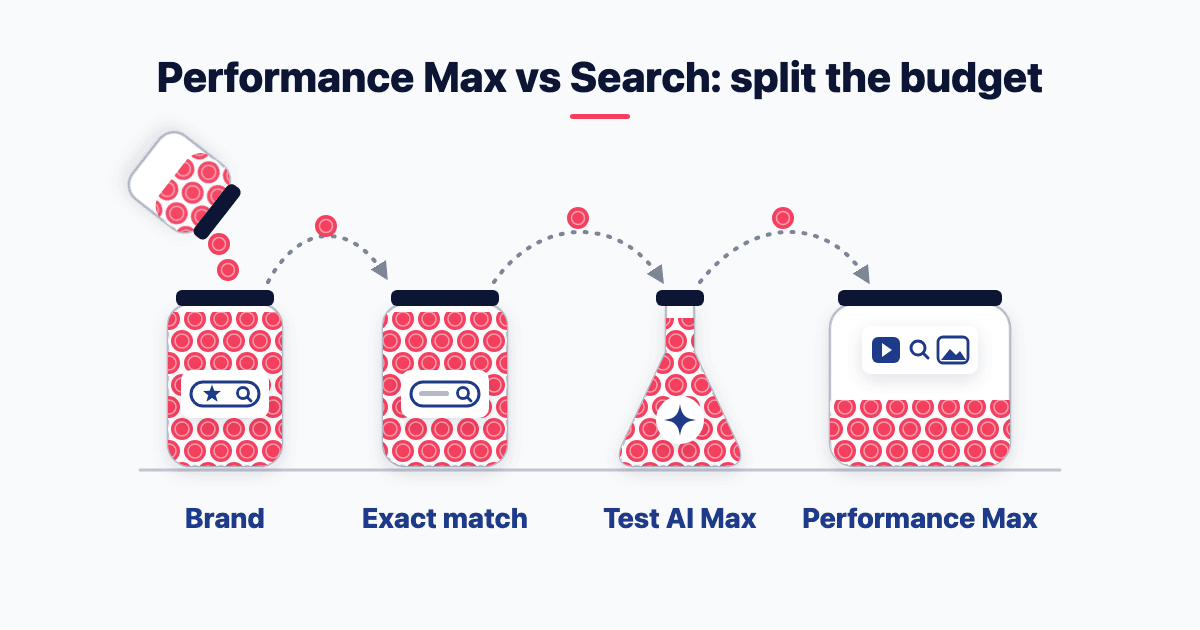
Google's serving rules give an exact-match keyword first claim on an identical search, ahead of Performance Max. Underfund its campaign, and it won't always get to use that claim. Settle Performance Max vs Search the way Google does: by query, not campaign type. Fund brand and proven exact-match Search first. Test AI Max before trusting it. Give Performance Max the rest, brand excluded.
Why now? Google's AI Max announcement scheduled automatic upgrades for many Search campaigns from September 2026. On 28 October 2026, its AI Mode ads announcement said ads in AI Mode are scaling to ten more countries. They need no separate budget.
What's the difference between Search, AI Max and Performance Max?
The newest confusion is Performance Max vs AI Max, since both use Google's AI to find searches. They work at different layers.
A Search campaign runs on keywords you choose. Exact and phrase match give the most control over which searches you pay for.
AI Max for Search is, per Google Ads Help, "not a new campaign type" but an "optimization layer" inside a Search campaign. Its core features are search term matching, text customization and final URL expansion.
Performance Max is "a goal-based campaign type" that reaches all Google ad inventory, Search and YouTube included (Google's Performance Max page). You'll often see it shortened to PMax.
The real difference is who picks the search. Exact and phrase: you. AI Max: Google, from your keywords, ads and site. Performance Max: Google, across every channel.
Which campaign gets the search when they overlap?
Your own keywords "don't compete with each other in the auction". When several match one search, Google's prioritisation rules pick one, in this order:
An exact-match keyword identical to the search.
An identical phrase or broad keyword, including AI Max, or an identical Performance Max search theme.
Whichever ad group Google's AI judges most relevant.
The highest Ad Rank: Google's auction score for each ad, which weighs bid, ad quality and the search's context (Google's Ad Rank definition).
"Identical" includes spelling corrections, but not plurals or synonyms. When AI Max and Performance Max both qualify, "the one with the highest Ad Rank will serve" (Google's AI Max FAQ).
Now the catch. The same rules say a keyword in a budget-restricted campaign "won't always be able to trigger an ad even if it otherwise could". And AI Max "won't be effective if campaigns are limited by budget" (how AI Max works). So an underfunded exact-match campaign quietly hands searches to the next campaign in line, perhaps Performance Max.
That changes the question. You aren't splitting money between campaign types. You're deciding which searches you control, and which you hand to Google's AI.
Performance Max vs Search: how should you split the budget?
Fund the layers in the order Google serves them: the serving-order split. Skip fixed ratios like 70/30. A ratio can't see your brand demand, margin or conversion lag.
Should you bid on your own brand name?
Rule: yes, on exact match, in its own campaign. Then test whether it adds sales.
I teach this at IIT Kanpur, the Indian Institute of Technology Kanpur. The session sheet (free Google sign-in) says: "Keep brand-defence on exact match." A search identical to your exact brand keyword goes to that keyword first.
Then add Performance Max brand exclusions, so its results show what it finds beyond your brand. Google's Performance Max FAQ calls them "often the better option for blocking brand traffic", because unlike negative keywords they catch "clear misspellings". They apply only to "Search, Shopping, and YouTube search inventory" (brand exclusions help).
Google's brand settings guide advises using them only for "campaigns that really need them". Your separate brand campaign makes the exclusion safe: brand searches still have a home. To check whether brand ads win sales you'd get anyway, run a pause test on your brand campaign.
How much do your proven exact and phrase keywords need?
Rule: enough that the campaign isn't "Limited by budget".
"Proven" means cost per sale inside your ceiling, on data old enough to be complete. Starve this layer and its searches go elsewhere.
Where does AI Max fit?
Rule: on top of a proven Search campaign, as an experiment first.
Google's AI Max experiments run inside one campaign, "instead of creating a copy of the campaign". A share runs with AI Max off, the rest with it on. Search term matching "will not work with manual CPC bidding" (AI Max FAQ). That's where you set the most you'll pay per click (Google's guide to manual bidding). Use automated bids.
What does Performance Max get?
Rule: what's left, brand excluded. Judge new customers and cost per sale for the whole campaign, not each channel.
Performance Max "optimizes for marginal ROI", the return on the next dollar, and channel averages "can be misleading", says Google's FAQ.
A new lever is coming. On 14 October 2026, Google announced channel prioritisation and budget allocation, rolling out "over the next months". You'll be able to set Search partners or the Display Network to low priority and cap their daily share, "on a best-effort basis".
A split only works if you can see what each line earns. At OurBus, a scheduled coach operator on the US East Coast, route search took 47% of spend for 25% of bookings. Once my performance marketing work rebuilt its paid engine, Performance Max plus brand search took 46% of spend for 70% of bookings. The client supplied the figures, and the shares were computed from the account's own weekly scorecard.
Route search wasn't dropped; it was "cut to the role it earns". But the after line bundles Performance Max with brand search, so it can't show which one earned the bookings. Split brand out, and each line's share is its own. For pricing each channel by the sale, see Google Ads vs Meta ads.
An illustrative $10,000 month: brand gets what its searches cost, say $1,200. Proven exact and phrase rise until not budget-limited, say $5,500, with AI Max tested inside. Performance Max gets the remaining $3,300. Amounts change monthly; the order doesn't.
Google upgraded your Search campaigns to AI Max: keep, steer or opt out?
Google's AI Max announcement covered campaigns using automatically created assets or the campaign-level broad match setting. They would be "auto-upgraded starting in September 2026", expected to finish "by the end of September". Dynamic Search Ads follow: that upgrade "will begin in February 2027".
Now Google's claim. With all features on, AI Max for Search campaigns see "an average of 7% more conversions or conversion value" at a similar cost or return. It's measured against "using search term matching alone", not a clean exact- and phrase-match campaign, in Google's internal data for non-retail advertisers. The session sheet puts it plainly: "It is a claim. Your audit is the verdict."
On 20 September 2026 I taught my IIT Kanpur cohort a six-check audit for this. The AI Max audit sheet (free Google sign-in) lists the checks. Run them in order:
Change history: each change, and who made it: you, an auto-applied recommendation or the upgrade.
Search terms beyond your keywords.
Asset honesty: any generated claim you can't prove?
Landing pages.
Brand and geo controls.
Cost per sale against your own rule.
If the upgrade is under two weeks old, don't judge cost per sale yet: "collect". Then give each campaign one verdict:
Keep: clean terms, honest assets, cost per sale inside your rule. Audit weekly.
Steer: good volume, but waste or bad assets. Use list-level negatives, brand or URL exclusions, text customization off, or search term matching off per ad group (how AI Max works). Re-audit in seven days.
Opt out or rebuild: waste you can't steer. "Toggle to opt out of all AI Max settings" (Google's AI Max setup guide), or rebuild as exact and phrase.
Two warnings. Turning AI Max off also disables the campaign's brand exclusions (Google's AI Max FAQ). And once the broad match setting moves to AI Max, "broad keywords are not treated as exact match keywords in prioritization". Add exact-match copies to keep that priority.
Do ads in AI Mode change how you split the budget?
Beyond the ten new countries, Google's 28 October announcement plans Brazil, Mexico and the UK for Q4 2026. Multiturn ads, shown in follow-up questions, are launching in the US.
What doesn't change, per Google Ads Help on ads in AI Mode:
No new campaign or separate budget: Search, Shopping and Performance Max campaigns are eligible automatically.
You "can't target ads exclusively to AI Overviews or AI Mode, or opt out" of them separately from Search.
"You aren't charged extra to participate", and negative keywords and brand exclusions still apply.
What changes is matching. Exact and phrase keywords qualify for ads in AI Overviews and AI Mode only "when a user's query expresses direct commercial intent". They aren't eligible for broader exploratory questions. AI Max, broad match, Shopping and Performance Max can match both kinds. Google's AI Mode ads post says AI Mode queries run "on average, three times longer than traditional searches" (its US report, May 2026). Nor is exact-match priority guaranteed on AI Mode searches (ad group prioritisation).
So the serving-order split holds. AI Mode is a reason to let AI Max earn a share through its experiment, not to open an "AI Mode budget".
The evidence is thin here. AI Mode results are "included in aggregate" in your reports, so you can't isolate them. Google's one data point, similar click-through rates for "sponsored and organic product list items", is its own US data. Treat it as a claim. For another AI answer engine with ads, see how to run a fair first test of ChatGPT ads.
How long should you wait before judging the split?
At least 30 days after the period you're judging ends. Conversion lag is the gap between click and sale, and it can run long. Conversions "can be reported up to 90 days after the click" (Google Ads Help on conversion lag). Until they arrive, recent weeks can show "fewer conversions, a higher cost per conversion".
Judge on a date range that "ends at least 30 days ago", longer if your conversion window is longer.
Segment by Conversions, then Days to conversion, to see your own lag.
In Smart Bidding's bid strategy reports, hover over the conversion columns to see conversions Google predicts are still to come.
A new bid strategy needs time too: see how long Smart Bidding takes to learn.
The objection: "Just put everything in Performance Max"
The case for it is real: Google's AI sees signals you can't, and one campaign gives it more data. But Google's own page says you can use Performance Max "to complement your keyword-based Search campaigns" (Google Ads Help on Performance Max). Exact match outranks it by design. And merging brand with non-brand hides brand demand inside the average.
So consolidate within each layer, never across brand and non-brand.
What to do this month: your budget split checklist
Check change history for campaigns moved to AI Max in September.
Run the six checks on each. Write one verdict and a re-check date.
Move brand into its own exact-match campaign, and exclude it from Performance Max.
Clear "Limited by budget" on proven exact and phrase campaigns before spending elsewhere.
Start AI Max as an experiment, not a switch.
When channel prioritisation arrives, set Display and Search partners to low priority, with a cap.
Re-split only on data that ends at least 30 days ago.
Not sure which of your campaigns Google upgraded, or how much of your Performance Max result is really your brand? Book a call and we'll go through your search terms together.
Frequently asked questions
Is Performance Max worth it for lead generation?
Yes, if it learns from leads that become sales, not raw form fills. Google's Performance Max FAQ advises enhanced conversions for leads, to tie leads to offline sales, and goals such as "qualified lead" or "converted lead". It also suggests checks like reCAPTCHA on forms. Train it on form fills alone, and it will find you more form fills.
Should a new campaign start on Target CPA or Maximize conversions?
Start on Maximize conversions until you know your ceiling. It "will try to fully spend your average daily budget" (Google Ads Help). Target CPA aims at an average cost per conversion you set. It can start with no conversion history, but be ready to spend up to twice your average daily budget (Target CPA help).
What's the difference between Performance Max and Demand Gen?
Performance Max chases conversions across all Google channels. Demand Gen is for when people "aren't searching for you". It's built to "create and convert demand on visual-first surfaces like YouTube, Discover, Gmail" (Google's Performance Max FAQ). It offers more control over placements, creative and audiences. Use Search and Performance Max to capture demand, Demand Gen to create it.
Can you run ads inside AI Mode in the UK?
Not as of 9 November 2026. Ads inside AI Overviews and AI Mode run in English in the US, Australia, Canada, India, Indonesia (AI Overviews only), Kenya, Malaysia, New Zealand, Nigeria, Pakistan (text ads only), the Philippines and Singapore (Google Ads Help). Google plans it for Q4 2026. Ads above or below AI Overviews show wherever those appear.
- Google Ads
- AI Mode
- Performance Max
Written by Siddhesh Joglekar
Fractional CMO and AI marketing consultant Siddhesh Joglekar helps founders and growth-stage teams build marketing engines that compound.