Marketing
AI content marketing: how to build a content engine that scales without becoming spam
AI content marketing that scales without becoming spam: where Google draws the line, a six-step engine with human sign-offs, and a kill rule for weak formats.

· 10 min read
Google's spam rules don't punish content for being AI-written. They punish many pages made to rank rather than help, "no matter how it's created". AI content marketing that scales does three things. Every piece starts from something only you have. A named person checks every fact before it ships. A format that misses its target is cut on schedule.
Below: where Google draws that line, a six-step engine that stays behind it, and how to tell if it works.
What is AI content marketing, and where does AI actually help?
AI content marketing means using AI models to research, structure, draft, adapt and distribute content. People own the ideas, the facts and the call to publish. Your AI content marketing strategy is mostly a decision about where that line sits.
Google itself names the jobs where AI helps most. Its guidance on using generative AI content says: "Generative AI can be particularly useful when researching a topic, and to add structure to original content".
Indian teams have already found the speed. In Adobe's 2026 India findings, 71% of organisations said generative AI "has improved the volume and speed of content ideation and production". Only 7% were deploying agentic AI, the kind that acts rather than just answers, at scale for content creation and support, Adobe's release says. The survey covered 250 Indian executives in October and November 2025.
So speed isn't the bottleneck any more. The system around the speed is. I wrote about this on LinkedIn in September 2025, and put it plainly: "Yes, the volume of content will explode. Yes, a lot of it will feel generic". This post is about not being the generic part. For where AI fits across the rest of marketing, see AI marketing strategy for Indian companies.
When does AI content become scaled content abuse?
Google defines it in one line: "Scaled content abuse is when many pages are generated for the primary purpose of manipulating search rankings and not helping users". That's Google's spam policies, last updated 28 August 2026. Its examples:
"Using generative AI tools or other similar tools to generate many pages without adding value for users".
Scraping content to generate many pages, "including through automated transformations like synonymizing, translating, or other obfuscation techniques".
"Stitching or combining content from different web pages without adding value".
"Creating many pages where the content makes little or no sense to a reader but contains search keywords".
So the test isn't AI versus human. Google's March 2024 announcement says the policy applies "no matter whether content is produced through automation, human efforts, or some combination of human and automated processes". A room of freelancers rewriting one page for every city is as exposed as a prompt doing it. The test is value per page.
Three Indian patterns sit close to that line. This is my reading of Google's examples, not its list:
City-swapped service pages. The same body with Pune, Indore or Nagpur swapped in, and nothing a reader in that city needs.
Many versions of one idea. My DigiAIM 12 session sheet asks for 8–12 distinct concepts across a month of social posts, 2–3 variants each: "never 25 versions of one idea".
Translation without adaptation. Google lists "translating" among the automated transformations used to mass-produce pages from scraped content. For your own posts, I'd apply the same test: does each language version add value for its reader? Aim for localisation, not raw translation: "idiom-aware, example-localised adaptation".
Google's own self-check asks: "Are you producing lots of content on many different topics in hopes that some of it might perform well in search results?" If the honest answer is yes, the engine is aimed at search, not at readers.
The cost is real: "Sites that violate our policies may rank lower in results or not appear in results at all". And spam updates are frequent: Google's Search Status Dashboard lists four in 2026 so far: 24 March, 24 June, 18 August and 24 September. The September one took 13 days and 16 hours to roll out. So judge an organic marketing plan page by page: would every page survive the next update?
What does an AI content marketing workflow look like, step by step?
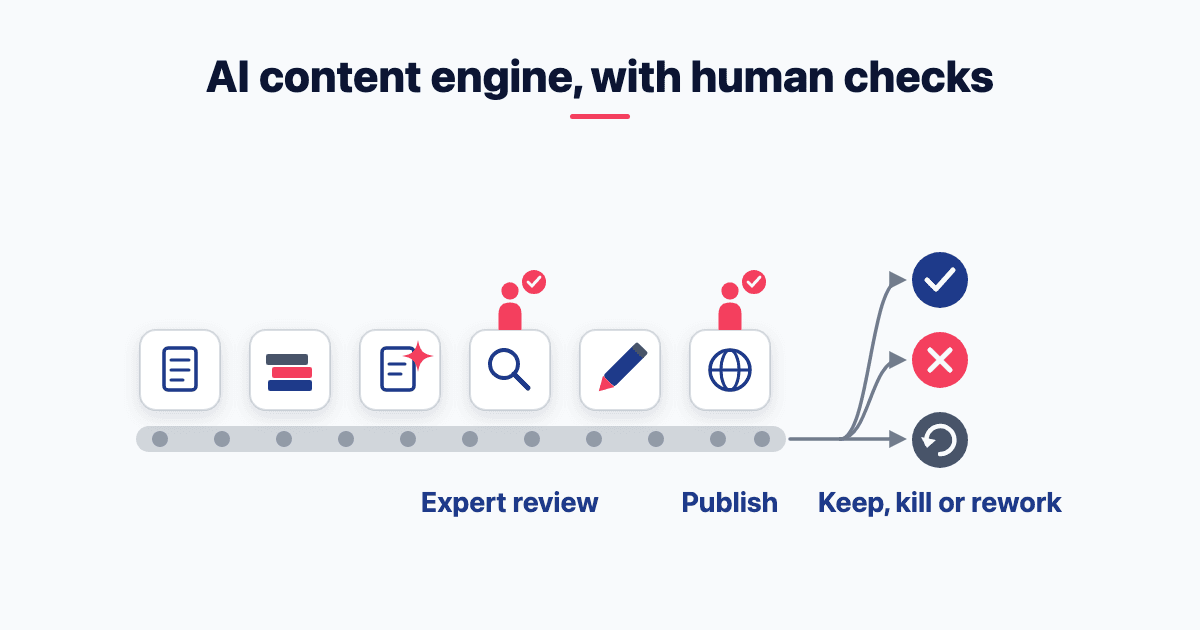
An AI content workflow has two layers: the machinery and the gates. On LinkedIn in September 2025, I mapped the machinery as five agents: research, content, design and prototyping, distribution, and analytics. Together they run a loop "from idea → execution → optimization".
The machinery is the easy part. The six steps below add the gates, and the two that matter most, expert review and publish, each need a named person.
Step 1. Brief: start from something only you have
Feed the brief what a model can't know: customer questions, sales-call notes, your own numbers, a teardown. My LinkedIn post on content creation put it this way: "The moat is no longer the tools - it's you. Your experiences. Your insights. Your voice." Google adds a test of purpose: every page should be created "primarily to help people".
Write it as a five-part CRISP brief (context, role, instructions, specifics and pain points), then add one rule from my session sheet: "No invented statistics, customer names, or claims — if you need a number, leave a [MY NUMBER] placeholder".
Step 2. Sources: save the evidence before anyone drafts
Collect the primary sources first, then draft from them. Google explains why the order matters: "generative models don't retrieve facts, but predict a likely sequence of words based on their training data". Without sources, a model fills the gaps with likely-sounding words. The person who writes the brief owns this step.
Step 3. Draft: AI drafts, one idea per piece
This is where AI earns its keep. As CEO of Programming Hub, I led the shift to AI-powered content pipelines "producing courses and marketing at a fraction of the earlier cost and time". The case study states the result: "+40% revenue in 18 months, profitable and bootstrapped, by moving content production to AI". That's May 2023 to November 2024, and the figures are from my tenure as CEO.
Keep each draft to one idea and inside its format's limits. A draft is done when every claim points to a saved source or a [MY NUMBER] gap.
Step 4. Expert review: a named person checks every fact
Google is blunt. "It is critical to manually factcheck and review all AI-generated content for accuracy and trustworthiness before publishing". Its guidance, last updated 1 October 2026, adds what teams miss. The review also covers titles, meta descriptions, structured data and image alt text, because those can appear in search results.
At DocTutorials, where I lead marketing as an adviser, I built an FMGE (Foreign Medical Graduate Examination) Instagram engine. It's "A four-agent system — planner, manager, designer, student reviewer — with a nine-persona faculty board, producing a 120-post monthly calendar".
In your own engine, whatever the agents pre-check, a named person who knows the subject signs off. For bulk catalogue copy, sampling can check the tone once the brand voice is locked in the prompt. Every fact, figure or claim in that copy still goes to the named person. Tell reviewers what my session sheet tells participants: "zero pushback means you didn't read".
Step 5. Edit: every correction becomes a rule
The session sheet's instruction is "Keep every redline you make". Each edit becomes a rule in the agent's standing instructions: "you are collecting its employment contract clause by clause". The tenth draft should need fewer fixes than the first. If it doesn't, the rules aren't being written down.
Step 6. Publish: behind an approval gate, under a real byline
Nothing ships until a person clicks approve. The build is in my guide to content drafts that wait for your approval.
Put a real person's name on the byline. Google's helpful-content guidance is clear. "Fabricating creator profiles (such as by using AI-generated headshots, made-up names, or false credentials to make content appear as if it was written by human experts) is a form of deception". Ads and AI images raise a separate labelling question under the Advertising Standards Council of India (ASCI): see what ASCI's guidelines make you label.
The engine's rule, from my session sheet: "Automate the shipping, never the judging".
How do you measure an AI content engine, and when do you kill a format?
Write the kill rule before a format launches, not after the numbers disappoint. My kill-threshold card from the DigiAIM session was written for content formats. It asks for "The ONE metric that matters: [saves / shares / replies / UTM clicks — intent, not applause]". A UTM click is a click on a tagged link that shows which post sent it.
Then it sets a floor, and "The window: [counted in posts, e.g., 4 posts — not in days]". On the decision date, you write one word: keep, kill or rework. As the card puts it, "Killing a format on schedule is a win". There's also the same card adapted for any test.
On the search side, add Search Console's Generative AI performance report to the usual Performance report. As of 31 August 2026, Google says it has "rolled out these insights to all websites worldwide". It shows impressions in AI Overviews and AI Mode, by page, country and device (Google's announcement).
Mark this year's spam-update dates on your traffic chart. Compare each page's impressions in the weeks before and after.
A better test: judge the cost per piece someone acts on, not the cost per piece published.
Isn't more content the whole point of using AI?
The objection, stated fairly: AI makes pages nearly free, so publish more and let Google sort it out.
Google answered it in its February 2023 guidance on AI content. Should you use AI to generate content? "If you see AI as an inexpensive, easy way to game search engine rankings, then no".
The better frame is the one from my LinkedIn post on content creation. The differentiator is no longer "Can you create?" but "Can you create content with perspective, depth, and authenticity?" Volume is fine once every piece passes the six steps. Without them, volume is how you lose.
What to do this month
List last quarter's pieces and mark the ones that started from something only you have.
Write the six steps on one page, with a person's name against expert review and publish.
Add two lines to every brief: sources before drafting, and [MY NUMBER] instead of a guessed figure.
Cap next month's social calendar at 8–12 concepts, with 2–3 variants each.
Write one kill threshold per format before the month starts.
Open Search Console's Generative AI report, note your top pages, and mark this year's spam-update dates.
Scaling a content engine? Book a call and bring one month's calendar and your kill rules; we'll check the gates before you add volume.
Frequently asked questions
Is AI-generated content good for SEO?
It can rank, but being AI-made gives it no edge. Google's 2023 guidance on AI content says: "Using AI doesn't give content any special gains. It's just content". So hold AI-written pages to Google's test for any page: is it useful, original and expert? Content generated mainly to manipulate rankings is against Google's spam policies.
Which AI tools are best for content marketing?
The gates matter more than the brand. You need three kinds of tools for AI content marketing. A chat model handles research and drafts. A workflow tool such as n8n runs the approval gate. Search Console measures. For the model, see which AI model your team should standardise on. The model is the easiest part to swap.
Do I have to tell readers that AI helped write a post?
Google doesn't say always. Its 2023 guidance says disclosures "are useful for content where someone might think 'How was this created?'. Consider adding these when it would be reasonably expected". It adds that "Giving AI an author byline is probably not the best way" to make that clear. For ads, see what ASCI's guidelines make you label.
How would I know if Google has penalised my site for AI content?
For a manual action, Google says it will notify you "in the Manual actions report and in the Search Console message center". Its "Major spam problems" action names scaled content abuse (Manual Actions help). But "in most cases we automatically discover it and remove it from our search results". So compare page impressions around each spam-update date.
Is it safe to hire an agency that promises 100 AI blog posts a month?
Only if every post passes the six steps. The risk sits with your domain, not theirs. Google's spam policies warn: "Sites that violate our policies may rank lower in results or not appear in results at all". Ask who checks the facts, whose byline goes on each post, what the kill rule is, and who owns the accounts.
- Content marketing
- SEO
- AI
Written by Siddhesh Joglekar
Fractional CMO and AI marketing consultant Siddhesh Joglekar helps founders and growth-stage teams build marketing engines that compound.