Marketing
AI-made ads in India: what ASCI's guidelines and the IT Rules make you label, ban or change
ASCI's guidelines on AI ads apply from late December: what needs a label, what no label can save, what needs none, and what the IT Rules add.

· 9 min read
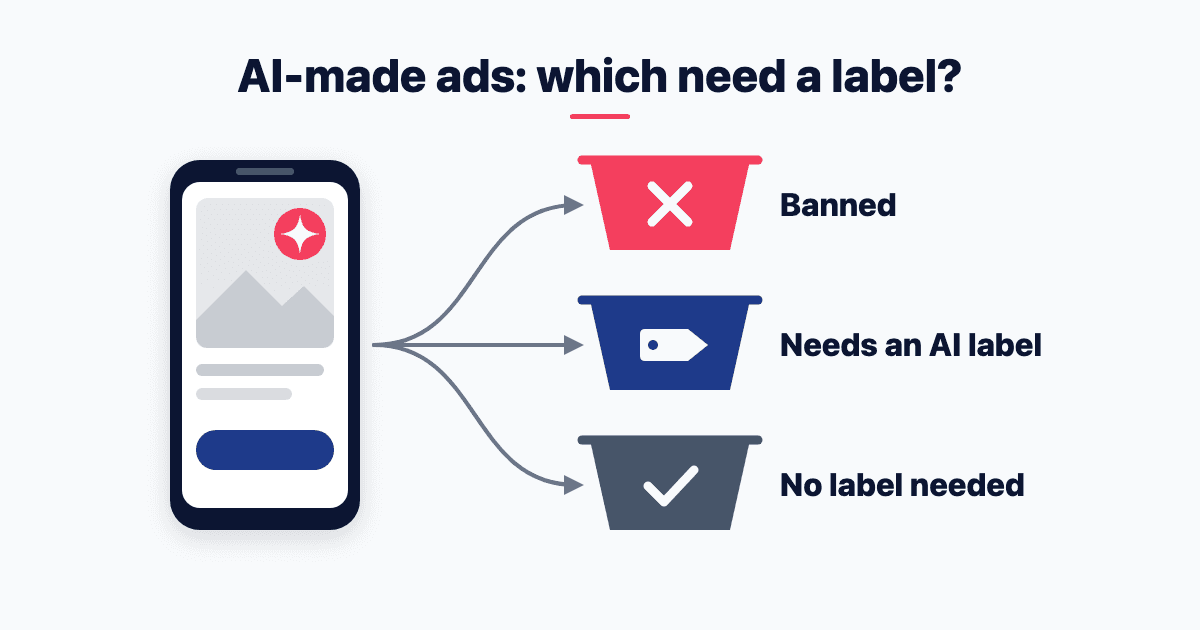
An AI label won't rescue a misleading ad. The Advertising Standards Council of India (ASCI) says so in its guidelines on AI in advertising, released on 29 September 2026. From late December, AI images, video or audio that sway buying decisions, and would mislead without a label, must carry one. AI-written copy needs no label.
What do the ASCI guidelines on AI cover, and when do they start?
They cover AI-made audio, images and video, not text: content made or "materially altered" by a computer "to appear real, authentic or true". It must also show "any individual or event" in a way a viewer would likely believe is real.
So the wrong question is "did we use AI?" The right one is "would a buyer be misled if nobody told them?" The council's focus is "managing consumer outcomes rather than regulating the technology". And every AI ad must still meet the whole ASCI Code.
ASCI's press release is dated 29 September 2026. The guidelines take effect "on the expiration of 3 months from the date of their publication". No calendar date is given, so count from the release: about 29 December. To be safe, plan for 17 December, three months from the signing date.
What is banned even with an AI label?
ASCI gives four examples that break the code whatever the label. It is blunt: "These will violate the ASCI code even if an AI label is used."
Faked endorsements: AI showing a real person using or recommending your product when they didn't.
Exaggerated results: a weight-loss ad using an AI image of "a lean, toned body" to show 100 kg dropping to 70 kg, when real results don't match.
Invented places shown as real: a hotel in a location that doesn't exist.
Stolen work or faces: unauthorised copyrighted work, deepfakes, or a likeness used without consent.
The May draft also listed "an AI generated fake doctor promoting a supplement" as banned (ASCI's May 2026 draft). The final text drops that example. Don't read that as permission. An AI "doctor" shown as a real expert still looks like a fabricated endorsement, and it can breach consumer law too.
My IIT Kanpur Session 5 sheet (27 September 2026) bakes the ban into the video-ad prompt: "No people who look like real celebrities." Write the rule where the creative gets made.
What must carry an AI label?
A label is mandatory when synthetic content "materially influences consumer decisions" and leaving it out would mislead. The six examples:
synthetic influencers and brand ambassadors;
a real person's face or voice replicated for personalised messages, even with consent;
fabricated events or settings that may change how buyers understand the product;
a product that doesn't exist yet, like an unbuilt housing complex;
sound effects central to the product, as in a headset ad;
paid AI product suggestions, labelled "Sponsored by [Brand]".
The last covers a chatbot recommending a brand that paid for it, as in ASCI's example: "What is a good moisturiser for Mumbai weather?" If you're testing ads inside ChatGPT, where ads appear as sponsored cards below the answer, read that clause first.
Virtual influencers already had to tell people they are "not interacting with a real human being" (ASCI's influencer guidelines). For paid creators, see the creator disclosure rules in the D2C guide.
My Session 5 sheet, from two days before the final text, has a slightly stricter rule of thumb: "Anything synthetic that could be mistaken for real footage gets a visible label." That's the safe side.
What needs no label?
No label is needed when the AI has "no material impact" on a buyer's choice:
minor edits: colour, lighting, noise, blemishes, "copy refinement";
decorative backgrounds, skylines, ambient music and jingles;
obvious fantasy, like a fairy fixing a product with magic dust;
text uses: "Generating or enhancing advertising copy";
accessibility: subtitles, captions and translations.
The Ministry of Electronics and Information Technology (MeitY) FAQ adds that text alone isn't covered by the Information Technology (IT) Rules either. But every claim in AI-written copy must still meet the ASCI Code.
One caution: decorative means "unrelated to the product's actual capabilities or promise". In practice, an AI background that changes how the product looks isn't decorative.
How big should the label be, and where should it go?
Wording is easy. The council accepts platform labels "or their own labels", such as "Audio/Video created using AI".
Size is where the evidence is thin. ASCI sets none, pointing only to its disclaimer guidelines "where applicable". Their video rules are the nearest benchmark:
lower-case text at least 26 pixels high in a 1080-line frame (57 at 4K);
at least 4 seconds on screen per line, in the same language as the claim.
They may not strictly apply. The disclaimer guidelines don't treat information given "in connection with a legal or regulatory or ASCI code requirement" as a disclaimer. A required AI label is exactly that. Treat them as a floor.
Ignore the "10%" you may have seen. It was in MeitY's October 2025 proposal. The notified IT Rules set no size. They ask AI tools for a label that's "easily noticeable and adequately perceivable". A MeitY notice of 21 April 2026 proposes a label "throughout the duration of the content". It's still a consultation draft (checked 11 October 2026).
My IIM Calcutta DigiAIM 12 Session 2 sheet already asks for it on avatar videos. The on-screen label, "AI-generated avatar of a real person", stays up "for the full duration". That's my rule; ASCI names no duration.
What do the IT Rules on synthetically generated information add?
A second layer sits with the platforms. The IT Rules amendment of 10 February 2026, in force from 20 February, covers content made to appear "real, authentic or true". Its duties fall on platforms and AI tools, not directly on you:
AI tools must label what they make "prominently", embed "permanent metadata" and block their removal.
Large social platforms must "require users to declare whether such information is synthetically generated information" before upload. Then they verify and label it.
So the change for you is the upload screen. MeitY's FAQ gives the example "AI-generated: Yes/No". Answer honestly. Platforms can remove unlawful synthetic content and suspend the account responsible.
Platforms also label on their own. Meta says it will detect ads made with third-party AI tools. My reading: a platform's label may sit where viewers never look. So add your own on-screen label to must-label ads.
AI tools mark your files too. In September 2025 I noted that Gemini images usually carry a mark: "check right bottom - there would be a marker for an AI generated image in general" (my LinkedIn post). Google's Gemini help page now says users in India can turn off the visible watermark only on an AI Ultra plan. Turning it off leaves the invisible SynthID watermark and Content Credentials untouched.
"ASCI is voluntary, so why bother?"
True: "ASCI is not a government body. It is a voluntary Self Regulatory Organisation" (ASCI's complaint FAQ).
But much of what ASCI bans, the law punishes too. Under the Consumer Protection Act, 2019, a "misleading advertisement" includes one that "falsely describes" a product or "deliberately conceals important information" (section 2(28)). The Central Consumer Protection Authority can fine a manufacturer or endorser up to ₹10 lakh. A later breach can cost up to ₹50 lakh (section 21(2)). Anyone who publishes a misleading ad, or is party to it, faces up to ₹10 lakh (section 21(4)).
A faked AI testimonial fits both ASCI's ban and the Act's definition. This is a plain reading of the published texts, not legal advice. Check a specific campaign with your lawyer.
What to do this week: check every AI asset before it ships
AI background behind a real product: no label if it's purely decorative. If it changes how the product looks or performs, it isn't.
AI model or "brand ambassador": label it, and don't let it resemble a real person.
A founder's AI avatar or cloned voice: get consent in writing, and label it.
Before-and-after visuals: show only real, substantiated results. No label fixes an exaggerated one.
AI-made setting or unbuilt product: label it. A place that doesn't exist, shown as real: don't run it.
Paid recommendation inside an AI assistant: label it "Sponsored by [Brand]".
AI-written copy: no label, but check every claim in it.
At upload: declare AI content honestly. Don't strip watermarks or metadata. Keep the source files and prompts.
Your calendar: check anything running past mid-December against this list now.
New to team AI rules? Start with the data rules a team signs off before anyone types.
If your team makes AI ads every week, I'd be glad to help. In a hands-on AI training session, they build real ads inside these rules. Invite me for a session.
Frequently asked questions
What is synthetically generated information under the IT Rules?
It's audio, images or video a computer made or altered so it "appears to be real, authentic or true" (IT Rules, rule 2(1)(wa)). It must also be able to pass for a real person or event. Routine edits, good-faith documents and accessibility uses are excluded. Text on its own isn't covered, MeitY's FAQ says.
How do AI labels work on Instagram and Facebook ads?
Meta applies its own "AI info" label to ads made or significantly edited with its AI tools. It says it will also detect third-party AI "through industry-standard signals" (Meta Newsroom). Those ads get the label inside "About this ad", behind the three-dot menu. ASCI accepts platform labels. My reading: for must-label ads, add your own on-screen label too.
Can an ad use an AI-generated actor or a celebrity look-alike?
An AI actor, yes, but label it to be safe: ASCI lists synthetic influencers and ambassadors as must-label. A real person's look-alike, used without consent, likely falls under the likeness ban. That person can also complain to the platform about impersonation, "including artificially morphed images". The platform must act within two hours (rule 3(2)(b)), down from 24.
Do the rules differ for AI ads on YouTube, Facebook or TV?
The ASCI code is the same in every medium: ASCI takes complaints across print, TV, radio, the internet and more (ASCI's press release). TV adds a legal hook: cable services can't carry an ad that breaks the ASCI code (Programme and Advertising Code, rule 7(9)). Online, large social platforms also ask uploaders to declare synthetic content.
- ASCI
- AI labelling
- Advertising
Written by Siddhesh Joglekar
Fractional CMO and AI marketing consultant Siddhesh Joglekar helps founders and growth-stage teams build marketing engines that compound.