Marketing
Meta ads structure in 2026: how many campaigns to run, how to test creative, and when Advantage+ helps
Meta ads structure for founders and growth teams in 2026: how many campaigns and ad sets to run, how to test creative, and when Advantage+ helps.

· 10 min read
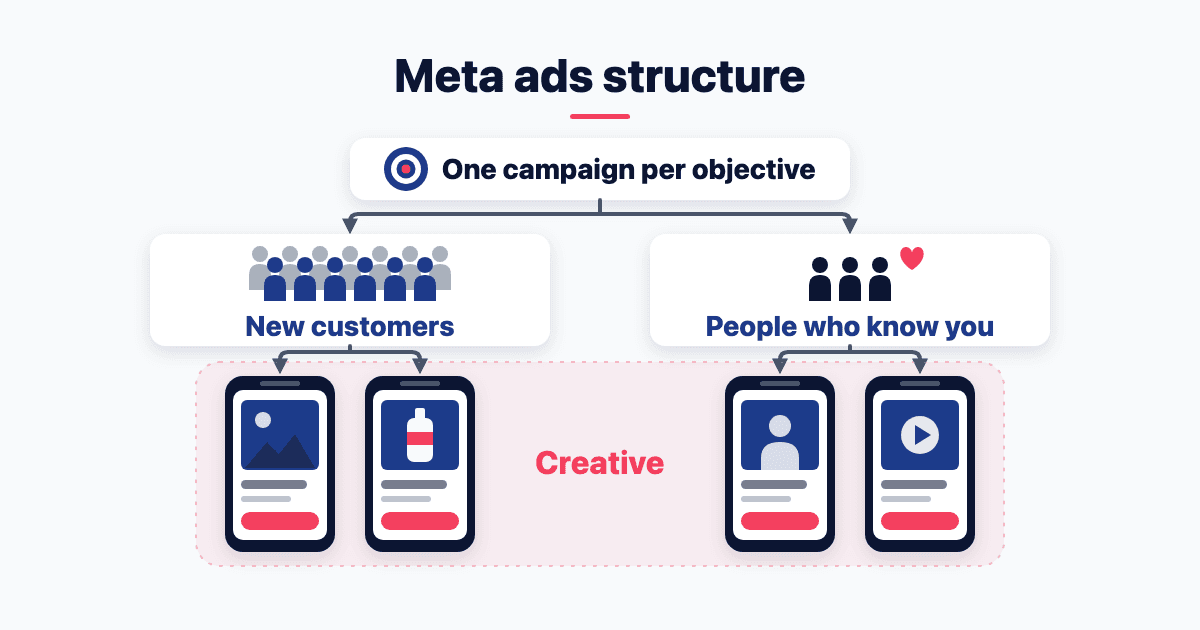
"In 2026 you steer Meta's targeting; you do not fence it." That's why the best Meta ads structure in 2026 is a small one. Run one campaign per objective, with one broad ad set for new customers and, once you have buyers, one for people who know you. Put your effort into creative. Meta still obeys four limits: location, minimum age, language and exclusions.
That line is from my session sheet on Meta targeting (free Google sign-in). I taught it on 20 September 2026 at IIT Kanpur, the Indian Institute of Technology Kanpur. Meta's developer documentation now says much the same.
How many Meta campaigns should you run?
One per objective. That keeps the account small enough to learn. The objective is the first campaign-level choice in Meta's Advantage+ campaign guide: "Step 1: Choose an objective for the ad campaign".
Inside each campaign, run one ad set by default and two at most. I call the pair a two-layer stack: one ad set for new people, one for people who know you.
Since Meta's 2025 change, advertisers "may now create more than one adset per campaign" in an Advantage+ sales campaign (Meta's Advantage+ campaign guide). Both layers fit in one campaign.
Why so small? Every extra ad set must feed its own learning. I've covered Meta's learning floor and the budget maths separately.
My rule of thumb: a second campaign needs its own objective or its own cost target (a separate product line or market). Each must also feed its own floor.
Don't split by funnel stage. A small budget can't carry four campaigns, one per step. Don't split by interest either (they're hints now), and don't give each creative its own ad set.
Structure also comes after the funnel. Take Iqra, an exam-prep learning platform in Morocco. My Meta acquisition plan there was an "Audience and creative framework for paid growth once the funnel could hold it."
What does Advantage+ audience still obey? Your exclusions
Advantage+ audience treats most of your targeting as hints, not fences. I teach targeting as two lists.
Hints, which the machine can go beyond: age range and gender, interests and behaviours, lookalike audiences, and custom audiences you add as a starting point.
Fences, which it must obey: location, minimum age, language, and custom-audience exclusions (for example, your existing buyers).
Meta draws the same line. Its Advantage+ audience reference lists location, minimum age, language and custom audience exclusions as "non-negotiable constraints". Some guides say Meta may ignore exclusions. Meta's own documentation says it doesn't expand them.
So exclusions are the audience lever you still control. Start with existing buyers, so you don't pay to reach them. Then add anyone else you never want to pay to reach, such as current subscribers.
Here's how to build your exclusion list from your order export. Upload only customer lists you have the right to use; that guide covers how.
The cap that went away. New Advantage+ campaigns no longer offer the old existing-customer budget cap (Meta's Advantage+ campaign guide), as the exclusion-list guide also notes. Some guides still tell you to set it.
Meta's replacement: "create two ad sets per ad campaign that separate existing customers from new customers." One includes your customer list, and Meta says to "Make sure this is not a suggestion". The other excludes it. Then give the first a "Daily spend cap of the ad set" (Meta's campaign budget guide). Your ceiling is back.
Advantage+ sales campaign vs manual: when does Advantage+ help?
Advantage+ or manual is the wrong question now. In June 2025, Meta's developer blog announced the end of the choice between an Advantage+ shopping campaign and a manual one. Advertisers get Advantage+ "with the complete range of ad features" in one set-up (Meta for Developers, June 2025).
It's three switches, and you keep the fences. Meta names them: Advantage+ campaign budget, Advantage+ audience and Advantage+ placements. A campaign counts as Advantage+ only while all three are on. If any one is off, its status reads "DISABLED" (Meta's Advantage+ campaign guide).
How I'd set them:
Budget: keep it on. It "distributes your campaign budget in real time" across ad sets (Meta's campaign budget guide). If one ad set needs a ceiling or a floor, use its daily spend cap or daily minimum target (a "best effort", Meta says), not a separate campaign.
Audience: on, for the new-people ad set. My session sheet on building and testing Meta ads (free Google sign-in) says "Advantage+ audience ON, country + age only." The people-who-know-you ad set uses your customer list as a hard inclusion. The campaign still counts as Advantage+: Meta says "Advantage+ audience should be used in a minimum of at least one ad set" (Meta for Developers, June 2025).
Placements: leave them on. To block one for brand reasons, Meta says "Placement exclusions may be set on the ad account level and the campaign will still be eligible" (Meta's Advantage+ campaign guide).
Creative enhancements: check them before launch. They sit outside the three switches. Several are marked "This feature is generated with AI" (Meta's Advantage+ creative guide), and "Advertisers can opt-out of Advantage+Creative features at any time" (Meta for Developers, January 2025). On that same sheet, a build is done only when creative-enhancement generation is off. Keep generated ones off until a person has checked every claim.
Setting up and running Meta campaigns is part of my performance marketing work.
My rule: Advantage+ helps when each ad set can clear its learning floor and the pixel records the real sale or qualified lead. It also needs several distinct concepts and a broad market.
Keep one switch manual for a controlled test or a regulated category. For housing, employment and financial products, Meta says access to Advantage+ audience "is currently being rolled out to advertisers" (Meta's Advantage+ campaign guide). Check what your category allows.
Migrating an old campaign? Moving an Advantage+ shopping campaign into the new format "will force the campaign into the learning stage", and "there is not a workaround for the learnings" (Meta's Advantage+ campaign guide). Do it in a quiet week, not before a sale.
Meta ads creative testing: how do you test creative in 2026?
I teach that creative now does much of the targeting. Here's why. Meta's retrieval stage selects ads "from tens of millions of ad candidates into a few thousand relevant ad candidates" (Meta Engineering on Andromeda, December 2024). Its 2026 model combines each ad's content with live context at the moment of serving, then scores how well the ad matches each person (Meta Engineering, October 2026). What your ad says helps decide who sees it.
Meta reports: "Since 2025, Meta Andromeda has delivered a 2.4% increase in conversions on Facebook" (Meta Engineering, October 2026). That's Meta's own figure across Facebook, not a promise for your account. Generative tools have also added "hundreds of millions of new ads" to the pool.
So my reading is simple: fewer ad sets, more distinct ads.
I learned the supply side of this at BYJU'S, an Indian K-12 edtech company where I was Vice President, Marketing. As I wrote in my guide to a direct-to-consumer brand's first AI budget: "At BYJU'S in scale mode, the marketing team's creative throughput was always the bottleneck — not budget, not bid strategy, not targeting."
Supply was the old bottleneck; variety is the new one. Here's the testing method in eight steps. I teach the first six; the last two rest on Meta's own documentation.
Start with a teardown. In Meta's Ad Library, pick a brand in your category. Count its active ads. Sort them into concepts: the same argument, format and hook make one concept. Count again. Note its longest-running active ad by start date (Meta's Ad Library API reference). That's the one they keep paying for. Then name the gap: an argument they have never tested.
Write concepts, not versions. "Each is a different ARGUMENT × FORMAT × HOOK. No two concepts may share an argument." A proof ad and a price ad are two concepts; two proof ads in different colours are one. Aim for "8–12 concepts, 2–3 variants each."
Name every file concept_format_hook_v1_[MMDD], where MMDD is the month and day. Bad names make the later kill-or-scale call impossible.
Use one ad set, not one per creative. If an AI assistant suggests five ad sets to test audiences, reply: "One ad set. Show me how I read audience performance from the breakdown report instead."
Write the kill and scale rule before launch. Base it on what a new customer is worth to you. Here's how to work out the most a new customer can cost you, with Indian examples.
Leave it alone. After launch, don't touch the ad set for 7 days. Just collect the data. Meta's reason: "Significant edits cause ad sets to reenter the learning phase" (Meta's learning-stage reference).
For a clean winner, run Meta's test, not a new campaign. Meta's documentation describes Creative Tests, "a controlled split test across 2–7 treatment cells" with "one ad (creative variant) per cell" (Meta's split-testing guide). Its rule: "test only one variable at a time". Decide your confidence level before you create the test.
Refresh on fatigue, inside the same structure. Fatigue "usually shows up as a falling click-through rate and a rising cost per action" (Meta's creative fatigue reference). One fix Meta's alert suggests is "a new ad with different images or videos in the same campaign". So add a new concept to the ad set you have.
Do broad targeting and Advantage+ take away your control?
Experienced buyers raise the strongest objection to a small structure: it costs them control. They run four layers (testing, scaling, retargeting, seasonal) for control and clean reads. Both are fair things to want.
But control was never the number of campaigns. You still choose the objective and the event Meta optimises for. You set the fences and make the creative. You can cap spend per ad set. And you read the breakdown report instead of splitting the account.
The evidence is thinner than either side admits. I haven't found an independent study comparing consolidated and split structures for small accounts. The budget splits in ranking guides carry no source, and Meta's 2.4% is its own platform-wide figure. So treat the two-ad-set default as a starting rule. Your breakdown report is the evidence.
Your Monday Meta structure checklist
List your campaigns. Merge any that share an objective and a cost target.
Set up the new-people ad set: Advantage+ audience on, location and age only, existing buyers excluded.
Add a people-who-know-you ad set only if you want to pay to reach them, with a daily spend cap.
Check that the campaign shows Advantage+ on. Keep generated creative enhancements off until checked.
Run the Ad Library teardown. Write 8–12 concepts, each with a different argument.
Name every file. Write the kill and scale rule. Don't touch the ad set for 7 days.
Watch click-through rate and cost per action. When they turn, add a new concept to the same ad set.
If you'd like help applying this to your own account, book a call. We'll go through your campaigns, exclusions and creative plan together.
Frequently asked questions
How do I turn off Advantage+ on a Meta sales campaign?
Change one of the three switches. Meta's Advantage+ campaign guide says that if you set up your "budget, audience, or placement details outside of the criteria", the campaign's Advantage+ state reads disabled. So set budgets per ad set, use fixed (not suggested) targeting in every ad set, or pick placements by hand. Switch off only the lever you need.
Is an Advantage+ sales campaign the same as Advantage+ shopping?
Yes, in updated form. Meta calls sales campaigns "the updated, streamlined versions of Advantage+ shopping campaigns", using "the same automation features" (Meta's Advantage+ campaign guide). They can also hold more than one ad set. From version 25.0 of Meta's API, the old type can't be created there; Meta's 2025 post put that in early 2026.
What is Meta Andromeda, and does it change how I structure ads?
Andromeda is Meta's ad-retrieval system: "the first stage of the ads recommendation pipeline" (Meta Engineering, October 2026). It narrows tens of millions of candidate ads to a few thousand (Meta Engineering, December 2024). It isn't a setting you switch on. My practical reading, not Meta's: distinct creative now matters more than extra ad sets.
Does the same Meta ads structure work for lead generation?
Yes. With the leads objective, the same three switches make what Meta's Advantage+ campaign guide calls "an Advantage+ leads campaign". The shape holds: one campaign, one or two ad sets, creative doing the work. The signal changes. Feed Meta a qualified-lead event, not raw form fills, and teach Meta which leads are good.
- Meta ads
- Creative testing
- Advantage+
Written by Siddhesh Joglekar
Fractional CMO and AI marketing consultant Siddhesh Joglekar helps founders and growth-stage teams build marketing engines that compound.