Marketing
Vernacular marketing in India: when Indian-language ads and landing pages pay back
Vernacular marketing for Indian founders: when Hindi, Hinglish or regional ads and landing pages pay back, and how to test them on cost per closure.

· 8 min read
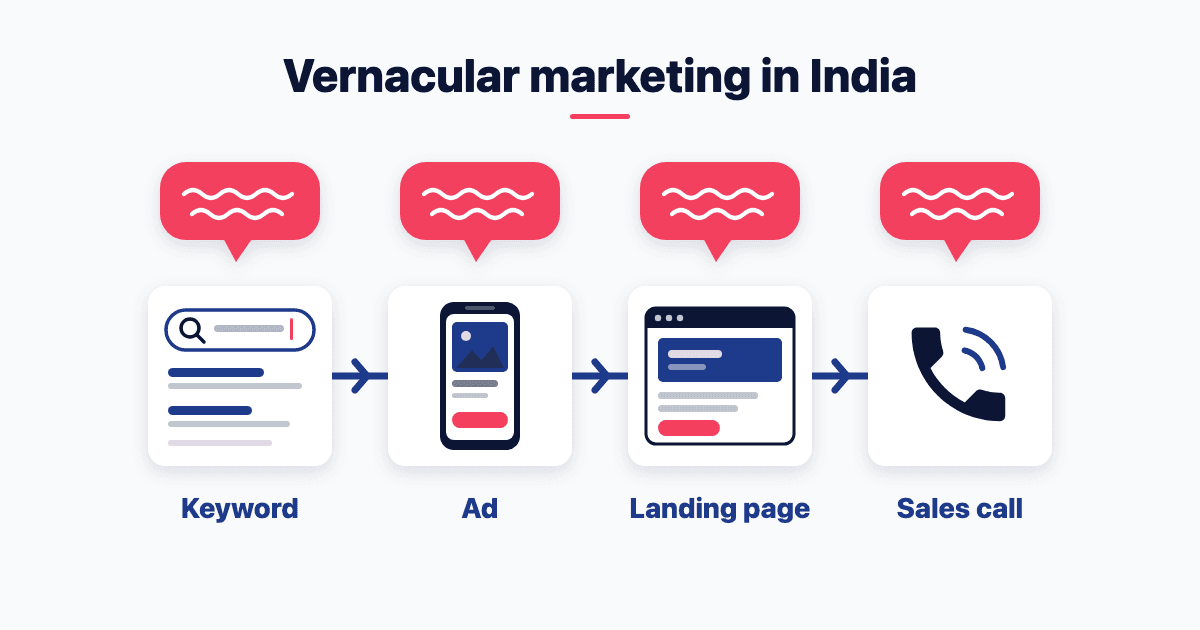
The 88% figure that vernacular marketing guides quote comes from a 2017 study by KPMG in India and Google, and it measures intent, not sales. Vernacular marketing means selling to Indian buyers in their own language. It pays back when the keyword, ad, landing page and sales call all match. Judge it on cost per closure, not cost per lead.
Perhaps your agency reports cheaper Hindi clicks. The real question is whether they became customers
What is vernacular marketing, and where does Indian-language demand sit?
Vernacular marketing means running your search keywords, ads, landing pages and follow-up calls in the buyer's Indian language. That includes Hinglish: Hindi typed in English letters, often mixed with English words.
IAMAI and Kantar's Internet in India 2024 report counts 870 million people, 98% of internet users, who went online in Indian languages in 2024. Its chart of top activities in Indian languages matters more. Watching videos leads at 81%, then music at 69%, social networking at 36% and online shopping at 23%. Online search comes last, at 19%. The chart states no base, so read it as a ranking, not a share of all Indians.
So the channel decides how much of your plan goes vernacular. Video and creators come first. Search ads earn a language only where your own search terms show the demand. If you sell to parents, see edtech marketing strategy in India.
Who decides which language your ad appears in now?
On Google Search, your ad's language does. Google's help page on language targeting says the campaign language setting goes from September 2026. That covers Search campaigns and the Search part of Performance Max. Instead: "We prioritize ads that match the user's search term language."
Bilingual searchers can see either language. Google's own example: "Pat may also enter a query in Spanish and be served an ad in English." Read Hindi for Spanish. With no Hindi ad, a Hindi search can still meet your English one.
On Google, you can't block a language, either. Google's Ads Product Liaison, quoted by PPC Land, said exclusions "are already not supported (e.g. leaving a language unselected doesn't mean it's excluded)". Search Engine Roundtable agrees. Your only lever is negative keywords.
One gap matters for India: Google's help page doesn't say how it treats Hindi typed in English letters. So start from your own search terms.
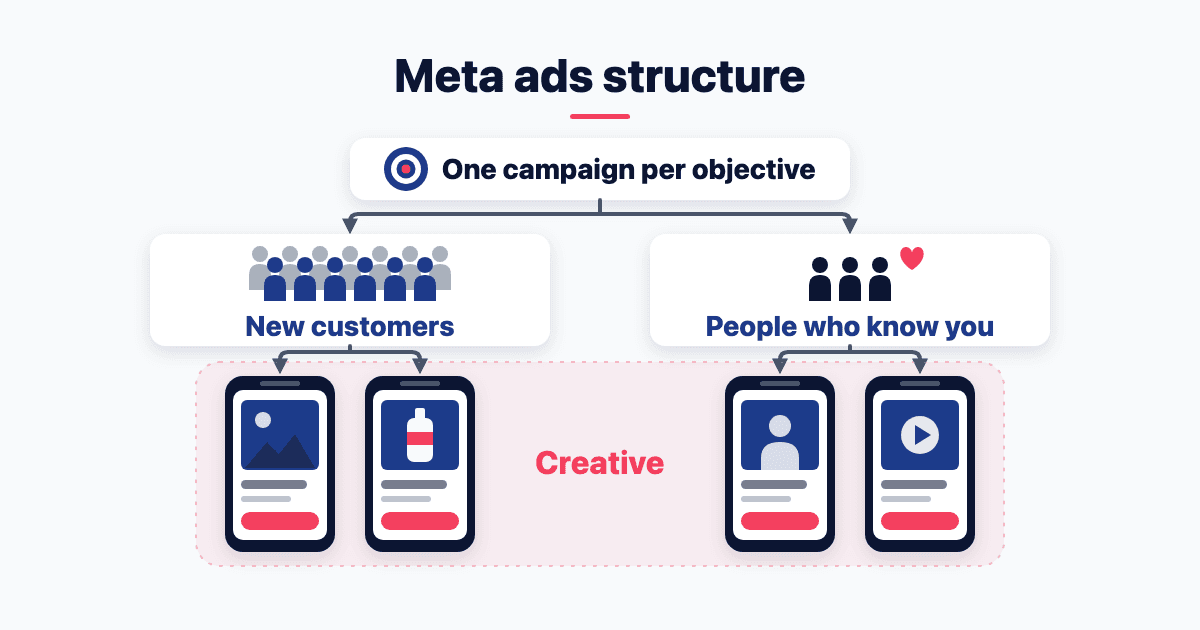
Meta's multi-language ads guide puts several language versions in one ad and shows "the right language version to the right people". A default version shows "if someone's preferred language does not match any locales specified in the asset feed". My reading: someone who reads Hindi but prefers English on Meta may see your English version. That's why phone language settings mislead. For setup, see how to structure Meta campaigns.
Hindi script or Hinglish: what should your Hindi ads, keywords and pages use?
Write the way your buyer types and talks. Google's 2021 UX Playbook for Indian Languages, built on interviews with Hindi, Tamil and Telugu users, says: "Users can use transliterated text (e.g. Hinglish) for typing." And: "Most of the users read and speak in colloquial language." So skip textbook Hindi. As I've argued before, vernacular isn't a translation job.
Keep one script per ad and per page. The playbook says: "Keep to a single language script." My IIT Kanpur session sheet on reading search terms by language (free Google sign-in) makes it a rule: "one language per ad group and per page." So run Devanagari Hindi, Hinglish and English as three ad groups, each with its own page. Devanagari is the script Hindi and Marathi are written in.
Google Search reads language from the page itself. Google Search Central says "Google uses the visible content of your page to determine its language." It advises "a single language for content and navigation on each page". Then check that the page says what the ad promised, in the same language.
Ask questions the way your buyer would. My IIM Calcutta e-commerce session (free Google sign-in) on 12 October 2026 asked the room to try one shopping question in Hinglish: "Goan fish curry ke liye kaunsa masala sabse accha hai, jo zyada namkeen na ho?" It means: which masala is best for Goan fish curry, one that isn't too salty?
Google India's blog said in October 2025 that AI Mode, already in English and Hindi, was rolling out in seven more languages, from Bengali to Urdu. Add a few Hinglish and native-script buyer questions to your keyword research.
How do you test whether vernacular ads pay back? Run the Language read
The test is "The Language read", Prompt 4 on the same IIT Kanpur sheet, taught on 18 October 2026. Its brief: "two weeks of search terms with the language column → what to change". In six steps:
Read two weeks of search terms, with a language column. Label each search English, Hinglish, Hindi or regional. The sheet says: "Two weeks of data with the language column before you act". If your account still shows the old setting, run it anyway as a watch-list.
Group searches by query language → ad language → page language. Flag the groups "NEW since the change (query language ≠ ad language)". Those are Hindi searches meeting English ads.
Give each group one decision. Keep, exclude, or "build a matching ad group AND landing page". A thin group gets "collect more". Mismatches you'll never serve go on "the negatives list (exact terms)".
Build one language end to end, including the follow-up. In a case from Google's playbook, Google's team helped HDFC Mutual Fund with "translated & transliterated keywords". The fund "built a quick easy hindi landing page". Its call centre was briefed to route calls to "Hindi speaking agents". Google reports 40% lower cost per acquisition on Discovery (a Google campaign type at the time) and 21% lower cost per click on Search. Those are platform metrics, not revenue.
Fix the funnel in that language before you buy traffic in it. At Iqra, a Moroccan exam-prep app I worked with, onboarding is now personalised by language.
Judge on cost per closure against your English baseline. Cost per closure is ad spend divided by paid orders, enrolments or signed policies, not by leads. Import closures as conversions, so the sheet's CPA (cost per acquisition) is your cost per closure. Its rule: "Flag any group with CPA over 1.3× baseline but under 15 conversions as 'collect more' rather than 'act'." These are my working thresholds, not statistical law.
A worked example, with illustrative numbers:
English ad group: ₹300 per lead and a 10% close rate, so ₹3,000 per closure.
Hinglish ad, English page, English-only callers: ₹180 per lead and a 4% close rate, so ₹4,500 per closure. That's 1.5× the baseline: cheaper leads, dearer customers.
Hinglish ad, Hinglish page, a Hindi-speaking caller: ₹180 per lead and an 8% close rate, so ₹2,250 per closure, 0.75× the baseline.
Payback: say translation, a native-speaker check and the page cost ₹40,000 once. At ₹750 saved per closure, it pays back after about 54 closures (40,000 ÷ 750 = 53.3).
Don't cheaper Hindi clicks prove it works?
Cheaper attention is not a cheaper customer. In the example, a lead 40% cheaper ends up costing 1.5× as much per customer.
The belief that vernacular ads work leans on one number. KPMG in India and Google's April 2017 report, with research by Nielsen, found that "88% of Indian language internet users are more likely to respond to a digital advertisement in their local language as compared to English". Its companion figure: "68% Internet users consider local language digital content to be more reliable than English".
Both are what people said in 2017, not what they bought. One guide ranking for this topic in November 2026 dates the 88% to 2024 and calls it trust. Even Google's Hindi case reports clicks and actions, not revenue. So cheaper Hindi clicks are a reason to run the Language read, not proof of payback.
Your first Language read
Export two weeks of search terms and add a language column.
Group them query → ad → page, and write keep, exclude, build or collect against each, dated.
Add exact-term negatives for mismatches you won't serve.
Build one language end to end: keyword, ad, page and follow-up call.
Import closures. Act on a group at 15+ conversions; a cost over 1.3× your English baseline is the trigger.
Work out how many closures repay the one-off build cost.
Planning a Hindi or Tamil build? Before you fund it, book a call and bring two weeks of search terms. We'll check which language has earned its own ad group and page. Paid search in Indian languages comes under my performance marketing service.
Frequently asked questions
Is vernacular influencer marketing worth it?
It can be, if you judge regional creators on closures, not views. Give each creator and language its own tracked link or code, and a page in the creator's language. On disclosure, the Advertising Standards Council of India's influencer guidelines say "The disclosure should be in English OR in the language as the advertisement itself". See a creator engine.
Can Meta translate my ads into Hindi automatically?
Yes. Meta's multi-language ads guide, updated 26 June 2026, lists English to Hindi among its automatic translations, and no other Indian language. For other languages, check Ads Manager's "Translate Text" option. Meta's Advantage+ Creative guide documents it without naming its languages. Either way, have a native speaker check every line, and "Build a translation glossary", as Google's playbook advises.
Do I need a separate website for each Indian language?
No. You need a separate URL for each language version of the pages you advertise, not a separate site. Google Search Central "recommends using different URLs for each language version of a page". It also says: "Avoid automatically redirecting users from one language version of a site to a different language version of a site." Let people switch languages themselves.
Which Indian language should a brand start with?
Start with the language your search terms already show, and that your team can answer the phone in. IAMAI and Kantar's 2024 report found 24% of urban internet users preferred Hindi for going online. Tamil, Telugu and Malayalam users were the likeliest to stick with their own language online; Gujarati, Marathi and Bengali users were among the least likely.
- India
- Vernacular marketing
- Regional languages
Written by Siddhesh Joglekar
Fractional CMO and AI marketing consultant Siddhesh Joglekar helps founders and growth-stage teams build marketing engines that compound.