Growth
App onboarding for Indian users: language, first value and the first week
App onboarding best practices for Indian users: ask for language instead of guessing, reach first value fast, and earn the notification opt-in in week one.
· 8 min read
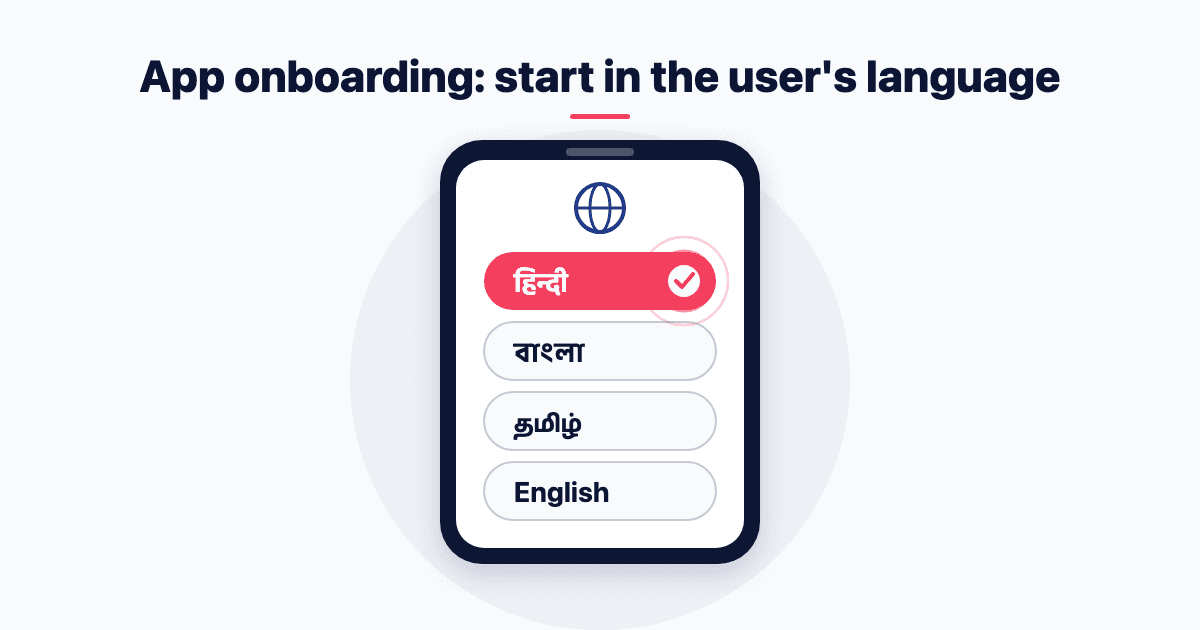
On Android 13 and later, a newly installed app's notifications are off by default. So onboarding can't count on push to bring people back. For Indian users, app onboarding best practices come down to three jobs. Let people pick their language. Get them to one useful result in the first session. Then earn the notification opt-in during week one.
This is for teams whose installs come in but whose users don't come back. Your app marketing strategy should win installs that turn into payers. This post picks up at the first screen. The usual lists of mobile app onboarding best practices say almost nothing about language, Android's rules or India.
Should onboarding guess the user's language from the phone?
No. Ask. In 2020, Duolingo reported that "over 95% of English learners in India had mobile phones set to English" (Duolingo's blog, September 2020). Its app "showed languages you can learn based on your phone language". The English course sat mid-list, so some learners never realised there was one for Hindi speakers.
Moving that course to the top, "regardless of your phone language", "led to a 2% gain in daily active users". One company, one test, reported in 2020. But the point holds: the phone's language is a poor guess.
Android agrees. Its documentation notes that "multilingual users set their system language to one language—such as English—but they want to select other languages for specific apps" (Android Developers, per-app language preferences). That's why Android 13 added a per-app language setting. Ask your developers to build the in-app picker on that same Android setting, so the choice holds everywhere. Older phones get "equivalent APIs" through Android's support library, AndroidX.
What to do:
Make language the first screen: one tap, no typing.
Write each language's name in its own script: हिन्दी, বাংলা, தமிழ்.
Let users change it later from their profile.
The demand is real. Google's 2021 playbook for Indian languages reports that 45% "of local language users prefer accessing content exclusively in regional languages" (Google's UX Playbook for Indian Languages). Its sources include a January 2021 Google and Kantar survey of 3,596 urban consumers. For 2024 figures, see the language section of my edtech guide.
What is first value, and how fast should a new user reach it?
First value is the first result the user installed your app for. Not the tour. Not the profile. The result:
For an exam-prep app, a first test taken or a doubt resolved (the week-one goal in my edtech marketing strategy guide).
For a payments app, the first transfer that goes through.
For a commerce app, a first order, or at least a saved list.
Advice on screen counts is mostly opinion. Use a rule instead: cut every screen before first value that doesn't change what the user sees next.
Ask one or two questions, and only ones that personalise the next screen. I worked with Iqra, a Moroccan Baccalaureate exam-prep app with 1–2K sign-ups a day (figures supplied by the client's leadership). It began with "One onboarding for every student, in every language". It moved to onboarding "personalised by level and language, in English, French and Arabic".
Then remove typing. If sign-up is a phone number and a one-time password (OTP), let Android read the code. Google's SMS Retriever API works "without requiring the user to manually type verification codes, and without requiring any extra app permissions" (Google for Developers).
Plan for users new to apps. Google's playbook says "Users with low digital literacy are reluctant to try out new features", and suggests "voice or video hints". Offer help by phone too: Google found that "most Indian language users preferred calling over chatting". If sign-up collects personal data, the consent notice belongs in this flow.
How do you plan the first week when notifications start switched off?
Most teams treat onboarding as the first five screens. It's really the first week. And on Android 13 and later, you have to earn the right to reach the user after day one.
How many users does that affect? In September 2026, about four in five Android page views StatCounter tracked in India came from Android 13 or later (StatCounter Global Stats). That's my sum of its shares for Android 13 to 17 in StatCounter's September 2026 data download (79.4%), and it counts web traffic, not phones.
Android's advice is to ask "in the correct context, so that it's explicitly clear what the notifications are used for and why the user should opt in" (Android Developers, notification permission). Or "you might wait until the third or fourth time the user launches your app".
In practice:
Ask right after first value, with the reason in the request. "Remind me the evening before my mock test" is a reason. "Allow notifications" isn't.
Tie the week's messages to the user's own dates. At Iqra, we built "A notification lifecycle tied to exam dates".
Plan the rhythm. AppsFlyer advises: "Plan messaging bursts between Days 5–10, optimise onboarding to encourage second and third opens" (AppsFlyer India Festive Report 2025).
Then test every message before it ships, with the exercise from my NKT College session sheet (Thane, 28 September 2026). Take one real notification and ask: "What job is this notification doing, who is it for, and what number does the team most likely watch?" Then write versions and test which one wins. AI drafts. You check. The number judges.
How do you know your onboarding is working?
Track four numbers, each split by language and by acquisition channel:
Onboarding completion: the share of new users who finish the flow (Duolingo's metric for its wording test).
Time to first value: from install to the first result.
Notification opt-in rate: users who allow notifications, out of those asked.
Day 1 and Day 7 return rates.
Be careful with app retention rate benchmarks. The Indian ones in AppsFlyer's report on the 2024 festive season sit under an iOS heading. Yet iOS is "just 6% of installs", says its State of App Marketing in India 2025 report. Your own last four weekly cohorts are a better baseline.
Instrument before you redesign. At Iqra, the event taxonomy came first: "The event model the product needed before any experiment could be run." Over a 90-day sprint, payment conversion went from 0.5% to ~1%. The figures were supplied by the client's leadership, and conversion is approximate and mid-programme. The gain came from the whole sprint, including a notification lifecycle and a maths knowledge graph, not from onboarding alone.
Onboarding then hands the user to the payment moment, covered in my guide to free-to-paid conversion.
"Just translate the app into Hindi"
Translation is enough, the argument goes: ship the Hindi strings and move on.
The evidence says otherwise. Duolingo found its Hindi interface "was actually often too hard for even native Hindi speakers to understand". Its currency was "मणि" (mani), but interviewed users called it "coin" or "diamond". Writing "language" and "level" in English during onboarding "led to a 1% increase in onboarding completion".
Google's playbook agrees on everyday words: "Literal translations of complex words are not easily understood". On script, it disagrees: "Keep to a single language script", though "Common acronyms and technical terms may be left in English". Duolingo mixed scripts and gained; Google says don't. One test reported in 2020 can't settle it, so test both on your own users.
Smaller rules from Google's playbook are worth copying:
"Build a translation glossary."
Don't "Show error messages in English".
Use English numerals, because "Numerals in Indian languages are difficult to read".
Write money in lakhs with the rupee symbol: ₹ 1,20,000, not ₹ 120,000.
Choosing these words is product marketing work, not a translation job.
What to do this quarter
Put language first: one tap on the first screen, changeable from the profile.
Write down your first value. Cut every screen before it that doesn't change the next one.
Ask at most two personalising questions.
Let Android read the OTP.
Ask for notifications after first value, with the reason in the request.
Plan week one's messages around the user's own dates, and run the three-question check on each.
Track completion, time to first value, opt-in rate, and Day 1 and Day 7 returns, by language and channel.
If your app gets sign-ups but few second sessions, I'd be glad to look at your first week with you: book a call.
Frequently asked questions
What is a good retention rate for an app?
It depends on category and platform. In AppsFlyer's 2024 festive-season data for India, under an iOS heading, shopping apps' average Day 1 retention rose. From 24.2% in October to 25% in November. Best-in-category finance apps kept 13.2% by Day 30, shopping 6.5% (AppsFlyer). iOS is "just 6% of installs" (AppsFlyer), so compare your own cohorts.
How do you increase app retention after the first week?
Give users a reason to open that's about them. AppsFlyer observed that "Apps that retained 2–3x more users by Day 30 consistently delivered re-engagement touchpoints, personalised journeys, and clear value beyond the first session" (AppsFlyer). That's a vendor's observation, not a test. From Day 7 to Day 30, every message needs something new.
What is a user onboarding flow?
A user onboarding flow is the sequence of screens and messages that takes a new user from install to their first useful result. For an Indian app, a good one runs: language, phone-and-OTP sign-up, one or two personalising questions, first value. Then comes a notification request in context, as Android advises.
Which Indian languages should an app support first?
Start from your own sign-ups by state, then the census. In the 2011 Census, 43.63% of Indians returned Hindi, or a mother tongue grouped under it, as their mother tongue. So most Indians have a different mother tongue. Next came Bengali (8.03%), Marathi (6.86%), Telugu (6.70%) and Tamil (5.70%). Android lets you "customize the language list per region" too.
- Onboarding
- Retention
- Consumer apps
Written by Siddhesh Joglekar
Fractional CMO and AI marketing consultant Siddhesh Joglekar helps founders and growth-stage teams build marketing engines that compound.