Growth
How to do influencer marketing in India: build a creator engine that lowers acquisition cost
How to do influencer marketing in India: score creators, brief approved claims, settle usage rights and TDS, and track each creator to cost per acquisition.
· 12 min read
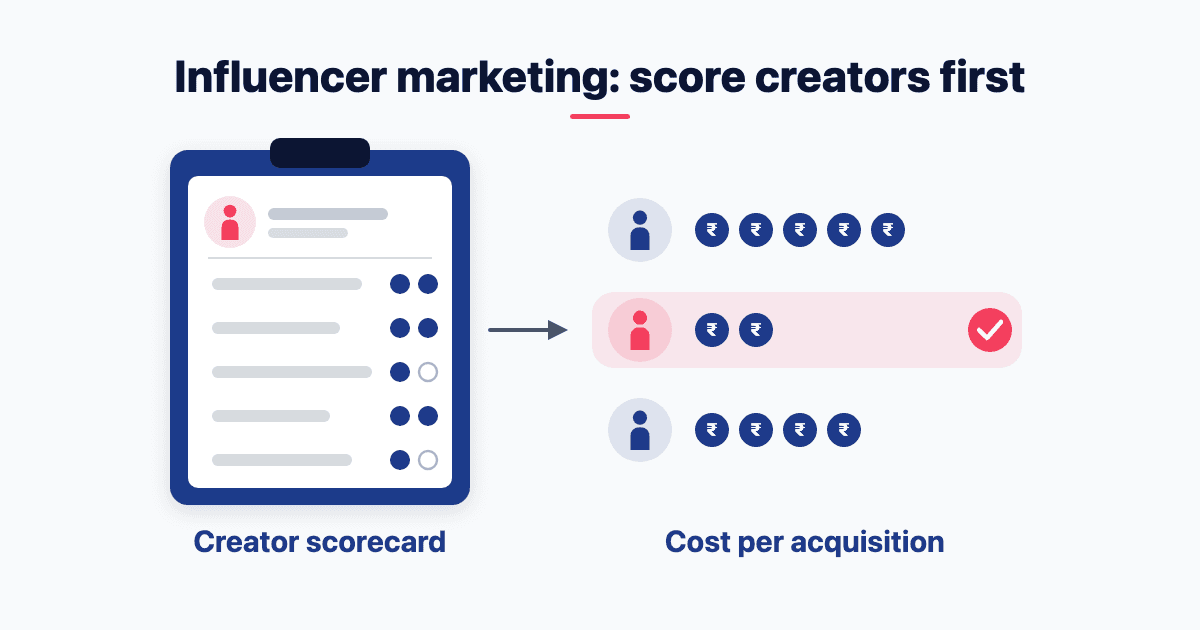
Buying a creator post is easy. Knowing whether it sold anything is hard. To do influencer marketing in India well, run creators as an engine, not one-off posts. Score them for fit and values, brief them on approved claims, and settle rights and tax in writing. Track each one to cost per acquisition. Cut those who don't pay back.
This guide is for direct-to-consumer (D2C), edtech and consumer-app teams with a creator budget to spend before Diwali. It walks through the engine's seven parts, in order.
What does a creator engine have that a campaign doesn't?
A campaign buys posts. An engine keeps a roster that gets better every month. It has seven parts:
A scorecard for choosing creators.
A brief with a claims sheet.
A quality and values check.
A contract.
Payment, including tax deducted at source (TDS) and goods and services tax (GST).
Tracking per creator.
A cut rule.
I lead marketing as an adviser at DocTutorials, a medical exam-prep brand. Its creator work began "ad hoc; no roster, no exclusion list, no outcome tracking." The case study now reports hundreds of signed creator collaborations. Between FY25 and FY26, cost per acquisition fell by roughly a third, with other levers also at work. It gives no absolute figures, at the client's request.
Which creators should you pick: nano, micro or macro?
Start small. One influencer platform's 2026 guide puts nano creators at "1,000–10,000 followers" and micro creators at "10,000–100,000 followers". Treat these as rough bands.
Test with nano and micro creators. You can afford enough of their posts to compare them.
Save larger creators for reach moments, such as a launch, once you know what converts.
Pick by your buyer's language and city, not by follower count.
What creators charge is in the FAQ below.
How do you find creators for your brand in India?
Look in four places:
Customers or students who already post about you.
Creators your buyers say they follow. Ask at onboarding or after purchase.
Category hashtags and searches on Instagram and YouTube.
Discovery platforms and agencies, which are faster but charge for it.
Keep a never-pitch list of accounts with a current competitor deal. Later, you can automate the creator shortlist.
How do you score a creator before you pay?
Score five lines 0, 1 or 2 each, for a total out of 10. It's a starting point: adjust it to your category.
Audience match. Are the followers your buyers, by city, language, age or exam? Ask for their audience-insights screenshot.
Topic fit. Do they already post about your category without being paid?
Real engagement. Comments that ask questions or show buying intent, not just emojis. No sudden jumps in followers.
Conflict check. No current paid deal with a direct competitor.
Compliance habits. Past paid posts carry a visible label. Health or finance creators hold the qualifications India's advertising self-regulator requires, and state them upfront in their posts. Its guidelines are linked in the next section.
Then act on the total:
8–10: offer a paid brief.
6–7: run a product-only or small paid test.
Below 6: skip.
A failed conflict or compliance line is a no, whatever the total.
What goes in a creator brief and a claims sheet?
A good brief fixes what the post says and leaves how to the creator:
One goal, one audience and one offer.
The creator's own tracking link and code.
The message, for the creator to tell in their own words.
The disclosure label and where it goes. The rules are in my D2C guide's creator section.
A draft review, deadlines, and your own check within 24 hours of the post going live.
Attach a claims sheet: the claims they may make, each with its evidence, and the claims they may not. The influencer guidelines of the Advertising Standards Council of India (ASCI) advise creators to "satisfy themselves that the advertiser is in a position to substantiate the claims made in the advertisement".
The council does look. Its release on the 2025-26 annual complaints report says: "Of the 1,609 influencer ads processed during the last financial year, 97.3% required modification". Those are only ads the council picked up. And "over 54%" were in categories the law prohibits or restricts, mainly illegal betting.
For personal care ads, the release flags "claims of visible, rapid or guaranteed results", dandruff gone in "1 wash", and "India's No1". Keep such claims off your sheet. Coaching and test-prep brands also face rules on topper and rank claims: see my guide to edtech marketing strategy in India.
How do you check a creator's content for quality and values?
Check at four points, not one: shortlist, brief, draft and live post. ASCI's 2023 online survey of 820 adults found "64% of respondents think that a brand becomes more trustworthy if an influencer endorses it". One online survey is direction, not proof. But if trust travels from creator to brand, so can a bad post.
When you shortlist, read the feed as a buyer would. The same survey says "Lack of transparency, repetitive content, and over-promotions cause audiences to stay away". So scroll their last 20 posts: count the paid ones, see what else they sell and how they answer critics. A clash with your off-limits list is a no, whatever the total.
In the brief, add a one-page brand sheet. Give your tone in three lines and an off-limits list: three to five topics, jokes or comparisons. Attach a past post of theirs you liked: the bar, not a script. The Department of Consumer Affairs' 2023 guide for influencers says they should not endorse anything "that they have not personally used or experienced". So ship the product early.
At the draft, fix facts and values, not voice. One round of changes, two at most. Check claims against the sheet, then the label and off-limits list. For quality, borrow my check for AI-made Instagram ads from an IIT Kanpur session on 6 June 2026: "Does it stop a thumb? Is it readable at phone size?"
After it goes live, checking the post is your job too. For a paid or gifted post, ASCI's guidelines make the brand responsible to "ensure that the posted Influencer advertisement is in line with the ASCI code". Where needed, it must "call upon the Influencer to delete or edit an advertisement or the disclosure label". If a creator's post uses an AI-made face, voice or scene, ASCI's AI labelling rules will apply as well.
At the 24-hour check, read the comments too. Confused buyers? Fix your next brief, not the creator. Note on the roster whether each post stayed on-brand, so renewals weigh content, not just cost per acquisition.
What should the creator contract say?
Put seven things in writing:
Deliverables: platforms, formats, dates and draft rounds.
Disclosure: the label, and your right to ask for an edit or deletion.
Claims: only those on the claims sheet.
Usage rights: reposts, your own paid ads, and paid ads from the creator's handle with their permission, plus the term and territory.
Exclusivity: the category and the window.
Payment: amount, schedule, the stated value of any product, and a GST invoice if they're registered.
Age: confirm the creator is 18 or over.
Under section 19 of the Copyright Act, 1957, an assignment is valid only "in writing signed by the assignor". With no period stated, "it shall be deemed to be five years from the date of assignment". With no territory, it is "presumed to extend within India" (Copyright Act, section 19, on Indian Kanoon). And under section 19(4), rights you don't use within a year of the assignment are "deemed to have lapsed", unless the contract says otherwise.
Section 30A applies section 19 to a licence too, "with any necessary adaptations and modifications" (section 30A on Indian Kanoon). So the same rules can apply when a creator licenses you usage rights, not only when they transfer the copyright. Don't lean on these defaults: write your own term and territory, and say whether unused rights lapse.
Exclusivity and rights cost extra. One agency's 2026 pricing guide estimates that "Rights, exclusivity and format move quotes 2x to 3x". It's a vendor's estimate, but budget for a premium.
On age, ASCI's influencer series on contracts is plain: "A contract entered by a minor is void ab initio", meaning void from the start. If a creator could be under 18, as in school test prep, take legal advice first.
How do you pay creators, and what about TDS and GST?
Deals mix cash, product and barter.
The new rule. The Income-tax Act, 2025 came into force "on the 1st April, 2026" (the Act in the Gazette of India). It sets TDS on "any benefit or perquisite, whether convertible into money or not, arising from business or the exercise of a profession of any resident". The rate is "10% of value", with a ₹20,000 threshold limit. This replaces section 194R of the repealed 1961 Act, though some guides still cite it.
Who deducts. A "specified person": any person "not being an individual or Hindu undivided family", such as a company or a firm. Individuals and Hindu undivided families count too once the previous year's sales or receipts passed ₹1 crore in business, or ₹50 lakh in a profession.
When it's a product. There's no cash to deduct from. For a benefit "wholly in kind", the Act says you "shall ensure that the tax required to be deducted has been paid" before providing it. So record each product's value, and agree how the tax gets settled before you ship.
The 2022 circular. A Central Board of Direct Taxes (CBDT) circular of 16 June 2022 covered the old section. A law firm's summary of the circular says the tax applied when an influencer kept the product. Old circulars survive only "so far as it is not inconsistent with the corresponding provisions of this Act". My reading is that this point still holds.
Cash fees. Advertising appears in two definitions: "professional services" and "work". Which one covers a creator's fee is your chartered accountant's call, so I don't state a rate.
GST. Creators supplying services need not register below ₹20 lakh of aggregate turnover. In Manipur, Mizoram, Nagaland and Tripura, the line is ₹10 lakh (a Central Board of Indirect Taxes and Customs flyer on GST registration).
For your chartered accountant: Income-tax Act, 2025, s.393(1) Table 8(iv) with Notes 2 and 6; s.402(28), (37) and (47); s.536(1) and (2)(j); CBDT Circular 12 of 2022.
This summarises the statutes; it isn't tax or legal advice. Confirm the tax treatment with your chartered accountant, and the contract with a lawyer.
How do you track each creator to cost per acquisition?
Give every creator their own trail:
A tagged link. Google Analytics' help page on campaign URLs lists "utm_source: Referrer" and "utm_content: Use to differentiate creatives". Give each creator a unique utm_content value.
A unique code, for buyers who never click.
A landing page, if the budget allows.
A "How did you hear about us?" question at checkout or enrolment.
Each creator's cost per acquisition is their all-in cost divided by tracked new customers. All-in means the fee, product value, any usage or exclusivity fee, and any agency or platform share.
An illustrative example, not a client's figures or a benchmark:
Creator A: ₹40,000 all-in and 20 tracked new customers, so ₹2,000 each.
Creator B: ₹1,20,000 and 24 customers, so ₹5,000 each.
Creator C: ₹10,000 all-in (product plus a small fee) and 8 customers, so ₹1,250 each.
Against a ceiling of ₹3,000, A and C pay back. B doesn't, yet. Your ceiling is the most a new customer can cost you, and it comes from your unit economics. Set it before the first post, not after. If you'd like help working it out, that's part of my growth strategy work.
"Creators build the brand. You can't measure that." Can you?
Both are true, so measure in two layers. The tracked number is a floor. Above it, look for halo signals: code use without clicks, "how did you hear" mentions, and brand searches in the week after a post.
That's how I teach it. In my IIT Kanpur session on 20 September 2026, I put creators at the "Interest" step: "Feed ads, carousels, creators." The same page says of the upper funnel: "Last-click is the wrong ruler here."
The halo has limits. Codes leak to coupon sites, and survey answers are self-reported. Treat the halo as evidence, not proof, and budget on the tracked floor.
When should you cut a creator?
Cut on evidence, not mood. Start from this rule:
Cut after two tracked posts or 30 days, if cost per acquisition is still above your ceiling with no halo signal.
Cut at once for a missing label after one reminder, a claim off the sheet, off-limits content, or a competitor deal inside the exclusivity window.
Renew creators below the ceiling, with a longer term and paid usage, so their best content runs as ads.
Review the roster every month. The aim is a roster that gets better, not bigger.
What to do this week, and in your first 30 days
Steps 1 to 4 fit in a week. The rest take the month.
Set your ceiling.
Build the never-pitch list.
Score 20 creators.
Write the brief, claims sheet and brand sheet.
Sign contracts with usage terms and an age check.
Settle TDS and GST with your chartered accountant before any product ships.
Give each creator a tagged link and a unique code.
Review after two posts, then cut or renew.
Want help scoring your roster and setting up tracking before the festive push? Book a free call.
Frequently asked questions
How much does influencer marketing cost in India?
It depends on the tier, and the published rate cards disagree. For micro creators, one influencer platform quotes "₹5,000 to ₹50,000 per deliverable", while one agency estimates "Rs 8,000 to Rs 80,000". Both are vendor figures. Usage rights and exclusivity push quotes higher. So budget from the most a customer can cost you, not from a rate card.
How much do influencer marketing agencies charge in India?
One agency estimates that agencies charge "Rs 50,000 to Rs 5 lakh per campaign, Rs 1.5 lakh to Rs 6 lakh a month on retainer, or 15% to 25% of creator spend". Self-serve platforms, it says, take a subscription or "8% to 15% of campaign spend". Either way, ask for creator fees passed through at cost, with audit rights.
Is influencer marketing regulated in India?
Yes. The Advertising Standards Council of India's guidelines are self-regulation, but the law applies too. The council's endorser page says its code "as well as the Consumer Protection Act, 2019 require celebrities/ endorsers to ensure that representations made by them in advertisements do not mislead consumers". The council's influencer guidelines count free products as material connections, "including those received unsolicited".
Should you spend more on creators in the festive season?
Only on creators who have already proved themselves. Raise spend where tracked cost per acquisition is below your ceiling. Don't test new creators in peak weeks, because a test needs normal weeks to compare against. And sign the contracts and claims sheets, and settle the TDS paperwork, weeks ahead, because approvals take time.
- Customer acquisition
- Influencer marketing
- Creators
Written by Siddhesh Joglekar
Fractional CMO and AI marketing consultant Siddhesh Joglekar helps founders and growth-stage teams build marketing engines that compound.