Marketing
How to create a website for your clinic: the pages, the logins and the upkeep, under India's 2026 rules
How to create a website for your clinic in India: pick the build route, keep the domain and logins in your name, add the pages several doctors need.

· 10 min read
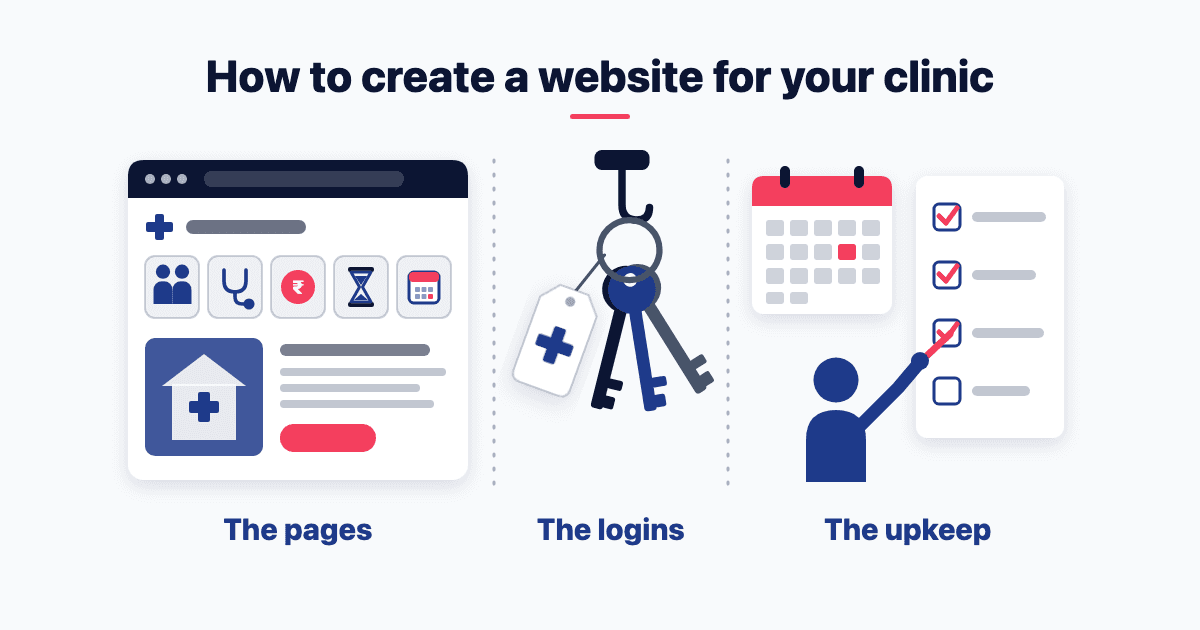
If you practise alone, one phone page is enough. A clinic with several doctors needs more pages: doctors, services, fees, timings and booking. Each may carry only the "factual information" that the National Medical Commission's (NMC) 2026 guidelines allow. Then come the keys and the upkeep. Register the domain in the clinic's name, keep every login, and make one person responsible for accuracy.
This guide is for general practitioners, specialists, dentists and clinic owners in private practice. Dentists follow their own 2014 Dentists Code, and each section notes where it differs. The guide reads each rule closely, but it isn't legal advice.
When is one page enough, and when does a clinic need more?
If you practise alone, start with the one-page phone site in my doctors' marketing guide. It has the spec. Then read the ownership section below, because it applies to one page too.
Several doctors change the job. One page can't show who sits on which day, at what fee, with which qualifications. Clause 9.1 of the NMC guidelines limits what a clinic may advertise to "objective and verifiable particulars". It also sets a hospital website's directory of doctors apart from a promotional advertisement, when the directory informs patients. Here's how that directory rule reads for a clinic's doctor profiles.
For dentists, Code 8.2.9 accepts websites "where all information is factual". Either way, the site grows by facts, not by features.
Should you use a website builder, WordPress or a developer?
Ask one question of every route before cost or looks: if you leave, what comes with you? The three routes answer it differently.
A hosted website builder: buy the domain separately, in the clinic's name. It's usually the quickest start. Wix's help page on moving a site says "the content you build on Wix belongs to you". It also says the site "needs to be hosted and operated on Wix's servers", though you can "purchase and manage the domain with another provider". So if you leave, you keep the address and rebuild the pages.
WordPress on hosting you pay for: choose it only if someone will run the updates. WordPress.org's export guide says: "If you are moving to a new host or just want a backup of your site data, then Exporting your site is the answer." So the content can move with you. The catch is upkeep: someone has to keep the software updated.
A developer or agency, on either route: they build, the clinic owns. The next section shows how. Read every line before it goes live. Under clause 4.4, publishing through "a digital platform, third party, advertising agency" "shall not, by itself, absolve" the doctor or the clinic.
Using an AI tool to draft the pages? Start with the brief in my doctors' marketing guide, which tells the tool to invent nothing.
The deciding question isn't price. Who at the clinic will change a fee or a holiday on a Saturday? Pick the route that person can actually use.
Who should own the domain, the hosting and the logins?
A clinic website is less a design job than a set of keys. If the keys sit in a developer's inbox, so does your clinic's address.
Start a one-page key sheet at the clinic. List the registrar, the builder or host, Search Console and the Google profile. Note who can access each, and every renewal date.
The domain. Choose the clinic's name first, then register the domain in the clinic's or the owning doctor's name. Use an email address the clinic controls.
For a .in address, the .IN Registry's FAQ asks you to "verify that you or an authorized representative of your organization has been named as the registrant". Its other advice:
Watch the inbox. Registrars most often send renewal notices "by e-mail". If that address belongs to someone who left, the domain can expire without your knowledge.
Check twice a year. Put it "on your calendar for verification twice a year".
Lock it. Ask the registrar for "Client Update, Client Transfer prohibited" statuses, so it changes only when you intend.
For .com and similar domains, ICANN, which sets the rules for their registrars, requires at least two renewal reminders (its expiry policy page). "All notices are sent to the registrant email address." Turn on auto-renew as well.
If someone else's name is on it, that person has to make or confirm the change to the clinic, through the registrar. That holds for .in, and for .com under ICANN's rules. To move registrars, you need the auth code, "basically a password for the domain name" (.IN Registry on transfers). Registrars must give it to the registrant on request, so if that's a former developer, you'll need their help first. Ask the registrar, too, whether a change of registrant blocks a move for a period.
The builder or hosting account. Open it in the clinic's own name and email, and add the developer as a user. Renewals go to a card and an inbox the clinic controls.
Search Console. Make the clinic a verified owner in Google Search Console, Google's tool for site owners. An owner "has full control over properties in Search Console" (Google's permissions page). Google adds: "If the only verified owner of your site leaves your team, you should verify ownership to maintain (or regain) access to the property."
The Google profile. Same principle: set up the Google profile in the clinic's own account.
Which pages does a clinic with several doctors need?
Six pages, each a set of facts.
Doctors: one entry per doctor, all in the same format. Carry what the 9.1 directory line lists: names, recognised qualifications, specialties, registration details and availability. For availability, give each doctor's outpatient (OPD) days and hours. Here's how to word each doctor's profile, including clause 8.3(ii)'s limit on promoting one doctor. That clause reaches clinics too. Clause 3.4 defines a "Hospital/Medical Institution" as a clinical establishment where patients may be admitted or "treated as out-patients".
Services: one page, as facts. Use 9.1's own particulars: "departments functioning, diagnostic facilities, emergency services, accreditation status, other facilities offered". Equipment can be listed too, without "claims of superiority, guaranteed accuracy, guaranteed outcomes, comparative claims" (Explanation II).
Fees: what each consultation or service costs. Clause 9.1 names "applicable fees". For dentists, websites "can also carry details of treatment facilities available and the fees for the same" (Code 8.2.9). See what to publish about fees and timings.
Timings and holidays, by doctor. List each doctor's days and hours, plus holidays and leave. The upkeep owner checks these lines whenever anything changes.
Location and contact. Address, map and phone, under the same name as the board and the Google profile.
Booking: appointments by doctor, or one front-desk number. For a WhatsApp button, follow the spec in my doctors' marketing guide. A form collects personal data, and clause 7.6 points to India's data-protection law. Check what a booking form needs under India's data law.
Delete from the template before launch. One Indian agency's price guide lists "Patient testimonials and reviews" and "Before and after case showcases" as features. Delete those blocks, review carousels, "best" claims and offers.
For dentists: Code 8.2.9 adds that "websites should not make claims or statements that are not factual and therefore misleading to the public".
Can the clinic's website carry health-education pages?
Yes, within limits. Clause 5.1 allows educational content that doesn't promote your practice or solicit patients. For dentists, Code 8.1.8 bars adverts dressed up as public education. Step 4 of my doctors' marketing guide quotes both clauses.
Whether a booking button on an education page breaks 5.1 is unsettled: see the open question on booking links in education posts. The careful reading: keep the article body free of offers and booking buttons.
Code 8.1.8 names TV, magazines and periodicals, not a clinic's own website. It also says such pieces shouldn't carry the clinic's phone number or address to attract patients. The careful reading applies that to a dental education article on your site too: no phone number or "book now" inside it.
Who keeps the website accurate after launch?
Name one person, and give them one fact sheet: doctors, OPD days, fees, holidays and registration numbers. The board, the site and the Google profile all copy from that sheet. Nothing changes anywhere until the sheet does.
Update it the day any of these happens:
A doctor joins or leaves.
A fee changes.
A holiday or a doctor's leave is fixed.
Someone with a login leaves. Remove their access that day.
Asking AI or a developer to make the edit? My AI 101 session sheet for KimsEducation students (free Google sign-in) shows the habit on a made-up clinic, Asha Clinic. Add "List every line you touched" to every edit request, and treat any redesign as "scope creep".
Two renewals belong in the clinic calendar. One is the domain, on auto-renew with reminders to the clinic's inbox. The other is the builder or hosting plan. Finally, make each page load fast on a mid-range Android phone.
Your clinic website, in eight steps
Decide: one page or several.
Pick the route that the person who updates the site can use.
Register the domain in the clinic's name, with a clinic email.
Make the clinic a verified owner in Search Console.
Build the six pages from one fact sheet.
Delete the template's testimonial and before-and-after blocks.
Name the upkeep owner, and put the renewal dates in a calendar.
Check the registrant details twice a year.
Rather have someone build it? For a dental clinic, or a clinic with several doctors, I'm happy to help. I can set up the factual layer only: the website and Google profile, with the doctors, fees, timings and registration details patients check. It's built with your facts, on a domain and accounts in the clinic's name, and you approve every line before it goes live. A flat fee, never per patient, lead or booking.
Practising alone? Clause 8.1(ii) bars a doctor from engaging "any third party for marketing medical services". Whether that rules out hiring help is still open, so read open question 1, on hiring marketing help first. Book a call, or see my organic marketing services.
Frequently asked questions
Is there a free website for doctors?
Not one to rely on until you know who controls it. Google once let businesses build sites inside Business Profiles. Its archived help page warned: "Existing websites made with Google Business Profiles will be turned off in March 2024." A redirect would work "until June 10, 2024". Check whose address any free site uses, and whether you can move it.
Can my clinic website show our Google reviews?
The careful answer is no, for now. Explanation V bars a doctor from requesting or sharing reviews "for professional promotion on social media". Whether a clinic's own site counts as social media under clause 3.6 is open. Consent alone doesn't make a barred testimonial allowed (6.2). The dentists' advisory flags "publishing patient testimonials" on social media. Leave review widgets off.
How much does a clinic website cost?
It depends on the route, so price the year, not the build. Add the domain renewal, the builder or hosting plan, and someone's hours for upkeep. For .com domains, ICANN requires renewal fees "clearly displayed on the registrar's website", so check that price, not just year one. Pay any helper a flat fee, never per patient (clause 8.1(viii)).
Do I need separate pages for each branch or each area we serve?
One page per real branch, yes; one per area, no. A branch page with its own address, doctors and timings is facts. Copies of one page aimed at different areas are something else. Google's spam policies call "having multiple domain names or pages targeted at specific regions or cities that funnel users to one page" doorway abuse.
- Website
- Doctors
- Clinic website
Written by Siddhesh Joglekar
Fractional CMO and AI marketing consultant Siddhesh Joglekar helps founders and growth-stage teams build marketing engines that compound.