Growth
How to increase admissions in a coaching institute without raising ad spend
How to increase admission in coaching classes on the same ad budget: size your catchment, fix the demo class, scholarship test, parent seminar and referrals.

· 10 min read
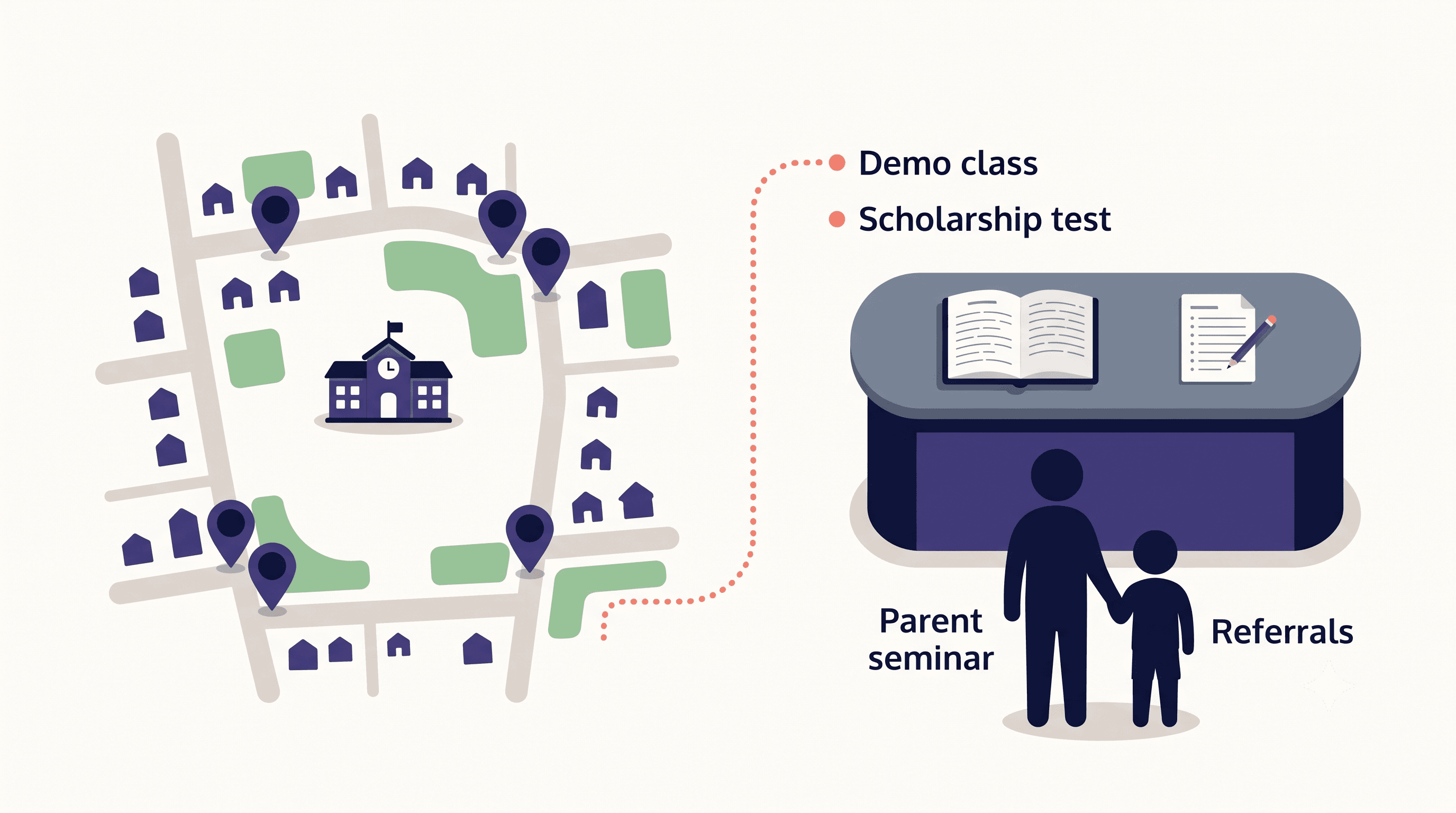
To increase admission in coaching classes without spending more on ads, win more of the families who already live near your centre instead of buying more enquiries. Size your catchment from public school data, then run four local routes to a seat: the demo class, the scholarship test, the parent seminar and referrals. Judge each by its cost per admission, not its cost per enquiry, and keep ads only where they win students more cheaply.
This guide is for institutes with one to five centres and a fixed ad budget.
How to increase admission in coaching classes without spending more on ads
Cost per admission is everything you spent to win students from one source, divided by the students from that source who paid and joined. The "spent" side has five parts: ad spend; printing, the hall and snacks; scholarship discounts actually given; referral rewards; and any extra staff or teacher hours you pay for. Most institutes count only the first.
So tag every enquiry with its source on the day it arrives: a column in the enquiry register, plus a label on each WhatsApp chat. The free WhatsApp Business app lets you "use labels and lists to organize your chats and contacts for easy follow-up" (WhatsApp Business guide for small businesses).
Illustrative figures for one hypothetical centre, to show the arithmetic. They are not benchmarks.
Search and social ads
Spent (₹): 1,20,000
Enquiries: 300
Admissions: 12
Cost per admission (₹): 10,000
Scholarship test (₹40,000 to run + ₹1,60,000 in discounts)
Spent (₹): 2,00,000
Enquiries: 250
Admissions: 20
Cost per admission (₹): 10,000
Parent seminars (two evenings)
Spent (₹): 25,000
Enquiries: 70
Admissions: 10
Cost per admission (₹): 2,500
Referrals (₹2,000 fee credit + ₹1,000 gift per admission)
Spent (₹): 36,000
Enquiries: 25
Admissions: 12
Cost per admission (₹): 3,000
Google Business Profile walk-ins and calls (photos, signboard)
Spent (₹): 5,000
Enquiries: 60
Admissions: 8
Cost per admission (₹): 625
All sources
Spent (₹): 3,86,000
Enquiries: 705
Admissions: 62
Cost per admission (₹): about 6,226
Leave out the discounts and the scholarship test looks cheaper than seminars or referrals, at ₹2,000 an admission. Counted honestly, it costs the same as ads. Seminars, referrals and the Business Profile win students at under a third of the price, so they get the next rupee and the next hour.
Review the table weekly during the season, the way DocTutorials, a national online test-prep brand, runs "weekly cost-per-acquisition reporting".
What you can afford to pay for one student is a separate number, and the edtech marketing strategy guide shows how to set that ceiling. If no one owns cost per admission from the ad account to the fee receipt, that is a growth strategy gap, not an ad problem.
How many students in your catchment could actually join?
Size your catchment in three steps.
Map last season's admissions by pincode. That shows how far families actually travel to you.
List every school in those pincodes on the government's school database, UDISE+ Know Your School (the Unified District Information System for Education Plus). Each school's report card shows enrolment by class. The data lags: one sample report card generated in November 2024 covers 2022–23.
Apply the national coaching share as a rough guide, not a forecast. In the government's 2025 education survey, 27.0% of school students took private coaching during the academic year: 30.7% urban, 25.5% rural (Press Information Bureau, Comprehensive Modular Survey: Education, 2025).
A hypothetical illustration, not a benchmark: say 14 nearby schools have 2,100 students in the classes you teach. At the urban rate, about 645 of them take some coaching, so the 62 admissions in the table would be roughly 1 in 10. The survey rate is a national average across all classes, so yours will differ.
Now list the schools that sent you nobody. That is where the scholarship test and the seminars go.
Digital marketing for coaching institutes starts with the free Business Profile, not ads. Google ranks local results mainly on relevance, distance and how well known a business is. It says "More reviews and positive ratings can help" and "There's no way to request or pay for a better local ranking" (Google Business Profile Help on local ranking). So fix your category, hours, batch timings and photos, and reply to every review.
Paid search has a ceiling too. As a published IIT Kanpur session sheet puts it, "you cannot buy more searches than exist". Past that point, a bigger bid buys the same families at a higher price.
What makes a demo class turn into an admission?
The cheapest way to increase students in coaching is to convert the demos you already run. Four habits make the difference.
Teach a real class. Seat the student in a running batch with the teacher they would actually get, not a star who won't teach them. Students judge the room and the peers as much as the lesson.
End with a 10-minute test. Hand the marked sheet to the parent the same day, so the conversation starts from evidence, not a pitch.
Book the parent conversation before the family leaves. For what follows, see where enrolments leak between enquiry and a paid seat.
Measure demo-to-admission by teacher and by batch. A teacher whose demos rarely convert is a fixable leak, and fixing it costs nothing in media.
Is a scholarship test worth running?
Yes, as a way to meet serious families in bulk, if you count the discount as acquisition cost. In the table, the discount is most of what the test costs.
Publish the score bands and discounts before the test, cap the top discount, and give every student a result analysis in person, with a parent present.
Date it around the national tests. The Aakash National Talent Hunt Exam (ANTHE 2026) runs offline on 9, 11 and 25 October and 1 November, and online from 27 October to 1 November (Aakash's official test page). Allen's Tallentex offers "Up to 90% scholarship on ALLEN courses" (Tallentex official site). A local test won't win on discount size. It wins on the in-person analysis, a small batch and a date that doesn't clash with theirs.
A school quiz is the same idea at scale. At BYJU'S, I ran the Discovery School Super League, India's largest school quiz: 25,000 schools and 70 lakh students a season. It ran inside a mix of mass media, digital and on-ground events "managed against one cost-per-lead target". Cost per lead fell 70% over the tenure (figures from public record and the author's tenure; scale is per season at peak). Your version is a quiz across the schools that send you nobody, with each school's permission.
Check the rules before you print the form.
A registration form collects a child's details. Under section 9 of the Digital Personal Data Protection Act, 2023, processing data of anyone under 18 needs verifiable parental consent from 13 May 2027 (commencement notification G.S.R. 843(E)). The DPDP consent checklist covers the form.
Hold every scholarship or topper claim to the 2024 coaching-ad rules, summarised in the edtech marketing strategy guide.
State laws differ, since the Ministry of Education left its coaching guidelines for states to legislate (Press Information Bureau, 7 February 2024). Rajasthan's 2025 Act, for example, covers centres with more than 100 students. It bars "misleading promises or guarantee of rank or good marks" (section 8) and gives parents the option to pay in "minimum four equal instalments".
This is not legal advice; check your state's current rules and ask counsel before changing a claim or a consent form.
How do you run a parent seminar that fills a batch?
The BYJU'S case study describes the job as building "the offline surfaces that create demand and the digital surfaces that capture it, at a cost the unit economics could carry". A parent seminar is the smallest offline surface an institute can build.
Pick a decision the parent faces now, not a talk about your institute. From the 2026 exams, the Central Board of Secondary Education holds two Class 10 board exams. The first, from mid-February, is compulsory; an optional second in May lets a student improve up to three subjects (board notification, 25 June 2025). That gives a Class 10 parent a real question: does Class 11 entrance coaching start in April, or after the May exam?
Keep the format simple:
A school hall or a housing-society hall, with permission.
A 40-minute talk by your best teacher, then questions.
No fee pitch from the stage; counsellors at the door.
An enquiry slip that records the parent's consent to be contacted.
Follow up within 48 hours with the slides and a demo-class slot. Count seats won against the hall, printing, snacks and staff hours.
How do you get more referrals from current students?
Referrals look unpredictable only when nobody asks at a fixed moment or counts the results.
Ask at a visible win: the first test result or the parent-teacher meeting, not the admission counter.
Reward both families, and pay the fee credit only after the referred student completes the first month, so you never pay for a no-show.
Give each family a named slip or code, and log it in the source column.
Reward referrals, never reviews. Google Maps bars businesses from offering "payment, discounts, free goods and/or services - in exchange for posting any review". It also bars them from choosing to "selectively solicit positive reviews" (Google Maps user-generated content policy). You may ask every family for an honest review with nothing offered in return.
The objection: "The big chains outspend us, so we have to spend more too"
The fear is fair: a national chain can open down the road and outbid you on the same searches. But budget buys reach, not relationships.
DocTutorials, where I lead marketing as an adviser, competes with well-funded incumbents in a category they own. Its case study says the incumbents "can always outspend a challenger on search" but "cannot outspend it on hundreds of relationships with the creators students already follow". Paid enrolments multiplied between FY25 and FY26, and cost per acquisition fell by roughly a third in the same period (at the client's request, the case study gives no absolute figures).
Your relationships are local: the schools, parents and past students in a few pincodes, which a chain's head office can't buy. As the BYJU'S case study puts it, "Scale is easy to buy and hard to afford."
The same logic holds for technology: point AI at your margins before your ad copy.
Your plan before the next batch starts
A marketing strategy for a coaching institute this season comes down to seven jobs:
Add a source column to the enquiry register today, and label WhatsApp chats by source.
Map last season's admissions by pincode, then list those pincodes' schools on UDISE+.
Build last season's cost-per-admission table, counting discounts and rewards.
Fix the Business Profile, and ask every family for an honest review after the first test results.
Rebuild the demo class: a real batch, a 10-minute test, and the parent slot booked on the spot.
Date the scholarship test and seminars around the national tests and board exams.
Start the referral ask at the first test result.
If you run more than one centre and cost per admission keeps rising faster than your fees, book a call.
Frequently asked questions
What is a good admission conversion rate for a coaching institute?
Your own last season is the benchmark that matters. A rate from a blog can't be compared with yours unless it says where it came from and what it counts as an enquiry. Track enquiry to demo, demo to admission by teacher and batch, and cost per admission by source, then aim to beat last season on each.
Can software help increase admissions?
Only if it makes the follow-up happen; software doesn't create demand. A source column in the enquiry register and labels on the free WhatsApp Business app are enough to start. Pay for software when the register can no longer tell you, every week, who needs a call today and what each source costs per admission.
How can I use social media to promote my coaching institute?
Use it to show families what they would get, then judge it by admissions, not likes. Post short clips of real classes, a sample result analysis and seminar invitations, and tag every enquiry it brings. Hold any topper or scholarship claim to the 2024 coaching-ad rules, and get a parent's consent before posting a child's photo or name.
Should every enquiry get a follow-up?
Yes, until the family joins or says no. Give each enquiry an owner, a next step and a date on the day it arrives, and review the open ones every week alongside the source column. Offer every new enquiry a demo-class slot within 48 hours, the same rule this guide gives for seminar follow-ups.
- Growth
- Edtech
- Coaching institutes
- Admissions
Written by Siddhesh Joglekar
Fractional CMO and AI marketing consultant Siddhesh Joglekar helps founders and growth-stage teams build marketing engines that compound.