Growth
How to sell on Blinkit, Zepto and Instamart: getting listed, the terms and the first 90 days
How to sell on Blinkit, Zepto and Instamart, for D2C founders: who buys your stock, the GST, food and barcode papers, the terms to ask for and a 90-day plan.

· 11 min read
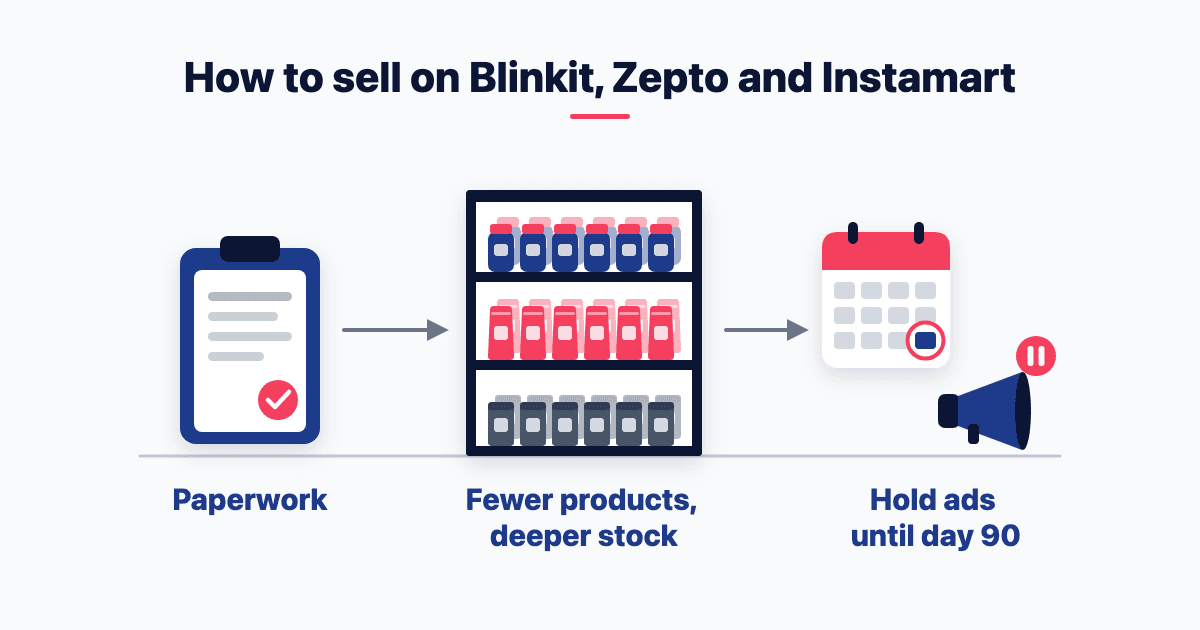
Getting listed on Blinkit, Zepto or Instamart is a supply deal, not a sign-up form. Apply with GST registration and, for food, a food safety licence or registration. Find out who buys your stock, because that sets your margin and payment days. Then start with three to five products in one city, and hold ads until day 90.
Who buys your stock on Blinkit, Zepto and Instamart?
It differs by app, and it sets your paperwork too.
Blinkit buys stock and sells it itself, alongside third-party sellers. Eternal's April–June 2026 results say Blinkit has completed "a full year as a 1P business" (PDF p.6). 1P, short for first party, means it owns what it sells. Its July–September 2026 results say it also lists items sold by third-party sellers. It had 2,751 stores at 30 September 2026 (PDF p.7).
Zepto runs a marketplace. Zepto's updated draft prospectus of 8 June 2026 says brands join "primarily to market and grow sales of products through our network of Merchant Partners" (p.11). Those are third-party sellers, paying a pre-agreed commission. Why? Foreign direct investment "is not permitted in the inventory based model of e-commerce" (p.654), and Zepto describes itself as foreign owned and controlled. It had 1,139 dark stores, small delivery-only warehouses, across 66 cities at 31 March 2026 (p.237).
Instamart runs a marketplace, and plans to hold stock too. Swiggy's October 2026 letter counts merchant-partner commissions and brand-partner advertising as Instamart revenue. Becoming Indian-owned and controlled "will allow Instamart to own inventory" (p.2). Shareholder and regulatory approvals are in. Swiggy says the switch starts midway through October–December 2026 and should finish over the next two to three quarters. It had 1,240 dark stores across 133 cities at 30 September 2026 (p.2).
Zepto's store count is six months older. I cite the filings for how each business works, not as an investment view.
What it means for you (my reading, not the apps' words):
Where the app buys your stock, you invoice it against its purchase orders. Your price to it must leave room for its margin.
Where a seller partner holds the stock, you sell to that seller. The app's commission comes off that seller's sale.
As my e-commerce session sheet puts it: "Quick-commerce terms vary: ask your account manager."
What documents do you need to sell on Blinkit, Zepto and Instamart?
Five things, and the first two are about GST. Call it the paper stack.
GST registration in every state your stock ships from. Section 24(ix) of the Central GST Act makes it compulsory, whatever your turnover, when you supply "through such electronic commerce operator who is required to collect tax at source under section 52". Section 25 says to register in each state where you're liable, within 30 days. You'll need a Permanent Account Number. One narrow exemption: see the first FAQ.
The app's warehouse on your registration, if your stock sits there. Section 2(85) counts "a warehouse, a godown or any other place where a taxable person stores his goods" as a place of business. In a state where you're registered, add it with form GST REG-14 within 15 days (Rule 19). On 22 October 2026, Rule 19 gave an officer 15 working days to approve it. The GST Council has recommended making that automatic. In another state, point 1 applies.
A food licence or registration for any food. The chief executive of the Food Safety and Standards Authority of India (FSSAI) restated the rule in November 2024 (government press release). No food business operator "can operate on any e-commerce platform without a valid FSSAI license or Registration". Its December 2024 advisory adds that claims "not substantiated on the product packaging" shouldn't appear online.
A GS1 barcode for every pack size. GS1 is the organisation that sets the global standard for product barcodes. GS1 India says marketplaces "generally ask for the GTIN of your product", the global trade item number behind the barcode. Only the brand owner, "or an entity authorised by brand owner", can apply, and it "usually takes 7-10 working days" (GS1's registration page). You can't change the number of barcodes later, so count every variant you'll add in the next few years.
The extras. Onboarding guides also list a bank account with a cancelled cheque, brand authorisation if you resell another brand, and sometimes a trade licence. Confirm them with the app.
A simpler route has been recommended. The GST Council's FAQ on its 57th meeting describes a new rule 14B. Where you have no premises in a state, a small seller could declare an app's warehouse "as their principal place of business", with its consent.
It covers only sales through apps that collect tax at source, so a sale to an app that buys your stock may not qualify. You'd also need a regular home-state registration, with biometric Aadhaar checks and a physical verification there. Input tax credit passed on must stay under ₹2.5 lakh a month, stock transfers aside. Output tax on sales to registered buyers can't exceed that.
Rule 14B and the automatic warehouse approval take effect from the date their notification sets (section 164 of the Central GST Act). Check the notifications and the GST portal before relying on either.
If the app buys your stock outright, does its warehouse still belong on your registration? That's an open question. This is not tax or legal advice; confirm registrations with your chartered accountant.
Which app should you start with: Blinkit, Zepto or Instamart?
One app, one city, picked on four tests.
Coverage. Are its stores in your city?
Model. Can you meet purchase orders into its warehouse? Or will you sell through a seller partner?
Terms in writing. Use the term sheet below before you commit stock.
Data. Condition 4 in my D2C guide: "You get sales and stock data by city and product often enough to act on. Ask before you sign."
Eternal's July–September results call Blinkit "the distribution and discovery platform for thousands of brands, many of them emerging" (PDF p.9). I read that as an open door, not a promise to list you.
No public data says which app takes on new brands faster, and the guides offer only estimates (see the 90-day plan).
Which three to five products should you list first?
Your fastest-moving, longest-dated, barcoded packs whose margin survives the app's cut. Run each stock-keeping unit (SKU) through five tests.
Impulse or top-up, priced for a small basket. That's condition 1 in my D2C guide: "The product is an impulse or top-up buy, priced for a small basket." For scale, Swiggy puts Instamart's net average order value at ₹506 for the quarter to September 2026, up 4.3% on a year earlier. It's Swiggy's measure, not a benchmark for the others.
Shelf life well above the floor. FSSAI's advisory says products "must have a minimum shelf life of 30% or at least 45 days before expiry, at the time of delivery". Every day in transit and on the store shelf eats into that cushion.
Contribution clears after the app's terms. Condition 3: "Contribution per order still clears after the platform's terms and ads."
One barcode per pack size, from the paper stack above.
You can make enough to fill every purchase order. See fill rate below.
Why so few? Zepto's filing describes a dark store as a small warehouse that "stocks a curated assortment" (p.11). Shelf space per store is scarce. Deeper stock on fewer products fills better.
What terms will you sign: commission, fees and payment days?
I couldn't find commission, fees or payment days on any of the three apps' public pages (checked 22 October 2026). So the only reliable answer to "what is Blinkit's seller commission?" is the one in your agreement.
Ranking guides don't agree. A fulfilment company's guide says "8% to 15%". A commerce-software vendor's says "8%–20%" in one place and "10 to 20%" in another. None cites a source.
What the filings do confirm:
Zepto's merchant-partner commission "is a percentage of the value of the offerings" (prospectus, p.31).
Zepto charges brands for services such as "purchase order management, consumer survey campaigns, inventory reports and brand support" (p.272).
Items that fail Zepto's quality check are discarded or returned "to its vendor" (p.272).
Eternal puts Blinkit's inventory losses at "about 1.8% of NOV", its net order value, from "expiry, shrinkage, damage, loss in transit or pilferage" (April–June results, PDF p.6). A large part comes from perishables, it says. Ask which losses, if any, come back to you.
The quick-commerce term sheet: eight questions to get in writing
Margin or commission, and on which price: maximum retail price, selling price or your invoice price?
Every fee: inward, storage, listing, purchase-order, data and visibility.
Payment days, counted from what: goods received, the sale or your invoice?
Deductions: who pays for returns, damage, expiry and rejected stock?
The minimum shelf life the warehouse accepts at inward.
Who sets purchase-order quantities, and how often orders come.
The fill-rate target, and what happens below it.
Which sales and stock data you get, by city and product, and how often.
Amazon, by contrast, publishes its fees; my guide walks one sale through Amazon's published fee tables. Test each product's unit economics against the answers you get before you sign; I'm happy to run the sum with you.
What is a fill rate, and why does it decide your listing?
Fill rate is the share of units on a purchase order that you deliver, complete and on time. Deliver 900 of 1,000 units and your fill rate is 90%.
The app watches it. Zepto's filing says brands get "real-time visibility into campaign performance metrics such as fill rates, ad spends, and payment tracking" (p.270).
A short fill leaves an empty shelf in the stores that ordered. Paid and organic sales stop together. That's why ads wait until supply is steady.
Stock gaps hide until someone counts them. In my July 2026 audit of The 1970 Shop, 41% of 59 SKUs were out of stock. That's a share of its catalogue, not a quick-commerce figure. They're audit findings, not results: revenue scale is withheld, and the programme is in progress with outcome figures to follow.
Why not list the whole range and let the app pick the winners?
More listings look like more chances to be found. On a quick-commerce app, stock decides sales, not the number of listings.
Twenty thin products give the app twenty chances to see you out of stock. And each short fill gives the buyer a reason to order less next time. So expand after day 90, from the products that sold through.
Your first 90 days, before any ads
Days 1–20: paperwork in parallel. Apply for GS1 barcodes. Get GST registration, or file the REG-14 amendment for the app's warehouse. Get your food licence. Apply to one app: Blinkit's seller portal, Zepto's partner portal or Instamart's brand team (a founder community's guide). Then send the term-sheet questions.
Days 20–45: terms, listing, first order. Get terms in writing, list three to five products in one city, and take the first purchase order. A commerce-software vendor puts Blinkit approval at "20–45 days". A founder community expects "roughly 6-8 weeks application-to-first-sale" on Instamart, for a prepared brand. Treat both as estimates, not promises.
Days 45–90: track weekly. Fill rate by purchase order. Sell-through by store. Expired and rejected stock. Payments received against invoices. Fix supply before anything else.
Day 90: the gate. Run the four-condition test in my D2C marketing strategy guide on your own 90 days of numbers. This plan tests condition 2 hardest: "You can keep every dark store you're listed in stocked." If all four hold, set a stock bar for each city and buy quick-commerce ads without burning margin. If not, fix the failing condition, or step back.
Weighing a quick-commerce term sheet, or picking your first three products? Book a call and we'll go through it together.
Frequently asked questions
Can I sell on Blinkit or Zepto without a GST number?
Only narrowly. Notification 34/2023 exempts sellers under section 22's turnover threshold who supply through an e-commerce operator. They must make no "inter-State supply of goods", sell through apps in one state only and hold an enrolment number. If the app buys your stock, you may be selling to it, not through it. This isn't tax advice: ask your chartered accountant.
Is it free to list products on Blinkit?
You can't confirm that in advance: I found no listing fee on any of the three apps' public pages. The cost sits in your contract, as margin or commission plus service fees. Zepto, for one, says it charges brands "based on the services availed". Ads are optional: Blinkit's ad platform has "no fixed minimum", as my quick-commerce ads guide notes.
Can I sell on Blinkit, Zepto or Instamart from home?
Yes, you can run the business from home, but the stock leaves it. It goes packed and barcoded to the app's warehouse or a seller partner. Food made at home still needs an FSSAI licence or registration, as the government's release says. And any place you store stock counts as a place of business for GST.
Do I need an agency to get listed on quick-commerce apps?
No. Brands deal with the apps directly: Zepto's filing says it enters "into contracts with our Brand Partners". An agency can save you time on catalogue files and follow-ups. It can't change the app's terms or your fill rate. So ask any agency what it does after the first purchase order, and who answers for a short fill.
- Blinkit
- D2C
- Quick commerce
Written by Siddhesh Joglekar
Fractional CMO and AI marketing consultant Siddhesh Joglekar helps founders and growth-stage teams build marketing engines that compound.