Growth
How to increase patients in your clinic: 7 fixes that need no discounts, camps or paid referrals
How to increase patients in your clinic in India: 7 fixes inside the NMC and dental rules, with no discounts, free camps or paid referrals.
· 10 min read
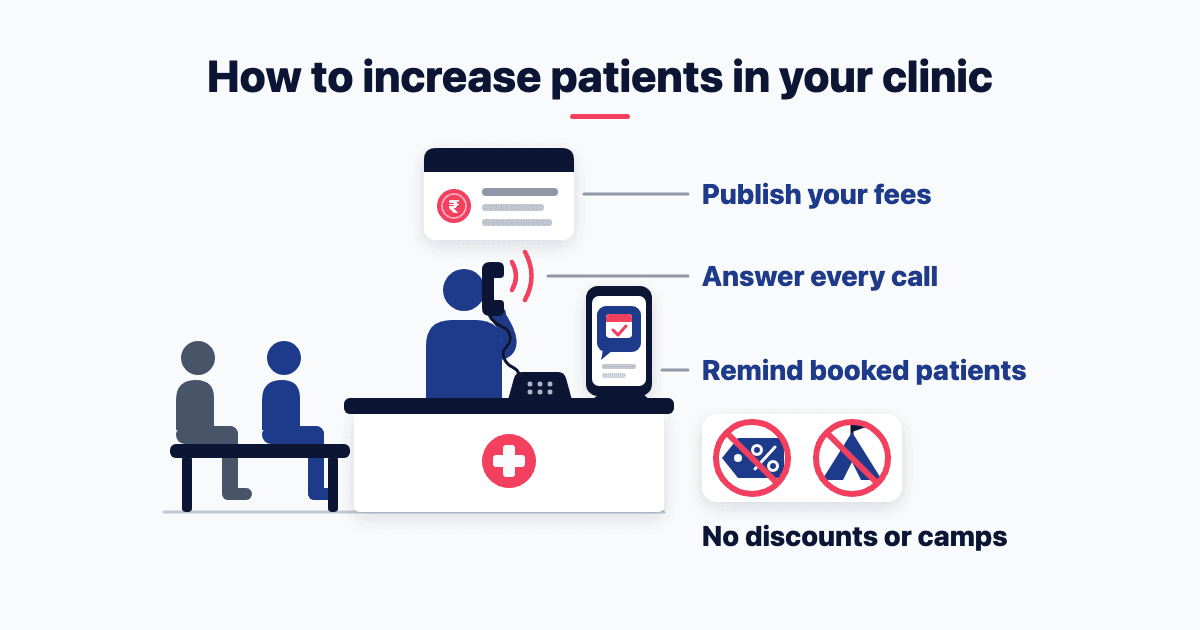
Search the web for "how to increase patients in clinic". Several guides in the results tell you to offer new-patient discounts, reward referrals or run free check-up camps. Indian rules for doctors and dentists bar or restrict all three. The patients you can win come from running the clinic better. That means every call answered, booked patients reminded, honest waits, published fees and referrals earned without paying.
Before you pay to reach new people, stop losing the ones who already chose you. The call nobody picked up. The follow-up nobody reminded them about. The patient who left after an unexplained hour. Each fix below closes a gap, inside the rules.
What do the top results tell you to do, and why can't you?
Four of those guides could be read in full. They come from software and chatbot vendors, and none of them mentions India's rules for doctors or dentists. Doctors answer to the National Medical Commission's (NMC) advertising guidelines of 6 October 2026. Dentists answer to the 2014 Dentists Code of Ethics.
Discounts, free consultations and rewards for referring. The NMC bars "discounts", "referral benefits" and "free procedures or similar inducements" used "in a manner that is likely to encourage unnecessary medical consultation, diagnostic investigation or treatment or otherwise amounts to solicitation of patients" (clause 8.1(x)). Instead: Fixes 5 and 6.
Free check-up camps. The Dentists Code lists "conducting camps and other promotional activity in schools, colleges, old age homes" as unethical advertising (8.1.2). Instead: Fix 7.
Sending only happy patients to Google. Google's Maps content policy doesn't allow merchants to "selectively solicit positive reviews". The NMC goes further: a doctor "shall not request or share patient testimonials, recommendations, endorsements or reviews for professional promotion on social media" (Explanation V). The safe reading: don't ask at all. See how reviews work for doctors on Google.
Testimonials and before-and-after photos. The NMC bars promotional "before and after" photographs (8.1(v)). The National Dental Commission's 14 October 2026 advisory flags "publishing patient testimonials and before-and-after photographs". Full list: what the NMC's October 2026 rules ban, clause by clause.
Paying anyone per patient. Agency or platform deals can't be "linked to the procurement or referral of individual patients" (8.1(viii)). Instead: Fix 6. Hiring help at all is less settled. Clause 8.1(ii) bars a doctor from engaging "any third party for marketing medical services". Whether factual website and profile work counts is still open. Practise alone? Get a health-law opinion first. Read what to ask anyone who markets your clinic.
Dentists: your Code says a dentist "may advertise provided that they maintain decorum" (8.1). Whether the NMC guidelines also reach dental clinics is unsettled, so use them as a benchmark.
This summarises the published rules as they stood on 26 October 2026. It isn't legal advice; for your own practice, ask a health-law adviser or your state council.
Fix 1. Read your own OPD register before you change anything
Find where patients are lost before you look for new ones. The answer is often in your outpatient department (OPD) register.
In my KimsEducation AI 101 session sheet (7 October 2026), the running case is Asha Clinic, "a made-up 12-bed clinic" in Secunderabad. One demo gives the AI two weeks of daily collections. Tuesday brings ₹22,800 and ₹21,900; other days run from ₹38,800 to ₹47,300. The prompt warns: "Do not state any cause as a fact." In a later demo, the human checks the clinic's own records: "I pulled the appointment log; Dr Mehta does not sit on Tuesdays."
In this made-up case, the dip was a rota, not a marketing problem.
Count these every week, by day and by doctor:
calls answered and calls missed;
bookings, no-shows and walk-ins;
where each new patient came from: ask "who referred you?" at registration.
In a dental clinic, count the empty chair-hours too. Paste totals into an AI tool, never names. Under the NMC's clause 7.2(d), any patient information used as AI input must comply with "privacy, confidentiality, data-protection and professional-ethics requirements".
Fix 2. Answer every call and WhatsApp, and give each one an owner
An unanswered call is a patient who may now ring the next clinic. The front desk is the cheapest place to start.
One named person per shift owns the phone and the clinic's WhatsApp number.
Missed calls go on a list, called back before the next session.
Keep saved, factual answers for fees, timings, directions and which doctor sits when.
My reading: a factual reply to a patient's own question is information, not advertising. The guidelines exempt information shared "without same being promotional and without any intent for commercial benefit" (Explanation I). But they list "messaging platforms (WhatsApp, Telegrams, Facebook etc.)" as a "medium of advertisement" (3.5). One promotional line can turn a reply into an ad.
Thinking of an AI bot on that number? Read whether an AI agent should answer your WhatsApp first.
Fix 3. Remind booked patients, and only booked patients
A reminder goes to a patient with a booked visit, or a follow-up the doctor advised and the patient agreed to. Never to the whole list.
A Cochrane review of phone-message reminders (2013) found "moderate quality evidence from seven studies (5841 participants)" that text reminders improved attendance. Overall, attendance was 78.6% with a text reminder and 67.8% with none. The limits: these were text messages, in trials published up to August 2012, and the review rates its evidence "low to moderate quality". Whether WhatsApp does better or worse, it can't say.
My sheet's reminder demo for the made-up clinic sets the brief: "Under 40 words." Include the clinic name, the slot and "a line to reply YES to confirm". Then: "No medical advice of any kind." Its check: "any line like 'please take your medicines' breaks the brief. Delete it."
Keep reminders one to one. The NMC names "digital mass solicitation" a serious violation (10.1(iv)). So no "health tips plus this month's offer" broadcasts, and no bulk sends to your whole patient list.
Put only the name, time and clinic in the message, never the condition. Both codes say patients' confidences "should never be revealed" (2002 professional conduct regulations 2.2; Dentists Code 4.2). Ask at booking whether the patient wants a reminder, and note it. For India's data-protection law, see the consent checklist for WhatsApp and text messages.
Dentists: send a six-monthly recall only when you advised it and the patient agreed. A recall to everyone who ever visited looks closer to solicitation.
Fix 4. Tell waiting patients the truth about the delay
Say the usual wait at check-in, update it when the doctor runs over, and offer to rebook.
An Indian study of 625 outpatients in three cities found "patients with higher waiting time were less satisfied with health care quality" (Mehra, 2016, abstract on PubMed). Its advanced analysis found only "weak support" for an effect on overall satisfaction. Treat it as a signal, not proof.
My sheet's front-desk demo asks what Priya, the made-up receptionist, says when the doctor is 40 minutes late: "under 60 words, English and Telugu, calm. Do not promise a time or give medical advice." The check: "'Ten more minutes' is a promise; the brief said none."
A WhatsApp note to today's booked patients about a delay is operational. If the wait ends up in a review, see how to reply to a review about waiting time.
Fix 5. Publish your fees and timings
For a medical doctor, this isn't marketing. It's a duty. The 2002 regulations say: "A physician shall clearly display his fees and other charges on the board of his chamber" (3.7.1). The Dentists Code allows fees in the clinic and on the website (5.7.1, 8.2.9).
Publish timings the same way: outpatient hours, which doctor sits which day, and holidays. Show the real fee, not a "starting at" teaser, and skip the "limited-period offers" that 8.1(x) names. Keep the board, the website and your Google profile identical. The steps and the other fee rules are in how to set up your clinic's website and online presence inside the 2026 rules.
Fix 6. How to get doctors to refer patients to you, without paying for them
Referrals come from good reports and fast replies, never from money. The NMC bars any "referral fee, lead-generation fee or other consideration" tied to referring patients (8.1(vii)). The 2002 regulations (6.4.1) and the Dentists Code (8.6.1) bar "any gift, gratuity, commission or bonus" for referrals. Dentists also can't employ an "agent or canvasser" to get patients commercially (8.1.4).
Both codes describe the honest loop instead. The referring doctor sends "a case summary of the patient" to the specialist, "who should communicate his opinion in writing to the attending physician" (2002 regulations 3.6). The Dentists Code (5.6) says the same. So:
write back every time, within the week;
send the patient back to the referring doctor for ongoing care;
make referring easy: one number, and a slot within days;
refer out generously when a case isn't yours.
New in the area? A factual note to nearby doctors is a permitted announcement "On starting practice" (8.2(ii)(a)). Keep it to qualifications, address, timings and what you treat, with no gift attached.
Fix 7. Give health talks in your own name, not camps
Teach, don't sell. The guidelines allow public-health "lectures or talks" on TV, radio and electronic media, in a doctor's "own name and designation" (8.2(iii)). The 2002 regulations let a doctor "deliver public lectures" on public health (7.11). Awareness work is fine "provided that such activities do not promote personal practice, do not solicit patients" (5.1).
In practice: one topic, at a housing society or a workplace. No offer, no "visit us" line, and no booking link: whether that counts as solicitation is still open.
Dentists have tighter limits. Public information "should not carry addresses telephone numbers, e-mail addresses etc." of the dentist or clinic "to attract patients" (8.1.8). The free-care exemption covers only registered charitable bodies that "provide fully free dental care and treatment out of altruism". A clinic's free check-up isn't that.
More in what doctors can post online.
"Wouldn't one good offer fill the OPD faster?"
Perhaps, for a while. But an offer rents patients. The seven fixes earn them.
An offer has to be bought again every month. Answered calls, reminders and letters back to referring doctors keep working.
Action is graded, and it starts with a show-cause notice (10.2). For a first violation, the State Medical Council may give "Warning and mandatory ethics training" (10.1(i)). Serious violations such as "inducement for patients" can mean "Suspension of 6-12 months" (10.1(iv)).
Some limits are still open, and the NMC "may issue such clarifications" (12). Where a rule is unclear, the cautious reading costs you little.
What to do at the clinic this week
Count last month's calls, missed calls, no-shows and patient sources, by day and by doctor.
Name the phone and WhatsApp owner for each shift.
Write a 40-word reminder. Send it only to tomorrow's booked patients who agreed to get one.
Put your fee and timings on the board, the website and your Google profile.
Write back to the last three doctors who referred a patient to you.
Stop every discount, referral reward and camp today.
Most of these fixes are habits your own team can run. The factual layer is where I can help: your website, Google Business Profile, fees and timings. I offer it to dental clinics and clinics with several doctors, for a flat fee, never per patient, lead or booking. You approve every line before it goes live, because the responsibility stays with you (4.4). In solo practice? Read the hiring question in the first section before you book. Book a call, or read how I approach marketing strategy.
Frequently asked questions
How do I get patients for a new clinic?
Start with a factual announcement and the basics from day one. The NMC guidelines allow a formal announcement "On starting practice" (8.2(ii)(a)), if it is "factual, non-promotional and limited in scope" (9.3). Send it to nearby doctors, publish your fee and timings, and set up your Google profile. Then run Fixes 1 to 4 from week one.
How can I increase my clinic's revenue without more patients?
Lose fewer booked visits, and complete the care you advised. In the Cochrane review, attendance was 78.6% with a text reminder against 67.8% with none. Give dental patients the "estimate of all costs" their Code asks for (5.7.1), so they can plan the full course. Never add tests: the NMC bars activities that "promote unnecessary diagnostics" (8.1(i)).
Should I list my clinic on Practo or Justdial?
Yes, if the profile stays factual. The NMC guidelines count "online healthcare platforms" as a medium of advertisement (3.5). Platforms hosting doctors must ensure "prohibition of paid ranking of doctors" (9.4). What you pay "online platforms" can't be "linked to the procurement or referral of individual patients" (8.1(viii)), so avoid per-booking fees. Dentists may list "on the internet" (8.2.8).
- Patient experience
- Clinic growth
- Doctors
Written by Siddhesh Joglekar
Fractional CMO and AI marketing consultant Siddhesh Joglekar helps founders and growth-stage teams build marketing engines that compound.