Growth
How to sell to schools in India: the buyer map, the calendar and a pilot that converts
How to sell to schools in India: map who decides, sell to the April-to-March school year, run a pilot that converts, and stay inside CBSE's rules.

· 11 min read
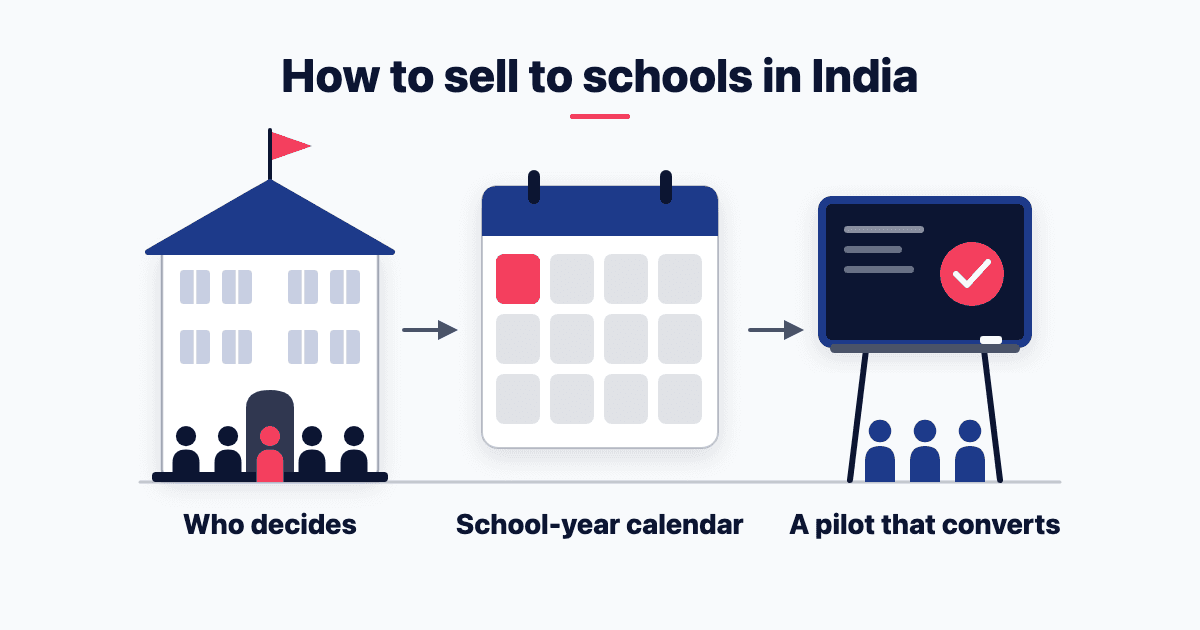
A school deal that needs a new fee line gets one chance a year, at best. The Central Board of Secondary Education (CBSE) has told private schools not to revise fees mid-session, and their session starts on 1 April. Here's how to sell to schools: map who decides, pilot for a term, and close before fees are fixed.
If you start in November 2026, plan your pilots for July to October 2027, for the 2028–29 session. You can still reach 2027–28 where a school sets next year's fees or budget late. There, run a short pilot that ends before that date.
Who decides when a school buys?
You're selling to a committee, not a school. Find out who sits on it before you pitch.
The Committee Map from my Superhuman Sales series starts from one line: "The room is bigger than the invite." It names four roles: "champion, blocker, economic buyer, ghost". In a private school:
Champion: the academic coordinator or subject head. They'll use your product, run the pilot and argue for you when you're not in the room.
The principal: the gatekeeper. The principal owns the timetable and the calendar, and makes the recommendation. In a small, owner-run school, the owner may be principal and buyer at once.
Economic buyer: the management. That's the "society/Trust/Company" that runs the school, in the words of CBSE's 2017 circular. Its 2011 circular says the society or trust "should invariably consult the School Managing Committee for review of fees or other annual charges".
Ghost: parents. The same 2011 circular says an unaided school "should consult parents through parents representatives before revising the fees". If parents pay, they're in the room even when they're not on the invite.
Blocker: whoever's workload grows. Often that's the computer-lab in-charge, the school office or a senior teacher who must change lessons. Win them over during the pilot, not the pitch.
With a school chain, ask early whether a central team decides for every branch. If it does, your first school is a reference, not the deal. This guide covers private schools, not government or aided ones.
Qualify each school before you visit. UDISE+ (the Unified District Information System for Education Plus) is the Ministry of Education's school data system. Of all Indian schools, not only private ones, its 2025-26 report found 69.9% had computer access and 67.4% had internet. So about one school in three has no internet connection. Look each one up on UDISE+ Know Your School before you pitch an app.
When do schools buy? Reading the school year as a sales calendar
Schools buy on a public calendar, and it starts on 1 April. Work to their year, not your quarter.
The board's Circular Aff-07/2023 of 17 March 2023 told schools to "refrain from beginning academic sessions before April 1st". Fees move once a year too. The 2011 circular is blunt: "The fee should not be revised during the mid session."
So the real deadline isn't 1 April. It's the day next year's fees and budget are fixed. Ask the principal for that date in your first meeting.
Two more things shape your timing:
Board exams. Keep Classes 10 and 12 out of pilots, because their year builds to board exams. Pilot in Classes 6 to 9.
Teacher training. The National Education Policy 2020 expects each teacher to "participate in at least 50 hours of CPD opportunities every year", as the board's Circular Skill-53/2024 quotes it. CPD means continuous professional development. Training that counts toward those hours opens a door in any month.
A planning template, not a rule (months vary by state and school):
April to June: onboard this year's schools.
July to October: run pilots.
November to January: win decisions, before fees are fixed.
February and March: sign contracts and set up.
April: go live.
How long does an Indian school sale take? There's no public figure you can check. So plan on the calendar, not on a cycle length.
What does a pilot that converts look like?
A pilot converts when the decision is agreed before it starts.
One class, one term, one champion. It's small enough to run well and long enough to show change.
Write three success numbers before day one. Lessons taught with your product, one learning check, and one output parents can see.
Put the decision meeting's date in writing. Set it before the fee-fixing date. A free pilot with no decision date is a sale you skipped.
Plan the close back from 1 April. The Mutual Action Plan, on the same Superhuman Sales page, is "a close plan the buyer authors, built back from their go-live date". For a school, go-live is the first day of the session.
Then give the school a win it can show parents. At BYJU'S, I conceived and ran a school quiz with Discovery, the Discovery School Super League. BYJU'S own page says it gives students a national stage to "win laurels for themselves and their school". At its peak, it reached 25,000 schools and 70 lakh students a season (figures from public record and my tenure).
Your pilot needs the small version: a showcase, a class report or a certificate. My edtech guide explains why schools lend a brand trust.
Build the compliance pack before the first visit
Staff verification. The National Commission for Protection of Child Rights' school-safety manual tells schools to "ensure Police verification of the school employees and connected staff". The same checks apply to people "employed on an ad-hoc or contractual basis". Expect questions about anyone you send on campus.
A security note. The manual's digital-safety guidelines tell schools to "Ensure that third-party vendors (who have contract with the school) have strong security measures in place". Bring one page on how you protect data and accounts.
Children's data. Any form a student fills in collects a child's data. Get the parental consent flow right first, using my Check 6 on children's data.
How should you price for a school, and who pays?
Decide who pays before you set a price, because each payer brings a different rule.
The school pays from its budget. Charge per student a year, or a flat fee per school. Management decides, on the fee and budget timeline above.
Parents pay through the school fee. Your line must go into next session's fee structure, never mid-session. The 2011 circular says fees should normally be charged "under the heads prescribed by the Department of Education of the State/U.T."
Parents pay you directly, by choice. It must be genuinely optional. The board's 2017 circular told schools to stop "coercing parents" to buy books, uniforms and bags "from within the premise or from selected vendors only". My reading: a compulsory kit or app sold only by you asks the school to do exactly that.
Free to the school, paid for by the demand it creates. Quizzes, olympiads and events, like the league above. If you use this model, sell nothing on campus and collect leads only with consent.
An illustration, not a benchmark: take one grade with 3 sections of 40 students, so 120 students. At ₹1,000 a student a year, that's ₹1.2 lakh.
As a budget line, management approves one number. As a fee line, ₹1,000 lands on 120 families' receipts, after their representatives weigh in. Same price, very different decision.
Delhi's 2025 school fee Act puts five parents on each private unaided school's fee committee, which approves fees by "unanimous agreement". The approved fee binds the school "for three academic years". The Act came into force in December 2025 and has been challenged in the Delhi High Court. Check where the case stands before you pitch a fee line.
The Act also moves your deadline. Management proposes fees for the next three-year block by 31 July. Ask when the school's current block ends and its next proposal is due. End your pilot before that proposal: the November-to-January window above doesn't apply.
Be wary of revenue shares paid to the school. The 2017 circular cites the affiliation rule that "commercialization does not take place in the school in any shape whatsoever". My reading: a commission on what parents buy is hard to square with that. Ask counsel before you offer one.
What do CBSE's rules allow inside a school?
Activities can happen on campus. Selling shouldn't. That's the line in CBSE circulars from 2009 to 2017. Check today's bye-laws too: other boards and state laws differ.
Selling on campus
Since at least 2009, the board has told schools their premises "should not be used for any commercial activity". That's in its 2009 circular, and the 2011 circular repeats it. In 2017 it reminded schools that educational institutions "are not commercial establishments". The 2011 circular warns that breaches "can lead to disaffiliation of the school".
So run the activity on campus, and sell off campus to parents who opt in.
Can a coaching institute tie up with a school?
Yes, if the tie-up adds to school rather than replacing it. Back in 2009, the board flagged schools "running coaching institutions within the school premises under the pretext of providing coaching for entrance examinations". Its verdict: "This is not approved by the Board."
The board now enforces attendance. In September 2024 it ran surprise inspections at 27 schools in Delhi and Rajasthan. On 6 November 2024 it announced that "21 schools had their affiliation withdrawn due to significant numbers of non-attending students" in Classes 9 to 12. Six more "were downgraded from Senior Secondary to Secondary level".
State law adds its own limits. Rajasthan's Coaching Centres (Control and Regulation) Act, 2025 is one. It applies from a date the state notifies in its Official Gazette, so check whether it's in force. Its section 6(2)(m) tells district committees to ensure coaching centres "do not conduct coaching classes" for school students "during their institutions/schools' hours". The Ministry of Education's 2024 coaching guidelines were "sent to States/UTs for consideration", so rules vary by state.
Classes held off the premises and outside school hours are easier to defend, and so is teacher training. Coaching inside the school, or anything that replaces attendance, puts its affiliation at risk. For filling coaching batches without more ad spend, I've written a separate playbook.
This is not legal advice: read the linked circulars, or ask counsel, before you sign a school agreement.
Are schools too slow, and can selling to parents replace them?
It's a fair complaint. Months of meetings, a committee you can't see, and a calendar that moves once a year.
But speed isn't the real problem. You aren't selling a product to a school. You're handing a principal a decision they can defend to management and parents.
Slow is just the calendar, and the calendar is public. Build your pipeline a year ahead, and the slow cycle becomes a predictable April.
Selling straight to parents is a different engine. I think it can run beside a school motion, but it won't replace one.
Your plan from November 2026
Start this month, in this order.
List 30 target schools and look each one up on Know Your School.
Draw a Committee Map for each: champion, principal, management, parents and blocker.
Build the compliance pack: staff verification, a security note and the consent flow.
Ask each principal one question: when are next year's fees and budget fixed?
If a school sets its fees or budget late, offer a short pilot that ends before that date. That's your route to going live in April 2027.
Everywhere else, book a one-term pilot for July to October 2027, in a class from 6 to 9. Give it three written success numbers and a decision date.
Write the close plan back from 1 April.
Pick the pricing model, and keep every parent purchase optional.
Planning school pilots for 2027? I'm happy to look over your buyer map or pilot design, or to help with the whole school go-to-market. Book a call.
Frequently asked questions
Is edtech B2B or B2C?
Both, depending on who pays. Selling to schools is B2B, or B2B2C (business to business to consumer) when parents pay through the school fee. A committee decides, on a once-a-year calendar. Selling to families is B2C, with a counselling funnel. You can run both. If you do, give school sales its own team, targets and timeline.
How do I get a meeting with a school principal?
Ask for a warm introduction rather than cold-calling. A school you already work with, or a school association, can make it. Make one specific ask: a short meeting about a pilot in one class. Avoid exam and admission weeks. If the principal is hard to reach, start with the academic coordinator, your likely champion.
How do I write a school tie-up proposal?
Keep it to one page. Name the problem for this school, then the pilot: class, term and champion. Add three success numbers and the decision date. Say who pays, and that any parent purchase stays optional. List what you need from the school, and attach your compliance pack: staff verification, a security note and the consent flow.
What should a school partnership agreement cover?
Cover scope and term, the pilot's measures and decision date, and fees and who collects them. Add data and parental consent (see Check 6 on children's data) and verification of your staff on campus. Get written permission before you use the school's name or logo in marketing, and set exit terms. Have counsel review it.
- Schools
- Edtech
- B2B sales
Written by Siddhesh Joglekar
Fractional CMO and AI marketing consultant Siddhesh Joglekar helps founders and growth-stage teams build marketing engines that compound.