Startups
Founder-led marketing: how a founder's own posts become a channel, and when to hand it off
Founder-led marketing, run as a channel: what to post, how often, how to count the sales conversations your posts start, and what to hand to a ghostwriter.

· 10 min read
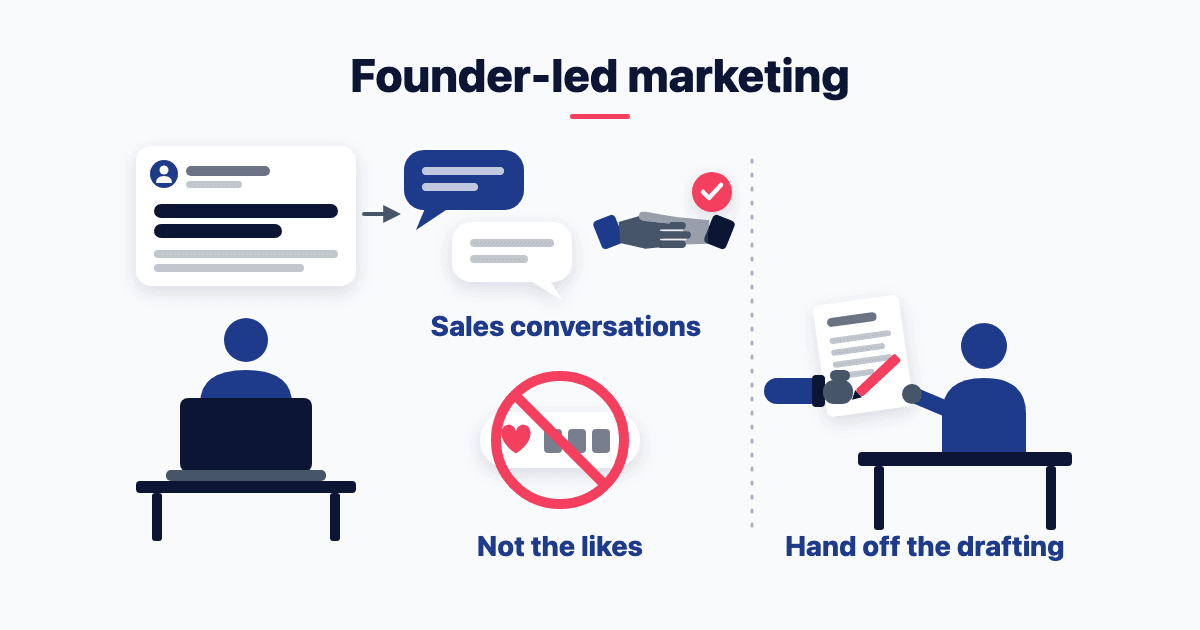
A LinkedIn post can win you a first customer. That doesn't make your posts a channel. Founder-led marketing becomes one when you post a few clear arguments every week and count the sales conversations they start, not the likes. Hand off the drafting once that works. Keep the opinions, the stories and the replies.
This is for founders who already post, and can't yet tell whether it pays or what they can safely delegate.
What is founder-led marketing, and when does it work?
Founder-led marketing is when the founder is the company's main marketing voice. Your own posts, talks and newsletters bring in buyers before a marketing team exists. The company borrows trust from a person, because it hasn't built a brand of its own yet.
It tends to work in three situations:
Buyers are choosing a person as much as a product, as in services and B2B software.
You understand the customer's problem better than anyone you could hire.
You have few customers and no marketing team yet.
At that stage it's the default, not a choice. It changes as you grow: here's who should lead marketing at each stage. Founder-led sales is the selling itself. This post is about the posting, and about making it repeatable.
What should a founder post? Arguments, not topics
Start from your positioning, not from a content calendar. Your posts should keep repeating who you help and what you replace. If that line isn't written yet, write your brand positioning statement first.
Then choose three or four pillars, and make each one an argument rather than a topic. I teach it that way in my content-engine session at IIM Calcutta, an Indian business school. The session sheet (free Google sign-in), from 12 September 2026, warns that hooks like "5 tips for..." are "topics wearing a hat".
Here's a made-up example. "Onboarding" is a topic. "We'd rather lose a sale than sign a customer we can't help" is an argument. People can agree with it, push back on it and remember it.
Pick one platform: the one your buyers already use. For many B2B founders, that's LinkedIn. The founder of a sales-software start-up described his playbook in his newsletter: "We opted to go hard on one content channel versus spreading ourselves across 3-4+".
The sheet applies the same discipline to formats: "Dashes are decisions". A dash in your plan marks a format you've chosen not to run.
Posts that start conversations are usually ones only you could write:
A customer's problem, in the customer's own words.
A decision you made, and the number behind it.
A mistake, and what you changed.
How you'd solve a common problem in your field.
As he put it: "Your stories are your moat in your content. Nobody can copy them".
How often should a founder post, and how long before you judge it?
Choose a cadence you can keep in your busiest sales month. Then hold it long enough to learn. A steady weekly rhythm teaches you more than a burst followed by a month of silence.
His lesson was blunt: "Commit to posting 5x per week for 6 months". He wrote, "We started posting mid-March". Yet "the channel didn't really start picking up till around August". That's one founder, one B2B audience and one platform. Read it as a reason to be patient, not as a timeline to expect.
Post on the days your reader is there. The sheet's calendar rule: "Weekdays my reader actually scrolls, not all 30 days".
Then set two review dates now. There's no reliable benchmark for when, so tie them to your own business. Put the early one after a few weeks of steady posting, and count the conversations started. Put the later one at least one normal sales cycle after that: the time a typical deal takes you from first call to signature. Judge pipeline there. Don't judge the channel week by week.
How do you measure founder-led marketing against pipeline, not reach?
Platforms count your reach to the last impression. Nobody counts pipeline unless you set it up.
His newsletter post, from January 2025, shows the gap. He wrote: "We drove more than $15M in pipeline inbound in 2024". He gave his reach exactly: "5,718,440 impressions" and "1,546,175 members reached". The posts' share of that pipeline got a phrase, not a number: "A lot of that was directly attributable to LinkedIn".
His post is generous with detail, and his $15M is his own self-reported result, not a benchmark. The lesson is the gap. Close it with four counts, using tools you already have.
Tag every link you post. A UTM tag is a label on a link that tells your analytics where the click came from. Google Analytics Help says that with these tags, "you can view which campaigns refer traffic". Use one pattern every time, such as utm_source=linkedin, utm_medium=founder_post and utm_campaign set to the pillar. The sheet builds the habit in: "Every post will carry a UTM link I add myself". This count runs low, because many readers never click.
Ask every new lead how they found you. Put "How did you hear about us?" as a free-text box on your booking or demo form. Ask again on the first call. Log "founder post" as a lead source in your CRM (customer relationship management system). This catches buyers who read for weeks, then searched for your name.
Log conversations started. Count comments and direct messages from people who fit your buyer, and that you move to a call. It's your earliest honest signal. Before you reply, research the person: the 12-Minute Account Brief, one of my free AI sales prompts (free Google sign-in), is built for that.
Review the chain monthly. Track posts, conversations, meetings, pipeline value and won deals, with your hours spent beside them. Judge pipeline only at your later review date.
Once you also run ads, every platform will claim the same deal. Here's why every platform claims the same sale, and how to check it.
When should a founder hand off the content?
Hand off a working channel, not a guess. Wait until your counts show posts starting conversations, then watch for three signals.
Your cadence breaks in busy weeks. The posting stops exactly when selling peaks.
Your ideas outrun your writing time. He built his workflow to go from idea to draft "without taking 15 hours of my week that I don't have".
Growth stops when you stop posting. That's key-person risk. The 1970 Shop's case study shows it. The brand is an Indian D2C (direct-to-consumer) snack company selling on Shopify and Amazon. Where it started: "No content engine; growth dependent on founder-led social". One of my deliverables: "A repeatable weekly system so growth is not gated on the founder's feed". The programme is still running, and the case study reports no results yet.
"Hand off" can mean three different jobs:
An editor: you write, and they tighten.
A ghostwriter: they draft from your calls and notes.
AI with a voice brief: a model drafts, and you or an editor check every line.
If you need someone to run all of marketing, that's your first marketing hire, a different decision. Setting up this system for a founder is part of my organic marketing and thought leadership work.
What can a ghostwriter, editor or AI take, and what stays yours?
Ghostwriting works when the split is clear. Hand off the production. Keep the judgement and the relationships.
Hand off:
Turning your thinking into drafts. The sales-software founder records a chat with the content team every two weeks. They turn each recording into about five LinkedIn drafts, which he reviews, edits lightly and approves. Expect more editing at the start: early on, he wrote, "I spent more time on edits".
A written voice brief. It helps a person or a model draft closer to you. The sheet opens its drafting agent with "You are the content writer for [BRAND NAME], writing in the founder's voice". It then asks for "3 lines on your brand voice". Its founder-voice video script adds: "Leave one imperfect, human line in". For the full process, see an AI content workflow with an approval gate.
The production around each post: editing, formatting, planning the posting calendar, tagging links, turning a post into a newsletter item, and pulling the monthly numbers.
Keep:
The arguments, and the call on what to post.
Every story and number, and only real ones. The same script's rules say "My real numbers only" and "Nothing I haven't actually done".
Approval of every post.
Your replies, comments and direct messages. That's where the conversations start. LinkedIn's User Agreement, effective 3 November 2025, bars using "bots or other unauthorized automated methods to… create, comment on, like, share, or re-share posts, or otherwise drive inauthentic engagement". Its Professional Community Policies add: "don't agree with others ahead of time to like or re-share each other's content". That rules out engagement pods, groups that agree to boost each other's posts.
Your login. The User Agreement says, "You will not share your account with anyone else". Its list of don'ts includes using another's account, "such as sharing log-in credentials or copying cookies". So nobody logs in as you. You press publish.
Your face and voice in any AI video. The policies bar synthetic media that "depicts a person saying something they did not say or doing something they did not do without clearly disclosing the fake or altered nature of the material". So label any AI avatar of yourself.
These are LinkedIn's terms as they stood on 9 November 2026. They're a platform contract, not law, and they change.
Aren't ghostwritten posts fake?
The objection is fair. Readers can often tell when a voice isn't yours, and a borrowed voice costs trust.
It's right in three cases:
The writer invents experiences you never had.
Someone else replies as you.
You stop reading what goes out under your name.
LinkedIn's policies ask members to "only share information that is real and authentic". An invented story fails that test, whoever typed it.
Handing off isn't stepping away. You hand off the production, never the point of view. The sales-software founder has a content team, and still writes that "building a team to support your content output doesn't mean it's 'hands off'".
So the test isn't who typed it. It's whether every opinion, story and number is yours, and whether you'd defend it in the comments.
Your founder-led marketing plan for the next 90 days
Write your positioning line, then three or four arguments. Reject one.
Choose one platform and a cadence you can hold in a busy month.
Tag every link, add "How did you hear about us?" to your forms, and add "founder post" as a lead source.
Reply to buyer comments and messages yourself, and log each conversation you move to a call.
Set your two review dates: conversations after a few weeks of steady posting, pipeline one sales cycle after that. If your deals take longer than a quarter to close, the pipeline review falls after these 90 days.
Once posts start conversations, write a three-line voice brief and hand off the drafting.
Keep the approval, the replies and your login.
Want your posts to keep working in the months you're busy selling? I'm happy to help you set up the counts and the hand-off: book a free strategy call.
Frequently asked questions
What's the difference between founder-led marketing and personal branding?
Personal branding builds the founder's reputation, and it's usually judged by audience size. Founder-led marketing points that reputation at the company's buyers, and it's judged by conversations and pipeline. Often they're the same posts with a different scorecard. If no post leads to a buyer conversation, you're building a personal brand, which is fine, but not yet a channel.
Should a founder post from a personal profile or the company page?
Post from your personal profile, because people follow people. LinkedIn's User Agreement says "you will only have one LinkedIn account, which must be in your real name". So don't open a second profile for the company. Keep the company page as the record that survives a hire or a departure, and reshare your best posts there.
Can a company pay to promote its founder's LinkedIn posts?
Yes. LinkedIn's Thought Leader Ads let a company sponsor its thought leaders' posts. You request permission in Campaign Manager, and the author "can either approve or deny your request". LinkedIn lists the "Brand Awareness, Engagement, and Video View objectives". It also suggests you "save their organic performance before running your campaign so you can measure its impact".
Does founder-led marketing work for consumer brands, not just B2B?
Yes, the method carries over, though the formats change. My session sheet (free Google sign-in) plans content across "Reel, carousel, LinkedIn text, avatar video, WhatsApp broadcast". Pick the platform your buyers actually use. Then keep the same counts: tagged links, the "How did you hear about us?" answer, and the buyer conversations your posts start.
- Founder-led marketing
- Startups
Written by Siddhesh Joglekar
Fractional CMO and AI marketing consultant Siddhesh Joglekar helps founders and growth-stage teams build marketing engines that compound.