Strategy
How to write a brand positioning statement: the one-line test before you spend on ads
Write a brand positioning statement in six blanks, see a worked example, then test it: can your sales calls, ads and homepage all use the same line?

· 8 min read
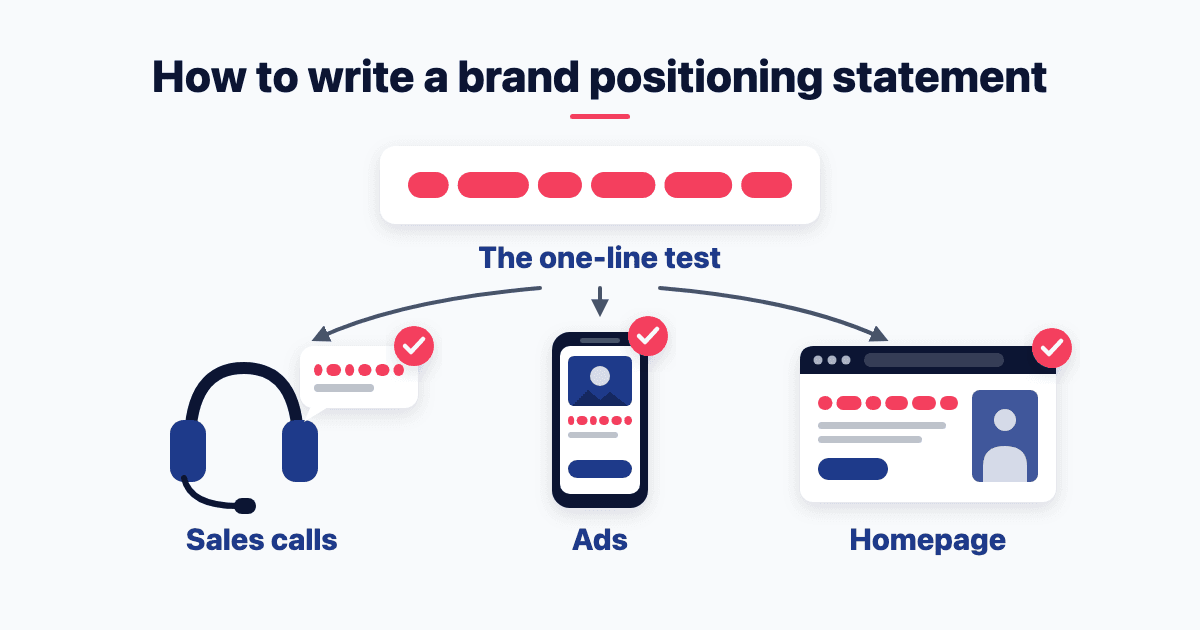
Your customers aren't meant to read your brand positioning statement. It's an internal sentence, and every ad, sales call and homepage should be built from it. Write it in one line: for [who] who [problem], [brand] is the [category] that [difference], unlike [the alternative], because [proof]. Then test it before you spend.
The template is the easy part. The hard part is choosing the alternative you're up against, then proving your difference in a 30-character ad headline.
What is a brand positioning statement?
A brand positioning statement is one internal sentence: who your brand is for, what it replaces and why it wins, with proof. A 2019 Wiley branding textbook gives it "four elements: a target, a frame of reference, a point of difference, and a reason to believe". It calls the statement "an internal document that is used to align all consumer-facing decisions related to the brand".
Below, those four elements become six blanks. The target becomes who and their problem. The frame of reference becomes your category and the alternative.
Without the statement, your deck, ads and homepage describe three different companies. Not sure you have a market yet? Read what marketing should do before and after product-market fit first.
How do you write a brand positioning statement? Six blanks, in this order
Here is the positioning statement template:
For [who] who [problem], [brand] is the [category] that [difference], unlike [the alternative], because [proof].
Who. One buyer in one situation, not a demographic list.
Problem. The job or the pain, in the buyer's own words, not your team's.
The alternative. What the buyer does today if you don't exist: a spreadsheet, an agency, another category, or nothing. The Wiley textbook notes that Uber "used an alternative category (taxi)". Blue Apron's founders framed it against grocery shopping, not takeout. They judged that "grocery bills provide a larger opportunity from which to 'steal' food-spending dollars than takeout". Pick the alternative with the most money or time behind it.
Category. The shelf buyers will file you on. When the iPhone launched in 2007, its name and advertising announced "a phone". That mattered, the textbook notes, because "Apple was known for making computers, not phones".
Difference. One benefit you can own against that alternative. The textbook's rule: "leaders select the benefit that reflects the main reason for using the category", while followers pick a niche.
Proof. A reason to believe you can show today. I teach at IIM Calcutta, an Indian business school. My session sheet there on social and conversational commerce (free Google sign-in) starts from a "Claims we can prove" list. Its banned claims cover "superiority without proof ('No.1', 'best')". If your difference needs the word "best", the proof blank is still empty.
A worked example, with a fictional brand
Many famous-brand examples online are guesses. NielsenIQ's guide to brand positioning explains why: "Because brand positioning statements are internal, they're not often available to the public".
So here's an honest one: Rasoi Roots, a fictional spice brand from the same session sheet of 19 October 2026. Its facts fill the blanks:
Who: "Home cooks aged 28–40", dual-income, cooking three to five nights a week.
Problem: regional food on a weeknight, without the grinding and the guessing.
The alternative: grinding and blending spices from scratch.
Category: masala, an Indian spice blend.
Difference: tastes like home, measured in grams, minutes and servings.
Proof: "Makes about 6 curries. Contains salt. No added preservatives."
Assembled, as my illustration: for dual-income home cooks who want regional food on a weeknight, Rasoi Roots is the masala that tastes like home, measured, unlike grinding spices from scratch, because each pack makes about 6 curries with no added preservatives.
The sheet's rule is "Positioning line: under 10 words, plus a two-sentence expansion." Its own line is "Your grandmother's blend, measured." The long statement stays inside. The short line goes out.
The one-line test: can your sales calls, ads and homepage all use it?
Start with the swap test. Put your nearest rival's name where yours is. If the sentence is still true, you've described a category, not a position.
Sales. Say the short line aloud on a first call. Expect the buyer to ask, "Why not [the alternative]?" Prepare your answer with the Objection Grid, my three-column sheet for answers (free Google sign-in).
Ads. Per Google Ads Help on responsive search ads, one ad takes up to 15 headlines of up to 30 characters, and 4 descriptions of up to 90. It warns that "assets can be shown in any order, so make sure they make sense individually or in combinations". It also asks for "as many unique headlines as you can".
So vary the wording, never the position. If one headline says "cheapest" and another says "premium", a searcher may see both. Your difference must fit one 30-character headline, and your proof one 90-character description.
Homepage. The hero carries the short outward line, not the internal statement. Check it with the five-second test for your landing page.
The pass rule: all three carry the same difference and the same proof. If one channel needs a different promise, fix the statement, not the channel.
Can't the ad platform find the winning message for me?
It can find phrasing, not a position. Google's own wording is "More headlines give Google Ads more options to assemble your messages into relevant ads". With text customisation on, now part of AI Max, Google Ads also writes extra headlines and descriptions. Google Ads Help on text customisation says they're based on "your domain, landing page, existing ads, and keywords in your ad group". So the platform can't choose your buyer or your alternative, and that choice comes first. A muddled position just gets written up faster.
Brand positioning statement vs value proposition vs tagline: what's the difference?
Three lines, three jobs:
Positioning statement: internal, for your team, agencies and AI tools. It rarely changes. The Wiley textbook says "ideally, the positioning endures over decades".
Value proposition: what one buyer gets, in their words. It goes on the page and in the deck, one per segment if needed.
Tagline: a public line. It can change with a campaign.
My rule: the value proposition and the tagline come from the positioning, never the reverse. Once the statement is written, put your positioning into Claude as standing context, so every draft starts from it.
When is brand repositioning the right call?
Three signs point to a new position. One warning says don't move lightly.
Sign 1: buyers file you on the wrong shelf. Rally, a US company that runs event and community group trips, began with this problem: "Rally read as a bus company, not a community product". My brand work was "A daily Twitter/X engine and a 'Rally 2035' AI concept film to reposition the group as future-first". Rally's case study claims no result for that brand work. Its headline story is the payment screen.
Sign 2: your proof can't carry the promise. The Wiley textbook describes Aleve, once positioned as a convenient pain reliever taken every 12 hours. For consumers, "12-hour dosing implied slow acting rather than convenient". So Aleve was "repositioned as the brand that relieves arthritis pain".
Sign 3: the first position never caught on. Apple's first watch launched as a fashion item and was reframed for health and fitness a year later. It worked, the textbook says, because the watch "never gained traction as a fashion accessory".
The warning: once a brand has traction, the same textbook calls repositioning "a strategy of last resort". Old Navy added a trendy line aimed at young, fashion-conscious women. That squeezed the wide selection its core customers came for, and sales fell "over 20 percent in several months".
A stretch isn't the only route; a separate brand is another. At BYJU'S, an Indian K-12 edtech company, I ran go-to-market for 4 brand launches in 3 years. One was Disney BYJU'S Early Learn (BYJU'S case study; figures from public record and my tenure).
Choosing between the two is part of the marketing strategy work I do with founders.
Write and test your statement before the next ad spend
List what buyers use instead of you. Circle the one with the most money or time behind it.
Fill the six blanks in one sentence.
Run the swap test with your nearest rival's name.
Cut the outward line to under 10 words, plus a two-sentence expansion.
Write five headlines of up to 30 characters, each carrying the same difference. Read any two together.
Say the short line on your next three sales calls. Note your answer to "Why not [the alternative]?"
Put it in your homepage hero, and date the full statement. Revisit it at a launch, or when a sign above appears.
Want to test your statement against your real ads and sales calls before the budget goes live? Book a call, and bring the six blanks, even half-filled.
Frequently asked questions
Is a positioning statement the same as a mission statement?
No. A mission statement says why the company exists. A positioning statement says how one brand wins one buyer against one alternative. They're easy to mix up: NielsenIQ's guide notes that "many sources mistake a company's mission or vision statement as its brand positioning statement". Keep them as separate documents.
What's the difference between rebranding and repositioning?
A rebrand changes the name, logo or look. A repositioning changes what buyers believe you are for. The Wiley textbook says it "may involve changing the frame of reference or reframing". You can do either without the other. But if buyers misunderstand what you're for, a new logo alone won't tell them.
How do you write a personal positioning statement?
Use the same six blanks, with you as the brand. The alternative might be another candidate, or the buyer doing nothing. One example: a portfolio that opens with a statement naming one of three AI product roles. It's from the session sheet (free Google sign-in) for my AI for Product Managers class at Great Lakes Institute of Management, Chennai.
What is a brand positioning map?
A brand positioning map is a chart with two axes buyers care about, such as price and convenience, labelled in their words. Plot yourself and each alternative on it. Then look for a valuable empty corner. The map helps you choose your difference; the statement commits you to it.
- Messaging
- Startups
- Brand positioning
Written by Siddhesh Joglekar
Fractional CMO and AI marketing consultant Siddhesh Joglekar helps founders and growth-stage teams build marketing engines that compound.