AI
How to use Claude for marketing: set-up, skills and five jobs to hand it
How to use Claude for marketing: set up Projects, Skills and connectors once, then hand it five marketing jobs, each with a check before anything ships.

· 11 min read
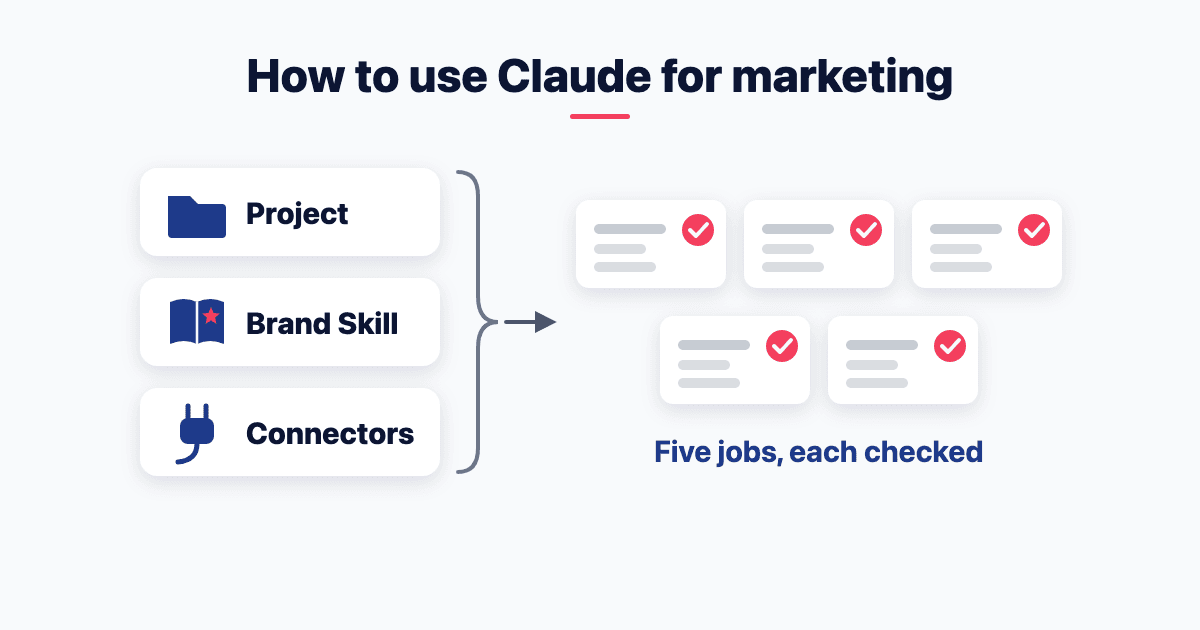
Chat gives you a reply. Your marketing team needs files it can defend. To use Claude for marketing, set it up once: your brand in a Project, your rules in a Skill, your tools connected. Then hand it whole jobs, such as a competitor scan or a monthly review deck, and check each one before anything ships.
I taught a three-session Claude track to 75 senior participants at IIM Calcutta. The set-up below follows my hand-outs from another IIM Calcutta course, AI in Action: Session 1 and Session 2. In April 2026, the big question from a class of working professionals was why Claude ships a major update almost every week.
Whatever the exact pace, every Claude feature below links to Anthropic's own page, checked on 11 Oct 2026. For which AI tool your marketing team should standardise on and what it costs, see my comparison.
How do you set Claude up for a marketing team?
Claude for marketing teams works best when one person sets it up once and everyone shares it. Budget about an afternoon.
First, check which Claude you have
On 16 Sep 2026, Anthropic said "Claude Cowork and chat are merging into one Claude" (Anthropic's announcement). It is rolling out on Pro and Max "over the next few weeks".
Pro or Max: does your message box still show "Chat" and "Cowork" options? Then you don't have it yet (Anthropic's merge article).
Team or Enterprise: these organisations "keep chat and Claude Cowork as they are today" (Anthropic's Team guide).
One catch: Cowork needs a paid plan. Anthropic says it "uses the same agentic architecture that powers Claude Code, with no terminal required" (Anthropic's Cowork guide). It takes on multi-step tasks instead of answering one prompt at a time.
Switch on file creation
On Free, Pro and Max, turn on "Code execution and file creation" under Settings → Capabilities. On Team it is on by default (Anthropic's file guide). Claude can then return Excel, PowerPoint, Word and PDF files. Skills need it too (Anthropic's Skills overview).
Session 1's rule: "Training off, file creation on, labels not names." Its traffic light sorts what goes in. Public material is fine on any plan. Your own performance numbers need a company-approved plan. Customer personal data, unlaunched products, media plans and research verbatims never go on a personal plan. For the detail, see the data rules, by plan.
Make one Project per brand or product
My definition: "A Project is a room for one role or one goal." It holds the instructions, files and chats for that work. Projects are on every plan. Free users get up to five, and Team users can share them (Anthropic's Projects guide).
Write the instructions in four parts: "role, context, output format, constraints." Then add what a new hire needs:
Your positioning note and brand book.
Two or three customer personas.
Your five best past ads.
The current offer sheet.
My rule of thumb: "the third time you paste the same context, it should have been a Project."
Memory is on by default on Free, Pro and Max. On Team it's "off for each member until they turn it on" (Anthropic's memory guide). Each Project keeps its own separate memory.
Write your first Skill: brand voice and claims rules
A Skill does a different job from a Project. Anthropic's distinction: "Projects provide static background knowledge that's always loaded when you start chats within them. Skills provide specialized procedures that activate dynamically when needed and work everywhere across Claude." (Anthropic's Skills overview)
So the Project holds what your brand is. The Skill holds how your team works. It's plain instructions written in Markdown, and Anthropic's guide to custom skills sets three rules:
Describe what it does and when to use it, in 200 characters at most. "Claude uses this to determine when to invoke your skill."
Keep it "focused on one workflow rather than trying to do everything".
Once it's on, "try several different prompts that should trigger it."
A marketing Skill can carry:
Your tone of voice, and the words you never use.
Claims that need proof first, such as "India's no. 1" or "guaranteed results".
Format rules, such as rupees in lakh and crore, and when Hinglish is allowed.
Every Skill "consists of a directory containing at minimum a skill.md file" (Anthropic's guide to custom skills). The guide adds: "Ensure the folder name matches your skill's name." Zip that folder and upload it under Customize → Skills (Anthropic's guide to using skills). On Team, an owner can provision it for everyone.
Connect the tools you work in, read-only first
Connectors let Claude reach apps such as Google Drive or Slack, and they're available to all users (Anthropic's connectors guide). "Claude inherits each person's permissions from the connected service," so it sees only what that person can.
On Team, an owner enables each connector first. The owner can let Claude "read files in Google Drive, but prevent it from creating or editing documents". Start there.
Session 2 sets the boundary: "It saves. It never sends. And it never logs in." A person sends.
Five marketing jobs to hand Claude, each with a check
Here is how to hand Claude real campaign work without trusting it blind. Each job gets four lines; the last is the check.
1. A competitor and category scan, with sources
Give: your category, three to five competitors and your markets. Use public information only.
Ask: "Research my category in India over the last 12 months: launches, price moves and new offers, with sources." In the merged Claude, type /deep-research (Anthropic's merge article). On Free, use a normal chat: web search is on every plan (Anthropic's pricing page).
You get: a report. Research is on paid plans and comes "complete with easy-to-check citations" (Anthropic's Research guide).
The check: open three cited links. For each, ask: "Is the claim on the page? Is the page dated inside the last 12 months?"
The principle: trust is built per claim, not per tool.
2. Customer language from reviews and interview notes
Give: an export of public reviews (marketplace, Google or app store) or interview notes, names stripped, in the brand Project.
Ask: Anthropic's own example prompt: "Go through these five interview notes and pull out the top themes, with a quote for each." Then ask how many reviews sit behind each theme.
You get: your customers' own words, ready for ads and landing pages.
The check: search for each quote in the source file. If you can't find it, treat it as invented. Then read a sample behind one theme yourself.
Interview notes are research verbatims, so they never go on a personal plan.
3. Search ad copy that fits the limits
Give: the brand Skill, the offer sheet, the landing page and one ad group's keywords.
Ask: up to 15 headlines and 4 descriptions for one responsive search ad, in a spreadsheet with a character-count column. Google allows headlines of "up to 30 characters" and descriptions of "up to 90 characters each" (Google Ads Help).
You get: a file you can edit and upload.
The check: sort by character count and fix anything over. Read the headlines in random order, because they "may appear in any order". Then tick every offer and number against the offer sheet.
Anthropic's own growth marketer built a workflow in Claude Code that exports ad copy "ready to upload directly into Google Ads (after undergoing manual review)". He also built a Figma plugin for ad creative. Of the two, Anthropic says, "What used to take 30 minutes per ad now takes 30 seconds" (Anthropic's marketing article). That is its figure about its own team, for tools he built, and it kept the review.
My IIT Kanpur session is blunter: "RSA copy is a strong first draft — the AI doesn't know your Quality Score history or real CPCs. Edit, don't ship." RSA is a responsive search ad; CPC is cost per click.
Claude "doesn't generate photos or illustrations the way image-generation tools do" (Anthropic's image FAQ). For ad photos and illustrations, use an image tool.
4. A campaign or launch brief you can argue with
Give: in the brand Project, the objective, audience, offer, budget, channels and your last campaign's results. Results and media plans need a company-approved plan, never a personal one.
Ask: a brief with a four-week calendar and measures. End with a stop line: "If anything is missing or two sources disagree, stop and ask."
You get: a draft. Anthropic says its product marketing team "uses Skills and Projects to create launch briefs, saving 5-10 hours per launch" (Anthropic's marketing article). Again, that is its own figure.
The check: every number must be yours: budget, target cost per lead, baseline conversion rate. If Claude supplied a number, cut it or source it.
Check Claude's keywords the same way. My IIT Kanpur session warns: "The keyword list is a draft — the AI doesn't know your category's search volume."
5. The monthly review deck
Give: last month's ad-platform and analytics exports as spreadsheet files, or the read-only Drive connector. These are your own performance numbers, so use a company-approved plan.
Ask: a workbook "with working formulas" (Anthropic's file guide) and a short deck. Session 2's monthly review is "five slides, three decisions".
You get: two files. Paid plans can also schedule recurring tasks, such as a weekly report (Anthropic's guide to scheduled tasks). Either way, it saves the files; a person sends them.
The check: trace three numbers to their source cells and re-add one total. For the rest, use the data-rules post's checking standard.
For a scorecard that runs and posts without a person, use an automation tool instead.
One gap in the evidence: no source in this post is an independent study of how much time Claude saves a marketing team. The time figures above are Anthropic's, about its own staff. So time your own jobs before and after.
"Our Claude output sounds generic." Is that the tool?
The objection: AI marketing copy all sounds the same, so why bother with set-up?
In my experience, generic output is usually a set-up problem, not a model problem. Anthropic's India brief found Claude's replies roughly match how complex Indian users' prompts are: 12.2 "years of education" for prompts, 12.5 for replies. Anthropic calls that "mirroring a global pattern where input quality shapes output quality". It is Anthropic studying its own users, on November 2025 data.
Anthropic's growth marketer says most marketers "just see it as a way to help streamline things like writing copy or brainstorming". Bland brief in, bland copy out.
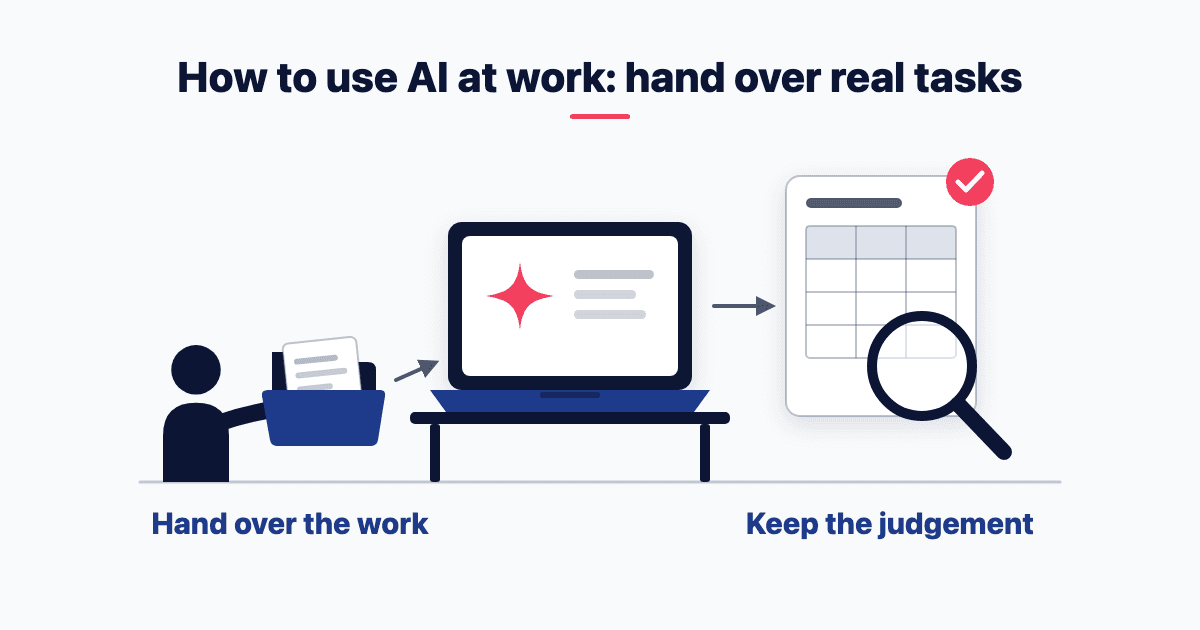
The Project and the Skill make your input specific: your positioning, your customers' words, your banned claims. The check keeps the final call with you. My rule: "It drafts, you sign."
What to do this week
Check which Claude you have: one message box, or separate Chat and Cowork options.
Switch on file creation. Make one Project for your main brand, with four-part instructions and three to five files.
Write one Skill for brand voice and claims, and test it with three prompts.
Hand over one job, starting with job 1 or 2 on public data, and run its check.
Write down how long that job took by hand and with Claude, and what the check caught.
Want your marketing team to set this up on its own campaigns, checks included? I run hands-on Claude training sessions for marketing teams.
Frequently asked questions
Is Claude good for marketing strategy?
Claude is good for generating options and stress-testing a plan, not for deciding one. It doesn't know your margins, search volume or past results unless you give them. Use Research for the market and a Project for your context, then argue with what it proposes. My Session 1 rule holds: "It drafts, you sign."
Should marketers use Claude Code?
Most marketers don't need it for the five jobs above. Cowork "uses the same agentic architecture that powers Claude Code, with no terminal required" (Anthropic's Cowork guide). Claude Code comes with paid plans, not Free (Anthropic's pricing page). Building your own tools? Then yes: why marketers who learn AI coding will own the next decade.
Is there a ready-made set of Claude skills for marketing?
Yes. Anthropic publishes a marketing plugin on GitHub, "primarily designed for Cowork" though it also works in Claude Code. Its commands include /campaign-plan, /brand-review and /competitive-brief. A plugin "bundles skills, connectors, and sub-agents into a single package" (Anthropic's Cowork guide). Start from it, then add your own brand Skill.
Is there a Claude course for marketers?
Anthropic's Claude Academy offers "free courses, tutorials, and use cases". Its course catalogue includes Introduction to Claude Cowork, which covers "plugins and skills, file and research workflows". On 11 Oct 2026, no course in the catalogue was specific to marketing. For a team working on its own campaigns, a hands-on session fits better.
- AI tools
- Marketing teams
- Claude
Written by Siddhesh Joglekar
Fractional CMO and AI marketing consultant Siddhesh Joglekar helps founders and growth-stage teams build marketing engines that compound.