Strategy
Vendor reference check questions for hiring a marketing partner, and how to read their case studies
Vendor reference check questions for a marketing partner: ten to ask, five checks for any case study, and how to verify one number with the client.

· 10 min read
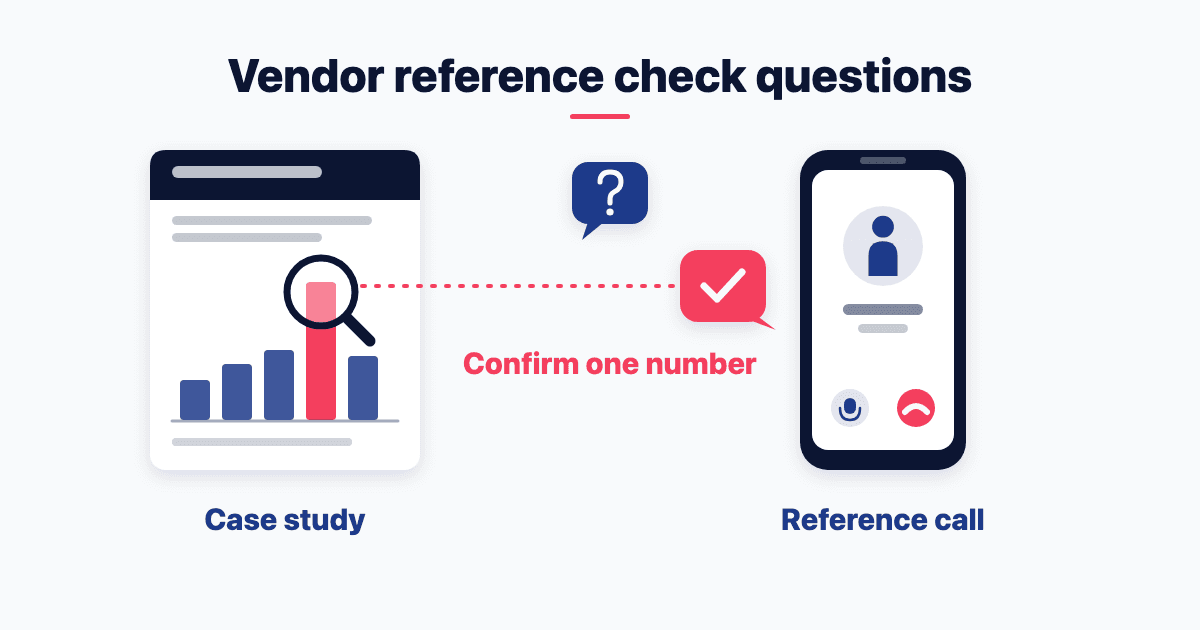
A case study on a vendor's website is the seller's own marketing. Mine included. A checkable one states five things: the period, the base, the source system, who supplied the figure and what's held back. Look for all five, then ask a reference to confirm one number in their own report. The ten vendor reference check questions below cover the rest.
This guide is for US companies, and buyers anywhere, checking a marketing agency, consultant or offshore team before they sign. It's about firms, not job candidates. As a fractional CMO, I'm on the seller's side of this checklist. My published US work includes OurBus and Rally, so read those case studies as sceptically as you'd read any other vendor's.
What should a marketing case study tell you before you believe it?
US federal buyers already have a standard for this. The Federal Acquisition Regulation, section 15.305, sets the test for a bidder's past performance. It reads: "The currency and relevance of the information, source of the information, context of the data, and general trends in contractor's performance shall be considered." The government's rewrite of those rules, published as deviation guidance, keeps those four factors word for word.
The Effie Awards, which honour effective marketing, ask for the same discipline. Their 2026 US entry kit tells every entrant: "Provide source of data, type of research, and the time period covered." Neither standard binds a private buyer. Both are worth borrowing.
Here are the five checks. Each example is a line from my own case studies, showing what a checkable claim looks like.
When, and did it hold? A result needs a dated period, recent enough to matter. One record month can be a calendar effect. The Rally case study is for an event and community group-travel business. It reports June 2026 as a record: 1.5–2× the previous best month, on gross booking value, with figures "indexed and supplied by the client". Then it shows "July and August held above the previous ceiling".
Against what base? A multiple or a percentage needs a starting point. An index is fine when it names its base. Rally's chart is "Indexed to the previous best month", and "The bar shows the midpoint of the 1.5–2× range the client reported for June." A midpoint, labelled as one, is the standard to look for.
From which system? Ad platforms, web analytics, sales databases and finance records each count differently. A good case study names its system. My OurBus Charters case study, for a US coach-hire business, says: "Cost ratio computed from the client's weekly Google Ads scorecard; funnel figures from the client's PostHog project, de-duplicated."
Supplied by whom? A figure the client supplied differs from one the vendor computed. Ask which one you're reading. The OurBus case study, for a US coach operator, says: "Figures supplied by the client and shown as multiples, growth rates and ratios."
What's held back, and why? Every case study withholds something. The test is whether it says what, and why. That's the next question.
Is a case study that hides revenue a red flag?
Some buying guides say yes: insist on absolute numbers, and treat "confidential" as a warning sign. That's the wrong frame. A hidden number is normal. An unexplained one is the warning.
Effie's rules allow exactly this. Entrants "may choose to provide those numbers as percentages or indexes, so that actual numbers are withheld." But the same entry kit warns: "When key metrics are withheld without explanation, judges may assume it is because the results were weak."
Here's an explained gap. The OurBus page leads with "1.6× monthly revenue in six months" (January to June 2026, all channels). Then it says: "Absolute revenue withheld at the client's discretion." That's a stated reason, and the figure has a named supplier. The Charters page does the same for profit: "Margin shown as state, not amount, at the client's discretion."
So ask each vendor, in writing, for the reason behind every withheld number. Then ask a reference to confirm the ratio, using the one-number check further down.
Which clients should you ask to speak to?
Start with the rule from my guide to choosing an agency. Speak to two current clients and one former one. Ask the former client how the exit went. Then add two things.
One reference whose set-up matches yours. Nevada's State Purchasing Division asks vendors for references "from current and/or former clients for projects of similar size and scope" (State of Nevada reference questionnaire). The federal rules ask for "efforts similar to the Government requirement". For a US company hiring offshore, that means a client with a similar time gap, channel and size. Still choosing the arrangement? See how US companies set up an Indian marketing partner.
The person who ran the work week to week, not the executive who signed. The same federal section tells evaluators to take into account "key personnel who have relevant experience". The signer knows the invoice. The manager knows the work.
"References are hand-picked. Why bother?"
Fair point. No vendor volunteers an unhappy client. So the questions below ask for a figure and a problem, not an opinion. A hand-picked client can still confirm a number or describe a bad week. Then add one reference you find yourself (see the section on confidential clients).
What vendor reference check questions should you ask?
Send the questions ahead of the call. Keep it to about 20 minutes, and take notes in the same order for every vendor. Questions 1–3 cover the work, 4–6 the number, 7–8 the bad week, and 9–10 the money and the end.
The quoted questions are the State of Nevada's own wording, from the reference questionnaire a vendor's client fills in and returns to the state.
"In what capacity have you worked with this vendor in the past?" You learn whether they saw the delivery team or only the sales process.
Who did the work week to week, and are those people still on your account? The result belongs to the people who produced it.
How fast did they respond when something broke? Nevada rates "timeliness in response and issue resolution".
The case study gives this figure for this period. Does your own report show roughly the same? The next section explains how.
Which system did that number come from, and who pulled it? This tests checks 3 and 4 from the case-study list.
What else changed in that period? Effie's standard entry form asks the same: "Marketing rarely works in isolation. Outside of your effort, what else in the marketplace could have affected the results of this case". A price change, a launch or a season can move a number on its own.
Tell me about one problem, and what they did about it. A federal request for competitive proposals must let bidders describe "problems encountered on the identified contracts and the offeror's corrective actions". Borrow that. Ask the vendor to name one problem with this client before the call, then ask the client about it.
"Was the schedule met and deliverables timely?" A good result delivered late can still cost you a season.
Was billing accurate and on time? Nevada rates "Accuracy and timeliness of billing".
"Would you recommend this vendor to your organization again?" Then ask: for the same work?
For the former client, add one more. Why did it end, and did the hand-back go cleanly?
How do you verify one number on a reference call?
You don't need their data. You need one yes or no.
Pick the case study's headline figure.
Before the call, send the reference that line and the case study's own source line, for example "computed from your weekly ad scorecard".
On the call, ask: "Does your own report show roughly that, for that period?" They needn't share a screen or a file. "Yes", "roughly" or "not quite" is the answer.
If they've never seen the number, the vendor computed it. Weigh it accordingly.
If the two numbers differ, ask why. It may be a different period, a different counting rule, or ad-platform figures set against the business's own records.
Know what this proves. One confirmed number shows the vendor reports honestly. It doesn't show they'll repeat the result for you.
What if the vendor says its clients are confidential?
Believe it. Serious buyers protect references too. The federal rules bar government staff from conduct that "reveals the names of individuals providing reference information about an offeror's past performance" (Federal Acquisition Regulation, section 15.306).
Nevada goes further. Its questionnaire tells references: "Do not return the completed reference questionnaire to the proposing vendor." The reason it gives is "To allow for candid responses".
So a confidential case study is fine. Having no way to check anything isn't. Ask for these, in this order:
A private call with the client's consent, arranged by the vendor, under your non-disclosure agreement if needed. That's the usual route anyway.
A former client, or the person who managed the work and has since changed companies.
The client confirms one figure by email, without being named publicly.
One reference you find yourself, through your own network.
If the vendor refuses all four, walk away.
If your partner is in India, how do you check the firm exists?
Use India's Goods and Services Tax (GST) portal. Its user manual says: "You can search the details of a taxpayer without login". Ask the firm for its GSTIN (its GST number), then enter it with the captcha text.
Without login, the search shows "Legal Name of Business, Trade Name, Effective date of registration, Constitution of Business, Principal Place of Business, Date of Cancellation (if applicable), Details of Return Filed". Match three things:
The legal name matches your contract and the invoice.
The record shows no cancellation date and no suspended status.
The place of business matches what the firm told you.
If the firm says it isn't registered, ask why rather than assume. For a partner in another country, check that country's public company register. This is a sense check, not legal or tax advice.
Which red flags should end the talks?
These cover proof and references only. For contract and account red flags, see the FAQ in the agency guide above.
A headline number with no period, no base and no reason given for what's withheld.
Every figure is the vendor's own calculation, and no client has seen it.
The vendor insists on joining or running the reference call.
The reference dealt only with sales, never with delivery.
The people the reference names have left, and nobody can say who replaced them.
No reference, no former client and no alternative.
For an Indian firm, the invoice's legal name doesn't match the GST record, or the record shows a cancellation date.
What to do this week
Run each case study through the five checks, and list the gaps.
Ask each vendor, in writing, for the reason behind every withheld number.
Ask for three references: two current, one former, and at least one whose set-up matches yours.
Send each reference one figure and its source line before the call.
Ask the ten questions, and compare notes across vendors.
For an Indian firm, run the GST search before you sign.
Then move to the paid test in the agency guide above.
Run the five checks on my case studies too. Then, if it helps, book a call and bring your questions.
Frequently asked questions
What should a vendor reference check email say?
Say who you are, which vendor you're considering and for what work. Offer a 20-minute call or written answers. Send the questions in advance, plus the one figure you'd like confirmed. Promise their answers stay private. Nevada's form keeps answers away from the vendor "To allow for candid responses" (State of Nevada reference questionnaire).
Is there a free vendor reference check template?
Yes. Public-sector buyers publish theirs. Nevada's State Purchasing reference questionnaire, revised October 2024, has 15 items, 12 of them rated. It tells the reference not to return it to the vendor. Use its structure, then add this post's one-number check and the question about a problem.
How do you know a vendor's reference is genuine?
Find the person yourself. Look up their contact details through their company's own website or switchboard, not only the email the vendor sent. Confirm their job title and how long they worked with the vendor. Then ask Nevada's opening question: "In what capacity have you worked with this vendor in the past?" (State of Nevada reference questionnaire).
Where can you see well-sourced marketing case studies to compare against?
Look at effectiveness-award entries. Effie's 2026 US entry kit says "All data, claims, facts, etc. presented anywhere in the entry form must reference a specific, verifiable source." It also points entrants to "sample winning cases" at effie.org. Read two or three, then hold each vendor's case study to the same standard.
- Case studies
- Reference checks
- Vendor selection
Written by Siddhesh Joglekar
Fractional CMO and AI marketing consultant Siddhesh Joglekar helps founders and growth-stage teams build marketing engines that compound.