Leadership
Fractional CMO cost in India: engagement models and what each buys
Fractional CMO cost in India, for founders: what advisory, embedded and sprint engagements buy, how to test the fee, and the GST and TDS lines.
· 11 min read
Fractional CMO cost in India depends less on hours than on what the CMO is allowed to decide. Published price guides from three Indian firms put a monthly retainer at about ₹1 lakh to ₹8 lakh-plus (cost guide, stage-based guide, tiered pricing page, all 2026). None of them cites a survey or dataset for its India figures. Most of the spread is scope: from an adviser who reviews your plan to an operator who owns your budget, team and number.
A fractional CMO engagement model is the contract shape: which marketing decisions the CMO owns, how often they are in the room, and how you pay.
How much does a fractional CMO cost in India?
The three guides' prices by engagement type, each a vendor's own estimate:
Adviser to the CEO: ₹1.5–2.5 lakh a month for 4–8 hours a week (tiered page).
Embedded fractional CMO: ₹2.5–5 lakh a month for 10–15 hours a week on the tiered page.
Fixed-scope sprint: projects at ₹3–15 lakh (cost guide).
Day rate or hourly: ₹25,000–50,000 a day (cost guide), though the stage-based guide calls India day rates "Not standard practice yet". Hourly: ₹6,000–12,000 (stage-based guide) or ₹8,000–25,000 (tiered page).
Two notes on the range:
A lower floor for small companies. The cost guide's monthly retainer runs ₹1–3 lakh, with a "sweet spot" of ₹1.5–2.5 lakh for 6–8 hours a week. It drops to ₹75,000 a month in its budget band for companies under ₹15 crore revenue.
The ceiling is not like for like. The tiered page's top tier, ₹5–8 lakh+ a month for 15–20+ hours a week, adds "a delivery pod (typically 2-4 people from the fractional firm)". So above about ₹5 lakh you may be buying a CMO plus a team. The same page puts the ceiling for "genuine fractional engagements" at "around Rs 8L-10L per month" for very senior operators.
What are the engagement models, and what does each one buy?
Based on the guides' descriptions:
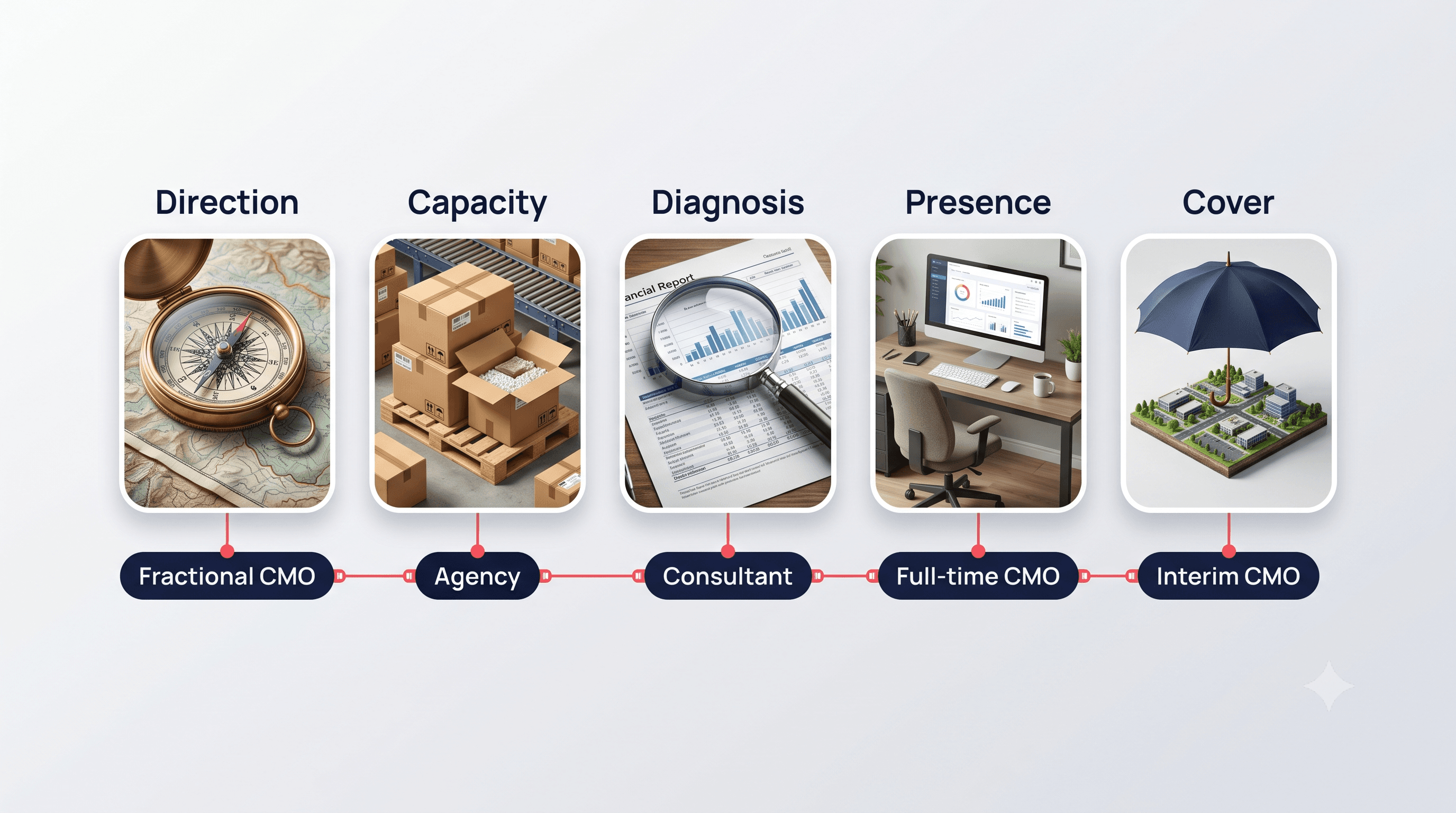
Adviser to the CEO. Weekly or fortnightly review, challenge and priorities; no team management or execution. Fits a founder who still runs marketing.
Embedded fractional CMO. Runs the plan, the operating rhythm, and team and agency reviews, with a weekly scorecard; no hands-on execution. Fits when a team or agency needs direction.
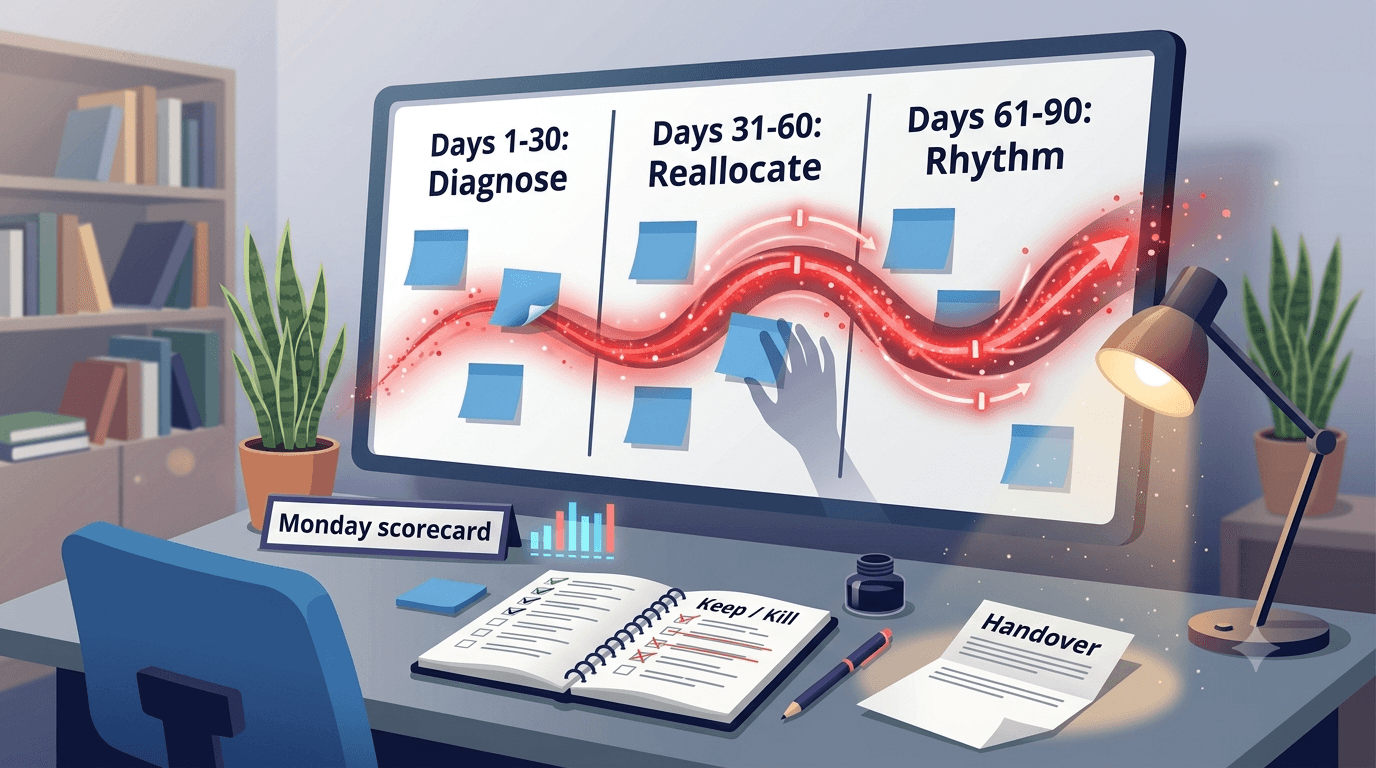
Fixed-scope sprint. A named deliverable and a decision, such as an audit or a go-to-market plan, in a fixed window such as 90 days. Fits when the problem is still unclear.
Day rate or hourly. One event or decision, such as a workshop or board preparation, with no continuity or accountability. The stage-based guide notes that hourly and day-rate models "are harder to forecast over a quarter".
One company, several models
I have worked with OurBus, a US intercity coach operator, since 2017: "first on organic and product, then on the paid engine, now as an adviser to the CEO" (OurBus case study). Decision rights and cadence don't depend on geography, so the same shapes apply to an Indian company.
The paid-engine phase was closest to embedded work. Spend had been concentrated in route-level search, which the case study calls "the most expensive way to buy a booking"; Performance Max and brand search now carry the volume. A Monday scorecard and Friday deep dive run as standing automation. The adviser role sits closer to the CEO's capital decisions, such as where to expand, than to the weekly account.
Start with a sprint when unsure
In my work with Iqra, a Moroccan exam-prep edtech, a 90-day sprint gave the product "an analytics taxonomy, a personalised onboarding, a notification lifecycle and a knowledge graph for maths". The engagement was then "renewed into a second scope" (Iqra case study). Write your sprint scope that precisely, so both sides can tell on day 90 whether it was delivered.
Equity and performance-linked fees
Two guides put equity, where it is offered, at 0.25–1% for early-stage companies, in place of part of the cash fee (tiered page, cost guide). The tiered page also reports performance components of "5-15% of base retainer".
A performance component only works if the outcome is instrumented, attributable and agreed before the first invoice; the stage-based guide also says it needs "clear attribution frameworks". If you can't define the metric cleanly, keep the fee fixed.
What does each price level actually buy, and what moves the price?
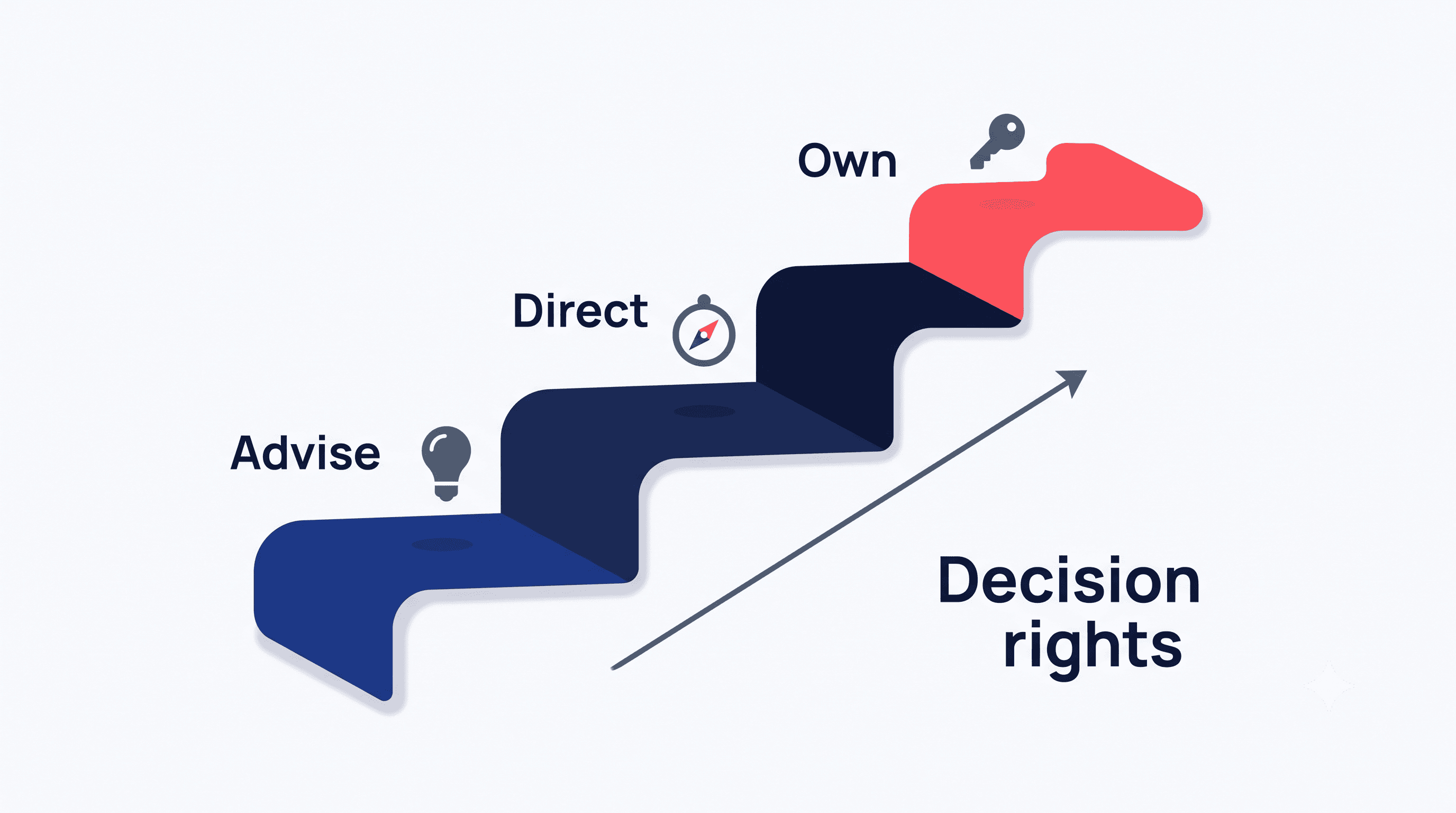
The tiered pricing page says its tiers rest partly on "scope of decision rights"; its top tier carries "paid media budget approval rights up to a defined ceiling". The stage-based guide puts a number on it: moving from advisory to a mandate where the CMO "approves budgets" can "move the price 2x to 3x for the same title". So scope by decision rights first:
Advise. Recommends priorities, channel mix, hires and agencies; you decide. Answers for the quality of the advice.
Direct. Decides the plan and the rhythm. Moves budget between channels within a limit you set. Recommends total budget and senior hires. Answers for one leading metric, such as cost per qualified lead.
Own. Decides spend within the approved budget, and agency and vendor choices. Recommends annual budget and targets. You see the number, or why it moved. Answers for the marketing number reported to the board.
In price, advise and direct roughly match the adviser and embedded ranges above; own matches the tiered page's top tier (₹5–8 lakh+), less whatever part of that price pays for a delivery pod.
At the direct and own levels, ask for case studies where a named number moved. The OurBus case study, for example, reports 1.6× monthly revenue from January to June 2026, all channels (figures supplied by the client, shown as multiples and ratios; absolute revenue withheld). Mapping these rights to your company and then running them is the job of a fractional CMO.
What else moves the price
Stage and sector. The stage-based guide quotes ₹1.5–2 lakh a month pre-revenue, ₹2–2.5 lakh at seed, ₹3–4 lakh at Series A–B and ₹3.5 lakh+ for mid-market. It says regulated or technically specialised sectors (fintech, healthcare, banking, financial services and insurance, deep tech) typically cost more.
A bundled team. Ask for the price with and without the delivery pod.
Seniority and track record. Experience at your stage costs more; ask for the named results that justify it.
Commitment. The stage-based guide notes that longer committed engagements "sometimes carry a modest discount" over month-to-month ones, so trade a longer term for a lower monthly fee.
How do you know if the fee is worth it?
Vendors justify their fees as a fraction of a full-time CMO. Yet their own full-time figures run from ₹50 lakh–1 crore a year fully loaded (cost guide) to "Rs. 8,00,000 to Rs. 20,00,000 a month" (stage-based guide; about ₹96 lakh–2.4 crore a year), so that anchor tells you little.
A better test is break-even. The cost guide runs one on customer acquisition cost, which needs an estimate of how far the CMO will cut it. A simpler version: divide the monthly fee by the monthly marketing spend it governs. The result is the efficiency gain the engagement must find to pay for itself. For an illustrative ₹2.5 lakh monthly fee:
On ₹50 lakh of spend, you need 5%. Worth testing an embedded CMO.
On ₹25 lakh, you need 10%. Plausible if the account has visible waste.
On ₹5 lakh, you need 50%. Unrealistic from spend alone; start with a sprint or an adviser.
If most of your marketing budget is people rather than media, use total marketing cost as the base. The test ignores value beyond spend efficiency, such as positioning, hiring and the board story (the cost guide lists the same three). So treat it as a floor: if the gain needed looks unrealistic, the engagement needs another clear reason.
The live version is marketing cost as a share of revenue. At OurBus it went from 5.34% to 4.76% of revenue between June 2025 and June 2026, "while the business grew" (figures supplied by the client, shown as multiples and ratios; absolute revenue withheld). Track it monthly, next to growth, because cutting spend alone can also lower it.
What is not included in the fee?
Budget separately for:
Execution: agency or freelancer fees, and any in-house hires.
Ad spend.
Tools and travel: some CMOs pass through their own tool stack or charge in-person days separately; the tiered pricing page puts these at "Rs 1.5L-6L" a year and "Rs 25K-75K per day".
Recruiting costs if the CMO helps you hire.
The invoice: GST and tax deducted at source
This is not tax or legal advice; confirm GST and tax deducted at source (TDS) treatment with your chartered accountant.
GST. Consulting falls under heading 9983, other professional, technical and business services, at 9% central tax (Notification 11/2017-Central Tax (Rate), Sl. 21, GST Council copy, as amended), plus state tax at the same rate: 18% in total. A CMO billing from another state charges integrated GST instead (Integrated GST Act, 2017, section 5).
On an illustrative ₹2,00,000 fee, 18% is ₹36,000 of GST and a ₹2,36,000 invoice. Ask whether each quote is inclusive of GST or plus GST, in writing; the tiered pricing page notes that firms quote both ways. Whether you can claim the GST back as input tax credit depends on your registration.
TDS. The Income-tax Act, 2025 took effect on 1 April 2026. TDS provisions once spread across many sections "have now been streamlined and grouped under a single section - Section 393" (Press Information Bureau note). Section 393(1) treats fees for technical services and fees for professional services as separate categories at different rates (Income-tax Act, 2025, Gazette text, Table Sl. 6(iii)). It covers payments formerly made under section 194J (an explainer on section 393(1)).
Which category a marketing retainer falls into is a classification call. Have your accountant make it before the first invoice, and write it into the contract so the invoice and your deduction match.
"That's ₹7,000 an hour": the objection, and why it's the wrong unit
The objection in its strongest form: a ₹3 lakh retainer at 10 hours a week, inside the embedded range above, is about 43 hours a month. That is roughly ₹7,000 an hour for someone who isn't in the building most days.
There are two answers. First, ₹7,000 sits at the low end of the published hourly ranges. Second, and more important, as the cost guide also puts it, you are buying decisions and accountability for a number, not hours.
The OurBus channel shift described above was a decision, not a quantity of hours.
The objection is right in one case. If what you need is output (campaigns shipped, content made, ads run), buy execution capacity, not a CMO.
What should a fractional CMO contract say, and what are the red flags?
The contract needs five things:
A one-page scope: the problem, 90-day outcomes, decision rights and the execution already in place.
Term and notice, checked against the norms below.
Cadence and access: the weekly scorecard, and data, ad accounts and tools from week 1.
Handover at exit: documents, dashboards and logins stay with you.
Tax and conflicts: GST and TDS treatment in the quote, and whether they advise a direct competitor.
Published norms:
Minimum term: experienced CMOs "generally will not accept engagements shorter than three months" (stage-based guide).
Commitment: a "6-month initial commitment", then "30-day notice after that" (cost guide).
Typical length: "Most credible fractional CMO engagements run 6-12 months minimum" (tiered page); "Most engagements run 6-9 months" in a Bangalore practitioner's FAQ (undated, read 28 September 2026).
Notice: "Standard is 30-60 days" on the tiered page; some quote 90 days for the top tier.
Do the arithmetic. The tiered page's own example: 90 days' notice on a ₹6 lakh-a-month retainer is ₹18 lakh committed even if the engagement isn't working.
Red flags in a cheap offer
A low price is not itself the flag, as the cost guide also points out; the flag is a mismatch between price and promise. The tiered pricing page says a ₹1.5 lakh-a-month "fractional CMO" who "promises to run your team end-to-end is either lying or about to burn out". The strategy-deck, client-count, day-30/60/90 and lock-in flags come from these two guides. Watch for:
Embedded scope at an advisory price: team, agency and budget work promised for a few hours a week.
Hourly billing with no written scope: you pay for activity, and the tiered page notes it gives the operator a reason "to maximize hours rather than outcomes".
No defined deliverables or metric for day 30, 60 and 90, so neither of you can tell whether it worked.
A strategy deck as the only deliverable: ask what will be running by week 6.
A "team" bundled at the floor price: ask who the people are, how senior, and how many hours each gives you.
Too many clients: ask how many they serve now and how their hours are split.
A 12-month lock-in with no way out.
What to do this week
Write the one-page scope: the problem, three 90-day outcomes and the execution in place.
Decide which decisions to hand over: advise, direct or own.
Run the break-even test. If the gain needed looks unrealistic, or you can't yet name the problem, start with a sprint.
Get every quote "plus GST" in writing, and ask your accountant how TDS applies before the first invoice.
Put one 90-day metric, with its baseline, in the contract.
If you want a second opinion on which model fits your stage, and a quote for it, book a free strategy call.
- founder
- pricing
- Fractional CMO
- CEO
- Marketing
Written by Siddhesh Joglekar
Fractional CMO and AI marketing consultant Siddhesh Joglekar helps founders and growth-stage teams build marketing engines that compound.