AI
AI training for employees in India: who goes first, what each tier learns, and how to tell it worked
Roll out AI training for employees in India in tiers: leaders, champions, function tracks, all staff, new hires. What each learns, and how to tell it worked.

· 10 min read
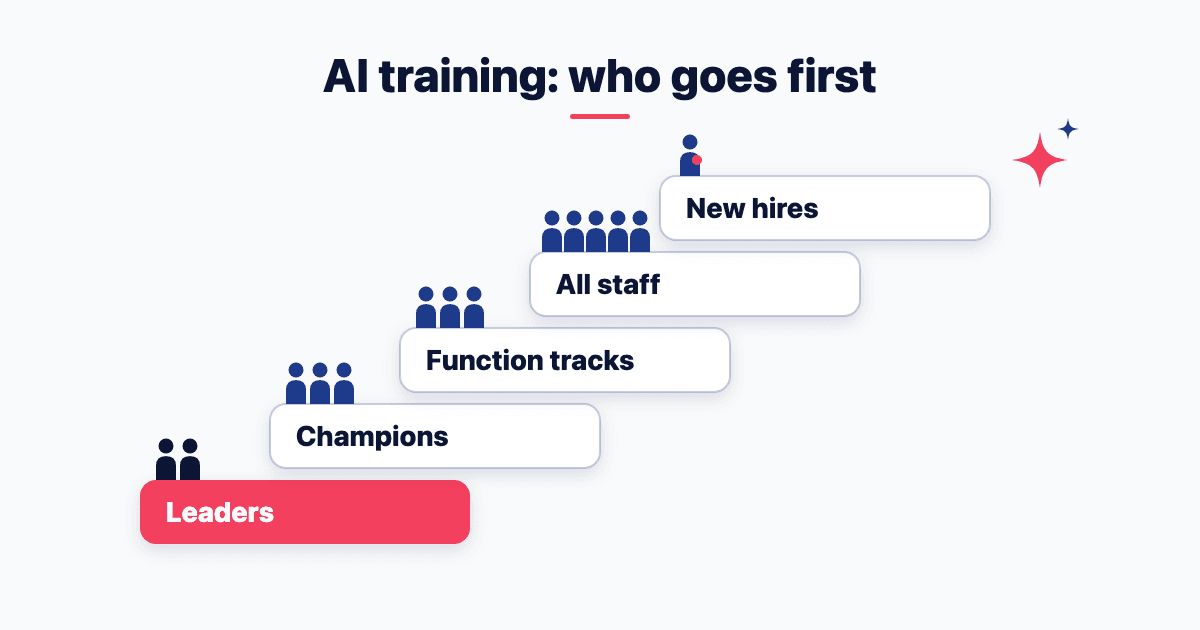
Many companies in India are rolling out AI training to all their employees, as an HR association's India report noted in July 2025. I think the order matters more than the reach. Train in this order: leaders, champions, function tracks, all staff, new hires. Judge it by what people still do with AI a month later, not by attendance.
Your people aren't starting from zero. In Microsoft's 2026 survey of AI users, Indian respondents ranked quality control of AI output highest of any market. That's 63%, against 50% globally (Microsoft's India findings). So AI training for employees in India should build that checking skill, not just give access. I've trained 2,000+ senior professionals since 2024, a count cumulative across institutions and corporates. Here's the order I'd use.
Why not give everyone the same AI training at once?
Because a generic course then reaches people before the rules are set, or before anyone has shown what good looks like in their job. Two of the three Indian examples in the HR association's report start broad:
A Mumbai-headquartered advertising firm "gave basic training on generative AI (GenAI) to all staff". Its HR director said: "Phase 2 is giving people that specialized training."
The law firm Cyril Amarchand Mangaldas "conducted foundational sessions to demystify AI", plus tool-specific workshops.
The third, a global technology services firm, splits "AI builders" from AI practitioners, and its leaders go "through exclusive AI immersion programs". That's closer to the tiers below.
In Microsoft's 2026 Work Trend Index, the setting mattered more than the person. Organisational factors accounted for more than twice the reported AI impact of individual ones: 67% against 32%. The organisational factors include "culture, manager support, and talent practices". The individual ones include "mindset and behavior".
That's a correlation in a self-reported survey, from the company that sells Copilot. I'd still act on it: train the people who shape the environment first.
Who goes first? Five tiers, in order
Each tier leaves with something the next one needs:
Leaders: the rules, and one real task done hands-on.
Champions: a working habit that others copy.
Function tracks: each team's own recurring jobs, rebuilt with AI.
All staff: AI literacy, plus the data rule.
New hires: judgement about quality, from week one.
1. Leaders: the rules, and one real task done hands-on
Leaders go first because their rules decide what everyone else may do. Train staff before the rules exist, and each team writes its own.
An Indian regulator singles out leaders, too. Recommendation 10 of the Reserve Bank of India's FREE-AI committee report, dated August 2025, says regulated entities "should develop AI-related capacity and governance competencies for the Board and C suite, as well as structured and continuous training, upskilling, and reskilling programs across the broader workforce who use AI".
It's a committee recommendation for entities the RBI regulates, not a binding direction. This is not legal advice. What a leadership session should cover is in AI training for leaders.
2. Champions: the people others copy
Pick one or two champions per function. Choose them for respect and daily use, not seniority. They show colleagues a working method on real tasks, and they hear the small questions a trainer never does.
Put each manager through the function track before their team. A manager who uses AI openly gives permission faster than any memo. When managers "actively modeled AI use", employees reported a 17-point lift in AI value. That's from a separate Microsoft-led survey of 1,800 workers in July 2025, and it's self-reported (Work Trend Index 2026).
The US Department of Labor's AI literacy framework agrees. One of its seven delivery principles is "preparing managers to play a supportive role in AI learning" (an HR body's write-up of the framework).
Champions also keep the work going after the trainer leaves. My programmes use "ship logs, capstones and teach-the-news formats that keep cohorts building between sessions". A champion running a weekly log of what each person built is follow-through you don't have to buy.
3. Function tracks: each team's own work
Finance, HR, sales and marketing each learn on their own recurring jobs, because a generic demo doesn't transfer. My case study names the starting problem: "Tool demos disconnected from the participant's own function." The fix was "function-specific tracks for marketing, sales, finance, HR and healthcare".
My IIM Calcutta executive series, which began in September 2026, shows the order. It goes "Think · Do · Repeat · Finance · HR, then Scale" (Session 1 sheet). Habits first, function sessions next, scale last. Each sheet opens: "Pick your function in the bar above. Every prompt, example and table on this page changes to fit it."
In March 2026 I wrote about a digital marketing and product management course I teach at IIM Calcutta: "Too often, AI discussions remain theoretical." So the room spent time "building, experimenting, and testing ideas live" (my LinkedIn post, March 2026). That's what a function track buys: the move "from AI curiosity to AI capability".
For one team's full syllabus, see the marketing team's curriculum. Running these tracks for sales, finance and HR teams is part of the corporate training I do.
4. All staff: AI literacy training for everyone
Only now does everyone get trained. AI literacy training for employees covers the baseline every role needs. The clearest public outline is the US Labor Department's framework of February 2026, with five "content areas of AI literacy" (the same write-up):
understanding AI's capabilities and limits;
exploring how it can be used;
"Directing AI effectively with clear prompts";
"Evaluating AI outputs for accuracy";
"Using AI responsibly, ensuring data security and accountability".
It's voluntary: it "doesn't impose any new requirements". Keith Sonderling, the US deputy secretary of labor, adds that "employers will need to define the specific AI skills and depth of knowledge that are most appropriate for each role and context". That's why literacy follows the function tracks, which show what each role needs.
Start the all-staff session with the data rule, in one line. It lives in the leaders' one-page rules and our consent checklist under India's data protection law.
Plan for locked laptops, too. My Session 1 sheet has a lane for "Office laptop blocks AI sites, or you work from a phone", using fictional or public documents only. End each all-staff session with one checked task per person, not a quiz; new-hire onboarding gets its own check, below.
5. New hires: judgement, not speed
New hires don't need speed. They need judgement. In May 2026 I ran a three-hour workshop with "~30 first-year hires at a BFSI advisory firm" (banking, financial services and insurance). Median age 23.
As I wrote afterwards: "They write 7x faster than my batch did at 23. And they cannot tell when the writing is bad." What took me 90 minutes at 23 took them 12 (my LinkedIn post, May 2026).
Seniors kept telling me "they can't write." My read: they write fine, with AI. "The gap is taste." So what learning and development teams should build isn't another "how to use AI" module. Free courses can teach the mechanics; they don't teach taste. Build that instead: a sense of quality aligned to the company's values, and a habit of protecting the new hire's own originality.
That was one cohort, one firm, one industry: a hypothesis, not a verdict. The usage side does fit ADP Research's global survey: "Young workers, men in particular, were the heaviest users of AI in 2025".
So put a before-and-after check into onboarding. My AI Readiness Test has 20 questions on the "Judgement you need in class and in early jobs". One domain, Evaluation, asks you to "Catch invented facts and wrong numbers". It was built for students and first jobs, and it's "a learning check — not an official certificate". Use it as a model for your own.
How do you sequence AI training programmes for employees over a quarter?
Here's a sample 13-week plan. It's a starting shape, not a benchmark:
Weeks 1–2: the leaders' session and the one-page rules.
Weeks 3–4: champions.
Weeks 5–10: function tracks, one or two at a time, co-run by the champions.
Weeks 8–12: all-staff literacy, in short sessions.
Week 13: review against the measures below.
From next quarter: a new-hire module inside onboarding.
Fit it to the Indian calendar. Keep finance's track away from quarter-close weeks, and plan around festivals. My own IIM Calcutta series notes: "18 Oct is off for Durga Puja. No session that Sunday."
Space the sessions out, because habits form between them. That series runs five three-hour Sundays. Participants leave Session 1 with "A Monday Card: three actions, none needing IT permission, and a 30-day habit plan."
How do you tell AI training worked?
Pick one number per function, and take the "before" reading first. My session sheets build this in as a Function Outcome Matrix. Each session adds a row:
Session 1 asks for the "Use case today", "The number it moves" and how to "Baseline it like this".
Session 2 asks for the "Job today", the "Files that come back" and "The number it moves" (Session 2 sheet).
Then give each tier one measure:
Leaders: rules published and signed.
Champions: ship-log entries each week.
Function tracks: their matrix number against its baseline.
All staff: the share still using an approved tool at 30 days.
New hires: the before-and-after check score.
Count use and proficiency, never attendance. One of India's largest IT services firms listed "270k+ with higher proficiency in AI/ML" in its FY26 results release, against a headcount of 584,519. The word it chose was proficiency, not "trained".
Microsoft's India release says Copilot's monthly active use "has passed 95%" at a different large Indian IT firm (Microsoft Source Asia). Another is at "over 91%". Those are the vendor's own figures, but the unit is right: use.
Don't lean on self-reported productivity. ADP Research found "daily users of AI were four times as likely as non-users of AI to say they were less productive than they could be". ADP itself says "we have no way of measuring the actual productivity" (ADP Research).
"Our people already use AI every day": the objection
Use is high, and staff say they own the thinking. In Microsoft's India findings, "Eighty-seven percent say they remain responsible for the thinking". That's self-reported.
But use isn't judgement. The new hires above wrote fast and still couldn't tell when the writing was bad. ADP's daily users felt less productive, not more. So training people who already use AI means shared rules, checking, and workflows for each function. It isn't access.
There's one exception. In my view, a 30-person firm where everyone already uses AI daily needs less. The leaders' rules, one literacy session and a champion may be enough, without function tracks.
What to do this quarter
Book the leaders' session first, and publish the one-page rules before anyone else is trained.
Name one or two champions per function, and train their managers ahead of the team.
Write one row of the outcome matrix per function, with today's baseline.
Book all-staff literacy with a locked-laptop lane, clear of quarter close and festivals.
Add a judgement check to new-hire onboarding.
If you're planning the rollout and want the leaders' and champions' sessions run hands-on, invite me to run a session for your team.
Frequently asked questions
What does AI literacy training mean?
AI literacy training means the baseline skills every employee needs to use AI safely and well, whatever their role. The US Labor Department's voluntary framework lists five areas, from understanding AI's limits to "Evaluating AI outputs for accuracy" (an HR body's write-up). It differs from tool onboarding, which teaches one product. Literacy should hold when the tool changes.
Is there free AI literacy training for employees?
Yes. In November 2025, India's electronics and IT ministry launched Yuva AI for All. It's a free, 4.5-hour self-paced course with a government certificate (Press Information Bureau release). It covers using AI tools "safely and responsibly". What it can't teach is your company's data rule, or each team's own jobs.
Should employee AI training be on Copilot, ChatGPT or another tool?
Train on the tool your company has approved, and teach a method that travels. My Session 2 sheet says: "Do real-file work in the tool your company has approved." The briefing and checking habits matter more than the brand. To pick one tool, see ChatGPT vs Claude vs Gemini.
How much does AI training for employees cost in India?
There's no standard rate. In a tiered rollout, the function tracks take the most preparation, because each is built on one team's own jobs. The other price drivers are in what drives the cost of AI training. Company AI plans are a separate budget line. Free self-paced courses can cover the all-staff basics.
- AI training
- Employees
- L&D
Written by Siddhesh Joglekar
Fractional CMO and AI marketing consultant Siddhesh Joglekar helps founders and growth-stage teams build marketing engines that compound.