AI
AI training for leaders: what a CXO session should cover, and what to skip
AI training for leaders should end with five decisions, not a tool tour. What a CXO session should cover, what leaders do hands-on, and what to skip.

· 10 min read
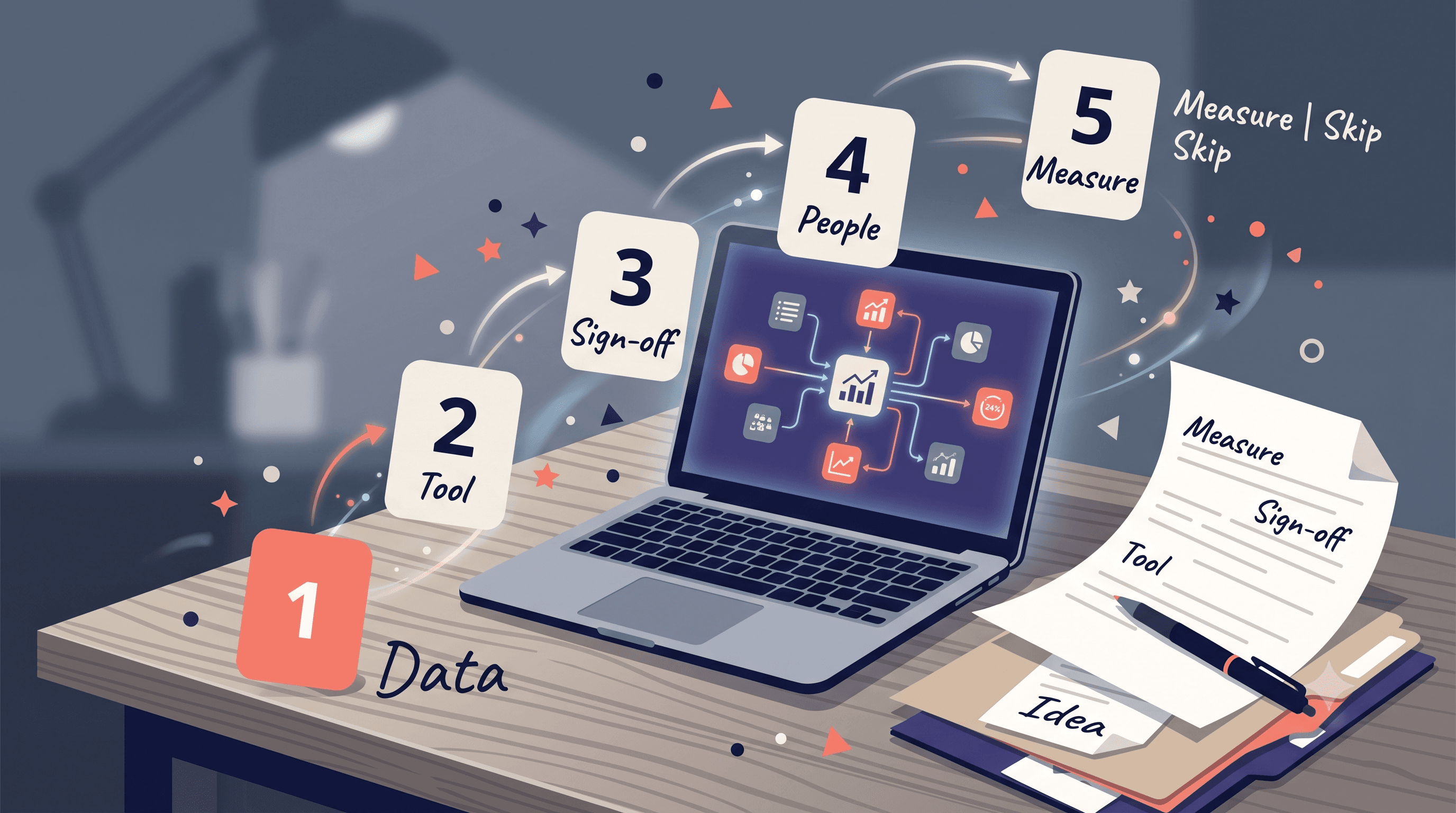
Good AI training for leaders ends with five decisions, not a tool tour. The leadership team agrees which data goes into which AI tool, which tool is approved, who signs AI-drafted work, where AI never judges people, and what each leader will measure. Each leader also does one real piece of thinking work with AI in the room, so the rules come from having seen it fail.
The rules are overdue. In a 47-country University of Melbourne and KPMG survey, 48% of employees worldwide reported uploading company information, such as financial, sales or customer data, into public AI tools. Fieldwork: November 2024 to mid-January 2025.
I have been guest faculty at IIM Calcutta for nine years, including on its Advanced Programme in AI for Leaders. My sessions have trained 2,000+ senior professionals since 2024, a count cumulative across institutions and corporates; one IIM Calcutta leadership cohort rated them 9.8/10 in 2026.
What should AI training for leaders achieve?
AI training for leaders is a session where the people who set budgets and rules use AI on their own thinking work, then agree the rules everyone else follows. Team training teaches workflows, as in AI training for marketing teams. Senior leaders make the calls that let those teams use AI safely.
The gap is rules, not usage. In Microsoft and LinkedIn's 2024 Work Trend Index for India, 72% of Indian AI users brought their own tools to work. And 54% of Indian leaders worried their organisation lacked an AI plan.
Nor does a ban or a policy close it. In the Melbourne survey, risky use such as uploading company information was most common where generative AI was banned (67%) or had a policy (56%), against 33% with no policy. The authors conclude that "outright bans may be ineffective, and that simply having policies does not guarantee compliance".
For firms the Reserve Bank of India regulates, a 2025 committee report recommends "board-approved AI policies covering governance, lifecycle management, vendor oversight, and annual review", as MeitY's India AI Governance Guidelines summarise it. For other sectors, see the six regulators an AI deployment answers to.
What should a CXO session cover? Five decisions to leave the room with
Examples come from published AI in Action sheets, written for an IIM Calcutta programme cohort, not one company's leadership team.
1. Data — What the room agrees: Which documents go into which AI plan; Published example to copy: A green, amber, red traffic light
2. Tool — What the room agrees: One approved tool and who switches it on; Published example to copy: The four-line note to IT
3. Sign-off — What the room agrees: A named person signs every AI draft; Published example to copy: "It drafts. You sign."
4. People — What the room agrees: AI never ranks, scores or screens a person; Published example to copy: Aggregates only, no group under ten
5. Measure — What the room agrees: One use case per leader, with a baseline; Published example to copy: "One use case, one number"
Decision 1. Data: sort every document first. The AI in Action Session 1 sheet uses a traffic light: green is "Fine on any plan", amber is "Company-approved plan only", red is "Never on a personal plan". Its red list includes "Board, committee and asset-liability committee papers", "Unpublished financial results", "Appraisal notes, even your own".
Section 8(1) of the DPDP Act, 2023 makes your company "responsible for complying" with the Act for processing "on its behalf by a Data Processor", "irrespective of any agreement to the contrary". More on who is liable when an AI agent acts. The Rules add access control and "logs, monitoring and review" (Rule 6(1)(b) and (c)). Both apply from 13 May 2027 (commencement notification; Rule 1(4)). Our reading: personal data goes only on a company plan with admin controls and a contract.
Listed companies: regulation 3(1) of SEBI's insider-trading regulations bars insiders from sharing unpublished price-sensitive information except "in furtherance of legitimate purposes, performance of duties or discharge of legal obligations". The regulation never mentions AI; the Session 1 sheet's gloss is "SEBI's insider-trading rules have no AI exception".
For which AI plans train on your chats, see the plan-by-plan list in our marketing-team guide; for consent, see consent rules for marketing. This is not legal advice.
Decision 2. Tool: one approved plan, one owner. Silence is not a rule: 56% of employees in the Melbourne survey had used AI at work without knowing if it was allowed. So name the approved plan, and who approves the next one. The Session 1 sheet gives leaders a four-line note for the CIO or IT head. It asks "which assistant and plan the company has approved, or is evaluating, and what data classes are allowed on it".
Decision 3. Sign-off: a named person carries it. The rule is "It drafts. You sign". The Session 2 sheet lets an analyst do the tracing and re-adding, but the judgement step "cannot be delegated, and nor can the signature". Save the output beside the source, marked "first draft by Claude, checked by [your initials]", so that "If an auditor asks 'what was the source?', the working paper answers". MeitY's guidelines (guidance, not law) agree: "humans should, as far as possible, have final control over AI systems".
Decision 4. People: AI never ranks, scores or screens a person. Session 2's working rule: "Every people use case works on aggregates only: cohorts, templates and role-level patterns, with no group smaller than ten people". Section 8(3) of the Act applies where personal data is "likely to be… used to make a decision that affects the Data Principal". The company must then "ensure its completeness, accuracy and consistency". Our reading: an AI summary of an appraisal or a candidate is that risk.
Decision 5. Measure: one use case, one number. Each leader leaves with "One use case, one number, and how to take the 'before' reading". The Session 1 cost test: "monthly price ÷ the value of your hour = the hours it must save". Its exit rule: "If you have not used it on five working days in a month, cancel".
The one page your managers get
The decisions reach everyone else as one page, the Session 1 Manager's Rule Card: "Six rules for anyone on your team using an AI assistant this week".
Public or fictional documents only, until the company approves a plan.
Nothing about any identifiable person. Not a customer, not a colleague, not a candidate.
No ledgers, board papers, drawings, prices, or anything under NDA.
Check every number at the source before it leaves your desk. Cite the document, never the assistant.
It drafts. You decide, and your name is on it.
Pasted personal data by mistake? Delete the chat. Tell the Data Protection Officer or IT head the same day.
Above it: "Your company's AI policy overrides this page". Session 2 adds: "The instruction goes to your managers in writing, not by example".
What should leaders do hands-on, and what should they skip?
Each leader does one job on a document holding no company data. The Session 1 sheet frames the leadership job as "walk into every room better prepared than the person presenting". Its 25-minute build produces "One decision memo and one meeting brief, made from a 30-page fictional or public document, with one number checked on the page by you".
Why personally? "You cannot delegate a check you have never done," says Session 2. Session 1 sums up the tool's place: "It decides nothing and signs nothing. It prepares you."
What to cut:
AI history and "how large language models work". Vendor agendas for an AI for business leaders workshop often open with them. Leaders need the failure modes, not the architecture.
Tool tours and benchmarks. Even Session 1 calls its four-tool comparison "a demonstration, not a benchmark".
Agent demos that book flights. That post's verdict: "The flight-booking agent is not the Indian operator's bottleneck."
A generic "AI roadmap" with no use case attached.
Prompt libraries. One good brief beats a hundred saved prompts.
As the Applied AI for Executives case study puts it: "Executives do not need another AI overview. They need to leave having built something."
An AI workshop for leaders, or a months-long programme?
What ranks for AI training for executives in India is mostly months-long programmes or vendor workshops of one day or 16 hours over four sessions. One business school's online leadership-with-AI programme, run with an online-education firm, takes 20 weeks at 4–6 hours a week for ₹2,39,000 + GST. IIM Calcutta's Advanced Programme in AI for Leaders takes 10 months of Sunday online sessions plus two three-day campus visits, for ₹4,92,000 plus taxes.
Disclosure: I teach the AI in Action sessions on the IIM Calcutta programme as guest faculty. Fees are list prices, checked 30 September 2026.
A programme suits the leader who will own AI. An in-company AI workshop gets the whole leadership team to agree one company's rules in an afternoon. The two AI in Action sessions quoted above each run three hours. No open-enrolment programme can agree your data rule, so often you need both.
The honest limit: a session sets rules, but habits need follow-through. The case study lists "No follow-through after the room empties" as a starting problem, and the Session 1 sheet ends with a 30-day habit plan. Book a 30-day review of the rule page.
"Our leaders need strategy, not hands-on": the objection
The objection is fair: a CXO's hour is expensive, the tools change every month, and strategy is the job.
But the five decisions are the strategy, and they are only as good as the leaders' picture of where AI fails. The Melbourne figures above show a written policy alone does not stop misuse (self-reported, and a correlation, not proof of cause).
Session 1 says the same of red lines typed into an AI project: "a reminder, not a control. By the time it objects, the data has already left. The control is you." And the hands-on part is one 25-minute drill, not a coding course.
What to do this week, before you book a leadership session
Pick each leader's most dreaded monthly document (board pack, monthly review, contract) and find a public or fictional stand-in.
Ask your IT and compliance heads which AI tools and plans are approved, and for what data. If the answer is "none", that is Decision 2.
Draft your red list: board papers, unpublished results, appraisal notes, customer personal data.
Ask each leader for one number they want AI to move, and today's baseline.
Ask any trainer for a real session sheet and the one page of rules the room will leave with.
If you want your leaders to leave with these five decisions made, not just a demo seen, invite me to run an executive session for your leadership team.
Frequently asked questions
Do board members need AI training too?
Yes, on oversight rather than tools. For firms the Reserve Bank of India regulates, a 2025 committee report recommends "board-approved AI policies covering governance, lifecycle management, vendor oversight, and annual review", as MeitY's India AI Governance Guidelines summarise it. Directors need one rule from the Session 1 red list: board papers never go on a personal AI plan.
Should leaders learn agentic AI?
Learn what an agent may touch, not how to build one. If an agent handles personal data, Section 8(1) of the DPDP Act, 2023 will make your company "responsible for complying", even for processing "on its behalf by a Data Processor". Apply the five decisions to agents first. More on who is liable when an AI agent acts.
Can AI training for leaders run online?
Yes. IIM Calcutta's Advanced Programme in AI for Leaders runs on Sunday online sessions plus two three-day campus visits. An in-company session works online too, if every leader has the tool open on their own screen and does the build themselves. In our view, agreeing the five decisions goes faster in one room.
- Governance
- Leadership
- Growth
- AI
- AI training
Written by Siddhesh Joglekar
Fractional CMO and AI marketing consultant Siddhesh Joglekar helps founders and growth-stage teams build marketing engines that compound.