Leadership
How to manage an offshore marketing team: overlap hours, a weekly rhythm and escalation rules that build trust
A 9-to-6 workday in India and a 9-to-5 day in New York don't overlap at all. How to set the overlap window, hand-offs, Monday scorecard and escalation rules.

· 10 min read
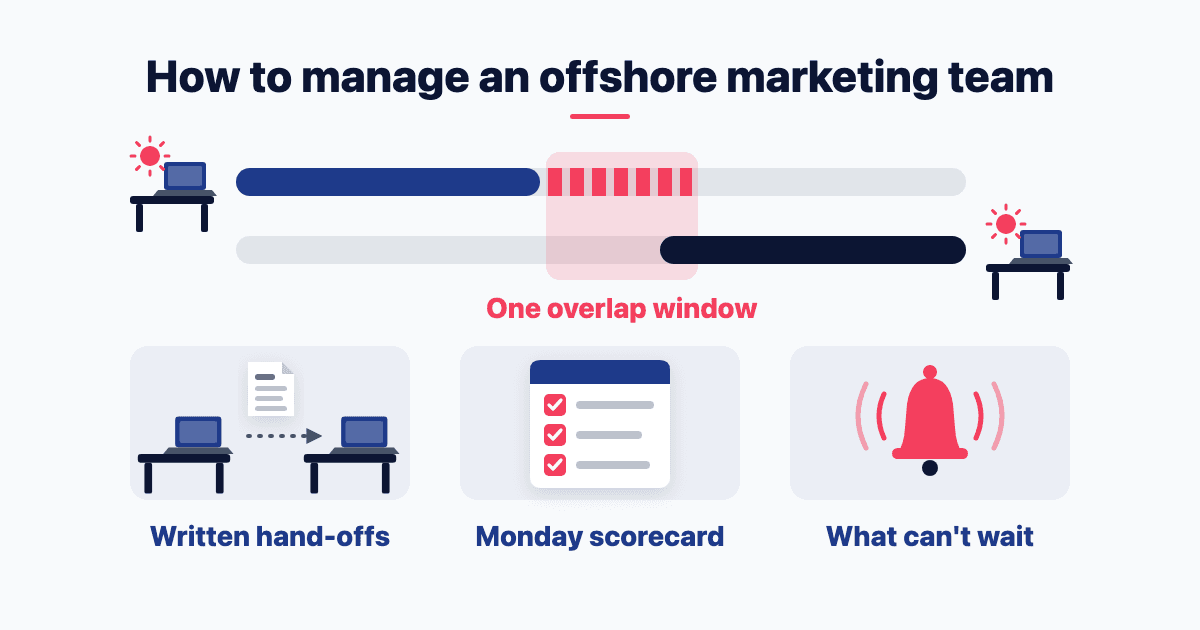
A 9-to-6 workday in India and a 9-to-5 day in New York don't overlap by a single minute, in any season. Your offshore marketing team doesn't need more calls to bridge that. It needs a rhythm you can check without asking: one overlap window, written hand-offs, a Monday scorecard, and clear rules for what can't wait.
Companies hire me as an outside marketing leader, and my US clients have included OurBus and Rally. So I'm an interested party, but the method works with any partner.
How do you build trust with an offshore team?
The worry is rarely the work itself. It's the drag: every task explained twice, a question that waits a day, and no idea what happened in the ad account overnight. If that's the arrangement, it eats the time you hired the team to save.
One widely cited study of this problem is old but still useful. In 1999, Sirkka Jarvenpaa and Dorothy Leidner published case studies of global virtual teams in Organization Science. They found such teams "may experience a form of 'swift' trust, but such trust appears to be very fragile and temporal" (Jarvenpaa and Leidner, 1999). The study also "describes communication behaviors that might facilitate trust".
That's one set of case studies from 1999, and it didn't study marketing teams. Read it as a direction, not a law.
Here's what I take from it. Trust with a team you rarely see isn't a feeling you build on calls. It's evidence that turns up on schedule, without you asking for it.
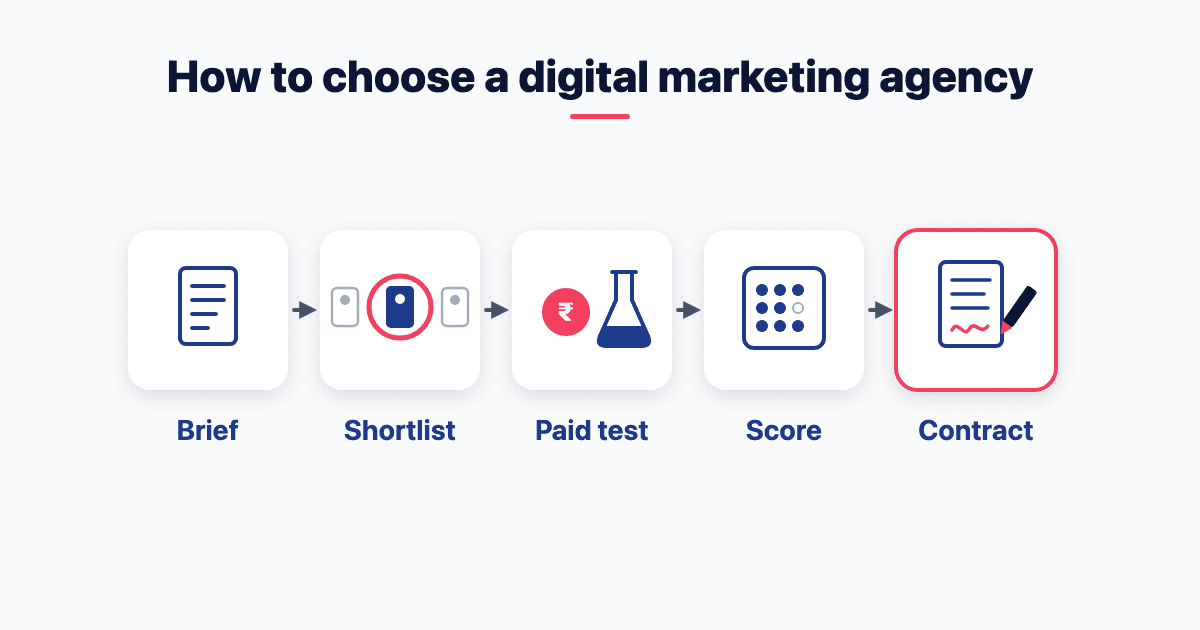
If you're still deciding whether to outsource marketing to India at all, start there. If you're choosing between partners, check a partner's case studies and references before you sign. This post assumes you've signed.
How much overlap do you need with a team in India?
Less than you'd think, but it has to be fixed. First, the arithmetic, because the gap depends on the season.
India's clock runs five and a half hours ahead of Coordinated Universal Time (UTC) all year. It hasn't moved its clocks since October 1945, according to the time zone database kept by IANA, the Internet Assigned Numbers Authority.
The US moves its clocks twice a year. Federal law sets daylight time from "the second Sunday of March" to "the first Sunday of November" (15 U.S.C. 260a). So the gap with India changes twice a year, and only because the US side moves.
The same law lets a state "by law exempt itself", and most of Arizona does. Phoenix stays on Mountain standard time all year (IANA's North America file). Below, 9 a.m. in each US city is shown in India time, computed from those zone records.
New York (Eastern) — Until 14 Mar 2027: 7:30 p.m. in India (10.5 hours behind); 14 Mar to 7 Nov 2027: 6:30 p.m. (9.5 hours behind)
Chicago (Central) — Until 14 Mar 2027: 8:30 p.m. (11.5 hours behind); 14 Mar to 7 Nov 2027: 7:30 p.m. (10.5 hours behind)
Denver (Mountain) — Until 14 Mar 2027: 9:30 p.m. (12.5 hours behind); 14 Mar to 7 Nov 2027: 8:30 p.m. (11.5 hours behind)
Los Angeles (Pacific) — Until 14 Mar 2027: 10:30 p.m. (13.5 hours behind); 14 Mar to 7 Nov 2027: 9:30 p.m. (12.5 hours behind)
Phoenix (Arizona) — Until 14 Mar 2027: 9:30 p.m. (12.5 hours behind); 14 Mar to 7 Nov 2027: 9:30 p.m. (12.5 hours behind)
Now the advice. Overlap is time someone gives up from their own day, so keep it small, fixed and protected.
East Coast: hold a short window early in your morning, which is the India evening, on set days. Use it for decisions, not status updates.
West Coast: your morning falls late at night in India. Go written-first and keep live calls rare.
Share the cost. An 8 a.m. Eastern call is 6:30 p.m. in India in winter: an early start for one side, a late finish for the other.
The invite: anchor it in one time zone, show both times, and put both clock-change dates in the calendar.
That last point matters. On 14 Mar 2027 an 8 a.m. Eastern call moves an hour earlier in India, and on 7 Nov 2027 it moves back.
What should be written down instead of said on a call?
Anything the other side will need while you're asleep. GitLab's public handbook defines the skill: "Asynchronous communication is the art of communicating and moving projects forward without the need for additional stakeholders to be available at the same time your communique is sent" (GitLab Handbook, Communication).
The hand-off note. Three lines, sent both ways at the end of every working day:
Done.
Blocked, and on what.
Needs your decision, and by what time in your zone.
Here the gap can work for you. A question sent at 5 p.m. Eastern lands at 3:30 a.m. in India in winter, so it's waiting when their day starts. A clear question gets its answer by your next morning. A vague one costs a full day, because the reply is another question.
The decision log. One shared document, one line per decision: the date, the decision, who made it, why, and what would reverse it. Anything agreed in the overlap call goes into the log that day. GitLab's handbook puts the principle plainly: "Meeting and meeting notes require a single source of truth" (GitLab Handbook, All-remote meetings).
A definition of done. Write one for every recurring task, so "finished" means the same thing on both sides. "Landing page live" isn't done. "Live, tracking tested, and the link in the hand-off note" is.
What weekly rhythm lets you see the work without chasing it?
One where the evidence lands before you ask for it. Four beats cover most marketing work:
A Monday scorecard on your desk before your day starts, with a few agreed flag signals.
A weekly leader digest: what changed in the funnel, readable in minutes.
A Friday deep dive inside the overlap, on anything the scorecard flagged.
A fortnightly cost pulse: cost per lead and cost per sale, measured on a schedule.
None of this is exotic, and beats like these can run as automation. The case study for OurBus, a US East Coast coach operator, lists "A Monday scorecard and Friday deep dive running as standing automation." At OurBus Charters, the case study lists "Weekly funnel and route-demand digests for the CEO."
Time the scorecard to your morning. As a worked example, not any client's set-up, take an account set to Eastern time, with a scorecard week that ends on Sunday. That week closes at midnight, which is 10:30 a.m. Monday in India in winter. Your 8 a.m. is 6:30 p.m. there. So a team in India has most of its Monday to pull the numbers, check them and write the flags.
For a Pacific account in winter, the week closes at 1:30 p.m. India time, and your 8 a.m. is 9:30 p.m. there. That leaves the India afternoon. It's tighter, so automate the number-pulling and keep people on the flags.
Check the account's time zone first. Google says reports segmented by time follow it, and standard accounts can no longer change it. Moving to a new account has a cost: copied campaigns don't bring their history (Google Ads Help on the time zone setting).
To build the scorecard itself, see a Monday scorecard that only reads your ad accounts. It's workflow 4 in the guide to n8n, a workflow automation tool.
On access, one rule: the accounts stay in your company's name, and each partner person gets a named login with 2-Step Verification. Google says it "can help keep bad actors out, even if your password has been compromised" (Google Ads Help on 2-Step Verification).
What happens when something breaks while you're asleep?
Decide before it happens. Write three lanes, each with a one-line rule: act, wait, never alone.
Act now, tell after. Protective moves you can undo: pause a campaign, cut a budget, pull a broken ad or landing page, or stop a misfiring automation. The hand-off note says what was done and how to undo it.
Wait for the overlap. Anything that spends more, launches something new, or changes an offer, a price shown in an ad or a brand claim. A wrong call here costs money or reputation, and a few hours' wait rarely does.
Never alone. User access, billing, account ownership and anything you can't undo. No one acts on these without a US admin.
Google enforces part of the third lane. Multi-party approval works "by requiring a second account administrator to verify sensitive changes", such as adding users or changing user roles (Google Ads Help on multi-party approval).
Two details matter here. It's "only applicable for accounts with more than 3 administrators", so an account with three or fewer won't have it. And requests arrive as in-product notifications that expire after 20 days. So a US admin checks them in the weekly review.
Two more pieces finish the escalation plan:
One urgent channel, with a named person on each side, and a written list of what counts as urgent.
Both countries' public holidays, swapped at the start of the year, so nobody escalates into an empty office.
How do you keep the work from resting on one person?
Name a backup for every recurring job. Distance makes one person's absence expensive: a missed Monday in India is a Monday without your scorecard.
Owner and backup. Every recurring job gets both, named, on the partner side: the scorecard, account changes, the content calendar.
The runbook. The hand-off notes, the decision log and the scorecard definitions together are the written instructions for running the work. If they're current, someone new can pick up from the page.
A real rehearsal. Once a quarter, the backup runs one full cycle while the owner watches.
The end state to aim for is the one in the Rally case study: "Three demand surfaces now sit under a growth plan the team can run without me." That was a hand-over to the client's own team. Apply the same test inside your partner's team: the work should survive any one person leaving.
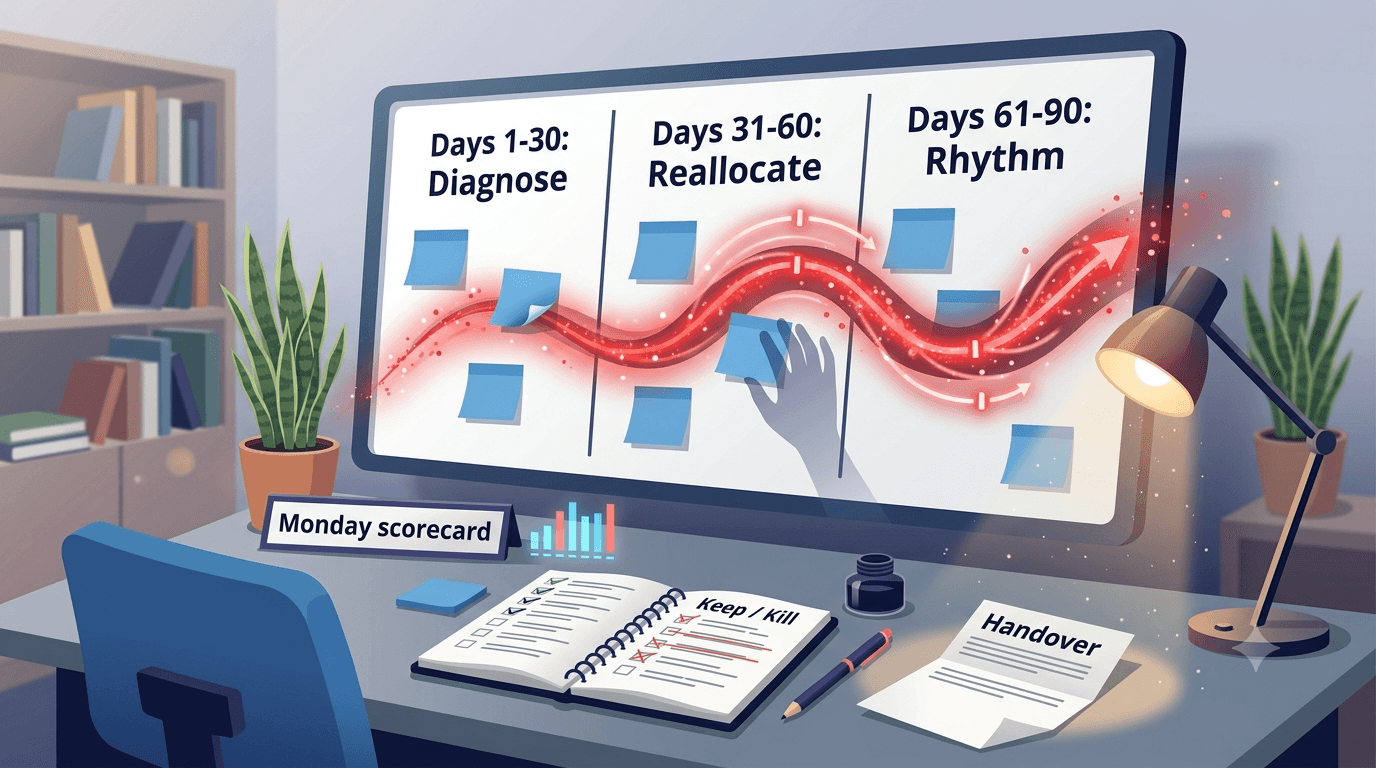
To check whether your own team could run the weekly review, use the handover test in the fractional CMO's 90-day plan.
What to set up before next Monday
Pick the overlap window in one time zone, show both times, and put 14 Mar and 7 Nov 2027 in the calendar.
Start the hand-off note and the decision log in one shared document.
Set the scorecard's deadline, on your desk before your 8 a.m., and agree its flag signals.
Book the Friday deep dive inside the overlap.
Write the three escalation lanes and the urgent channel. Turn on 2-Step Verification for every login.
Name a backup for every recurring job.
If you'd like an outside marketing leader to run this rhythm with your team, that's the fractional CMO work I do. Book a call and we'll look at your week together.
Frequently asked questions
What is the time difference between India and the US?
The 50 states run 9.5 to 15.5 hours behind India, by state and season. The 48 contiguous states span 9.5 to 13.5. Anchorage, Alaska, is 14.5 hours behind until 14 Mar 2027, then 13.5 until 7 Nov 2027. Hawaii doesn't change its clocks, so it stays 15.5 hours behind all year (IANA's North America file).
Should an offshore marketing team work US hours?
Usually not. A full 8 a.m. to 5 p.m. Eastern day is 6:30 p.m. to 3:30 a.m. in India in winter. That's a permanent night shift for the people doing your work. Buy a fixed overlap window, written hand-offs and an urgent channel instead. You get timely answers without asking anyone to live on your clock.
What tools do you need to manage an offshore marketing team?
Fewer than most lists suggest. You need the ad and analytics platforms themselves, with a named login for each person. Add one shared document for hand-offs and decisions, one chat channel plus one urgent channel, and a scorecard that reads the accounts. GitLab's rule applies: meeting notes need "a single source of truth" (GitLab Handbook).
How do you vet an offshore marketing agency before hiring?
Check before you sign, not after. Verify one result in the reference's own system rather than on a slide, and pay for a small test instead of judging a free pitch. The reference-check guide covers what to ask, and the agency selection guide covers how to run the paid test.
- Trust
- Offshore team
- Remote work
Written by Siddhesh Joglekar
Fractional CMO and AI marketing consultant Siddhesh Joglekar helps founders and growth-stage teams build marketing engines that compound.