Growth
Is selling on Amazon profitable in India? The fee-and-ad maths before you list
Is selling on Amazon profitable in India? For D2C founders: walk one sale through 2026 fees, GST and ads, find break-even ACoS, then pick FBA or Easy Ship.

· 10 min read
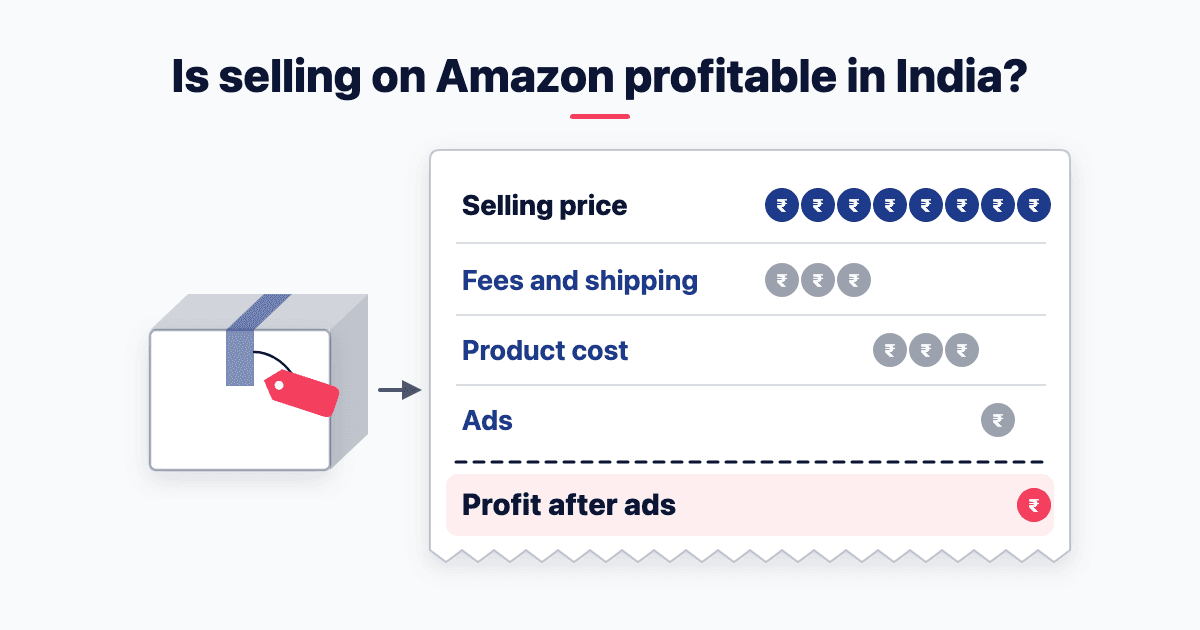
Amazon.in's profit formula for sellers subtracts five costs from your price, and ad spend isn't one of them. Ads are what decide. So, is selling on Amazon profitable in India? Yes, when each unit still earns money after the ads it took to sell it. Before you list, find your break-even advertising cost of sales (ACoS).
Where does the money from one Amazon sale go?
In my e-commerce session on 12 October 2026, we walked one product through the fees: a ₹149, 100 g spice pouch on Easy Ship. The brand on the session sheet is a fictional teaching brand. The fee lines come from Amazon.in's fee page, re-read on 22 October 2026, at the Standard seller tier. Product cost, returns and the ad split are illustrative.
Per unit, in rupees:
Selling price: ₹149
GST on the product, at 5%: −₹7.1. That rate is an assumption; check yours with your tax adviser.
Referral fee: ₹0. Herbs and Spices pays "0.00% for item price <= 1,000".
Closing fee (Easy Ship, ₹0–300): −₹2, effective 7 September 2026.
Weight handling, first 500 g (Easy Ship, Standard tier): −₹55, effective 16 March 2026.
Product cost and packaging: −₹45. Illustrative, about 30% of the price.
Returns and damages: −₹3. Illustrative.
Contribution before ads: ₹36.9
My verdict: "The referral fee is zero and Amazon still keeps ₹57 of a ₹149 sale." It's tempting to read the zero-referral headline as a price cut. I'd frame it differently: "The commission went to zero. The marketplace tax did not. It moved into logistics and ads."
Amazon then adds tax to its fees: "We will apply 18% (eighteen percent) GST to all fees displayed above." On ₹57, that's about ₹10. The Central Goods and Services Tax Act, section 16(1), entitles "every registered person" to input tax credit, subject to conditions. It covers supplies "used or intended to be used in the course or furtherance of his business".
So if you're GST-registered, that ₹10 is usually claimable, and the walk leaves it out. If you can't claim it, add it to your costs. This is not tax or financial advice.
Amazon's own formula is "Profit = Selling Price – (Referral Fee + Closing Fee + Weight Handling Fee + Other Applicable Fees + Product Cost)". It names no GST on the product, no returns and no ads. For the wider channel choice, and for cash on delivery and returns, see my D2C marketing strategy guide.
Then check your own category's row, because zero isn't universal at or below ₹1,000:
"Electronic Devices", bar a few listed types such as TVs and cameras, pay 9% up to ₹1,000.
Books pay 2% above ₹250 up to ₹500, and 4% above ₹500 up to ₹1,000.
Beauty – Fragrance pays 14% above ₹500 up to ₹1,000.
ACoS or TACoS: which number tells you if ads pay?
ACoS judges a campaign. Amazon Ads' ACOS guide gives the formula:
ACOS = (ad spend ÷ ad revenue) x 100
It counts only the sales the ads are credited with.
Total advertising cost of sales (TACoS) judges the business: ad spend divided by all sales, ad-led plus organic, times 100. Amazon's guide doesn't define it; sellers use it.
On the pouch, with the session's illustrative numbers:
ACoS 38%: ₹56.6 of ads per ad-led unit, so that unit makes −₹19.7.
TACoS about 19%: half the units are ad-led, so ads cost ₹28.3 per average unit. That unit makes +₹8.6.
Read the two together, week by week. If TACoS falls while ACoS holds, organic sales are growing behind the ads. If TACoS rises while total sales stay flat, ads are probably replacing sales you'd have had anyway.
What is a good ACoS on Amazon?
A good ACoS is one below your break-even. Break-even ACoS is contribution before ads divided by selling price. Amazon Ads says "There isn't a definitive number for a good Amazon ACOS." It adds: "In order to maintain a profit, your Amazon ACOS needs to be lower than your profit margin."
On the pouch, ₹36.9 ÷ ₹149 is about 25%. So at 38%, every ad-led sale loses money. If you think in return on ad spend (ROAS), break-even is the inverse: ₹149 ÷ ₹36.9, or about 4×. My guide to break-even ROAS for quick commerce ads uses the same logic. It also shows a city holdout, to test whether ads added sales at all.
Now the identity that links your ads to your listing. Break ACoS down by clicks, and the clicks cancel out:
ACoS = (clicks × cost per click) ÷ (clicks × conversion rate × price)
So ACoS = cost per click ÷ (conversion rate × price)
Cost per ad-led order = cost per click ÷ conversion rate
So better conversion lowers ACoS at the same bids. My what-if for the fictional brand: "lifting conversion from 7.8% to the category's ~12% at the same clicks takes ACoS from 38% to about 25%." Treat that ~12% as part of the teaching example, not a benchmark. And even then, the single pouch only breaks even on ads: about 25% against about 25%.
Lifting conversion is listing work. Start with the listing audit prompt from the same session.
A word on benchmarks. I couldn't find an independent source for typical Amazon India seller margins or ACoS. The ranges some guides quote carry no source. So manage to your own break-even, not someone's average.
New campaigns get some grace: "new campaigns tend to have a high ACOS, merely because of their newness", says Amazon Ads. Give a launch a fixed time limit before you judge it.
Short on time? I can build this unit economics model with you from your settlement reports.
Why are price and pack size your biggest levers?
Because the fees come in rupee bands. My take: "Fees are fixed rupees, not percentages, so price and pack size are strategy: a 200 g twin-pack at ₹279 would still pay the same ₹57." Today's tables still agree: no referral fee, a ₹2 closing fee and ₹55 for the first 500 g.
Here is the twin-pack, on the same illustrative inputs. The arithmetic is mine:
Price ₹279, less GST at 5% (₹13.3), fees (₹57), product and packaging (₹90) and returns (₹6).
Contribution before ads is about ₹112.7, so break-even ACoS is about 40%.
At the same cost per click and conversion, an ad-led order still costs about ₹56.6. ACoS falls to about 20%.
The ad-led twin-pack makes about +₹56, against −₹19.7 for the single.
That rests on one assumption: the twin-pack converts like the single. A higher price can lower conversion, so test it.
Then watch the cliffs:
₹300. The Easy Ship closing fee jumps from ₹2 to ₹23 for ₹301–500. It's ₹48 for ₹501–1,000 and ₹79 above ₹1,000. The bands use "Item price including shipping charges". So ₹299 and ₹329 are ₹21 apart in fees.
₹1,000. Above it, the referral fee applies to the whole price: "Total Referral Fees = Item price x Referral Fee percentage". Herbs and Spices goes to 8%. A ₹999 spice gift box pays ₹48 in Easy Ship closing fees. At ₹1,049, it pays about ₹84 in referral plus ₹79 closing. List it under Hampers and gifting, and the rate is 11.5%.
500 g. Easy Ship at the Standard tier charges ₹55 for the first 500 g and ₹75 for 500 g to 1 kg. Amazon charges on actual or volumetric weight, "whichever is higher". Volumetric weight is "(Length x Breadth x Height)/5000" in centimetres, so carton size counts too.
So price just under a band edge, and pack to stay under 500 g. Build combos that spread the fixed fees across more product.
FBA, Easy Ship or Self Ship: which costs less?
Same pouch, Standard tier, Herbs and Spices. Fees per unit, before GST:
Easy Ship: ₹57. That's the ₹2 closing fee plus ₹55 for the first 500 g. You store and pack; Amazon delivers. Pay on Delivery is available, and the Prime badge is "By invite only".
Fulfilment by Amazon (FBA), labelled FC on the fee page: ₹70 regional, ₹96 national. That's a ₹14 closing fee, ₹17 pick and pack, and ₹39 or ₹65 for the first 500 g. Storage adds "₹50 per cubic foot per month". The session sheet is blunt about it: "On FBA at national rates, fees rise to ₹96 and the unit loses money before a rupee of ads." The sum: ₹149 − ₹7.1 − ₹96 − ₹45 − ₹3 = −₹2.1.
Self Ship: ₹20 plus your own courier. "There is no shipping fees levied by Amazon.in", and the closing fee up to ₹300 is ₹20. Pay on Delivery isn't offered, and Prime is "Only for customers in nearby pincodes with Local Shops on Amazon". Self Ship beats Easy Ship only if your courier costs under ₹37 an order.
What does FBA buy? The Prime badge, and Amazon says it can "increase your chance of winning the Buy box", if you meet its performance requirements. You can "Try FC at no additional cost for 1st 3 months/100 units".
My rule of thumb:
Easy Ship for light, low-price products with tight margins.
FBA only when Prime and the Buy Box lift conversion enough to pay the extra ₹13–39 a unit. Higher conversion lowers ACoS, as above.
Self Ship only with a cheap, reliable local courier.
These rates are for one tier: "new sellers who will join the "Standard" level in the Amazon STEP program". The Basic level pays more per shipment, and Premium and Advanced pay less.
Easy Ship and Self Ship carry one more cost: reliability. From 17 August 2026, seller-cancelled orders pay "10% of the order value for orders below ₹10,000", plus 18% GST. That's from an Amazon seller-forum notice reported by Outlook Business. It also applies when the seller "does not ship and confirm the shipment within 24 hours of the estimated ship date". An Amazon spokesperson said such cancellations are "less than 1% of orders on Amazon.in".
"Ads lose money now, but they buy us rank": when that's true
It's a fair point. Launch spend above break-even is normal, and new campaigns run high. My answer still holds: "Ads pay only if they lift organic rank and repeat purchase."
So make it testable. Set a time limit for the launch push. Watch TACoS and organic units on that product every week. If TACoS isn't falling by the deadline, the ads are renting sales, not buying rank. Cut back to break-even.
Before you list: your Monday checklist
Check that every listing is live, in stock and buyable. In my July 2026 audit of The 1970 Shop, 8 of 10 Amazon listings were inactive. Those are audit findings, not results; the programme is still in progress.
Pull your category's referral row and your price band's closing fee from the fee page.
Walk one unit to contribution before ads, with GST, packaging and returns.
Divide by price to get your break-even ACoS. Compare it with today's ACoS and TACoS.
Re-run it for a twin-pack, and for a price just under a band edge.
Price FBA, Easy Ship and Self Ship for your weight and your buyers' regions.
Set an ad stop rule: a time limit, and TACoS falling.
Pick one product you're about to list, or one whose ads you plan to raise. Book a call, and we'll walk its numbers together.
Frequently asked questions
Can I sell on Amazon India without GST?
Usually not for taxable goods. Amazon's seller FAQ asks for a GST number at registration. Its registration guide lets you skip it only for exempt products, "such as books or Bangles". Notification 34/2023-Central Tax lets some small single-State e-commerce sellers enrol instead of registering; Amazon's FAQ doesn't mention that route. Unregistered, you can't claim input tax credit on Amazon's fees.
Did Amazon's 2026 fee changes make selling cheaper?
Mostly. From 16 March 2026, Amazon's seller blog says, referral fees became zero under ₹1,000; most fee-table rows show 0%. From 7 September 2026, FBA, Easy Ship and Seller Flex closing fees rose ₹1 up to ₹500 and ₹3 above. Easy Ship and Self Ship seller cancellations are now charged as a share of order value (Outlook Business).
How much do Amazon ads cost in India?
There's no set price. Amazon's Sponsored Products page says campaigns "have no monthly or upfront fees". You set a daily budget and a maximum bid per click. What matters is cost per ad-led order: cost per click ÷ conversion rate. At ₹4.50 a click and 8% conversion, that's about ₹56. That's illustrative; I found no Indian cost-per-click source.
Is selling books or clothes on Amazon profitable?
It depends on your category's fee-table row. Books pay 0% up to ₹250, 2% to ₹500, 4% to ₹1,000 and 13.5% above. Most apparel pays 0% up to ₹1,000, then a rate on the whole price. Shirts pay 21%. Men's T-shirts pay 23%, except polos, tank tops and full-sleeve tops. A ₹1,049 shirt pays about ₹220 in referral.
- Unit economics
- Amazon
- Marketplaces
Written by Siddhesh Joglekar
Fractional CMO and AI marketing consultant Siddhesh Joglekar helps founders and growth-stage teams build marketing engines that compound.