Marketing
Diwali marketing for D2C brands: the last week, and the 30 days after
Diwali marketing for Indian D2C brands: delivery cut-offs and spend pacing for the final week, then buyer groups, returns, the second offer and a holdout.

· 11 min read
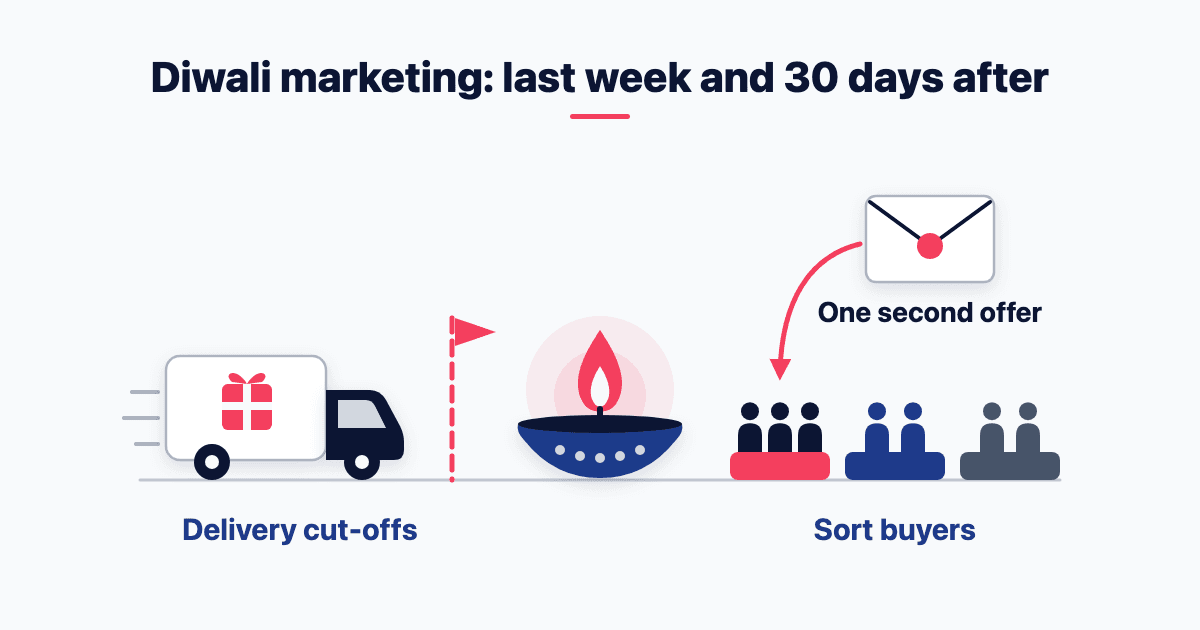
Diwali brings buyers. Most aren't back by March. Of new buyers in the fortnight before Diwali 2022, 34% bought again from the same retailer between November and March. That's a Criteo managing director's figure, quoted by Social Samosa. In Diwali marketing's final week, sell only what arrives in time, with no new discount. Then spend 30 days earning repeat orders.
The calendar is late this year. The India Post holiday list has Diwali on Sunday 8 November 2026. The central government's 2026 holiday order, as reprinted by GConnect, has Bhai Dooj (Bhai Duj) on Wednesday 11 November. Drik Panchang lists Dhanteras on Friday 6 November, 19 days later than last year. That gap will fool your December numbers unless you plan for it.
This is for direct-to-consumer (D2C) brands selling on their own site and on marketplaces. The longer half is the 30 days after, where I think most brands have no plan.
Can your orders still arrive before Diwali? Set a cut-off for each delivery zone
Check stock before you spend the last week's budget. The 1970 Shop's July 2026 audit found 41% of 59 SKUs (stock-keeping units) out of stock. That programme is still in progress, with outcome figures to follow, so I claim no festive result. Stock first, spend second.
Then set a last order date for each zone:
Order-by date = arrival day − courier transit days − packing days − one buffer day at peak.
Ask your courier, in writing, which days around Diwali, Govardhan Puja and Bhai Dooj it won't pick up or deliver.
An illustration in calendar days, Sundays included. The gift must arrive the day before the festival, with one packing day and one buffer day. For Diwali, that's Saturday 7 November.
A 2-day metro zone must order by Tuesday 3 November.
A 5-day zone must order by Saturday 31 October. For your slowest zones, that's today.
For Dhanteras, that's Thursday 5 November, so the metro zone must order by Sunday 1 November. A 5-day zone has already missed it.
If your courier or warehouse rests on a Sunday or holiday in between, set the cut-off a day earlier for each.
After a zone's cut-off, change the promise on product pages and ads. Say "arrives after Diwali", offer a digital gift card that arrives instantly, or sell through quick-commerce apps in the cities where you're stocked. I'd treat a late gift as a likely refusal or return.
How should you pace ad spend from Dhanteras to Bhai Dooj?
Pace against your own curve, aligned by festival day, not by date. Call Dhanteras day 0 in last year's daily orders: Saturday 18 October 2025 against Friday 6 November 2026. Then compare day 1 with day 1.
Four rules for the week:
As each zone's cut-off passes, stop ads that promise pre-Diwali delivery there.
Move that budget to zones that can still receive, stocked quick-commerce cities and gift cards.
Keep some remarketing budget for carts left before the cut-off.
After Bhai Dooj on 11 November, switch festive prospecting off, unless your own orders show a region still buying. The next rupee goes to the post-festive plan.
Weight spend towards Dhanteras only if your own data shows a spike there. Thinking of creators this late? Read the note on festive creator spend first.
Should you add a bigger discount in the final week?
No. Add no new discount you'd have to defend in December. I think a deeper last-week cut trains discount-led buyers to wait for the next one. It hands margin to orders that would have come anyway. And it makes December's full price look like a price rise.
My IIM Calcutta session sheet on social and conversational commerce uses Rasoi Roots, "our fictional Pune spice brand". One of its five bad samples is a WhatsApp broadcast: "Dear Customer, Greetings from Rasoi Roots!!! … Get FLAT 20% OFF on ALL our masalas. … Hurry!!! Offer valid till stocks last." My rule: "no fake urgency".
Give buyers a true reason to buy this week instead. Hold the price, and offer gift wrap, a delivery date you'll hit, or a gift card for the late shopper. If stock really is low, say so. Otherwise even "last 10 packs" counts as fake urgency.
How do you keep cash-on-delivery risk down at peak?
The maths and the standard levers are in what cash on delivery and returns really cost. Peak week adds two risks of its own, in my reading:
A late gift paid by cash on delivery is the order most likely to be refused. After a zone's cut-off, consider prepaid-only there, or for high-value orders.
A gift shipped to someone else leaves the payment with a recipient who never agreed to pay. Prefer prepaid when the shipping address differs from the buyer's.
Who did Diwali bring you? Sort festive buyers into groups
Go back to that 34%. It's one company's 2022 data from retailers, not a D2C benchmark. Still, the direction is clear: most new festive buyers in that data hadn't bought again between November 2022 and March 2023. So sort them before you send anything.
A festive buyer isn't a customer yet. It's one order, and a reason to find out more.
Three splits from your order data:
Full price or discount-led. Did they use a festive code or pay the sale price? Until your own data says otherwise, assume discount-led buyers respond to a second discount once, and to little else. Full-price buyers need a reason, not a rebate.
Gift or self. Look for gift wrap, a gift message or a different shipping address. The recipient isn't your customer yet.
Own site or marketplace. Follow up only with own-site buyers who gave permission. On a marketplace you get the sale; the marketplace keeps the relationship. Check your seller agreement before contacting those buyers off the platform.
Keep corporate and bulk orders out of these groups (see the FAQ).
Which festive buyers should get no marketing at all?
Before any follow-up, build a no-marketing list:
Buyers who allowed only order updates: order, delivery and return messages, never offers.
Anyone with an open return or complaint, until it's resolved.
Buyers who returned the whole order.
Gift recipients. You hold their address for delivery, not permission to market.
Marketplace buyers, outside the platform.
Make it a gate, not a filter. My IIT Kanpur session sheet on closing the loop makes it the first step: "Node 0 is a consent check". The short version: "No tick: one confirmation, then out."
Watch the quiet trap: a discount code slipped into a delivery or return confirmation. In the same session I warn that "One offer line in the WhatsApp leg flips the template from utility" to marketing. Here's which WhatsApp messages count as marketing. For consent under India's Digital Personal Data Protection (DPDP) Act, use the DPDP consent checklist. This is not legal advice.
How should you triage festive returns and exchanges?
Some of mid-November's returns are regret, and I know the feeling. In an October 2025 LinkedIn post, I admitted it: "Around Diwali, one of the things I have been guilty of doing is splurging on stuff that I would not use later". So I vibe-coded a "Need-Want calculator" with AI. Your customers don't have one. Don't fight regret returns. Route them.
Five lanes, inside the return policy you published before the sale:
Wrong size or variant: exchange first, and fast, to keep the revenue.
Damaged, defective or not as described: replace or refund without argument.
Unwanted gift: offer the recipient an exchange or store credit, where your policy allows.
Arrived after the festival: apologise, then offer a credit to keep it or a free return.
Changed mind: apply the published policy, and don't argue.
Tag every return with a reason code and the buyer's group. If discount-led buyers return far more often, that discount bought returns, not customers.
When should the second offer go out? Consumables, durables and gifts
Send one second offer per group, timed to what you sell, and only to buyers with a marketing tick.
Consumables: time it to when the first pack runs out, with a reminder about a week before.
Durables: there's no reorder. Send care or use tips first, then an accessory or refill. Don't send "buy again" to someone who just bought a pressure cooker.
Gift buyers: the next occasion, not the next pack.
Full-price buyers: something useful, such as early access, not a discount.
Back to the fictional Rasoi Roots. Its Goan Fish Curry Masala comes in a 100 g pack that "Makes about 6 curries". Assume two curries a week; that's my illustration, not data. The pack lasts about three weeks, so the reminder goes around week two. For a Dhanteras order, that's around 20 November, with the offer around 27 November: both inside the 30 days.
Build it as one branch, not a new campaign: the "bought-once" branch after your welcome flow. In the lifecycle flows I teach, every step has four decisions: "trigger · delay · one job · exit". The global exits are "bought, replied, unsubscribed, consent withdrawn". For festive buyers, I'd add one more: a return opened.
How do you read December's numbers without fooling yourself?
Don't compare November with November. Compare with the same stretch around last year's festival, a rule from my 90-day plan for a fractional CMO. This year:
The 30 days after Dhanteras 2026 run from 6 November to 6 December.
The same stretch in 2025 ran from 18 October to 17 November.
So a November-to-November read sets this year's peak against last year's after-festival weeks.
Then prove the second offer worked, with a holdout. Before you send, hold back a random slice of each group, say one in five. That share is my judgement call, not a rule. The held-back slice gets order updates only.
Judge it by my test: "proof = margin per recipient by arm". Under about 30 conversions per arm, call the result "directional" and keep the control running. A small brand's holdout often stays under that line in one season.
This customer holdout isn't the after-Diwali city holdout for quick-commerce ads.
Track three numbers by group at 30 and 60 days: repeat rate against the holdout, return rate, and discount spent per extra repeat order. Groups and holdouts are retention work, which my growth strategy service covers alongside acquisition and conversion.
Why not just run a post-Diwali sale for everyone?
The case for it: it clears stock, it's simple, and the buyers are warm.
But a blanket sale pays full-price buyers to do what they'd do anyway. It risks training discount-led buyers to wait. And it reaches people with no marketing tick. It costs you list, too. The fictional Rasoi Roots' Thursday blast "got 21 orders from 10,950 deliveries, and 164 opt-outs". That's nearly eight people leaving the list per order.
A sale is right for clearing dead stock. Then run it with a holdout, and keep the no-marketing list out.
What to do this week, and through the 30 days after
31 October to 3 November: check stock, publish cut-offs by zone, and add no new discount.
4 to 8 November: taper spend as cut-offs pass, and go prepaid-only where a late gift is likely.
9 to 11 November: tag orders by group, and set up return lanes and the no-marketing list. After Bhai Dooj, switch festive prospecting off (pacing rule 4 has the one exception).
Week of 16 November: clear returns, and send tick holders a use-and-care message.
Late November to early December: one second offer per group, timed by category, with a holdout.
Around 6 December and 5 January: read each group at 30 and 60 days against the holdout and last year's stretch.
If you'd like to talk through your festive buyer groups or the holdout before the second offer goes out, book a call.
Frequently asked questions
What is a win-back campaign?
A win-back campaign is a short sequence for customers who have gone quiet past the point they'd normally buy again. My IIT Kanpur session sheet lists it among the lifecycle flows: "welcome, cart rescue, win-back, replenishment". For festive buyers, it starts only after their expected reorder date, so it's never the first message after Diwali.
How do you calculate repeat purchase rate?
Repeat purchase rate is the share of a group's buyers who placed a second order within a set number of days. Divide those repeat buyers by all buyers in the group. Count it by group and by first-order week, and leave out fully returned orders. Then compare it with the holdout, so you see what the second offer added.
Should corporate Diwali gifting orders count in your repeat-customer numbers?
No. Keep corporate Diwali gifting as its own group: one buyer, many units and a yearly cycle. Mixed in with consumer orders, these orders distort your first-order count and your repeat rate. Plan their follow-up around next year's festival and the buyer's own calendar, not a consumer flow built for one-pack shoppers.
When does the festive season end for Indian sellers?
The Diwali run ends with Bhai Dooj on Wednesday 11 November. It's the last Diwali-week date on the central government's 2026 holiday order, as reprinted by GConnect. Chhath Puja (15 November) and Guru Nanak's Birthday (24 November, India Post) follow. Treat Bhai Dooj as your default date to switch festive prospecting off.
- Customer retention
- D2C
- Diwali
Written by Siddhesh Joglekar
Fractional CMO and AI marketing consultant Siddhesh Joglekar helps founders and growth-stage teams build marketing engines that compound.