Marketing
ChatGPT Ads in India: should your brand test them, and how to run a fair first test
ChatGPT Ads are live in India from ₹725 a day. Check if your category can advertise, what you can measure, and how to run a fair four-week first test.
· 9 min read
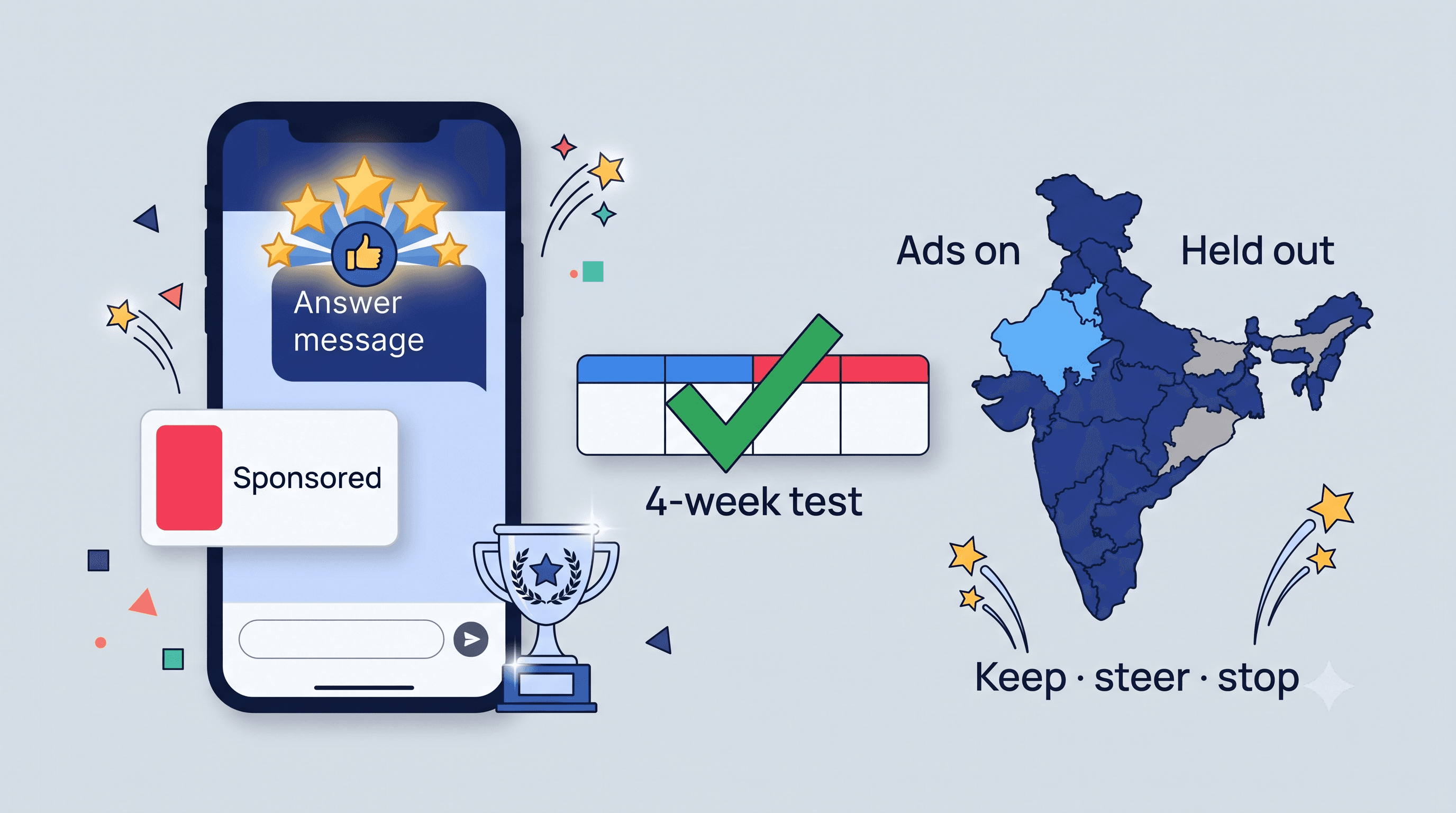
ChatGPT Ads in India are open to eligible Indian businesses through OpenAI's self-serve Ads Manager, from ₹725 a day for a campaign billed in rupees (OpenAI's setup guide). Test them only if your category is allowed, your buyers talk a purchase through before making it, and you can track the sale after the click. Then run one time-boxed test with a written kill rule and a comparison group, because the platform's own reports can't show which sales are new.
Status on 30 September 2026: OpenAI's ads FAQ calls the platform a beta, and its ad policies have changed six times since March.
What are ChatGPT Ads in India, and who sees them?
Ads began showing on ChatGPT in India in late August (TechCrunch, 27 Aug 2026; CNBC, 28 Aug 2026). OpenAI said on 31 August 2026 that self-serve buying through its Ads Manager was opening in India that day (OpenAI's announcement).
Who sees ads: Free and Go users, and logged-out users (only ads "appropriate for all audiences"). Not Plus, Pro, Business, Enterprise or Edu users, under-18 accounts or Temporary Chats (OpenAI help: Ads in ChatGPT). Never near personal health, mental health or politics.
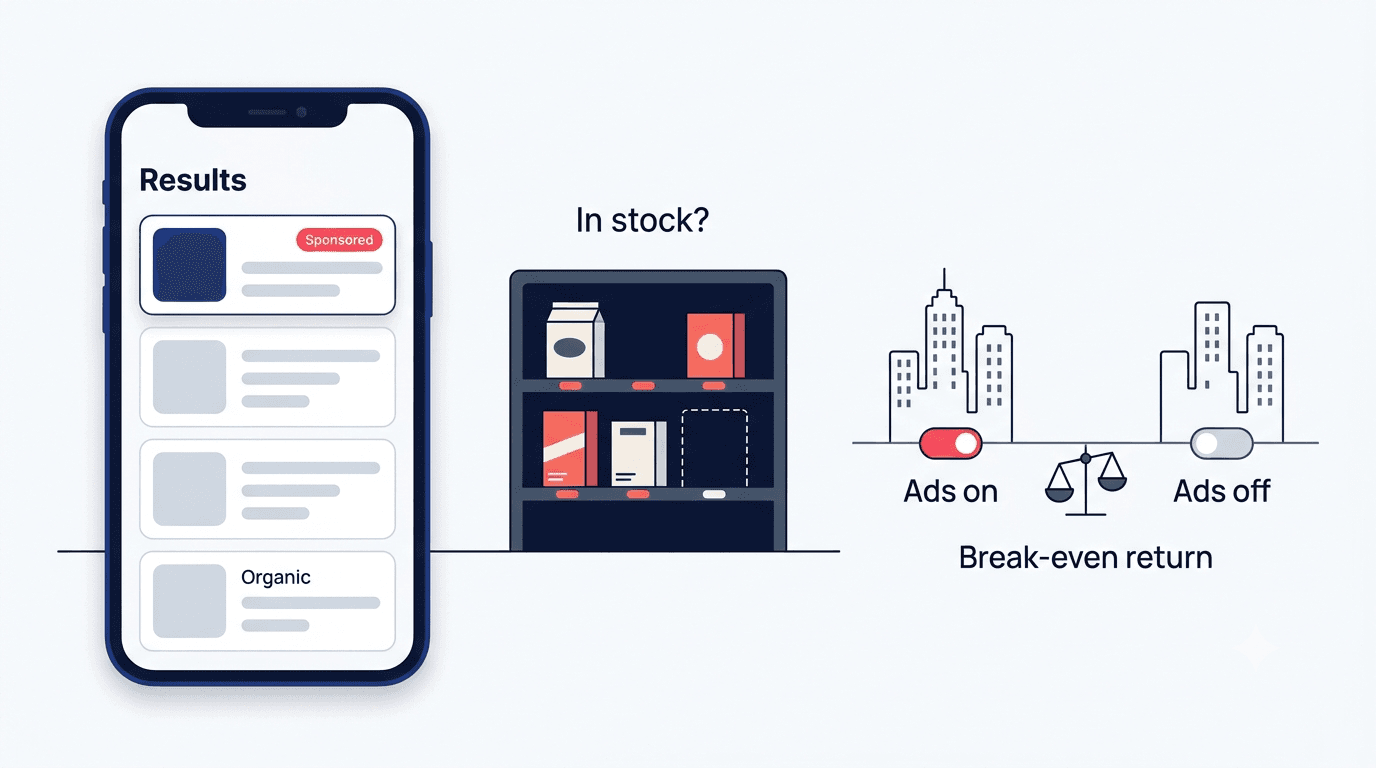
The format: a sponsored card below the answer (one or more can appear, sometimes from several advertisers), with your name, logo, headline, description, image and link (OpenAI help: the basics and Ads in ChatGPT).
Matching: the conversation, your ad and landing page, plus "context hints" you write, which "are not exact-match keywords".
Can your brand advertise on ChatGPT in India?
OpenAI's ad policies, version 1.6 (September 2026), in brief:
Lifestyle and household goods, local services, travel, digital products, education — OpenAI's rule: Early focus; For an Indian brand: Eligible, subject to review
Financial services — OpenAI's rule: "generally prohibited" outside the US; For an Indian brand: Ask OpenAI first; IndusInd Bank reportedly advertises credit cards (Storyboard18, 29 Sep 2026)
Health services — OpenAI's rule: "generally prohibited" outside the US; For an Indian brand: Hospitals, clinics, diagnostics: ask OpenAI first; expect a no
Legal services — OpenAI's rule: Prohibited outside the US; For an Indian brand: Not available
Housing and individual job listings — OpenAI's rule: Prohibited; For an Indian brand: Portals may advertise if no listing is named
Alcohol, gambling, political, dating, adult — OpenAI's rule: Disallowed; For an Indian brand: Not available
OpenAI may approve financial, health and legal advertisers case by case, which may explain the IndusInd report. The rules cover the ad, image and landing page, which must let OpenAI's ad checker (OAI-AdsBot) and search crawler (OAI-SearchBot) through your firewall and robots.txt (OpenAI's guide to creating ads).
What does ChatGPT Ads cost, and what will the reports show?
ChatGPT Ads pricing is set by a "relevance-weighted, second-price auction" (the basics). From the campaign setup guide:
The minimum daily budget for a campaign billed in rupees is ₹725.
You buy Views, Clicks or Conversions, and even Conversions campaigns bill per click or per thousand views: "You do not pay per conversion."
OpenAI's only published bid figure is in dollars: a $3–5 maximum per click to start (the basics). Set yours from your ceiling on the cost of a new customer.
The reports show views, clicks, spend, click-through rate and costs, plus conversions once you install OpenAI's Pixel or Conversions API. (One Indian guide says there is no pixel; OpenAI documents both.) Attribution is "last-touch" and "not multi-touch". Conversions arrive 24–48 hours late, and breakdowns are by device, country and platform only.
OpenAI's FAQ says it "does not yet have performance benchmarks". Rupee click prices going round come from one Indian agency's single campaign, which it calls "a real data point, not an industry benchmark".
So the reports tell you what the platform touched last, not what it caused.
Should your brand test ChatGPT Ads now? Three filters
Your category is allowed. Banks, insurers, health providers and B2B firms: ask OpenAI first.
Your buyers talk a purchase through. Tanishq is using it for gold exchange and wedding jewellery (Storyboard18, 23 Sep 2026). A practitioner quoted by exchange4media names autos, travel, electronics, education and B2B software. An impulse snack isn't a ChatGPT conversation.
You can see the sale and afford to learn. The Pixel or Conversions API fires on the real purchase or qualified lead, and you could lose the whole test budget without missing your acquisition-cost target.
If any filter fails, wait. Fix tracking and landing pages first.
How to run a fair first test of ChatGPT Ads
To advertise on ChatGPT, sign up at ads.openai.com as a business based in India (OpenAI's availability rules). Running ads on ChatGPT so the result means something takes six steps.
1. Write the hypothesis and kill rule first
For example: "ChatGPT Ads bring first-time buyers at no more than our cost per new customer on Google generic search, within four weeks." Then write the number that stops the test. As our IIT Kanpur session on building and testing Meta ads puts it: "We write kill rules before we look."
2. Size the budget from conversions, not from ₹725
The minimum is a spending floor, not a learning floor. The arithmetic, with an illustrative ceiling of ₹1,500 per new customer:
28 days at ₹725 is ₹20,300. If each new customer costs the full ₹1,500, that is about 13 customers, well short of a readable result.
Our holdout rule of thumb is about 30 conversions in each group: the states you hold back (step 3) and the ads. Thirty customers at ₹1,500 cost ₹45,000, roughly ₹1,600 a day for 28 days.
Run one campaign with several ad groups, since each campaign carries its own minimum. Choose the Clicks objective unless you log many conversions a week; OpenAI warns that rare events "can make performance harder to evaluate" (conversion campaigns guide).
3. Pick a comparison group
The best option is a state split. OpenAI says states and cities are targetable "where available", and new product-feed campaigns are country-only (campaign setup guide). Check the picker; don't assume India has state targeting.
If it does, run ads everywhere except two or three low-volume states. Ads Manager has no state breakdown, so read results by pin code in your order data.
If not, alternate weeks with ads on and off, which is weaker. Never compare an ads-on festive-sale week with an ads-off normal week. A state split puts the festive season into both groups.
4. Count new customers, not attributed conversions
Exclude existing customers with a customer-list exclusion, which can be smaller than the 25,000 matched users that targeting needs (custom audiences guide). Upload only lists you have the "rights, notices, consents" for, as OpenAI's developer docs require. Our DPDP consent checklist for marketers covers uploads (our summary, not legal advice).
At OurBus, what was missing was "an acquisition machine that could tell the difference between demand it created and demand it merely collected". A loyal customer who clicks your ad on the way to buying is collected demand. Our D2C guide covers separating demand you create from demand you collect.
5. Tag traffic so paid and organic stay apart
Tag ad clicks with your own source, such as
chatgpt_ads, mediumpaid, and OpenAI's{campaign_id}and{ad_id}macros (measuring results).Never use
utm_source=chatgpt.com. ChatGPT already adds it to organic referrals (OpenAI's publisher FAQ).Decide before launch whether the one-day view-through window counts.
Leave AI text customisation, which is opt-in, switched off. It adapts your headlines and "automatically translates ad copy" (OpenAI, 16 Sep 2026); you need to know what buyers read. The IIT Kanpur session on auditing Google's AI Max upgrade lists the same switch-off as a lever.
Log brand-search clicks in Search Console the week before launch, then watch them. OpenAI notes a buyer may convert later "without a direct ad click" (conversion campaigns guide).
6. Give one verdict at four weeks: keep, steer or stop
The AI Max session's rule: "One verdict. One reason. One re-check date. Written down." Treat the first two weeks as data collection: don't judge cost per customer while an automated product is new.
Stop: above your ceiling after about 30 conversions, with no lift against the comparison group. If 30 orders is a small share of your monthly sales, the split can't show lift: "no lift" means unproven, not zero.
Steer: cheap clicks, few first-time buyers. Tighten exclusions, context hints and the landing page.
Keep: new customers at or under the ceiling. Run four more weeks, with more budget, before calling it a channel.
Want the test designed and read for you? That is part of a performance marketing engagement.
The objection: "Early movers win, so spend big now"
Early learning is cheap; early scale isn't. OpenAI says delivery and spend "fluctuate during the beta" (ads FAQ). Its headline example is a single ecommerce advertiser's "3x return on ad spend across its campaigns over 28 days" (OpenAI, 31 Aug 2026).
Indian evidence is thinner: Tanishq claims "benchmark-beating results" but gives no figures (Storyboard18). Scale once your test shows sales the ads added.
What to do this month
Check your category against the rules above.
Let OAI-AdsBot and OAI-SearchBot through your firewall and robots.txt.
Install the Pixel or Conversions API and test one real conversion.
Log a week of brand-search clicks before launch.
Write the hypothesis, ceiling and kill rule.
Pick the comparison group, then launch one campaign.
For the organic half of AI search, see Google AI Mode shopping in India.
Planning a ChatGPT Ads test? Book a free strategy call and we'll check your hypothesis, comparison group and kill rule before you spend.
Frequently asked questions
Should we start a ChatGPT Ads test during the festive season?
Only if you can split by state. A state split puts the festive season into both groups, as long as the states you hold back share the festival calendar of your ads-on states. With alternating weeks, wait until the festive peak passes, so you never compare a sale week with a normal one.
Do ChatGPT Ads work for B2B companies?
Only if OpenAI accepts your category, so ask first. Its ad policies say ads in the initial test period are "primarily limited to consumer verticals", and other categories are "disallowed at launch". If you are approved, a practitioner quoted by exchange4media puts B2B software among high-consideration categories, but OpenAI "does not yet have performance benchmarks" (ads FAQ). Make a qualified lead the conversion, not a closed deal.
Which Indian brands are advertising on ChatGPT?
Trade press has named Tanishq, for gold exchange and wedding jewellery (Storyboard18, 23 Sep 2026), and IndusInd Bank, reportedly for credit cards (Storyboard18, 29 Sep 2026). Tanishq claims "benchmark-beating results" but gives no figures. Treat these as signs of interest, not proof the channel will work for you.
- ChatGPT Ads
- AI
- Gen AI
- Paid Media
Written by Siddhesh Joglekar
Fractional CMO and AI marketing consultant Siddhesh Joglekar helps founders and growth-stage teams build marketing engines that compound.