Marketing
How to increase sales on Amazon India without more ads: listing, reviews and the AI shopper
How to increase sales on Amazon India without more ads, for D2C sellers: fix the listing, earn reviews within the rules, answer Rufus, test for 7 days.

· 11 min read
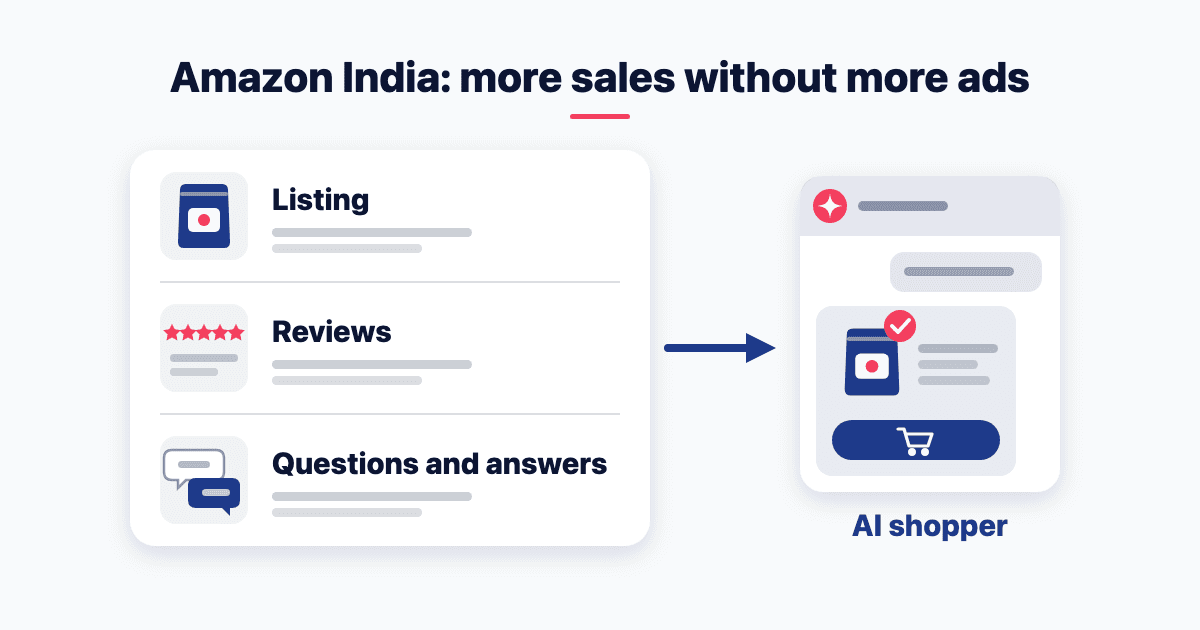
Ask Amazon's shopping assistant about your product, and it answers from your listing, your reviews and your questions and answers. None of that is billed per click. So to increase sales on Amazon India without more ads, make all three answer your buyer's real questions. Follow the review rules. Test one change at a time, for seven days.
What does Amazon's shopping assistant read before it recommends you?
On Amazon.in it's called Rufus. On a product page, Amazon India says, "Rufus will generate answers based on listing details, customer reviews, and community Q&As". It also uses "information from across the web". A "What do customers say?" button gives shoppers a quick overview of your reviews.
My e-commerce session at IIM Calcutta on 12 October 2026 put the cost in one line: "A weak listing now costs you the recommendation, not just the click."
So run a day-0 check before you change anything:
Write the six questions your best customer would ask. One in her own words, then usage, fit, size or value, ingredients, and a comparison with the category's usual choice.
Ask Rufus each one on your own product page.
Mark each answer: answered, partly, not answered, or contradicted (the listing says one thing, the reviews another).
Ask the same six again on day 7.
Outside Amazon, put one of your six questions to ChatGPT and Google's AI Mode as well. Trace each reason they give to a title, a bullet, a review or a questions-and-answers (Q&A) reply, and check that it's true.
What should you fix first: relevance, conversion or velocity?
First, check that a shopper can actually buy the product today. If it's out of stock or the listing is down, nothing below matters yet.
Then score the listing 1 to 5 on three levers, as my listing audit prompt does:
Relevance: "will the right searches, and an AI shopping assistant, match this product?"
Conversion: "once a shopper lands, does the page answer her questions and earn the Buy click?"
Velocity: "what here helps or hurts sales speed and ratings over time?"
Fix the weakest first. And keep a fourth option open: operations first, for when the product or pack is the real problem.
The tempting frame is "we need more traffic". For a listing with steady sessions, I think that's wrong. Shoppers and the assistant are already reading the page. It just isn't answering them. And some problems aren't copy problems: if reviews say torn pouches, "copy cannot fix a seal".
Before you add ad budget, check whether the product makes money after ads. And whether Amazon should be your main channel is a question for your D2C marketing strategy in India.
Audit first, spend later. That was the order of my growth strategy work at The 1970 Shop: the fix list was sequenced before any increase in spend.
How do you write an Amazon title and bullets that sell?
Start with the title. Take Rasoi Roots, a fictional teaching brand, and its ₹149, 100 g Goan fish curry masala. Here's its 225-character title:
"Rasoi Roots Goan Fish Curry Masala Powder | Fish Masala | Fish Curry Masala | Seafood Masala | Prawn Masala | Curry Masala Powder for Fish Chicken Egg Veg | Best Organic Natural Spices Mix | Healthy Masala No.1 Quality | 100g"
Count the faults:
"Masala" seven times: keyword stuffing.
"Best", "Organic" and "No.1": claims it can't prove.
The pack size, last.
A bullet headed "IMMUNITY BOOSTER", which is a health claim.
Two rival brands' names in the backend search terms, which shoppers never see.
My title rule fixes most of this: "Brand, product and pack size first, then the region or use cue, then one provable proof point. No keyword stuffing, no ALL CAPS, no claims you cannot prove."
Using only the product facts the teaching case supplies, a rewrite could read "Rasoi Roots Goan Fish Curry Masala, 100 g | Makes About 6 Curries | No Added Preservatives". That's my illustration, not a tested title.
Each bullet "starts with the shopper's outcome in 3 to 6 words, then the fact that backs it". The five cover taste, usage, pack size, what's in it and what isn't, and who it suits. Where a fact is missing, the prompt flags the gap instead of inventing one.
Before anything goes live, run a claim check. Health words, "organic", "No.1", "natural" and competitor names go to a human. The check is a flag, not legal advice.
Run the listing audit prompt from my IIM Calcutta session on your own product in any free AI chat tool. Then read every line, because "The model is a fast first reader, not the judge".
What should your images and Amazon A+ content do?
Give each image one job. Start with three:
Main: the real pack on a plain white background. For the shooting rules, see which product images to shoot and which to generate.
Second: an infographic that makes pack size and usage obvious on a phone.
Third: the real dish, with the pack in frame. "A North Indian chicken curry on a Goan fish masala listing is a trust leak."
One rule for AI tools: "Never let an image tool redraw your pack, label or net quantity."
A+ content is a richer product description, with images. Amazon.in's seller blog lists modules such as "Product Comparison Charts" and "Image and Text Blocks". To use it, "you need to be registered as a brand owner through the Amazon Brand Registry process".
Use that room for answers that don't fit a bullet: how to use the product, how it compares, and your six shopper questions.
How do you get more reviews on Amazon without breaking the rules?
Ask every buyer the same neutral way, and never pay for a review.
What you may do:
Use the Request a Review button on each order. A year-old Amazon staff post on its India seller forum says it works "5-30 days after delivery" and translates the request into Indian languages.
Send a neutral request. Amazon.in's Community Guidelines give a seller's example: "Please share your honest experience with our product by leaving a review!"
Add a thank-you insert. An Amazon staff post on product inserts says inserts may "thank customers and request they leave a review based on their experience".
What you may not do, per the same guidelines:
Pay in any form: "cash payments, refunds, free or discounted products, gift cards, warranties, services, or other incentives". That holds "even if a seller offers a refund to remove or change a negative review".
Ask unhappy buyers to contact you outside Amazon "before leaving a negative review". Amazon lists that as a violation.
Let connected people review. Amazon bars anyone with "a direct or indirect financial interest in the product" or a "personal connection to the seller, author, brand or artist". That means you, your staff, friends and relatives.
Ask for a changed rating. An Amazon staff post on Account Health says "asking customers to modify negative feedback may be considered in violation of the policy and can impact your account health rating".
Indian law points the same way. Rule 6(2) of the Consumer Protection (E-Commerce) Rules, 2020 says: "No such seller shall falsely represent itself as a consumer and post reviews about goods or services or misrepresent the quality or the features of any goods or services."
Separately, the Bureau of Indian Standards has published a standard on online reviews, IS 19000:2022. It covers "suppliers/sellers of products and services that collect reviews from their own customers" (government release, December 2022). At its launch, the government said the standard would "initially be voluntary" (launch release, November 2022). This is not legal advice.
For a consumer brand, free-product reviews have one allowed route: Amazon Vine. Those reviews carry the label "Vine Customer Review of free product".
Reviews only sell where people can read them. When I audited The 1970 Shop in July 2026, 3,500+ reviews were invisible to Google. Its review schema (the code search engines read) was broken. That's an audit finding, not a result; the programme is still in progress. If you sell direct too, build reviews Google can read on your own site.
How do you turn reviews and Q&A into answers?
"Your reviews are already writing your FAQ. Read them before the assistant does." My review-mining prompt does that reading. Paste up to 50 reviews, and it returns the themes, the five questions your listing fails to answer, and three fixes. Each fix is marked as "a listing fix or a product, packaging or operations fix that copy cannot solve".
Two rules: "Delete reviewer names before you paste." And spot-check the output, because "Counts from a model are approximate".
Then work the Q&A section. Amazon.in's Community Guidelines bar anyone connected to the product's owner from posting questions. "They can post answers, but only if they clearly and conspicuously disclose their connection". So answer every real question, fast and fully.
On the fictional listing, a shopper asked if the pouch was 100 g or 200 g. The brand replied, "Please check the product description for details". That's a lost answer.
Move your best answers into the listing too, because Rufus reads the listing itself, not only the reviews and Q&A. Then hunt for the worst status. "CONTRADICTED is the most expensive status: the listing says mild, the reviews say salty."
How do you test one listing change in 7 days?
Amazon has its own A/B testing tool, Manage Your Experiments, but the bar is high. A three-year-old Amazon staff post about the tool on its India seller forum says it needs Brand Registry and "high-traffic ASINs" (Amazon's product IDs). Those "may get several dozen orders per week, or more". If you qualify, use it.
If not, run my 7-day test:
One product, one change, one metric. "Two changes teach you nothing."
Write the hypothesis: "If we change X, metric Y moves from A to B, because Z."
Pick the metric by what you changed. For a page change, read unit session percentage (conversion) in "Seller Central → Business Reports → Detail Page Sales and Traffic by child item". For a title or search-term change, note your organic rank on 3 keywords daily, skipping Sponsored results.
Set one guardrail, such as rating not lower or returns not higher.
Write the baseline and target before day 1. Then "Change nothing else for seven days: price, coupons, ad budget, images."
Log one number a day, same time, same report.
Expect two things. My session pack warns that days 1–2 often lag while the platform re-indexes. And a flat result is a result.
A before-and-after week isn't a controlled test. A sale or a season can move the number, so track a similar product you didn't change. Then read the result for what it is: "Seven days won't prove you right. It will tell you whether you're allowed to keep going."
Your Monday checklist
Pick one product with steady sessions, and confirm a shopper can buy it today.
Ask Rufus your six questions. Note each answer's status.
Run the listing audit on one product, and pick one lever.
Mine 20 to 50 reviews for the questions your listing misses. Answer every open question in Q&A.
Use the Request a Review button on each order, or send the neutral request. Delete any incentive wording from inserts.
Make one change. Log one metric for seven days.
If you'd like to walk through one product's listing and reviews together, book a call. Bring your six questions and the assistant's answers.
Frequently asked questions
Does A+ content increase sales?
Amazon says it can. Amazon.in's Brand Registry page says Basic A+ "can increase sales by up to 8%" and well-implemented Premium A+ "by up to 20%". Amazon's US page agrees, citing "Amazon internal data". These are Amazon's own "up to" claims, not independent results. On Amazon.in, A+ needs Brand Registry. Test it on your own listing for seven days.
What is Amazon Rufus, and is it available in India?
Rufus is Amazon's generative AI shopping assistant. Amazon India says it's "now available to all India customers in the Amazon Shopping app and on desktop", behind an icon of "chat bubbles with sparkle". In the US, Amazon renamed it Alexa for Shopping on 13 May 2026. Amazon India's page still called it Rufus on 22 October 2026.
Can customers rate a product on Amazon without writing a review?
Yes. Amazon.in's Community Guidelines let shoppers "Leave star ratings from one to five, without writing a full text review". Not every buyer can, though. They must have "spent at least INR 1500 on Amazon.in" on orders delivered in the past 12 months; promotional discounts don't count. That's one reason ratings build slowly. Keep any request neutral.
How do I rank on Amazon's first page without ads?
Make the product easy to match and easy to buy, and keep it in stock. The Amazon.in seller pages I read don't say how organic rank is weighted, so treat guides quoting percentages as unsourced. Put the words shoppers type into your title and backend search terms. Then track organic rank on three keywords daily, skipping Sponsored results.
- Reviews
- Amazon
- Listings
Written by Siddhesh Joglekar
Fractional CMO and AI marketing consultant Siddhesh Joglekar helps founders and growth-stage teams build marketing engines that compound.