The Sector Lens: Where AI Is Reshaping the BSE 100 in FY27
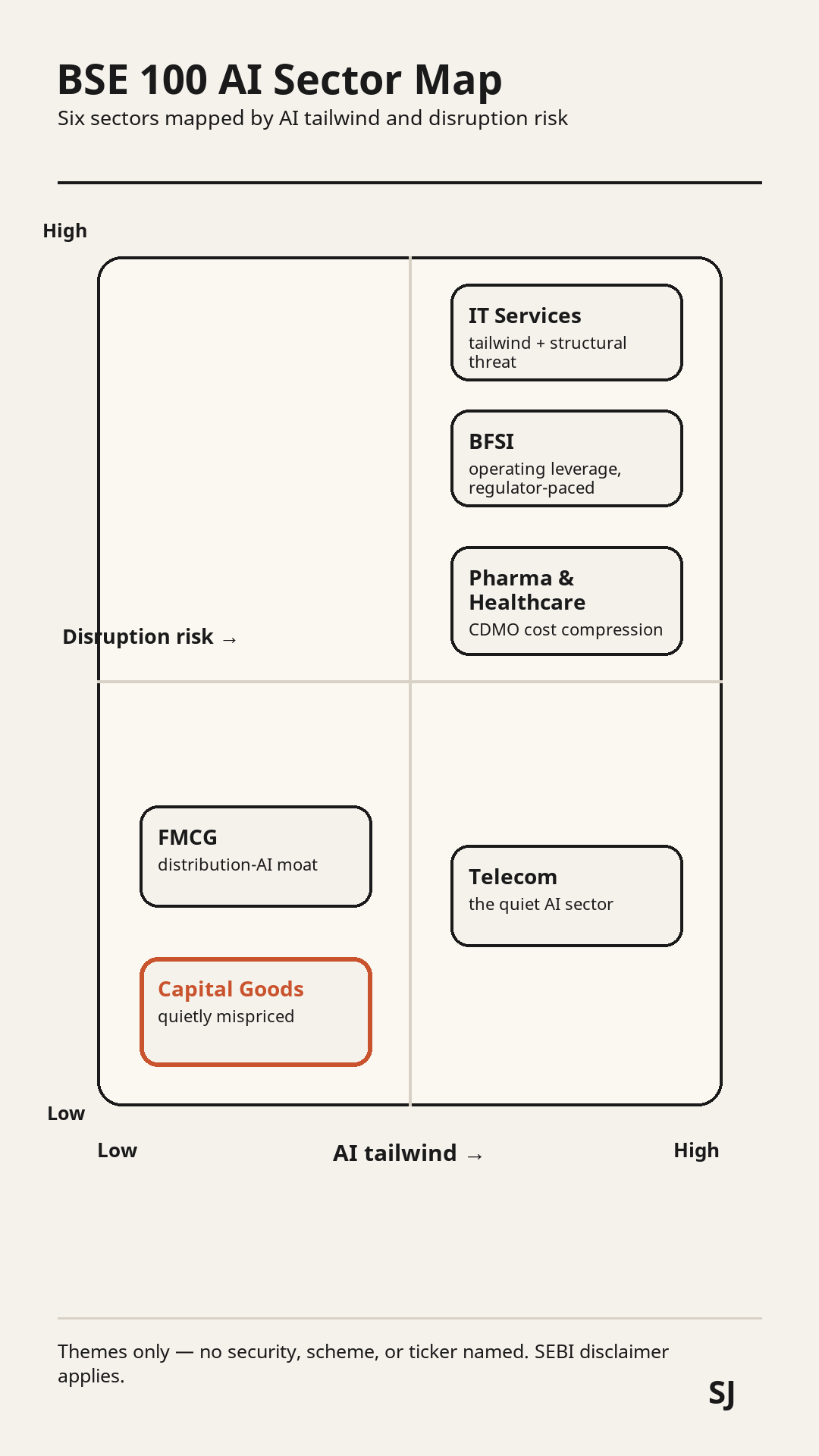
Six sectors. Three with rising AI tailwind. Two with structural disruption risk. One quietly mispriced. Themes only — no picks

· 5 min read

This memo is sector-level only. No stock names, no mutual fund schemes, no buy/sell calls — see the standard disclosure at the bottom. What follows is an AI-operator reading of the FY27 sector map for the BSE 100. Six sectors, four frames each: where AI helps, where AI threatens, what the audited numbers will show first, what the analyst lens should sharpen.
IT Services — the most reshaped sector on the index
The Indian IT services majors have spent two years describing AI as a tailwind. The honest read is that it is both tailwind and structural threat at once. Tailwind on AI-implementation revenue, internal productivity, code-generation efficiency. Threat on the underlying utilisation model, on the linear headcount-revenue relationship, on per-engineer billing rates for the work AI now does. The analyst question that matters for FY27 is not "what is AI doing for the top line?" but "what is AI doing to the gross margin per employee?" If revenue per employee rises faster than employee cost, the AI transition is paying. If margin per employee compresses, the sector is in the wrong half of the transition. Expect the bifurcation across the listed pack to widen sharply in FY27. As a sector view, this is the most heterogeneous bet on the index.
BFSI — AI-driven everything, regulator-bound
Banks and large NBFCs are deploying AI across the stack — fraud, collections, customer interaction, underwriting, treasury. The tailwind is real and the operating leverage is meaningful. The constraint is regulator pace. RBI's master directions in FY27 will set the boundary on what is operationally possible. The sector view: AI-mature private banks and large NBFCs continue to compound; smaller and mid-tier NBFCs face an AI-capability gap that becomes visible as a cost-income gap by H2 FY27. The thematic frame is operating efficiency, not new revenue.
Pharma and Healthcare — drug discovery is the wrong story
The AI-in-drug-discovery narrative is genuinely interesting but unlikely to move audited Indian pharma numbers within FY27. The story that will is AI in clinical trial operations, AI in regulatory submission generation, AI in supply chain. Indian pharma's contract research and CDMO businesses are particularly exposed to AI-driven productivity gains — and to the cost compression that follows. Indian listed hospitals are AI-laggards in operations; the gap between AI-mature hospital chains and the rest is widening but not yet priced into the sector. Watch for hospital chains where AI moves the average length-of-stay number — that's the operating leverage story.
Telecom — the quiet AI sector
Telecom does not feature in the AI conversation often enough. It should. Network operations AI, customer churn prediction, fraud detection on telecom transactions, AI-driven enterprise services — all of these compound for the Indian telecom majors. The cleanest read on the sector is that AI in network ops directly improves capex efficiency, which is the line item the Street cares about. The added optionality is AI-as-an-enterprise-product, which Indian telcos are still under-monetising. Sector view: stable, with quiet upside.
FMCG and Consumer — AI in distribution, not in shelf
The AI conversation in Indian FMCG has been about marketing tech and creative generation. That is the noisy half. The quieter and more meaningful half is AI in distribution — sales-force productivity, route optimisation, retailer ordering prediction, secondary sales forecasting. Indian FMCG is structurally a distribution business, not a marketing business. The companies that move AI investment from the marketing line to the distribution line will widen their lead over the next 24 months. Sector view: dispersion within the pack widens; the consumer-distribution AI gap becomes the new moat conversation.
Capital Goods — the quietly mispriced sector
Capital goods is the least obvious AI beneficiary on the BSE 100, and quite possibly the most interesting one. AI in industrial operations, predictive maintenance, design automation, and EPC project management compounds slowly but durably. Most Indian capital-goods names have low AI visibility, which means the Street is not yet pricing it. If the next 24 months produce meaningful AI-driven margin expansion in the listed capital-goods pack, the analyst-day disclosures will surprise. Sector view: under-discussed, under-priced relative to operating-leverage potential.
The themes that cross sectors
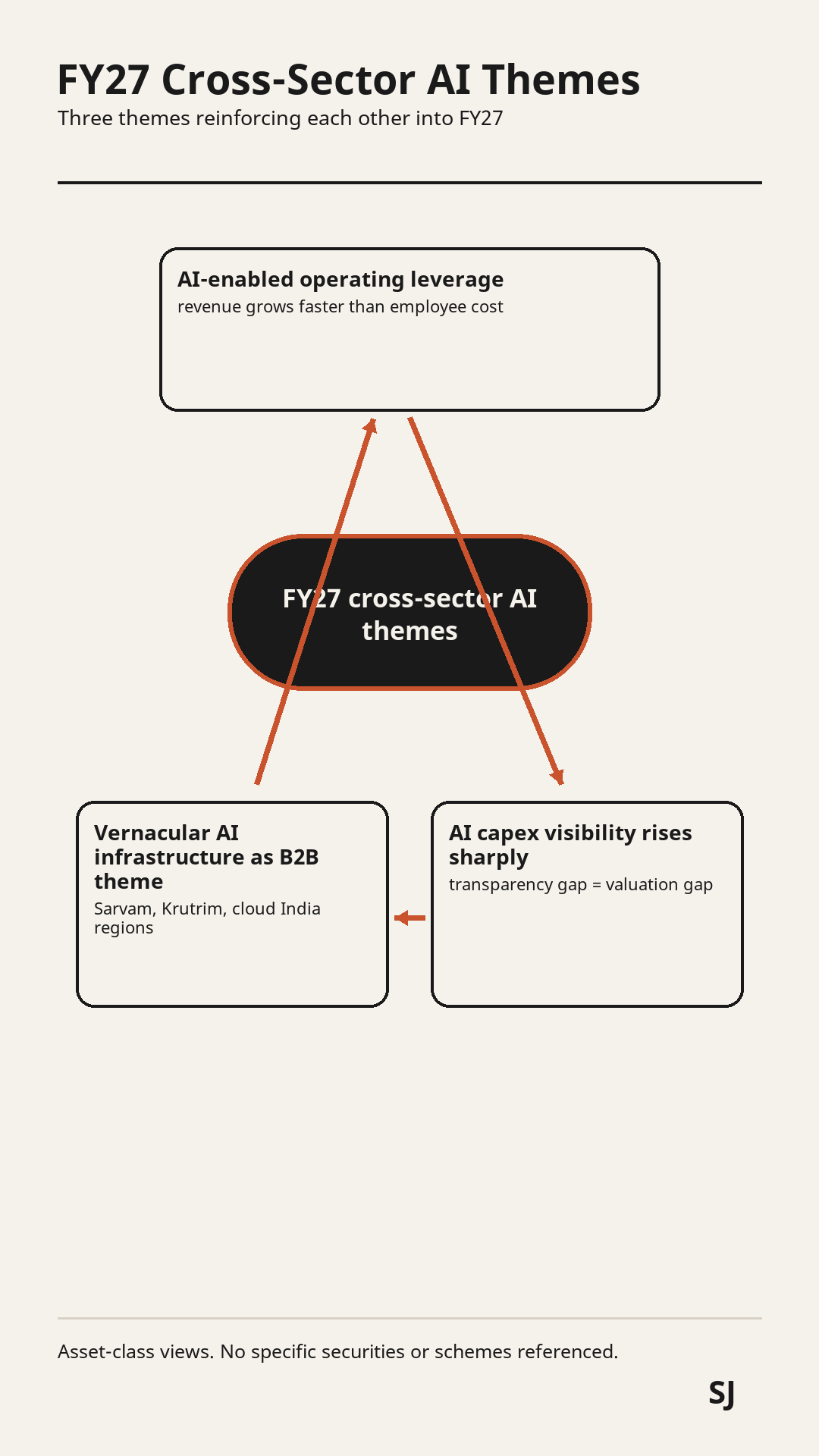
Three asset-class-level themes worth holding in the frame for FY27, again at the theme level only:
1. AI-enabled operating leverage as a cross-sector factor. Look for it wherever revenue grows faster than employee cost — IT services, BFSI, pharma CDMO, telecom.
2. AI capex visibility in Indian listed companies will rise sharply in FY27. The transparency gap between leaders and laggards becomes a valuation gap.
3. Vernacular AI infrastructure as a B2B theme — Sarvam, Krutrim, and the cloud players' India-region investments. This is a private-market theme today and a public-market theme by FY29.
What this memo is not
This memo is not a stock recommendation, a mutual fund recommendation, a thematic ETF pick, or an asset allocation call. It is a reading of where AI is reshaping sector economics within the BSE 100 over the FY27 horizon. Sector and thematic views reflect the author's reading of public information.
The sector lens is more honest than the stock lens. The AI transition will reshape the index by sector before it reshapes it by name.
---
Standard disclosure
This post is for educational purposes only. It is not investment advice and not a recommendation to buy or sell any security, mutual fund, cryptocurrency, or commodity. Sector and thematic views reflect the author's reading of public information as of the publish date. Consult a SEBI-registered investment advisor before acting. Past performance is not indicative of future returns.
Written by Siddhesh Joglekar
Fractional CMO and AI marketing consultant Siddhesh Joglekar helps founders and growth-stage teams build marketing engines that compound.