Quantum Computing, Explained Like You're a CEO (Not a Physicist)
Quantum computing explained for CEOs — no physics needed. What qubits do, why India's quantum mission matters, and 3 actions to take now.
· 7 min read
Here's something I found fascinating - In 2021, an IIT Madras online course on quantum computing drew a few thousand curious enrollments. In 2026, enrollments crossed 2,08,000 in a single year. Either two lakh Indians suddenly fell in love with physics, or the market is telling you something.
This series is for the second group — the CXOs, marketers, and managers who keep seeing "quantum" on conference agendas and consultant decks, and would like to be the one person in the room who actually knows what it means. In the next ten minutes, you will understand what a quantum computer is, what it is genuinely good for, why 2026 is the year the excuses ran out, and what to do about it on Monday morning.
Not a single equation. Let's go.
First, the machine you already know
Every computer you have ever used — your laptop, your phone, the server running your CRM — thinks in bits. A bit is a switch: on or off, 1 or 0. Nothing in between. Your entire digital life is a staggeringly fast game of flipping trillions of these switches, one definite state at a time.
This works beautifully for most problems. But some problems don't scale politely. Try computing the optimal delivery route across 50 cities, or simulating how a new drug molecule folds, and the number of possibilities explodes faster than any classical machine can check them — even if you gave it every GPU on the planet and the lifetime of the universe.
Classical computing's weakness isn't speed. It's that it must consider possibilities one at a time.
Now, the Mumbai local
A qubit — the quantum computer's basic unit — breaks that rule through a property called superposition.
Here's the analogy I use with my MBA students. Picture the 8:47 AM Borivali fast local. A classical bit is a commuter who is definitely in one compartment. You want to find her? Check compartments one by one.
A qubit is a commuter who — until the train halts and you actually look — exists in every compartment simultaneously, with different probabilities of being found in each. One qubit explores two states at once. Two qubits explore four. Fifty qubits explore over a quadrillion states — at the same time.
The catch: the moment you observe the system, the superposition collapses and you get one answer. The entire art of quantum computing lies in choreographing the computation so that wrong answers cancel each other out and the right answer is what remains when you finally look. (Physicists, I know the analogy is imperfect. That is what analogies are for.)
Entanglement: the dabbawala trick
The second quantum property, entanglement, links qubits so that measuring one instantly tells you about the other — regardless of distance. Imagine two dabbas packed by a very mischievous dabbawala such that opening one in Nariman Point instantly determines what's inside the other in Thane. Einstein called this "spooky action at a distance" and disliked it intensely. The universe, unbothered by Einstein's feelings, does it anyway.
Entanglement is what lets qubits work as a coordinated system rather than isolated switches — and it's also the foundation of quantum-secure communication, which India has been quietly getting rather good at (more on that below).
What quantum computers are actually good at (and terrible at)
Here is the sentence to remember: a quantum computer is not a faster laptop; it is a different instrument. A tabla is not a faster sitar.
Quantum machines promise transformative advantages in three problem families:
Simulation of nature. Molecules are quantum systems, so simulating them on quantum hardware is playing on home turf. Drug discovery, battery chemistry, fertilizers, new materials — enormous relevance for Indian pharma and manufacturing.
Optimization. Delivery routing, portfolio construction, supply chain design, media mix allocation — problems where possibilities explode combinatorially.
Cryptography. Quantum computers will eventually break much of today's encryption — and quantum techniques also enable communication that is physically impossible to eavesdrop on. Both halves of that sentence matter to your business.
And what are they terrible at? Email. Excel. Running your website. Streaming cricket. For 95% of computing, classical machines will remain cheaper, faster, and vastly more practical. Anyone selling you "quantum-powered" everything is selling perfume in a physics bottle.
Why 2026 is the year the excuses ran out
For decades, quantum computing was perpetually "ten years away." Four developments changed the tone:
The advantage milestone is here. IBM expects the first verified cases of quantum advantage — a quantum machine provably beating classical computers on a real problem — by the end of 2026, with fault-tolerant machines targeted for 2029.
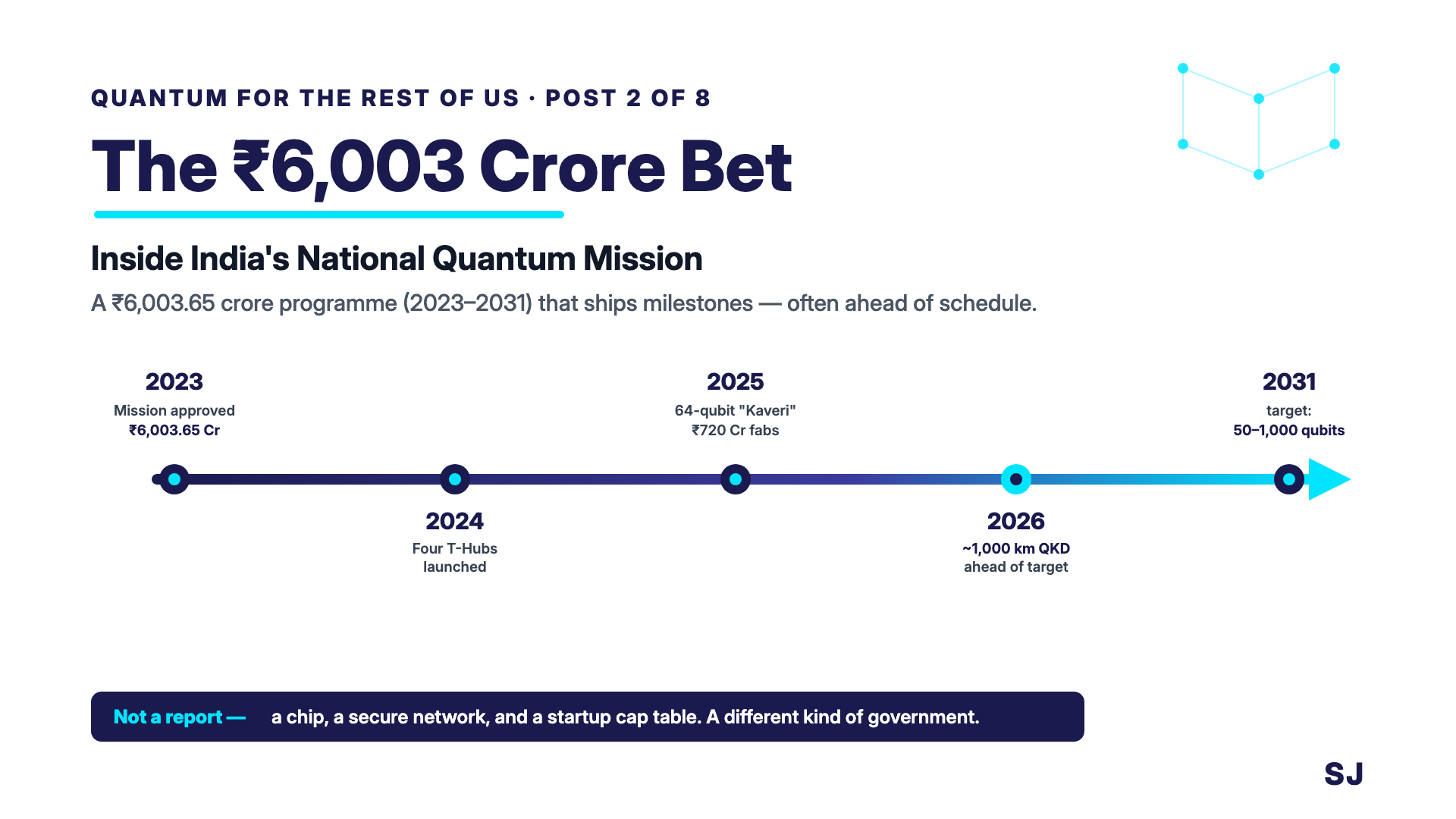
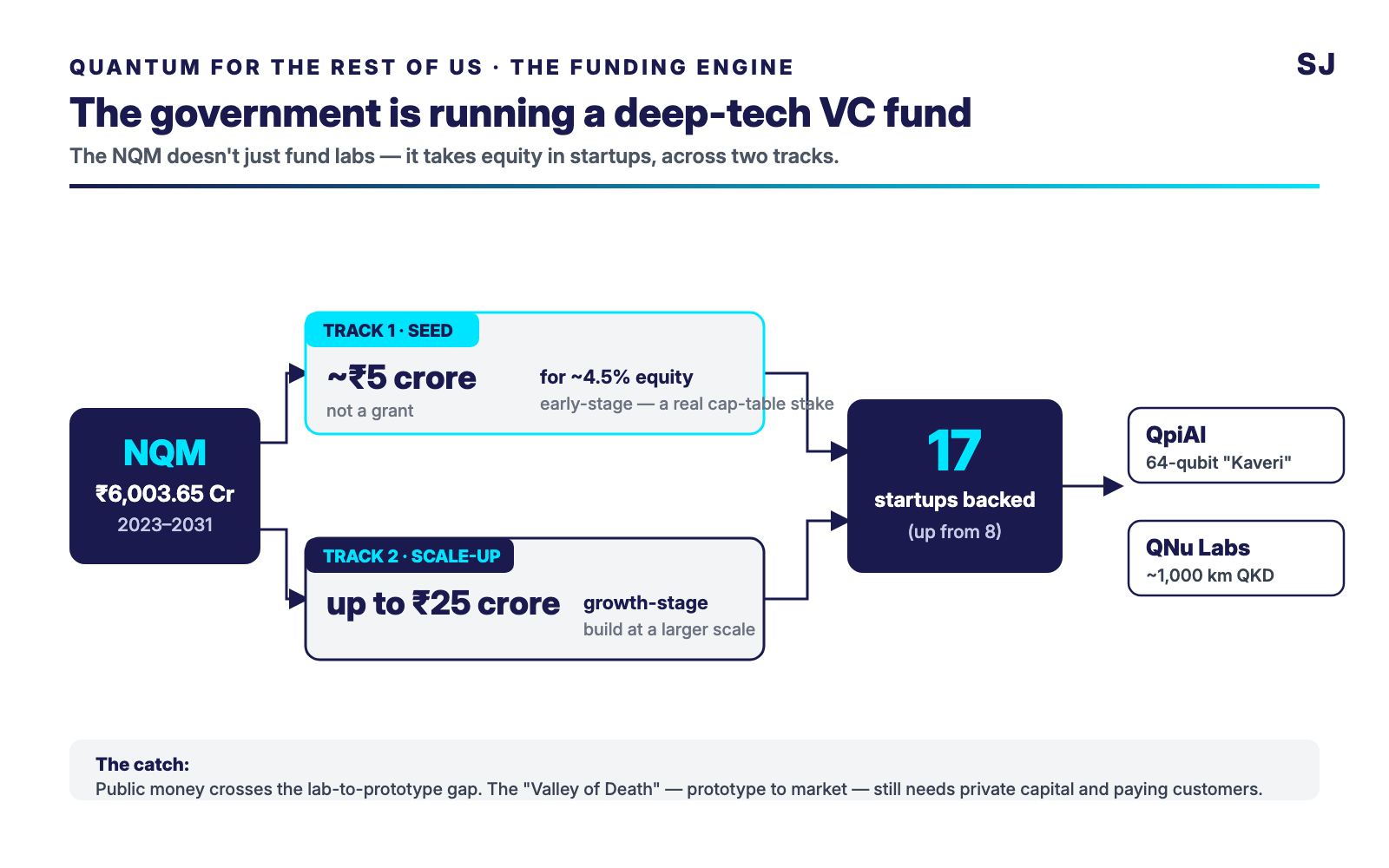
India built a real programme. The National Quantum Mission (₹6,003.65 Cr, 2023–2031) has set up four thematic hubs across computing, communication, sensing, and materials, involving 150+ researchers across 43 institutions — and now backs 17 startups with funding tracks of up to ₹25 Cr.
Indian hardware exists. Bengaluru's QpiAI unveiled India's first full-stack quantum computer (the 25-qubit Indus) in April 2025 and a 64-qubit chip by November. Amaravati's Quantum Valley — a government–IBM–TCS–L&T alliance — is targeting a 133-qubit machine. In April 2026, India demonstrated a 1,000 km quantum-secured communication network on indigenous technology, ahead of schedule.
The regulators moved. India's quantum-safe roadmap requires critical sectors — banking, telecom, power, defence — to begin migrating to post-quantum cryptography by 2027, with full national adoption targeted by 2033. Compliance deadlines, unlike hype cycles, come with budgets attached.
NITI Aayog estimates quantum technologies could unlock $1–2 trillion in global value by 2035, with India aiming for a top-three position. Directionally, the signal is unmistakable.
The one risk you cannot postpone
A preview of Part 3 of this series: adversaries are already running "harvest now, decrypt later" attacks — stealing encrypted data today and stockpiling it, betting that a future quantum computer will crack it open. If your business holds data that must stay confidential for 10+ years — health records, financial data, IP, government contracts — the quantum threat is not a 2035 problem. It started yesterday.
Your Monday morning checklist
Three actions, none requiring a physics degree:
Ask your CISO one question: "What is our post-quantum cryptography migration plan, and which of our vendors have one?" If the answer is a blank stare, you've learned something valuable.
Map your exposure to the three problem families. Where does your business lose money to optimization or simulation bottlenecks? That's your future quantum use-case list.
Assign one owner. Not a task force — one curious person who tracks the space quarterly and briefs leadership in 15 minutes. That's the entire investment the moment demands.
The one-liner to steal for your next board meeting: Quantum computing will not replace your computers. It will replace your assumptions about what is computable.
Next in the series: The ₹6,003 Crore Bet — Inside India's National Quantum Mission. We go under the hood of the most ambitious deep-tech programme India has ever run.
Frequently Asked Questions
Is quantum computing going to replace classical computers? No. Quantum computers excel at specific problem classes — simulation, optimization, cryptography — while classical machines remain superior for everyday computing. They will work together, the way GPUs complement CPUs today.
When will quantum computers be commercially useful? IBM expects verified quantum advantage by the end of 2026 and fault-tolerant machines by 2029. Early commercial value in chemistry, finance, and logistics is expected in the late 2020s; security impacts are already here via "harvest now, decrypt later" risks.
What is India doing in quantum computing? India's National Quantum Mission (₹6,003.65 Cr, 2023–2031) funds four thematic hubs and 17 startups. Milestones include QpiAI's indigenous 25- and 64-qubit systems, a 1,000 km quantum-secured network, and Amaravati's Quantum Valley targeting a 133-qubit machine with IBM and TCS.
Do I need to hire quantum physicists for my company? For most organisations, no. The immediate need is quantum literacy in leadership and a post-quantum security plan. Specialist hiring matters only if you are in pharma R&D, advanced materials, security products, or financial engineering.
What is post-quantum cryptography and why does 2027 matter? Post-quantum cryptography (PQC) refers to new encryption algorithms that resist quantum attacks. India's national roadmap requires critical sectors — banking, telecom, power, defence — to begin PQC migration by 2027, with full adoption targeted by 2033.
Sources & further reading
Department of Science & Technology, Government of India — National Quantum Mission overview (dst.gov.in)
IBM Quantum Blog — "Breaking ground on India's quantum future" (ibm.com/quantum/blog)
Press Information Bureau — National Quantum Mission progress releases (pib.gov.in)
The Quantum Insider — India's national quantum-safe security roadmap (Feb 2026)
Vision IAS / NITI Aayog — quantum economy value estimates
Swarajya — "How India Built a Quantum Ecosystem in Three Years" (May 2026)
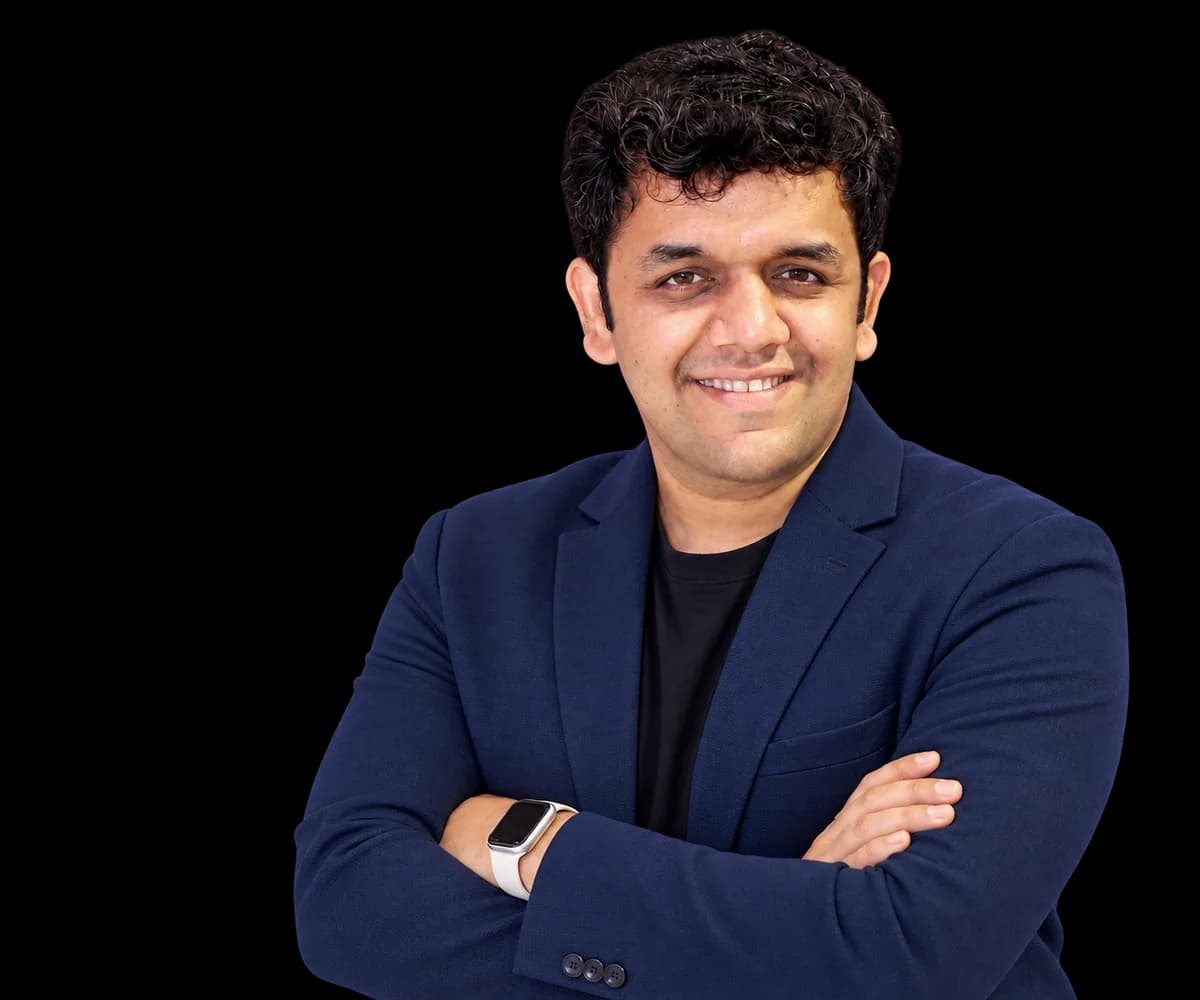
Siddhesh Joglekar teaches Product Management, Digital Marketing, and Generative AI at IIM Calcutta & E&ICT, IIT Kanpur. He writes about emerging technology for business leaders at siddheshj.com
Written by Siddhesh Joglekar
Fractional CMO and AI marketing consultant Siddhesh Joglekar helps founders and growth-stage teams build marketing engines that compound.